Foreign Correspondent (1940)

foreign_correspondent_xlg

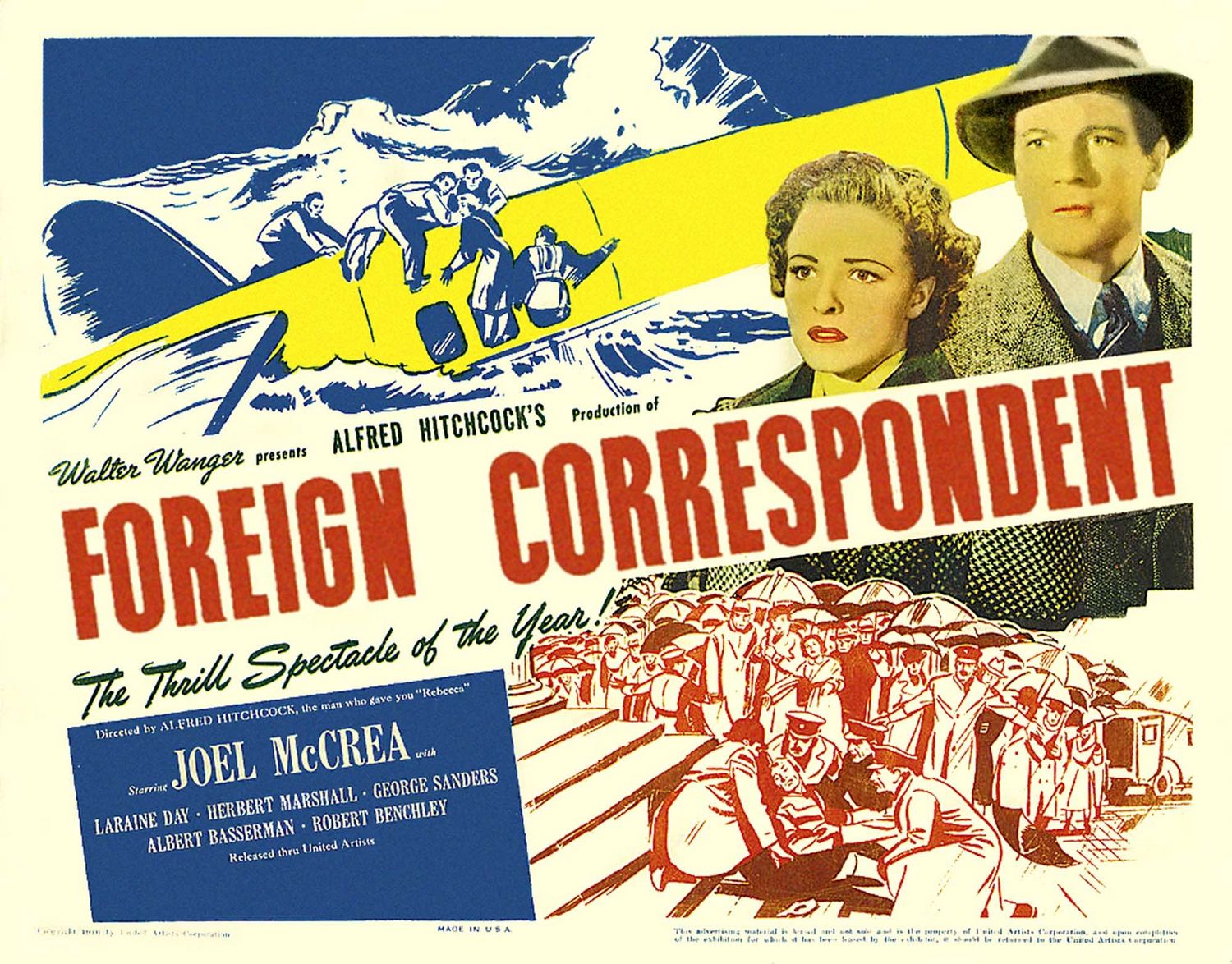
When we discuss the pantheon of great Hitchcock films, we very rarely mention his 1940 war comedy-thriller Foreign Correspondent. There’s good reason for that: in comparison with the rest of Hitchcock’s oeuvre, Foreign Correspondent occupies a lesser category and could be blocked in with such films as Stage Fright, Saboteur, and Dial M For Murder. But even the worst of Hitchcock’s films have something to be said for them, and Foreign Correspondent is a far cry from being the worst. It is neither a great film nor a bad one, neither wholly successful nor a round failure. It has just enough hidden in its depths to make it intriguing, without ever quite making it great.

Foreign Correspondent features Joel McCrea as the titular correspondent Johnny Jones, who in the first few scenes changes his name to Huntley Haverstock and becomes the foreign correspondent for the New York Globe. Jones’s editor Mr. Powers (Harry Davenport) send our hero to Europe to drum up some “real news” about the European situation. Once in London, Jones encounters Mr. Van Meer (Albert Bassermann, who earned an Academy Award nomination for his role), a Dutch diplomat who has been trying to keep the peace in Europe. When Van Meer disappears during a luncheon thrown by Fisher (Herbert Marshall), the head of a united peace organization, Jones becomes embroiled in European politics and the machinations of a shadowy group bent on advancing the European war machine and obtaining vital secret information. Things are further complicated with Jones’s burgeoning romance with Fisher’s daughter Carol (Laraine Day) and the timely appearance of fellow newspaperman Scott ffolliett (George Sanders).

The first twenty minutes of Foreign Correspondent play like a wartime screwball comedy, beginning with the re-christening of Jones as Haverstock because his editor doesn’t like his name. Jones encounters Van Meer in a taxi on the way to the luncheon (the film’s MacGuffin, actually), but the political issues are promptly superseded by the adorable love/hate relationship that quickly develops between Jones and Carol. In fact, for much of the film’s opening act we see very little of that so-called Hitchcockian touch, with scenes that might have been shot by Howard Hawks or Preston Sturges. It’s a perfectly entertaining opening, but we’re all waiting for something important to happen.
Foreign-4

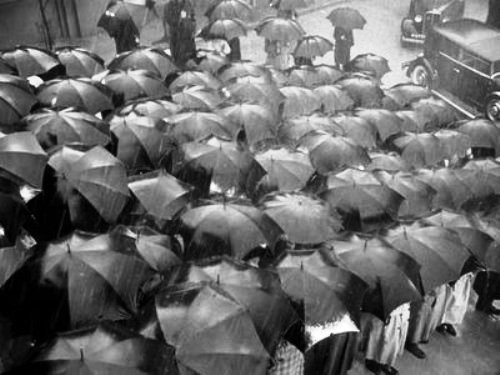
The important event turns out to be the apparent assassination of Van Meer on the steps of a conference building in Holland. The scene has that Hitchcockian feeling, as a beautiful crane shot over a sea of umbrellas establishes an immediate sense of foreboding. That same sea of umbrellas impedes Jones’s pursuit of the assassins through the streets, as bullets fly and at least one innocent bystander loses his life. Jones eventually springs into a car that contains Carol and Scott ffolliett (that’s two small f’s), and a chase through the Dutch countryside ensues. The rightly praised sequence involving a windmill and the uncovering of at least part of the villains’ scheme finally convinces the audience that, yes, we are watching a Hitchcock film. It’s a tense series of events, punctuated by humor from both Sanders and McCrea, and the well-known “Hitchcockian Blot” of a windmill turning against the wind.

From there, the film moves along at a strong pace, mixing the screwball romance with some recognizable “Hitchcockian” set pieces, each grander and more tension-filled than the last. Foreign Correspondent actually has more in common with Hitchcock’s British work than it does with his more famous American movies. The slow-burning screwball opening recalls The Lady Vanishes, while moments of humor provided by British and American character actors highlight moments of tension. Jones is an All-American hero lost in the morass of European politics that he either cannot or does not want to understand – a bit of a change from the stolid British types of Richard Hannay in The 39 Steps.
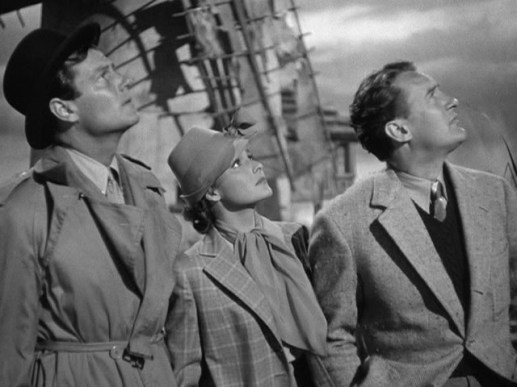
foreigncorr1

The cast of Foreign Correspondent is an excellent one. McCrea and Sanders set each other off perfectly, a meeting of nationalities attitudes that never veer into caricature. McCrea is a forthright hero with a good heart and a rather narrow vision of politics (his very American “let’s have a showdown” is repeated enough times for it to be taken ironically). But McCrea is a good enough actor to play the part of Jones with a lightness that never becomes silly, and a concern for humanity that supersedes his more naive aspects. His passion for Carol is genuine, as is his desire to tell the truth about what’s happening in Europe, if he can ever figure it out. Meanwhile, Sanders as Scott ffolliett is the unsung hero of the picture, occupying centre-stage for much of the latter part of the film after the director has apparently grown tired with his young lovers. ffolliett is one of Sanders’s most sympathetic and complex roles; yet another proof that Sanders was a very good actor when he put his mind to it.

Herbert Marshall occupies the difficult role of Fisher with a dash of charm and earnestness that we might not expect, his smoothness both charming and suspect from the start. Albert Bassermann’s Van Meer is the philosophical center of the film, a diplomat desperate to keep the peace and recognizing all too well that he shall fail. Laraine Day might come off as a touch too earnest and forgiving, and she has none of the strength of character we usually see in the best Hitchcock heroines, but she’s far from a poor actress and her character, while undemanding, provides a consistent lightness in the midst of the dark that permeates the second half of the film. The all-too-brief appearance of Edmund Gwenn, playing against type as a vile assassin, provides one of the film’s greatest sequences.
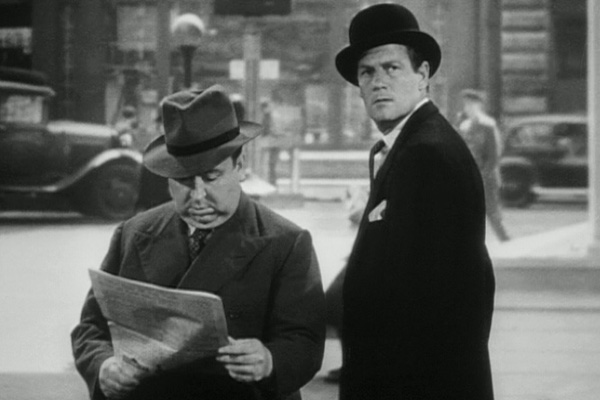
Foreign-Correspondent

If Foreign Correspondent does not come off, it’s largely due to a confusion of plot and tone. While Hitchcock regularly blended light comedy with thriller, Foreign Correspondent fails to follow through on some of its promise. The film has several climaxes, and what’s at stake for Jones et al. is not always clear, as though the situation in Europe became more important as the film was being made. The immediacy of the propaganda aspect means that the film becomes heavy-handed with its message, and Jones and Carol become too representative of the earnest young couple trying to survive in a world gone mad.  Several speeches evidently inserted for propagandist effect appear a bit overwrought to modern eyes.

That being said, there are so many wonderful and truly spectacular cinematic moments in this film, it’s a shame that the whole does not perfectly hang together. The scenes at the windmill and at the peace conference I’ve already mentioned; there is also a tense sequence atop a cathedral that perfectly demonstrates Hitchcock’s ability to generate audience suspense. The final sequence aboard an airliner makes for one of Hitchcock’s most visceral, intense moments, but I won’t spoil the surprise.

Foreign Correspondent was made in 1940 and released at the beginning of the Battle of Britain. As such, it is indeed a masterpiece of propaganda – such a masterpiece, in fact, that it received praise from Joseph Goebbels, who remarked that it “will make a certain impression upon the broad masses of the people in enemy countries.” The film ends with a call to America, to realize just what is going on in Europe and to take steps to stop the “lights from going out” all over the world. It has a immediacy to it only present in the best films of the period, a sense that the outcome is uncertain and that war, for America as well as for Europe, is imminent.



The Avengers: Trojan Horse

Trojan Horse (Episode 03-20, February 1964).

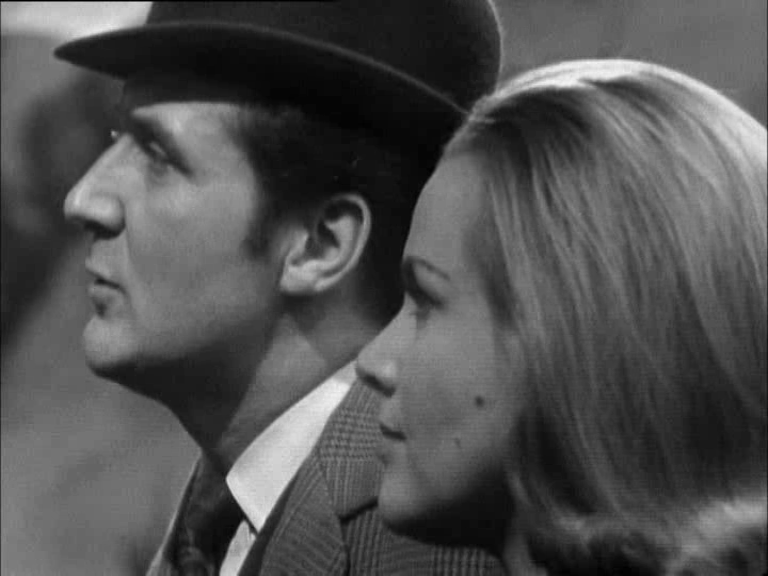
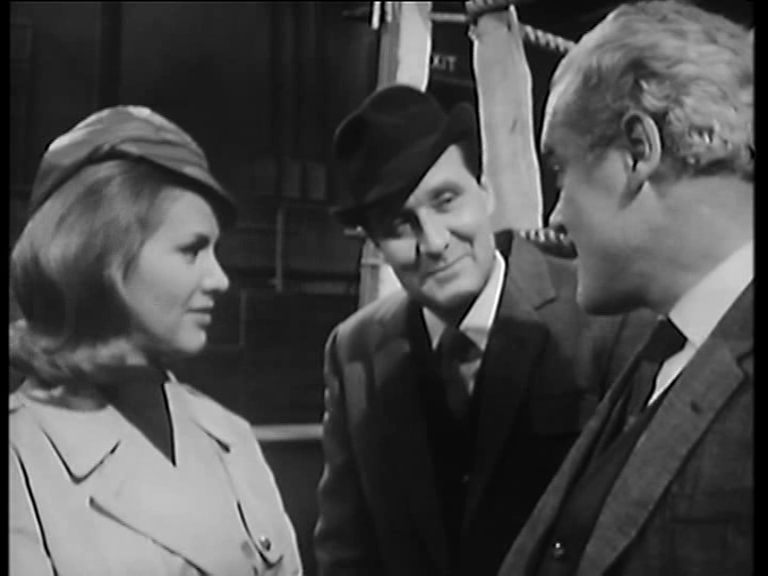
trojan-horse-steed-cathy

Trojan Horse brings us to the stables and the racetrack, and marks one of the greatest oversights of the series: not getting more use out of John Steed’s name. Although his equestrian derivation is briefly, and humorously, referenced in The Little Wonders, I find it shocking that Trojan Horse manages to get all the way through a very horsey episode, complete with discussion of what a good rider Steed is, without once alighting on the fact that our hero’s last name is synonymous with that of a particularly virile male horse.

That little disappointment out of the way, Trojan Horse is a middling episode that neither impresses or bores. Steed arrives at Meadows, ostensibly to look after a horse named Sebastian that’s owned by an Arab sheik. As always, there’s more to it than that. The Ministry has managed to trace some high profile murders back to the stables, and Steed is there to investigate. He enlists Cathy to help with the bookmaking side of things, and she’s promptly employed by Tony Heuston (the deliciously smarmy T.P. McKenna) in a scene that says much about Cathy’s expansive talents, and even more about Honor Blackman’s memory. In the process, Steed and Cathy begin to uncover an assassination ring at the stables.

As with many Avengers episodes, the plot of Trojan Horse leaves a little to be desired. There’s plenty of intrigue, but the initial set-up of Meadows as the site for a kind of Murder Inc. run by Heuston and his cronies simply does not make sense. There are some fun scenes, including Steed teasing Cathy about her excitement over horse-racing, and a rather introspective discussion between Cathy and Heuston about his past. Heuston is a combination of oozing charm and villainy, but there is something sympathetic in the way that McKenna plays him that makes him more complicated than many an Avengers villain. Given that our two heroes are rarely in the same scene in Trojan Horse, having a strong villain for Cathy to interact with raises the episode just a little.

All in all, Trojan Horse probably should have been much better than it is. It has the makings of a good episode, with an intriguing setting and some quality villains, but the script never quite gets there.


Ghostbusters (1984): The Marshmallow Apocalypse

Part II

gatekeeper

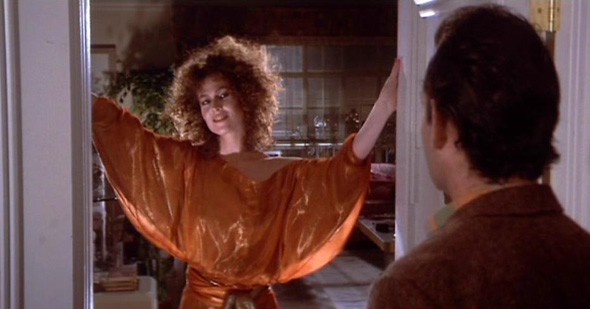
Femininity and sexuality figure into the film in a similar complicated manner.  Dana (Sigourney Weaver) essentially plays the ‘straight man’ to the three Ghostbusters, particularly Peter.  Again taking the Marx Brothers comparison, she is Margaret Dumont or Thelma Todd.  Peter pursues her, erotically, flirtatiously and even in a somewhat predatory manner.  He maintains control of sexuality and the male/female binary until the evil spirit Zuul possesses her.  Her possession transforms her first into a libidinous and sexual character, then into a demon dog.  When Peter arrives at her apartment, he is confronted with not the somewhat reticent woman who has resisted his slightly sarcastic and lascivious advances, but a full-blown sexual creature, complete with make-up and wind-blown hair.  His reaction is discomfort, if not downright terror.  Still, the relationship is not as simplistic as it first appears.  What disturbs Peter is not only Dana’s suddenly intense sexuality; it is also that her sexuality is uncharacteristic of her.  It does not necessarily represent a danger to him, but a danger to her.

Dana: I want you inside me.

Peter: OK.  No, I can’t.  It sounds like you’ve got at least two people in there already.  Might be a little crowded.  C’mon, why don’t you just quit trying to upset and disturb Dr. Venkman and just relax?

Unwilling to take advantage of the situation and actually sleep with her, he rejects her advances and asks to ‘speak to Dana.’  Peter, who makes sexual advances to almost any female throughout the film, is at a loss and disturbed when met with a manifestation of feminine libido.  Simultaneously, however, he acts in the kindest, most moral way possible.  He declines to take advantage of her, recognizing that the woman clinging to him is not Dana at all, but a spirit inhabiting her body.  He finds recourse to jokes, as he does throughout the film, but the scene takes on a new level of discomfort and nervous energy.  Far from the playful tone of sexual innuendo that has been exchanged between them from the beginning, Dana now makes almost violent sexual advances towards him.  Peter, for all his talk, is not a sexual predator.  His reaction is to try to get help and locate the ‘real’ Dana within the false one.  Their relationship will return to a masculine/feminine dialectic in the end, but I would argue that in this case Peter succeeds in recognizing the ‘real’ Peter that would not take advantage of a possessed woman.  His sexuality, despite his lasciviousness, does not extend to actually engaging in illicit or dangerous sexual acts.  He can only make jokes.

Sexuality continues to be a central concern of the film.  The Ghostbusters are associated with a strictly masculine paradigm, represented in the plethora of phallic symbols and innuendo.  The guns they use to capture ghosts, the ever-present PKE meter that Egon likes playing with, and lightly comic jokes about Twinkies and ‘crossing the streams’ punctuate moments of sexual humor throughout the film.  At the same time, Ray and Egon are fairly clueless about women—Ray has one sexual fantasy about a ghost, and Egon cannot seem to recognize it when their secretary Janine (Annie Potts) flirts with him.  Peter, as the only Ghostbuster who has any real heterosexual relationship, nonetheless becomes terrified at the first sight of a truly sexualized woman.  In all of this, however, the film manifests an awareness of the tropes it plays with.

gozer1

The apocalyptic narrative of the film comes into play through the realm of sexuality.  Gozer, the one who will bring about the apocalypse, can only be summoned through the sexual union of the Gatekeeper and the Keymaster.  The Gatekeeper in this case is a woman, the Keymaster a male, calling attention to the sexual puns inherent in those titles.  The Keymaster controls the phallic; the Gatekeeper controls the feminine.  This references the familiar euphemism for female genitalia as a ‘gate’ that needs a phallic male ‘key’ to unlock it.  Films such as The Devil’s Advocate (Warner Bros., 1997) and Rosemary’s Baby (Paramount, 1968) found their apocalyptic ideology within the necessary joining of masculine and feminine, resulting in the end of the world or the coming of the Anti-Christ.  Ghostbusters subverts these recognizable tropes of the apocalyptic by making them comic.  Even before the appearance of Mr. Stay-Puft, the apocalypse is something to laugh at.  The coming together of the hypersexual Dana as Zuul and Louis Tully (Rick Moranis), the nebbish accountant, as Vinz the Keymaster is a humorous image.  Dana stands head and shoulders above Louis; she literally sweeps him off his feet.  Their embrace is extremely stylized; as they kiss the wind blows, the music swells and the camera swirls around them.  The shot has a self-conscious camp aesthetic, although it avoids total parody.  What in other films is a terrifying, erotic moment becomes a piece of comedy.

Although Winston and Ray engage in the most serious elucidation of the coming apocalypse in their brief scene, the full explanation for what has happened in Dana’s apartment is given by the most intensely intellectual figure in the film:

Egon: It’s not the girl, Peter, it’s the building…The architect’s name was Evo Shandor; I found it in Tobin’s Spirit Guide…After the first World War, Shandor decided that society was too sick to survive.  And he wasn’t alone; he had close to a thousand followers when he died.  They conducted rituals up on the roof.  Bizarre rituals, intended to bring about the end of the world, and now it looks like it may actually happen!

Peter (singing): So be good, for goodness sake! Somebody’s coming…

The scene occurs in a holding cell after the Ghostbusters have been arrested.  Surrounded by prisoners, Egon gives a speech about the sickness of society and the ritualistic desire to bring about the end of the world.  Despite the seriousness of his speech, he keeps a steady smile on his face as he speaks.  The smile, the apparent enjoyment he has out of explaining the coming apocalypse, elucidates the strange festivity, the comedy of death.  The world is going to end; Egon smiles and Peter sings.  When they appear in the Mayor’s office, they again perform a comic apocalypse:

Ray: Real wrath of God type of stuff.  Fire and brimstone coming down from the skies.  Rivers and seas boiling!

Egon: Forty years of darkness, earthquakes, volcanoes!

Winston: The dead rising from the grave!

Peter: Human sacrifice, dogs and cats living together, mass hysteria!

Coupled with the Biblical imagery are the comical aspects of ‘dogs and cats living together.’  While the apocalypse does not seem a completely banal occurrence in this scenario, the comedy of the situation, the gallows humor of laughing at the end of the world, permeates the entire scene.  The subversion of the usual somber tone of apocalyptic films and imagery transforms the apocalypse itself into a farce, something not to be taken seriously.

ghostbusters

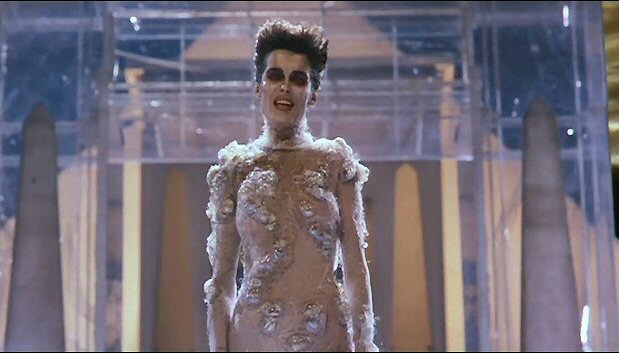
The final sequence of the marshmallow apocalypse brings together the manifestations of the repressed, libidinal impulses, and the dialogues of phallicism and gender into a final festival moment of comic destruction.  Supported finally by the establishment (including the Army, the Police, the Fire Department and the Mayor’s office), the four working class figures arrive to stop the end of the world.  The crowd that stands to greet them and cheer them on is a multicultural, multi-ethnic and multi-classed crowd, come together in festival to watch the Ghostbusters save the world.  Gozer manifests itself initially as a woman, played by supermodel Slavitza Jovan, a deliberately sexualized figure who threatens to destroy the Ghostbusters.  Recovering from her initial attack, the Ghostbusters return to (comical) phallic symbolism:

Peter: Got your stick?

All: Holding!

Peter: Heat ‘em up!

All: Smoking!

Peter: Make ‘em hard!

All: Ready!

The deliberate phallicism of the dialogue again relates the ‘wands’ of the Ghostbusters proton packs to not terribly subtle phallic imagery.  They attack Gozer, but fail to conquer her.  Instead, she demands that they name the ‘form of the Destructor,’ making the choice about what it is that will destroy them.  Here the sexualized figure, un-subdued by phallic masculinity, turns to a chosen apocalyptic image; only the chosen image is a marshmallow man.

Mr. Stay-Puft is the final and most potent manifestation of the repressed libidinal psyche, actually coming from the mind of one of the Ghostbusters.  Ray justifies his choice by saying that he tried to think of something that ‘could never destroy us.’  The apocalypse, then, is going to be wrought not by a sexualized supermodel, or a prehistoric demon dog, but a walking wad of puffed sugar.  The apocalypse thus manifests itself as an empty figure of fun, a sugary concoction that stomps around midtown Manhattan.  The ironic nature of the apocalypse becomes humorous and painful:

‘Sometimes it’s hysterical irony and sometimes it’s a painful irony.  Life has all of these contradictory feelings and contradictory results…We’re always shut off from pure joy’ (Ramis, as qtd. in Spitznagel 4).

The festivity of the apocalyptic scenario in Ghostbusters acts as a manifestation of painful irony: the world is about to end, but how ironic that it will end in a rain of marshmallow.  Mr. Stay-Puft is also a corporate logo, a symbol of consumerism, and therefore a post-modern construction within the cinematic milieu.  Ray does not think of just any harmless character, but a harmless corporate character.  The film proposes destruction based around a literally rampaging consumer product.

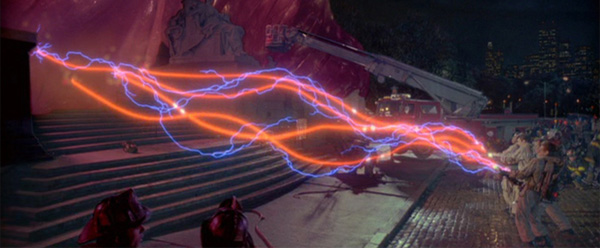
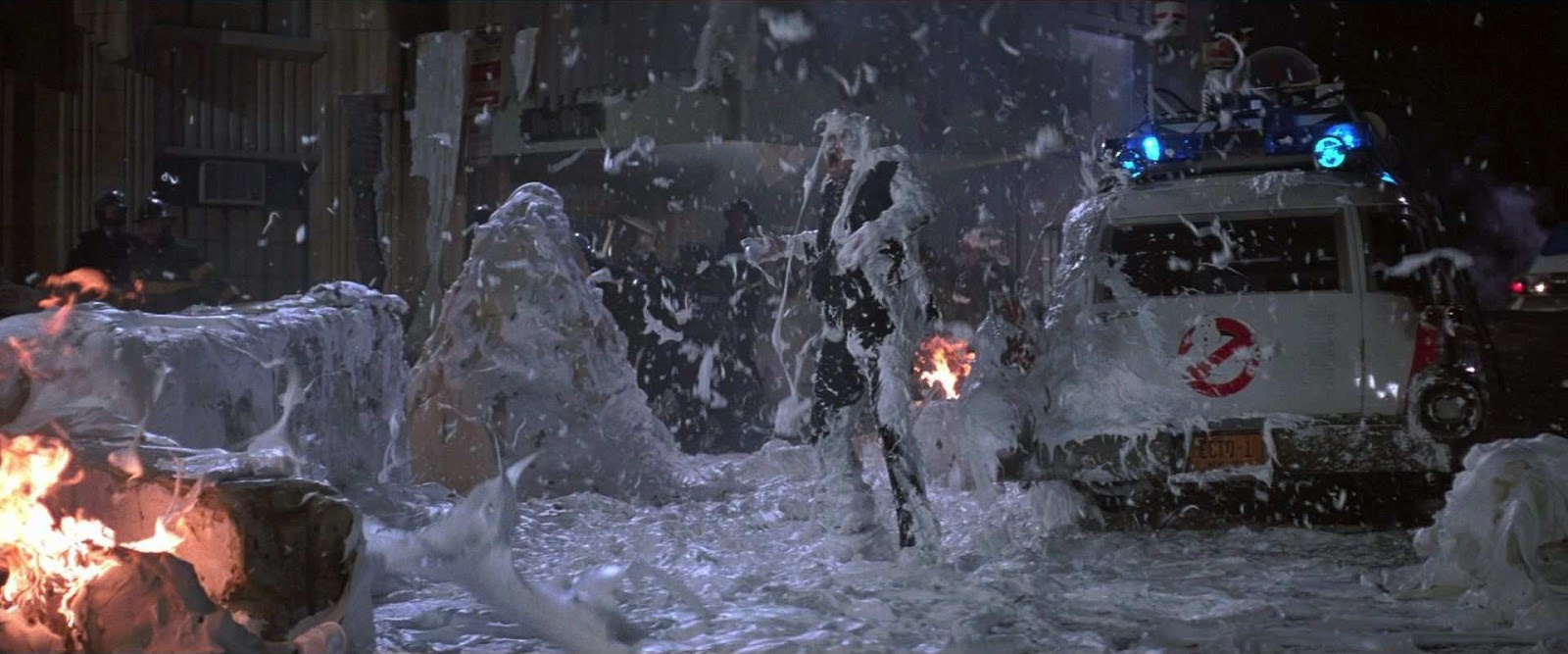
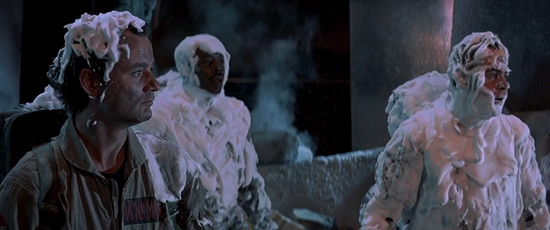
The Ghostbusters defeat Mr. Stay-Puft by doing what has already been stated as dangerous—they cross the streams from their proton packs, apparently reversing the polarity of Gozer’s door and destroying Mr. Stay-Puft.  If we carry through the phallic symbolism already related, the Ghostbusters comically and sexually unite, establishing a homoerotic masculine paradigm that ends with the destruction of first the sexualized Gozer (who is nonetheless also asexual—she need not be male or female), and the freeing of Louis and Dana back into ‘normal’ sexuality.  Mr. Stay-Puft erupts in a rain of marshmallow, covering everyone below.  There is no denying the apparently orgasmic and masturbatory imagery this scene involves, as the four Ghostbusters combine their phallic instruments, resulting in an explosion of white foam that covers them all from head to foot.  Emerging from death, the Ghostbusters establish a new, highly masculine paradigm that nonetheless allows for comic rebirth.  The city and the world are saved through an orgasmic explosion of male sexuality.

This is the ultimate transformative moment of comedy, as the bringer of death appears in a comic form, and death itself explodes in an abject bodily function.  The ending of the world is satirized through Mr. Stay-Puft.  The film satirizes the union of sex, death and destruction through the establishment of a figurative male union and a New York covered in sugar/semen.  Although the images and thematics of Ghostbusters are exceptionally serious, taking on the end of the world, the problems of normative sexual relationships and the eruption of the chaos world in the form of enjoyable but damaging libidinal excess, the comedy of the film subverts the tropes from within, by acknowledging their terror, but also their humor.  In the end, Mr. Stay-Puft explodes and the Ghostbusters save the day, destructors themselves from within the system.  The marshmallow apocalypse is averted, but we are all still covered in sugar.

Ghostbusters1354


Aykroyd, Dan and Harold Ramis.  Making Ghostbusters, ed. Don Shay, Columbia

Pictures Industries, New York: 1985.

Bakhtin, Mikhail.  Rabelais and His World, trans. Helene Iswolsky, Indiana University

Press, Bloomington: 1984.

Hallenbeck, Bruce G.  Comedy-Horror Films: A Chronological History 1914-2008,

McFarland & Company, Inc., London: 2009.

Meehan, Paul.  Cinema of the Psychic Realm: A Critical Survey, McFarland & Company,

Inc., London: 2000.

Paul, William.  Laughing Screaming: Modern Hollywood Horror and Comedy, Columbia

University Press, New York: 1994.

Ramis, Harold.  ‘Commentary on Ghostbusters’ in Ghostbusters, dir. Ivan Reitman,

Columbia Pictures: 2005.

Spitznagel, Eric.  ‘Interview with Harold Ramis’ in The Believer, March 2006.

Tudor, Andrew.  ‘Why Horror? The Peculiar Pleasures of a Popular Genre’ in Horror,

the Film Reader, ed. Mark Jancovich, Routledge, New York: 2002.

Wood, Robin.  ‘The American Nightmare: Horror in the 70s’ in Horror, the Film Reader,

ed. Mark Jancovich, Routledge, New York: 2002.


Hackford, Taylor (dir).  The Devil’s Advocate, Warner Bros., 1997.

Polanski, Roman (dir).  Rosemary’s Baby, Paramount, 1968.

Reitman, Ivan (dir).  Ghostbusters, Columbia, 1984.

Ghostbusters II, Columbia, 1989.

Ghostbusters (1984): The Marshmallow Apocalypse

gb-marshmallow

*This is a reprint in two parts of a paper I wrote for Ed Guerrero’s “Horror, Sci-fi, and Difference” class during my Master’s degree at NYU. With the 30th Anniversary of the release of Ghostbusters coming up this month, I thought it appropriate to post here. Check back next week for Part II!*

‘Funny us going out like this: killed by a hundred-foot marshmallow man.’ –Ray Stantz (Dan Aykroyd) in Ivan Reitman’s Ghostbusters (Columbia, 1984).

One of the more indelible cinematic images of terror and humor of the late twentieth century is that of a gigantic marshmallow man stomping through New York City like a sugary Godzilla nearing the end of GhostbustersGhostbusters itself is one of the more interesting installments of a subgenre typically referred to as horror-comedies, a combination of the explosion of the chaos world of horror with the carnivalesque humor of the comic tradition.  A film rife with horrific and apocalyptic imagery, it finds both its terror and its humor in the depiction of the end of the world occurring at 55 Central Park West, with the world destroyed not in a rain of blood and fire and terrible vengeance from above, but puffed sugar.

Ghostbusters may appear to be a frivolous work, but it can and should be taken seriously as a depiction of humor within the horrific.  Humor and death are often linked, a way of dealing with the progressively terrifying world.  In Bahktin’s definition of grotesque realism, he identifies the physical world of the comic with the organic transformation of death into life:

The ever-growing, inexhaustible, ever-laughing principle which uncrowns and renews it combined with its opposite: the petty, inert, “material principle” of class society…The grotesque image reflects a phenomenon in transformation, an as yet unfinished metamorphosis, of death and birth, growth and becoming (24).

Death and the comic concept of renewal are inextricably linked; the world must end in order to be reborn.  If we examine Ghostbusters through this lens, as a serious if also comic examination of death and comic transcendence through parodying and satirizing the end of the world itself, we may elucidate how this film, and other horror-comedies, defy the ineluctable nature of death by literally making fun of the repressive as well as the repressed.

Much horror functions as an expression of the repressed in the form of the monster; much comedy too expresses the repressed in the anarchic vision of the comedian or comedians.  The difference is usually that the figure of horror, the monster, is a frightening manifestation of the repressed psyche, a figure that represents gender, class, race or sexual difference that the homogenous society represses.  Comedy, by contrast, revels in anarchic expression, the libidinal impulses of the central comedians and their subversion of the social order.  Both genres represent eruptions of the chaos world in anarchic visions.  They are festive arts that challenge the social order through the creation of fear, laughter, or both.

True festive art…is an art that ultimately celebrates communality, much as any festival does…Festivity is not opposed to depth of meaning.  As Bakhtin has noted, certain truths are only available through festive art.  A worldview that sees a split between body and spirit limits the value of material existence (Paul 71).

When comedy and horror function in tandem with each other, they form a deep expression of what Paul here defines as a ‘festive art:’

The seriousness of this festivity…resides in the extent to which it inverts the most deeply rooted values of Western culture (71).

In exposing and then making fun of what is most terrifying, we acknowledge the fear, but also the absurdity of the fear.  The Ghostbusters participate in a carnivalesque rebellion and joy in destruction usually only open to the monsters of the horror genre.  Acting from within the system, the Ghostbusters succeed in subverting the system.

Despite the at times conservative, masculinist nature of its discourse, Ghostbusters inserts its central figures into a material world that refuses to acknowledge the spiritual.  The spiritual then manifests itself as something only they can control because they are capable of recognizing its existence.  The Ghostbusters have a complicated relationship to the ghosts they capture.  They are essentially agents of repression, ‘exterminators’ who arrive to trap and confine the libidinal impulse.  Neither the first film nor its sequel address what happens to the ghosts once they are captured, or the moral and ethical complexity of keeping these spirits within a ‘containment unit.’ The three original Ghostbusters are all white middle-class males, educated and, at the opening of the film, acting from within institutional confinement.  They are representatives of scientific materialism, all doctors dedicated to the trapping of spirits.  They act at the behest of the ruling establishment to arrive and exterminate (or trap) the manifestations of the return of the repressed.  In doing so, however, they subvert the system in acts of anarchic destruction.

ghostbusters1

Athough initially functioning within the establishment, the Ghostbusters come to reject and be rejected by that establishment.  The first fifteen minutes of the film sees them confront their first ghost, and lose their jobs at the university.  Although they may be educated, they nonetheless appear as working class figures.  They are self-described exterminators, essentially the ghost police, identified as such by the uniforms that are janitorial jumpsuits.  They live in an old firehouse somewhere on the Lower East Side; their car is a refurbished ambulance.  Their names are also indicative of class, religion, and immigrant background: Peter Venkman, Raymond Stantz, and Egon Spengler (Harold Ramis).  Throughout the film various members of mainstream WASP society treat them with confusion, contempt and downright aggression.  The villains of the film are all representatives of the WASP establishment: the dean at their university (Jordan Charney) and Walter Peck, a representative of the EPA (William Atherton).  The establishment, although willing to exploit them, is equally unwilling to trust them.  When they are called in, it is unwillingly and with evident embarrassment on the part of the Mayor (David Margulies).  The Ghostbusters stand in a liminal position between the libidinal spirits they trap and the material establishment world.

Many of the ghosts in Ghostbusters function as manifestations of libidinal impulses, grotesque representations of the natural body in their obsessions with food, sex, violence, and destruction.  Freed from their material existences, the spirits are also free to indulge the libidinal impulses they were perhaps denied in life.  The most obvious of these is the famous ‘Slimer’ character, actually referred to as ‘Onionhead’ in the screenplay, the first ghost the Ghostbusters trap (Aykroyd 78).  A floating yet apparently physical being—he comes into physical contact with Peter Venkman (Bill Murray) and ‘slimes’ him—his libidinal drive is to eat and drink.  He first appears consuming plates of food from a service cart, later eating food from a banquet table and drinking bottles of wine that pass through his spiritual body.  His spirit haunts the ‘Sedgwick Hotel,’ an upper class establishment.  The Sedgwick is the site for the ultimate in class gluttony.  Onionhead consumes the remnants of apparently lavish meals; he invades a sumptuous banquet hall and devours food and wine.  We may perhaps view Onionhead as the libidinal manifestation of upper class gluttony, come to revenge itself, a literal return of the repressed.ghostbusters_480_poster

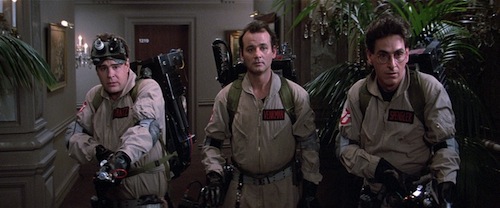
The Ghostbusters tracking and trapping of Onionhead bears closer scrutiny.  They are out of place at the Sedgwick, arriving noisily, dressed outlandishly and carrying gigantic pieces of equipment on their backs.  The hotel manager (Michael Ensign) seems uncomfortable in their presence and asks them if everything can be taken care of ‘quietly.’  Harold Ramis remarks, in the DVD commentary, that the Ghostbusters were conceived as Marx Brother-type characters and the Sedgwick Hotel sequence bears this out (Ramis, ‘Commentary’).  Comically out of place, they are working class figures in an upper-class setting.  Incapable of controlling their equipment, they destroy a large section of the hotel, burning holes in walls, harassing guests, and causing destruction in the banquet hall.  They find humor, if not total release, in this destruction:

Ray: I think we’d better split up.

Egon: I agree.

Peter: Yeah, we can do more damage that way.

In hunting down Onionhead, they destroy a chandelier, a full bar, break several tables, glasses and china, and light things on fire.  At the conclusion of the scene, they charge four thousand dollars for the destruction they have caused, threatening to replace the captured spirit if they do not get their money.

Whether wittingly or unwittingly, the Ghostbusters actually cause more destruction than the ghost they hunt.  Like the Marx Brothers, the Ghostbusters are dependent on the mainstream for their livelihoods; no longer employable as scientists, they have recourse to the working class milieu, but in doing so are able to take revenge, monetary and otherwise, on the system that has rejected them.  They may be dependent on the system itself to support them—they certainly do not try to exist outside of it—but they are able to subvert it from within.  What is more, they make the system pay for its own destruction.  This joy, the humor that comes out of not only Onionhead’s gluttony but the destruction brought about by the Ghostbusters, succeeds in a satiric carnivalesque rebellion that allows the rejected, now working class figures to begin a process of destruction from the inside out.

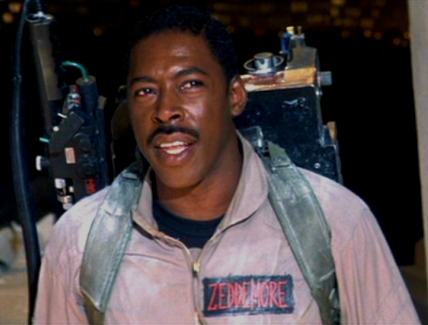
A third of the way through the film, the Ghostbusters are joined by another liminal figure, this one legitimately working class: Winston Zeddemore (Ernie Hudson).  Winston acts as a fourth, lesser figure in the triumvirate, a sort of Zeppo to the Ghostbusters.  Winston is the only solidly working class figure in the film.  He has not lost his class in the way that the other three have.  The fact that he is a black man complicates issues of race, although none of the other characters make reference to his blackness.  Certainly he is demarcated as different from the other three, in class and race background, and in the part he has to play.  The casting of Eddie Murphy, the initial choice for the role, might have resulted in a more equitable balancing of comedy and dialogue between the four men, but as it stands, Ernie Hudson probably has the least input of any character in the film.  Harold Ramis even admitted that the Winston character went through numerous changes and that because they were so concerned about including an African-American and avoiding charges of racism, they created him as almost too good (Ramis, ‘Commentary’).

Winston is one of the few characters to express religious leanings and the first to indicate the possibility of their actions being tied to the apocalypse:

Winston: Do you remember something in the Bible about the last days when the dead rise from the grave?

Ray: I remember Revelation 7:12.  ‘And I looked, as he opened the Sixth Seal and behold there was a great earthquake, and the sun became as black as sackcloth and the moon became as blood.’

Winston: And the seas boiled and skies fell.

Ray: Judgment Day.

Winston: Judgment Day.

Ray: Every ancient religion has its own myth about the end of the world.

Winston: Myth? Ray, has it ever occurred to you that maybe the reason we’ve been so busy lately is that the dead have been rising from the grave?

Zeddemore_01

This is the most serious exchange in the film, one of the few instances when the comedy ceases for a moment and the possibility of the actual ending of the world becomes clear.  By placing the apocalyptic prophecy in the mouth of the most liminal character, a true representative of the working class and the oppressed, the film ties its apocalyptic imagery to the place of the repressed.  Winston stands for practicality (‘Ray, when someone asks if you’re a god, you say YES!’) and a spiritual otherness that counterbalances the intellectual superiority of Egon, the naïveté of Ray and the showmanship of Peter.  The mixture of practicality and spirituality can sometimes smack of stereotyping—of course the black man heralds the coming apocalypse! —despite the concerns of the (white) writers to avoid such stereotypes.  Winston at some level fulfills the stereotype of the ‘magical negro,’ whose connection to the spiritual world is more attuned than that of the white mainstream figures.  His practicality, however, subverts and complicates this archetypical characterization.  He acts within a more complex racial climate that, while it does not fully equalize the role of the black man, avoids making him a stereotype.  For the film at least, blackness is a non-issue.  Given the apparent liminality of the other three Ghostbusters in terms of class and ethnic background, the film does not easily fall into a black/white binary.  Winston actually has the last line in the film, and while this does not fully restore him to equality with the other three, it does at least give the most practical and most liminal figure the last word.  Far from viewing Winston as the ‘black servant’ of the white males, he acts as a down-to-earth character that represents the blending of practicality and spirituality that the others lack (Paul 128).

The Avengers: Brief For Murder

Brief For Murder (Episode 03-01, September 1963)

steed-cathy-brief-for-murder

Season 3 of The Avengers got off to what can only be described as a unique start. Brief For Murder opens with the public trial of Wescott (Alec Ross), a man charged with selling government secrets to an unidentified recipient known only as Johnno. Wescott gets off due to the brilliant machinations of his solicitor Barbara Kingston (Helen Lindsay) and the Lakin Brothers, Jasper and Miles (John Laurie and Harold Scott). Cathy Gale is on hand for the verdict, and makes it publicly known that she still believes that Wescott is guilty, and that none other than her erstwhile friend John Steed is the mysterious Johnno. Furious at her insinuations, Steed threatens Cathy and then lawyers up with the Lakin Brothers. The brothers, it turns out, have been making a mint by engineering criminal cases to get their client off scot-free. When Steed appears and asks them to help engineer a case so he can murder Cathy, they’re only too happy to oblige.

Brief For Murder side-steps a problem that some later episodes of The Avengers would have: letting the viewer know more than the characters. Instead, a good half of the episode has Steed and Cathy at murderous odds, the purpose behind their apparent hatred of each other kept unclear. The result is one of the more intelligent episodes in Season 3, beginning a character arc of mutual distrust between Steed and Cathy that would have some sort of conclusion in The Nutshell. Although we’re fairly confident that Steed is not actually trying to murder Cathy, just what he’s up to – and how much she knows – remains ambiguous until the third act.

A competent cast reinforces an original and intelligent plot. Aside from the usual pleasure of watching Patrick Macnee and Honor Blackman verbally fence, there the added enjoyment of the bizarre and gleeful Lakin Brothers, played by John Laurie and Harold Scott. Laurie is one of the best recurring character actors to appear in The Avengers – he already popped up once in Death of a Great Dane, and would return for the Emma Peel episode A Funny Thing Happened On The Way To The Station. The Lakin brothers are so excited to be able to work out legal arcana in service of their nefarious clients that they can almost be forgiven the whole criminal thing.  As Steed quips nearing the end, “I’m going to miss them.”

While Brief For Murder never rises to the heights of humor or eloquence that some Season 3 episodes achieve, it’s nevertheless one of the better ones.

The Avengers: The Nutshell

The Nutshell (Episode 03-04, October 1963).

steed-cathy-nutshell

Directly following the disturbing doppelgänger episode The Man with Two Shadows (read about that one next week), The Nutshell features another development in the Steed and Cathy relationship, straining it almost to the breaking point. The pair are called in to investigate a break-in and possible sale of government information from a secret nuclear bunker called Nutshell. Steed’s odd behavior concerning the investigation begins to worry Cathy, however – especially when it’s discovered that he’s had several meetings with the girl who broke into the facility. Steed is arrested for espionage and imprisoned at Nutshell, where he undergoes torture at the hands of his own security organization.

The Nutshell plunges us deep into the heart of the spy organization that Steed works for, drawing into question his loyalty. Following so close on an episode that ends semi-ambiguously in terms of Steed’s identity and his relationship to Cathy, The Nutshell focuses tightly on the character relationships and what the pair don’t tell each other. Steed is tortured by the very people he has sworn loyalty to and interrogated without trial. At one point, Cathy asks a representative of Nutshell whether they obey the same moral laws as the rest of the world, to which she is given the curt reply that the only crime in Nutshell is endangering security. It’s a murky world, and one which Cathy is evidently not comfortable with. She watches Steed’s torture on closed-circuit cameras, and the acute nature of her own suffering reflects in Blackman’s face.

Steed, meanwhile, further complicates the viewer’s feelings about him. Some strong editing of scenes means that the audience is kept guessing as to his motives. He and Cathy engage in several discussions about their nature of their work, revealing something of Steed’s personal politics and the strain his job puts on him. Unlike James Bond, Steed was never a character who seems superhuman. If anything, he’s more flawed and less sure of himself at times than Bond, but has the makings of a true hero beneath it all. Macnee is always a good comic actor, but here he shows that he can play drama just as well.

The Nutshell represents the best of Season 3 in terms of pacing and performance. There’s barely a misstep – a remarkable feat for an episode of live TV with numerous location changes and complicated sets. The secondary cast, including Avengers regulars John Cater and Patricia Haines, is excellent, as cold and precise a set of bureaucrats as you can ask for. If there’s a single problem with the episode, it’s the somewhat perfunctory conclusion which, following a very intense series of events, feels a little sudden and anti-climactic. However, that’s a small quibble in what is otherwise a superb episode.


The Avengers: Build A Better Mousetrap

Build a Better Mousetrap (Episode 03-21, February 1964).

build-a-better-mousetrap

Season 3 of The Avengers begins moving the show farther from its noir roots and into the stranger realm of spy-fi fantasy and pastiche. While Build a Better Mousetrap would not become one of the episodes re-adapted to the candy-colored world of Emma Peel, it does indicate a slight shift in tone for the dynamic duo of Steed and Cathy. There are still the underworld noir elements at play, including the presence of a motorcycle gang, but the characters are broader and the British quirkiness more apparent.

Steed and Cathy head to the English countryside to investigate some strange goings-on in a small English village. A nearby atomic energy plant appears to be causing mechanical failures within the radius of the village, but Steed of course thinks there’s more to it than that. The failures happen to coincide with the presence of a youthful motorcycle gang on the weekends, who have also run afoul of two charming old ladies living in a rebuilt watermill. So, Cathy joins the gang and Steed investigates both the atomic plant and the mill, with predictably bizarre results.

Build a Better Mousetrap trades on a combination of bizarre British character types and audience assumptions about them. The innocent old ladies could be behind the disabling of mechanical devices and the thuggish motorcycle crew might just be having a good time. The secondary characters are well-drawn and enjoyable to watch, from the slightly creepy landlord of the local pub to a former army colonel and his daughter (the latter keeps hitting on Steed in a very strange manner). Things are not all as they seem and misunderstandings between characters increase the stakes. The mystery lies not so much in who causes the mechanical failures (that becomes evident fairly early on), but why and how.

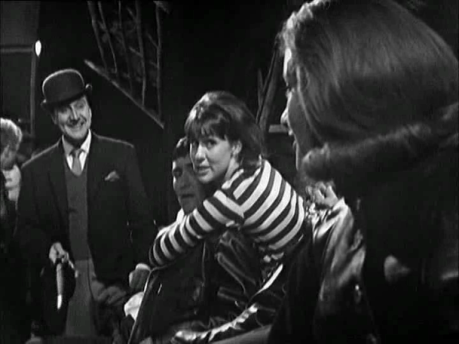
This episode includes some of the best visual jokes in The Avengers, with more than a few scenes that allow our main characters to pop. Steed is amusingly out of place amid the young motorcycle gang, while Cathy, in her leather jacket and boots, fits right in. Cathy enjoys herself at motorcycle rallies and dance parties, while Steed has an entertaining sequence as a representative of the “National Distrust,” insinuating himself into the good graces of the two old ladies. The tight pacing and enjoyable character vignettes keep everything fun and breezy, although there are darker elements at work here too.

An absurd, entertaining piece of television, Build a Better Mousetrap ranks right up there with the top episodes of Season 3.

The Invisible Woman (2013)

The Invisible Woman

2.JPG

We often acknowledge Charles Dickens as one of the finest writers of the 19th Century. Certainly he was one of the most influential, developing the three volume novel as a work both of art and entertainment, and the novelist as a celebrity and public figure with moral and ethical responsibility to his public. Like many great public figures, though, Dickens’s private life was less than stellar, wrapped up in Victorian social and sexual mores. He was, in short, no better than most people, and at times perhaps a great deal worse.

The Invisible Woman claims to tell the story of Dickens’s semi-public relationship with Ellen Ternan, a young actress whose relationship with Dickens would last the rest of his life. Because of both the extreme secrecy of the relationship – Dickens was still married – and the fact that Dickens burned his entire correspondence with Ternan, the actual circumstances of much of their relationship remains largely hearsay and speculation. Dickens had already engaged in a fairly public infatuation with his wife Catherine’s sister Mary earlier in his life, and it is true that he separated from his wife around the same time he’s believed to be involved with Ternan. As with most biographical or semi-biographical films, The Invisible Woman should probably not be taken as “the truth,” but rather a speculative version of it.

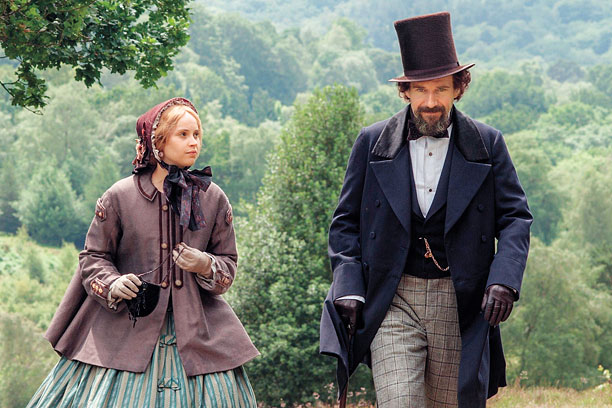
The film opens with the first appearance of Ellen “Nelly” Ternan (Felicity Jones), long after her affair with Dickens has ended. A married woman, she still harbors fond and not-so-fond memories of the man she loved. The film rolls us back to their first meeting during a production of The Frozen Deep, a joint play by Dickens (Ralph Fiennes, who also directs) and Wilkie Collins (Tom Hollander). Nelly is the youngest in a family of actresses headed by Frances Ternan (Kristin Scott Thomas); she’s also the least talented, with difficulty projecting beyond the footlights. She and Dickens share an immediate attraction and rapport, however, and their relationship progresses from a great man and his acolyte to a great man and his somewhat recalcitrant mistress.

The Invisible Woman thankfully avoids some of the cliches that could have marred its project. Fiennes’s Dickens is not a seducer, but neither is he wholly sympathetic – he’s a talented author and celebrated philanthropist who cannot bear not to be adored. His attraction to Nelly is both that of an older man falling for an attractive younger woman who obviously venerates him, and as a man who believes he’s found someone who understands him. His treatment of his long-suffering wife (Joanna Scanlan) is reprehensible, yet we do not fully condemn his character. The whole plot becomes bound in the mores of Victorian society, which permits a man to have an affair but condemns the woman with whom he has it.

Felicity Jones plays Nelly as a woman in a relationship she both desires and wishes to end. All but sold by her mother, who believes she will never be able to support herself as an actress, Nelly falls for Dickens but does not really wish to be his mistress, condemned by the culture that surrounds her. A painful scene between Nelly and Catherine Dickens shows both women as victims of their society. They caught in love for a man who will always, as Catherine says, choose his public above any woman.

If The Invisible Woman fails anywhere, it is in the somewhat lax use of the framing narrative. This is meant to be something of a flashback and something of a mystery. There’s a lack of clarity in the connection between Nelly’s persistent unhappiness in her current life and her complicated experiences in the past. Jones plays even the younger Nelly as a somewhat unhappy and certainly a troubled young woman, giving her little space to change over the course of the narrative. While I never doubted her passion for Dickens was sincere, I did doubt its depth – she seems to worship him as a writer, conflating the man and the public figure. As such, the emotional connection between them feels shallow where it should, in my view, have been more complicated. The ending of the film is abrupt and a little unsatisfying, as though there was no way to bring the narrative to any kind of a round conclusion for either character.

Despite one or two shortcomings, however, The Invisible Woman is one of the better semi-biographical films about the time period. The Victorian era tends to either be romanticized or treated with undue harshness on film – The Invisible Woman avoids these pitfalls by approaching its characters as human beings, good people who sometimes behave badly. At the heart is the mystery of the human experience, and a sense of both profound joy and deep melancholy. When looked at in that light, one might imagine that Charles Dickens would be proud.

The Avengers: Mandrake

Mandrake (Episode 03-18, January 1964).

steed-cathy-mandrake

I had intended to try to keep to the order in which these episodes aired, but I cannot hold my tongue about one of my favorite Avengers episodes.

In Mandrake, Strange things have been going on in the graveyard of Tinby, including the burial of an abnormal number of men who were never in Tinby in their lives. Steed’s interest is piqued with the death of a work colleague and his burial in the same graveyard. Steed and Cathy set about investigating the deaths, which leads them into a seedy world of a two-man Murder Inc., made up of Dr. Macombie (John Le Mesurier) and Roy Hopkins (Philip Locke), who help heirs to organize the murder of prominent men.

Mandrake has so much to recommend it, I don’t know where to begin. The secondary cast elevates the episode – Le Mesurier and Locke are both excellent character actors in their element here (they pop up in earlier and later episodes, making them among the most dependable doppelgängers in the series). The addition of Annette Andre as Judy, a shopgirl who works for Hopkins, provides some of the most charming repartee in the episode. She and Steed develop a quick flirtation with such easy, light chemistry it almost makes one wish that Andre had come back a few more times (she does crop up in a much later episode of spin-off series The New Avengers, but has no scenes with Macnee).

Mandrake also balances its two leads admirably, giving Steed and Cathy plenty to do together and separately. Cathy goes off to interview the vicar of the Tinby church where the murdered men have been buried, while Steed trails Hopkins and flirts with Judy. Steed roughs up the son of his old friend, and Cathy has an exciting graveyard fight with the local gravedigger – a fight which ended with Blackman accidentally knocking out her opponent. While there’s a bit of a dearth of Steed and Cathy banter to be had here, it’s more than made up for by the exchanges between our leads and the secondary characters.

Sharp and tightly written with excellent pacing, Mandrake really stands at the top of the Cathy Gale series, and is arguably one of the best Avengers episodes period.

The Avengers: Killer Whale

Killer Whale (Episode 02-26, March 1963).

killer-whale-steed-cahty

Killer Whale, the final episode of Season 2, takes Steed and Cathy into the underground world of boxing and its unlikely connection to the perfume trade. Steed has discovered a possible link between the boxing ring belonging to ‘Pancho’ Driver (Patrick Magee) and the illegal smuggling and sale of ambergris, a key ingredient in the production of perfume. Steed enlists Cathy and her young boxing protege Joey (Ken Farrington) to infiltrate Pancho’s ring and discover who’s doing the smuggling and how. Meanwhile, the bowler-hatted one draws the more cushy job of hanging around a perfumier and fashion designer’s establishment, under the guise of obtaining a wardrobe for his “niece,” to see where the ambergris is actually going. This being The Avengers, complications naturally arise, including murder, imprisonment, and the use of Cathy’s judo skills.

In some ways, Killer Whale is a last hurrah for the more underworld-themed episodes of Season 2. Season 3 will be a bit more refined – though not without its deviations – and occupied far more with the British upper-classes. As such, Killer Whale is a nice transition, with the charming Joey facing off against the less-charming Pancho, and expanding upon the connections between a criminal underworld and the clean-cut upper world of fashion designers.

Although the boxing angle is quite fun, the best parts of Killer Whale take place at the perfumier’s. Steed has a slightly tense tete-a-tete with a posh young man who keeps referring to him as “sport” – another chance to underscore class conflict, as the same young man turns out to be the most vicious criminal of the bunch – as well as the chance to make eyes at the attractive young models wandering around. Steed certainly draws the plumb job on this one, his not-inconsiderable charm in full force right alongside his inherent ruthlessness. Cathy meanwhile has to do the dirty work, which usually gets her either imprisoned or tied up.

Killer Whale concludes the second season on a fairly high note, with our two heroes getting along pretty well (and Cathy moved into a brand new apartment). When they return in Season 3, two against the criminal factions, they’ll do so with slightly less conflict but, oddly enough, slightly more distrust. Season 3 will feature Steed possibly turning traitor more than once, and a tightening of their friendship that will make them, in the end, the most complicated relationship that The Avengers will ever feature.