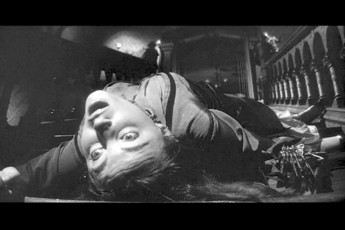
 ‘I’m coming apart, a little at a time. A little at a time. Now I know where I’m going. I’m disappearing, inch by inch, into this house.’—Eleanor (Julie Harris) in Robert Wise’s The Haunting (MGM, 1963).
In my previous discussion of the variation on the monstrous feminine in haunting films, what I call the haunted feminine, I identified Robert Wise’s 1963 film The Haunting as one of the purest examples of this trope in cinema. The relationship between Hill House and the character of Eleanor in the film functions on multiple levels. The haunting becomes a projection of her inward repressions, and an expression of the destructive power located in the mind of the woman. The film focalizes the narrative through Eleanor, laying bare her psychological state, and opens up an interpretation that views the haunting as a direct manifestation of her repressed psychology. An examination of several key sequences of the film permits for an expansion of the concept of the haunted feminine, laying open this film in particular, and haunting films in general, to Freudian interpretation and exposition.
The book on which the film is based, The Haunting of Hill House by Shirley Jackson, conceives Hill House itself as a manifestation of insanity:
Hill House, not sane, stood by itself against its hills, holding darkness within…silence lay steadily against the wood and stone of Hill House, and whatever walked there, walked alone (Jackson 3).
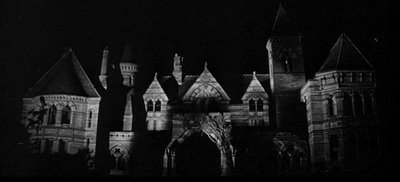
The film visualizes this aspect of the novel, with images of the house silhouetted against a dark sky and photographed from low, canted angles. The initial introduction of the house occurs before the opening credits. Dr. Markway’s (Richard Johnson) voice speaks the first paragraph of the novel almost verbatim over shots of the imposing house. The second introduction occurs through Eleanor’s eyes. A montage of several shots presents her first experience of Hill House: first a panoramic shot of the whole façade of the house; second another angle view of the house, this time a little closer; third a close shot of some of the details of the exterior; and fourth an even closer shot of dark windows.
A few things should be noted about this sequence of shots. The initial view of the house fails to match Eleanor’s eye line. She looks to the right of the frame, but the house is shot from a left angle. The camera cuts back to Eleanor, still looking  to the right of the frame. The frame cuts to the correct angle in reference to Eleanor’s eye line match, but becomes confusing because the angle is lower and the shot closer than the original view. The last two shots, of the details on the house and the dark windows, are impossible to read as point of view shots, because they are progressively closer, while we know Eleanor has not moved. This technique causes a uncanny experience in the viewer and emphasizes the house’s insanity. Eleanor observes the house from these canted, disparate angles and immediately identifies the house as ‘sick.’ That it is impossible that she could look at the house in this way not only typifies the disjointed, disturbing nature of the house itself, but also points out that this is Eleanor’s view of the house. The final shot of the dark windows matches on the next shot of Eleanor’s eyes, identifying the pair. The house appears to be literally looking at her, as her voice-over makes clear: ‘it’s staring at me.’ The film expresses Eleanor’s thought processes, and her increasing madness, through use of her voice-over. It forces the viewer to enter into Eleanor’s mind. This could be interpreted as overkill, as director Robert Wise mistrusting the strength of the visuals to convey the message. It does, however, emphasize Eleanor’s subjectivity. Is it the house that is ‘not sane’ or Eleanor?
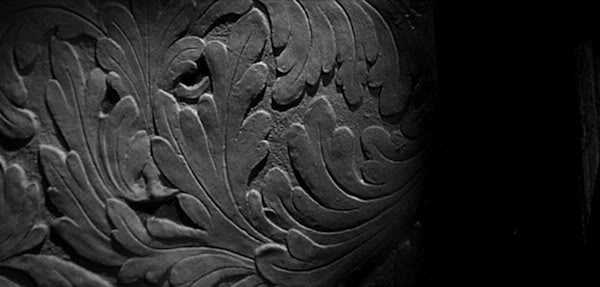
The film builds to a sequence of ‘haunting’ scenes, each of them different in their own ways, and each progressively more focalized through Eleanor. The first haunting scene occurs the first night in the house. It develops through a complex montage of shots and sounds, beginning with the opening shot of the darkened Hill House. It then fades to the long main staircase, in the interim superimposing one of the details of the house (a carving of a male face) briefly onto the image of the staircase. Wise utilizes the technique of brief superimposition numerous times as a way of structuring the film as haunted. These images haunt the frames of the film and disconcert the viewer. Over the medium shot of the dark staircase, a banging noise comes over the soundtrack. The image fades to the corner of a room as a light comes on and Eleanor gets out of bed. She believes for a moment that the noises come from her dead mother, who used to knock on the wall to get her attention.
Eleanor’s relationship with her mother forms the first indication of her numerous complexes. The narrative has already identified another sound of beating on the wall with the death of the nurse who failed to respond to an invalid’s knocking for help. The film proposes multiple identifications for the manifestation of the knocking. The knocking is associated first with the nurse who engages in sexual activity, resulting in the death of her patient and then her own suicide. The knocking then relates to the experience of Eleanor, who blames herself for her mother’s death because she failed to respond. It may be argued that Eleanor internalizes the apparent ‘sexual deviance’ of the nurse, who causes death through illicit sexual activity. Freud’s discussion of fear and sexual anxiety in ‘Inhibition, Symptom and Fear’ relates to this:
I found that attacks of fear and a generalized state of apprehensiveness are precipitated by certain sexual practices such as coitus interruptus, frustrated arousal, and enforced abstinence—in other words, whenever sexual excitement is inhibited, checked or deflected before it has achieved gratification (Freud 177).
Reading the scene in this light, the knocking becomes a manifestation of an interrupted sexual impulse that locates itself in the relationship between sex and death. Female sexuality as either repressed (Eleanor) or too expressive (the nurse) becomes the site and cause of death and madness. The film locates Eleanor’s sexual inhibition in her relationship to her mother whose illness and demands preclude her from enjoying normal sexual relationships. Eleanor, stopped from healthy sexual expression by the necessity of caring for her mother, experiences extreme guilt at her mother’s death. The knocking becomes a manifestation of Eleanor’s guilt complex.
Eleanor rushes into Theo’s (Claire Bloom) room at her call.
Theo: I thought it was you pounding.
Eleanor: It was.
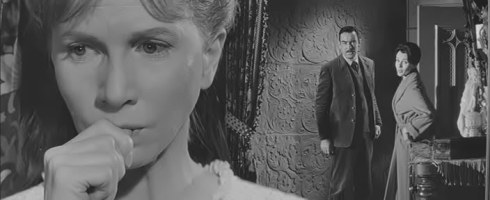
Theo experiences the noises as something caused by Eleanor. Eleanor for a moment reinforces this construction. The apparent misidentification allows the haunting to be read as an outward manifestation of Eleanor’s inhibition. It becomes a physical expression of her repression in the form of a monstrous Other. The ‘thing’ that haunts Hill House attempts to get into the room with Eleanor and Theo, but fails. Eleanor asks if the door is locked, Theo responds negatively and the doorknob begins to turn.
Eleanor: You can’t get in!
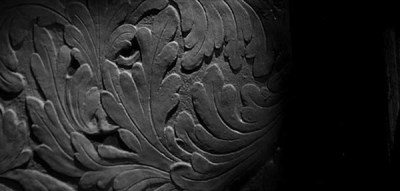 As soon as Eleanor denies the ‘thing,’ the pounding ceases. The haunting ends when Eleanor’s conscious mind represses a manifestation of the unconscious. As soon as she denies it, it goes away. The film focalizes the second memorable haunting sequence as solely the experience of Eleanor. The scene begins with an exterior shot of a single tower of the house, bringing the viewer closer than in the opening of the previous sequence. The scene cuts to the interior of Eleanor and Theo’s room. Eleanor watches and listens as first a masculine voice murmurs and a feminine voice giggles. She watches a single spot in the wall as a face begins to emerge from the ornamentation on the wall. The entire sequence plays from Eleanor’s point of view, creating ambiguity about whether the voice and the image of the face in the wall are products of Eleanor’s imagination, a projection of her mind into the physical realm, or an actual haunted presence. As the scene proceeds, the face in the wall becomes more pronounced, developing eyes, nose and an open mouth, the woman’s laughter replaced by the (apparent) sound of a child crying. Eleanor begins narrating in voice-over at this stage:
Eleanor: This is monstrous. This is cruel. It is hurting a child and I will not let anyone or anything hurt a child…I will take a lot from this filthy house for his sake, but I will not go along with hurting a child.
Eleanor ends the sequence by screaming, again denying the presence of the Other. The lights come on and she discovers that she has moved from her bed to the couch by the wall and that the hand she thought was Theo’s is no hand at all. This scene functions as the beginning of Eleanor’s entrance into a union with the house, as she narrates herself into a position of power. She says that she ‘will not let anyone or anything hurt a child,’ establishing herself as the figure who will ‘save’ the hurt child. Her enigmatic statement that she ‘will take a lot from this filthy house for his sake’ (italics mine) bears closer scrutiny. She may be referring to Dr. Markway, with whom she has developed an infatuation. She may be referring to the dead Hugh Crain. She may even be referring to the house itself, which she begins to form an unnatural connection with. Prior to the sequence, Eleanor has grown more attached to the house, believing that the house ‘wants’ her. She forms a narcissistic, potentially sexual attachment to the house as her ‘home.’ This second sequence heightens her connection to the house.
The final haunting sequence occurs near the end of the film and visualizes Eleanor’s total breakdown, her passionate desire for union with the house, as the house literally begins to implode upon her. It is the most physical manifestation of the haunting, claimed as the realization of everything the film has built to. It also is the one full-fledged haunting sequence that all the main characters participate in. The sequence actually opens from within the house, realizing the full progression of the establishing shots from the two previous sequences, each of which opens in a closer shot. Now the camera is in the room with Markway, Eleanor, Theo and Luke (Russ Tamblyn). The pounding noises from the first sequence occur again, until they stop in front of the sitting room door, where the four characters gather. The door begins to cave in on itself, as the force on the other side pushes it in.
Each haunting sequence has failed to expose what it is that haunts Hill House. No actual ghosts or monsters ever appear. The haunting remains sublimated within the psychic realm, and reinforces that concept of Eleanor’s repression as being part and parcel of the haunting. At this point, the repressed Other, almost succeeds in breaking through, in crumbling the door and revealing itself to the inhabitants. Eleanor chooses to go out and face the ‘thing.’ At each point in The Haunting, Eleanor has denied the ‘thing’ entrance and so it remains behind walls and doors. Finally, she opens the door and runs out to meet it. She encounters no ghost, no ‘thing.’ She runs through the fast crumbling house as glass breaks, metal scrapes, and the house grows wildly imbalanced. These are all sounds focalized through Eleanor and, other than a single mirror falling, have no visual reality. Mirrors abound in this sequence. Eleanor first encounters her distorted image in a convex mirror above a mantle. As she runs into the conservatory, a mirror reflects her image, and then falls off the wall. At each turn, Eleanor encounters a reflection of herself. She has gone out to meet the haunting Other of Hill House only to discover that the Other is herself. Her confrontation with the repressed side of herself, the inhibition that has manifested itself in the form of the monstrous Other, causes the house to ‘destroy itself.’
Eleanor: I’m disappearing inch by inch into this house.
Having confronted the repressed Other, Eleanor loses control and wishes to become a part of the house. She nearly succeeds in committing suicide but is stopped at the last moment by Markway. This returns to the issues of inhibited sexuality and can be seen as a sort of ‘coitus interruptus.’ The patriarchal representative of scientific materialism stops Eleanor’s sexualized union with the house, the full realization of her repressed psyche.
 The conclusion of the film, however, establishes the supremacy of the supernatural manifestation of the female psyche over the masculinist rational paradigm. The film exposes the medical discourse of Dr. Markway, who functions as a representative of the medical establishment and the need to control and explain the Other, as insufficient. He seeks to explain the haunting, to locate some scientific proof for the paranormal. Refusing to fall into the discourse of scientific materialism, Eleanor completes her union with the house and a full recognition of her sublimated desires. The ending, though it concludes with Eleanor’s death, may be read in a triumphal light, as Eleanor finally discovers her place of belonging in confrontation and final acceptance of the sublimated Other. Having confronted the haunting only to confront herself, Eleanor drives her car into a tree, killing herself:
Eleanor: So now I’m going. But I won’t go. Hill House belongs to me. I knew it. I knew it. Hill House doesn’t want me to go.
She briefly resists, but Eleanor gives in to the ‘will’ of the house and the will of her subconscious. Her repressed psyche in the form of the haunting takes over the wheel and unites her and the house in a union of sex and death. Although she ends her life, she becomes incorporated into the house and succeeds in facing and accepting her sublimated desires. Her inhibitions exposed, she can finally go home.
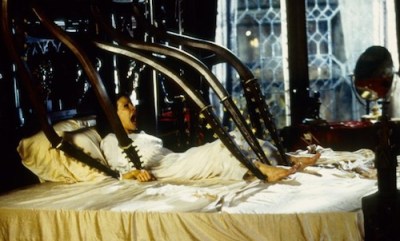
When The Haunting was remade in 1999, it opened the discourse of the film to new interpretation. The remake articulated Eleanor’s relationship with the ghosts (and there are actual physical ghosts in the remake) as the role of savior. Her death becomes unambiguously triumphant when she succeeds in ‘saving the children’ from an evil house that is haunted by the spirit of her past relation. Aside from the hokier aspects of the film, the remake streamlines the concept of the original into a discourse not about the abject mind of the female, but the motherly ‘savior’ who sacrifices herself to rescue the children from a monstrous masculinity. This brings to the fore the ambiguous function of the original to form a both sad and possibly triumphant conclusion. Eleanor, freed from the functions of science and patriarchy, finally unites sexually with the house and in doing so comes ‘home.’ Hill House remains a place where ambiguity reigns, where the things that go bump in the night are never explained, and where successful sexual union only ends in death. It is also the only site of triumph for the repressed, reviled woman who comes to terms with her sublimated psyche, who confronts her fears and enters into a sense of belonging. Something finally happens to Eleanor.
Jackson, Shirley. The Haunting of Hill House, Penguin Books, New York: 1987.
Creed, Barbara. ‘Horror and the Monstrous Feminine: An Imaginary Abjection’ in The Dread of Difference: Gender and the Horror Film, ed. Barry Keith Grant, University of Texas Press: 1996.
Doane, Mary Ann. The Desire to Desire, Indiana University Press, Bloomington: 1987.
Freud, Sigmund. ‘Beyond the Pleasure Principle’ in Beyond the Pleasure Principle and Other Writings, trans. John Reddick, Penguin Books, New York: 2003.
‘Inhibition, Symptom and Fear’ in Beyond the Pleasure Principle and Other Writings, trans. John Reddick, Penguin, New York: 2003.
‘On the Introduction of Narcissism’ in Beyond the Pleasure Principle and Other Writings, trans. John Reddick, Penguin Books, New York: 2003.
Kristeva, Julia. Powers of Horror: An Essay on Abjection, trans. Leon S. Roudiez, Columbia University Pres, New York: 1982.
Lawrence, Amy. Echo and Narcissus: Women’s Voices in Classical Hollywood Cinema, University of California Press, Berkeley: 1991.
Williams, Linda. ‘When the Woman Looks’ in The Dread of Difference: Gender and the Horror Film, ed. Barry Keith Grant, University of Texas Press: 1996.
De Bont, Jan (dir). The Haunting, Dreamworks, 1999.
Wise, Robert (dir). The Haunting, MGM, 1963.
*Paper originally written for Horror and Sci-Fi, Prof. Ed Guerrero. Copyright Lauren Humphries-Brooks 2009






 Suddenly, a shot rang out ...