The Dunwich Horror (1970)

The Dunwich Horror (1970)

dunwich_horror_xlg

Adapting the work of horror writer H.P. Lovecraft is a challenge for any screenwriter, or director. Like Poe, much of Lovecraft’s power lies in his verbiage. His horrors are the concealed, obscure terrors of dreams, and his writing chock full of purple prose invoking nameless fears and indescribable stenches from dark Cyclopean caverns. Moving that kind of writing to the big screen is nearly impossible, because Lovecraft trades on things that cannot be seen or, once seen, cannot be described.

The Dunwich Horror makes a good attempt at adapting one of Lovecraft’s better known stories to a visual medium. The film was directed by Daniel Haller from a script co-written by Curtis Hanson, who would go on to direct L.A. Confidential and The Hand that Rocks the Cradle. It was produced for Roger Corman’s American International Pictures, which immediately indicates what we can expect from the production.

Following a bizarre birth sequence and some truly epic opening credits, the film properly begins with the introduction of Wilbur Whateley (Dean Stockwell, looking more 70s than I thought was humanly possible). Whateley wants access to the dangerous and forbidden book of black magic, the Necronomicon, stored in the library of Miskatonic University and owned by Dr. Henry Armitage (Ed Begley, in his final film role). To this end, Wilbur hypnotizes one of Armitage’s students Nancy Wagner (Sandra Dee) into furnishing him with the book. When Armitage appears and refuses to allow Whateley to take the Necronomicon away with him, Whateley puts another plan into action: he has Nancy drive him home to Dunwich, where he lives in a ramshackle old house with his grandfather (Sam Jaffe, having the time of his life) and something vague and rumbly in the attic. It soon becomes clear that the Whateleys are a weird and creepy family (if we didn’t know that already), and Nancy will be their next victim in an arcane ritual designed, as most things are, to bring about the end of the world.Dunwich 05

Anyone who has read the original Lovecraft story will recognize the initial plot about the Whateleys, and also that the whole “sacrifice a virgin to the Old Ones” is nowhere close to that story. The Lovecraft narrative deals more with the birth of Wilbur, his upbringing, and the fear he inspires in the townspeople of Dunwich prior to the arrival of “the horror” in the title. The narrative then shifts to the “Dunwich horror” and how the townspeople discover it and defeat it with the help of Armitage and the local doctor.

The film of The Dunwich Horror ignores most of the first part of the original story and focuses on the underlying theme of sexuality, present in much of Lovecraft’s work. Wilbur’s seduction of Nancy is accomplished through drugging her drink, hypnotizing her, and finally having sex with her on a stone altar – the entire sequence, though not explicit, plays like a soft core porn film that pretty much kills Sandra Dee’s virginal teenage image for good. The point of this part of the plot is unclear, save that the opportunity to show Dean Stockwell and Sandra Dee having kinky altar sex was too good to pass up.

Dean Stockwell takes the lead in this film, his fabulous mustache and 70s perm really hammering home the change of time period from Lovecraft’s – although it does match the “decadence” that Lovecraft finds so horrifying. But he’s also that combination of creepy and charming that makes his eventual seduction of Nancy believable, even if we wonder why any sane young woman would agree to get in the same car with a man who looks and talks like a pimp. Sandra Dee gives a perfectly serviceable performance as Nancy, although not much is demanded of her beyond being innocent and then writhing around on an altar. The elder actors are having a lot of fun with their respective roles, especially Sam Jaffe, who wanders around the house making arcane pronouncements and shouting in the face of his grandson.dunwich-1970-2

The problem with The Dunwich Horror is that there’s not much horror to go around. The film spends more time on the inevitable seduction of Nancy than it does on building up the terror surrounding the thing that rattles the attic door. However, I will give the film praise for creating an invisible “lurking terror” which, when it finally breaks loose, does its evil very effectively. The climax of the film does not quite work, however, as we’ve spent far too much watching Nancy become the vessel of the Old Ones and far too little time with reasons why that is a bad thing. I never thought I’d say this, but they needed to inject a little less attempted subtlety and a little more Lovecraft.

At the end of the day, The Dunwich Horror is a good, but not great, B-level Corman production. It’s never dull, and is actually far better than I expected it to be. Still, I wanted a bit more horror to go with my Dunwich.

The Avengers: Second Sight

Second Sight (Episode 03-08, November 1963).

cathy-second-sight

Second Sight is one of the stranger Season 3 episodes for a number of reasons, the most prevalent being the subject matter. While it is not quite successful in developing its strangeness to the fullest extent, it nevertheless has so many interesting and macabre elements that I found myself wondering how it could have been improved as a filmed episode, with time and energy devoted to drawing out some of those elements.

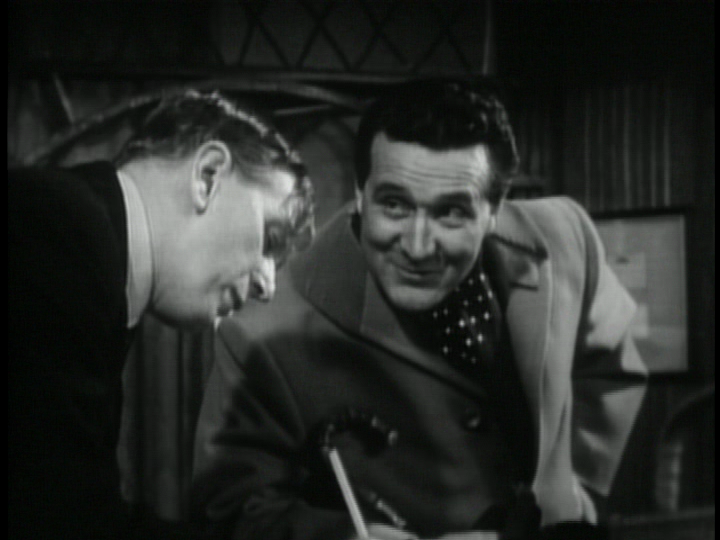
This is one of those episodes in which Steed has a fairly routine assignment: he represents the British government in the importation of corneal grafts sent from a clinic in Switzerland to treat eccentric millionaire Marten Halvarssen’s (John Carson) blindness. The grafts are to be transported in a sealed, sterile container, which means that no one can inspect the contents. Steed suspects that there’s something not quite right in the whole set-up, and so sends Cathy off to pretend to be a researcher interested in corneal grafting. She discovers that the grafts are to be taken from a live donor, a former acquaintance of Halvarssen’s, and winds up going off to Switzerland in the company of an eye surgeon (Ronald Adam) to see the operation done.

The very subject of taking corneal grafts from a live donor is enough to veer Second Sight into creepy territory. As with some of the best Avengers episodes, Second Sight gives nothing away. We know that surgeons Eve Hawn (Judy Bruce) and Neil Anstice (Peter Bowles) are not what they seem, but their game remains unclear, revealed in degrees as the episode proceeds. Halvarssen’s apartment is deliberately structured to be confusing to all but the millionaire, creating an Expressionist mis-en-scene that carries on to the clinic in Switzerland. The Swiss sequences are even more disturbing, and use the limits of live television to excellent claustrophobic effect. Steed and Cathy are balanced, “normal” characters plunged into a twisted world, as bothered as the audience by the events of the episode.

The secondary cast is likewise an asset here. Peter Bowles and John Carson were old hands at Avengers episodes, the latter appearing in one guise or another for most of the series’ run. Carson has a lot to do here as Halvarssen, a sinister and sympathetic character in equal measure. Bowles gets to be a bit more extreme, playing Anstice as a fully nasty piece of work who seems to delight in the suffering of others. But my favorite secondary character here is Ronald Adams’s Dr. Spender, the eye surgeon that accompanies Cathy to Switzerland. Spender is a blustering fool, insulting Cathy at every turn, and making life harder for Steed. He’s also one of the funnier characters to come through this episode, wholly out of his element in dangerous surroundings. The first scene where he blusters into Steed’s apartment is worth the whole episode.

Meanwhile, Steed and Cathy are hitting their stride as a team. Their first scene together has them coming back from stock car races, bickering like a couple: Cathy complains about the weather, Steed points out that he went to that lecture the other day (“Complaining bitterly the whole time,” as Cathy concludes). The two are not just work colleagues: they’re good friends and spend a lot of their free time in each other’s company.

With so many excellent elements in place, Second Sight should be one of the best of the season. Yet the episode doesn’t come together as a whole – the plot is a trifle thin, once revealed, and certain sequences (like the murder of Dr. Spender) are funny rather than frightening. This is one of those occasions where the set-up is more intriguing than the pay-off, and the general air of nastiness and the macabre falls apart in the final act. The episode disappoints because it’s not as good as it should be.

Still, for all of that, there’s enough good here to make Second Sight worth a viewing. Like many episodes from this period, it improves on re-watching and I’ve found more to like about it the more I’ve seen it.

The Avengers: The Secrets Broker

The Secrets Broker (Episode 03-19, February 1964).

steed-secrets-broker

The Secrets Broker is an odd episode – I return to it time and again in the hopes that I can bring myself to fully enjoy it. It’s not a bad episode per se, but it lacks a certain something to draw it into a cohesive whole.

The death of an agent prompts Steed and Cathy into investigating a wine merchant and a spiritualist circle in connection with the potential theft of necessary plans for underwater navigation. Steed discover some excellent claret and a sinister wine merchant, while Cathy hangs out at the design facility in the hopes of picking up some information, where she discovers that the chief designer’s wife is having an affair. The viewer is unfortunately subjected to far too much of the latter, turning the episode into a domestic melodrama for a good portion of its runtime. Steed’s investigation into the wine merchant angle turns up far more interesting results, narratively-speaking, with a gang of villains using blackmail and faux spiritualism to gather information and pass it on to “the enemy.” It all culminates in several deaths, a wine-tasting, and a séance.

All of that makes The Secrets Broker sound more interesting than it is. The episode has many ingredients that should form one of the best entries into the season, but it somehow manages to fall short. I’ve mentioned the domestic melodrama angle, with the lovers played by Patricia English and Ronald Allen. English is usually more dependable than this – she played Carlotta in Mission to Montreal, and reappeared in the Emma Peel episode Never Never Say Die, and was a highlight in both. But here she’s forced into the part of a whiny, self-pitying wife, passionate about her singularly uninteresting lover who forces her into cutting alarm wires at the design facility, all to avoid the embarrassment of having to explain their affair to her designer husband.

Avengers writers seem more at home with pseudo-science than with pseudo-spirituality – both this episode and Warlock make very little out of their supernatural elements. The spiritualism angle is never fully developed, although it did have promise. Mrs. Wilson (Avice Landone) and her daughter Barbara (Jennifer Wood) run a spiritualist circle that works next door to the wine shop, helping to funnel information via Barbara’s “trances.” While Mrs. Wilson herself is one of the better, nastier female villains in The Avengers, the use of the circle is never made clear. The pair are charlatans, but it’s difficult to grasp why they need to use spiritualism at all – everything seems to be done very effectively at the wine merchant’s.

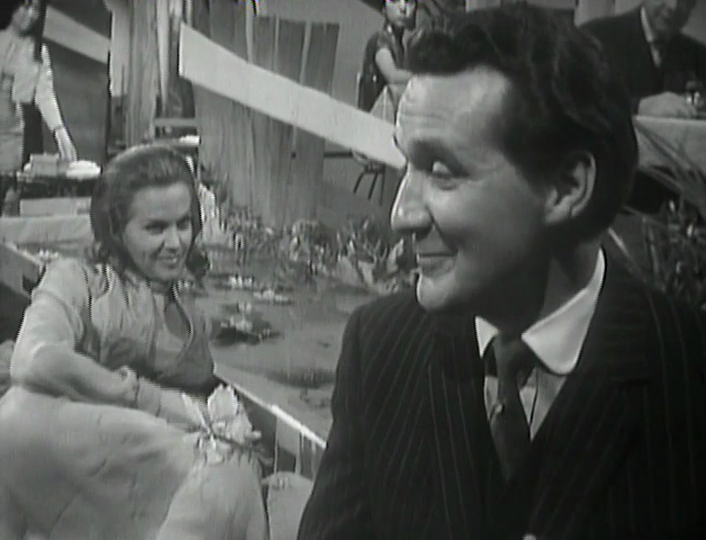
The episode does have some strong points, however, including Jack May as the creepy wine merchant Waller. Waller feels like a villain without an episode: his sinister voice and demeanor could have been used to much greater effect, but the episode pops when he’s on the screen. The same goes for our two heroes, who manage to get in some nice repartee and even an edge of flirtation while feeling their way through. Cathy’s “what makes you think I have depraved tastes?” response to a bottle of apricot brandy Steed gives her evokes a knowing smile from Patrick Macnee and a near giggle from Honor Blackman. Steed has some of his best scenes with Waller as they verbally spar via an ostensible discussion of wine. Cathy has the least to do, but she does get in a few nice judo throws in a short but intense fight in the wine cellar.

I’ve now written more about The Secrets Broker than I have about almost any other episode. I still struggle with this one – I want to like it more than I do, and perhaps in time I will discover even more to say about it. In any case, it’s worth a look, and hardly boring, if only just for that apricot brandy joke.

1984-a-thon: The Razor’s Edge (1984)

When Todd over at Forgotten Films asked me to participate in the “1984-a-thon,” my first reaction was: “there were good movies made in 1984?” Then I went through the long, long list of films released that year and was pleasantly surprised at the number of excellent films included therein. The 1984-a-thon also meant that I finally got around to watching a film that has been on my queue for too long:

The Razor’s Edge

1984 The razors edge - El filo de la navaja (ing) (hs)

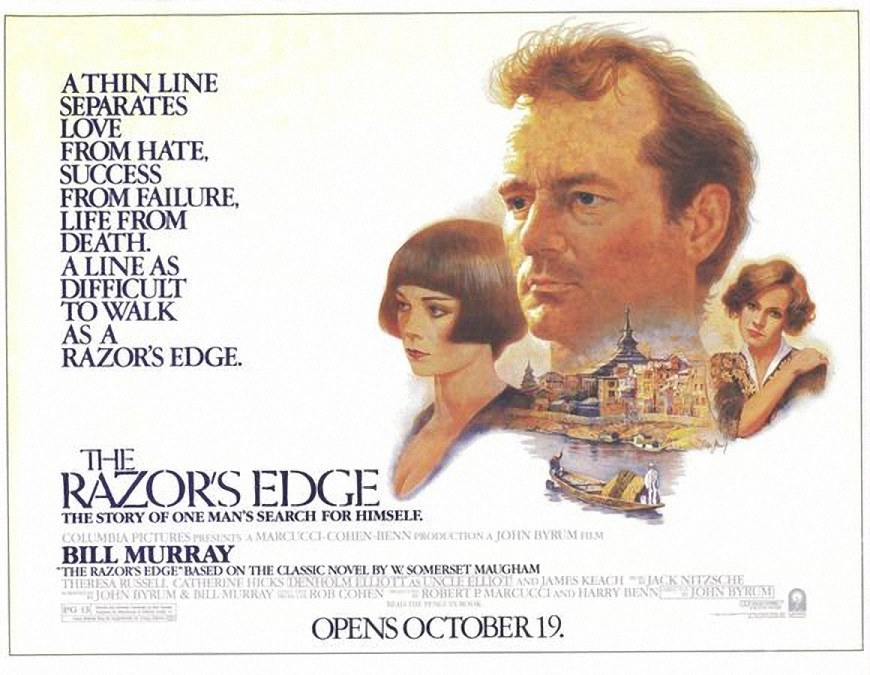
Back before he joined up with Wes Anderson and Jim Jarmusch and went through a dramatic career resurgence, Bill Murray was known first and foremost as a comedian.  Armed with that wry, knowing sense of humor and slapstick that most of us associate with his persona, he appeared in a handful of comedic roles and made a name for himself in films like Meatballs, Caddyshack, Stripes, and, of course, Ghostbusters. But Murray always considered himself more than just a funny guy (not that that’s anything to sneeze at) and so took on his very first dramatic role in an adaptation of W. Somerset Maugham’s The Razor’s Edge. 

The Razor’s Edge was directed by John Byrum from a script written in collaboration with Murray, and bears only a nodding resemblance to the 1946 film with Tyrone Power in the lead. Murray is Larry Darrell, a young man from a small town in Illinois who joins the ambulance corps during World War I, leaving behind his fiancée Isabel (Catherine Hicks). The horrors of war take their toll, opening his eyes to the moral bankruptcy and complacency of the life he left behind. When Larry returns to his hometown he’s unsatisfied with the safe and business-like life offered by post-World War I America and heads to France to “find himself” through hard work and intellectual introspection. Isabel is horrified by the way he chooses to live and leaves him for his erstwhile best friend Gray (James Keach). Larry finally falls for Sophie (Theresa Russell), the girl who always loved him but who remained divided from him by circumstance. The rest of the film meanders through France, Britain, and India as Larry searches for meaning in a life and world that has ceased to make sense to him.

John Byrum only directed a few films in his career; The Razor’s Edge was the third, and unfortunately bears the hallmarks of an inexperienced filmmaker. Most critics of 1984 focused on Murray’s performance as the major problem with the film, but things go much deeper than that. The film has a wandering, episodic structure, as characters move in and out of each other’s lives, yet the audience remains almost aloof from the characters. Larry is the central figure, but the characters who surround him and inform on his existence are so sketchily drawn that they almost become non-entities, figures there for Larry to bounce off of rather than characters in their own right. Murray’s wry, comedic sensibility might be partially to blame here – like the film, he seems aloof from the very beginning.

razors-edge

As Larry moves on to find himself in a Buddhist monastery, the film takes on an Orientalist theme. This is hardly surprising in an adaptation of a Somerset Maugham novel, or in a film of this period – in fact, the DVD version of The Razor’s Edge includes trailers for Seven Years in Tibet and Gandhi. The idea of a Westerner turning to Buddhism to find the meaning of his life is hardly unique, but the film fails to examine the underlying problems of that portion of the plot. In general  The Razor’s Edge is a story about introspection and enlightenment that refuses to examine itself, its superficiality at odds with the growth of its central character.

This superficiality has more to do with the script and direction than anything else. The script and performance styles have a weirdly anachronistic feeling to them; more than once I felt as though I was watching actors from 1984 pretending to be people from 1920. Both Catherine Hicks’s Isabel and Theresa Russell’s Sophie are contemporary characters dropped into another world, their voices, attitudes, and dialogue more in keeping with the America of 1984 than of 1920. Sophie is supposed to be Larry’s “true love,” but Russell’s performance – which should have been affecting – instead comes off as almost callous and unbelievable in her behavior. She’s a Valley girl dropped into the Midwest of the early 20th Century. It was difficult to feel any sort of sympathy for Sophie or for Isabel, both of whom are intended to be damaged and complex characters but lose their complexity in the script.

MSDRAED EC008

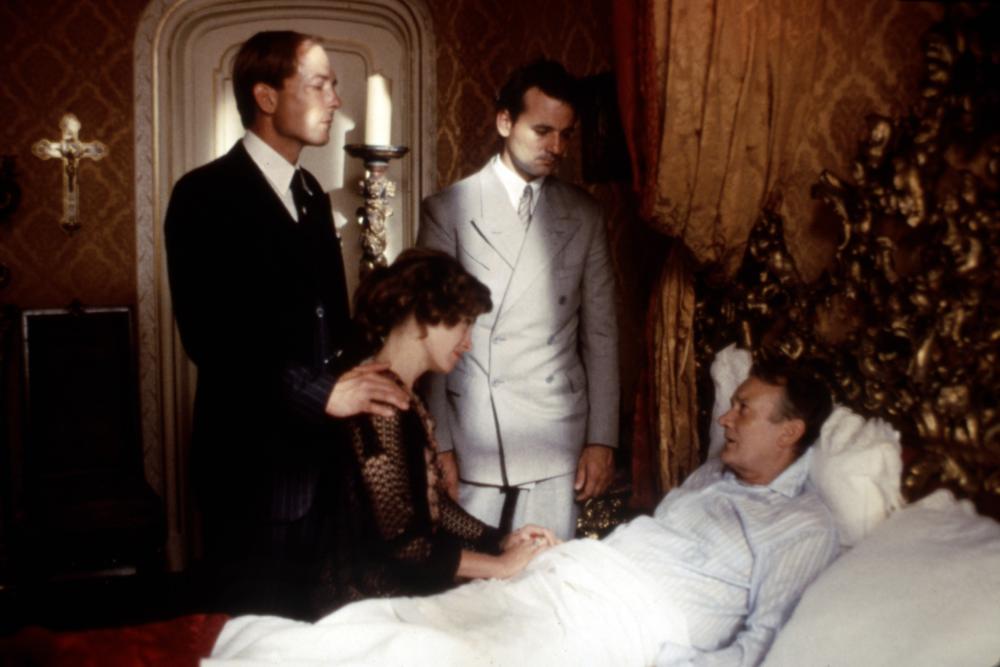
The major exception to this anachronistic tendency is Denholm Elliott, playing “Uncle” Templeton. Templeton is a dandy, a “man-about-town” still trying to live in the society prior to World War I. He is part of a less confusing world, ill-equipped for the changes wrought by the war and its aftermath, and as such feels like a man out of time. Unable to cope with the new society, Templeton tries to retreat to his memories of the past in his opulent Parisian home, stalwartly maintaining his savoir faire in the face of a society he cannot understand. Elliott plays him with a pathos missing from most of the other performances – Templeton is both pathetic and lovable, and you want him to find a place in the gone world. It seems odd that the character most out of touch with his time period should come off as the most believable.

Then there is Murray. While far from pitch-perfect, his performance as Larry has been unfairly maligned. Certainly Larry carries around some of Murray’s trademark sarcasm, but there is an underlying sensitivity and intelligence to the character that hints at the actor’s later ability to walk the line between humor and melancholy. The war does not transform Larry so completely that he fails to retain his fundamental personality – the character keeps a continuity often missing from these tales of transformative experience and the search for meaning. You believe that he can change as he does. Murray is fun to watch in almost any incarnation, but here he proves that he does have a strong dramatic sensibility that does not have to be at odds with his more obvious style of comedy.

The Razor’s Edge is not a bad film, but it squanders the opportunity to be a great one. It hints at a depth and introspection it never quite achieves, burying some excellent ideas (and performances) beneath romantic renderings of a bygone era. The female characters fail to spark, and there is at least one scene where a pivotal moment fails to achieve its emotional aim. At the same time, watching a younger Murray in a rare dramatic role provides a glimpse of the mature actor beneath the immature facade. It’s a shame he wasn’t able to capitalize on that until much later.

The Razor’s Edge actually owes its existence to Ghostbusters. When The Razor’s Edge had difficulty obtaining backing after Murray’s casting, Dan Aykroyd came to the rescue: he convinced Murray to appear in Ghostbusters in exchange for Columbia Pictures greenlighting The Razor’s Edge. Whether or not that was a good exchange must be subject for debate, but it’s likely Murray would never have done Ghostbusters if it had not been for The Razor’s Edge. That in itself might be reason enough to give this film a chance.

The Avengers: The Little Wonders

The Little Wonders (Episode 03-16, January 1964).

the-little-wonders-steed-cathy

The Little Wonders is a fan-favorite episode for a number of reasons, not the least of them being that it contains the one and only on-screen kiss between Steed and Cathy. It’s also one of the most amusing episodes to come out of Season 3, hinting at the slightly crazier plots to come when Mrs. Peel enters the fray.

Steed starts off the weirdness by putting on a clerical collar enters the orders as a way of uncovering the machinations of a criminal syndicate known as Bibliotheque, whose members pose as clergymen. He takes the place of the Reverend Hardbottle (arrested at customs) at a “convocation” designed to establish who will be the successor to the dying Bishop of Winnipeg.  Meanwhile, Cathy investigates the connection between Bibliotheque and a doll’s hospital in central London. These two threads will come together, of course, but not before Cathy has a chance to be threatened by men in sunglasses and Steed carves out a name for himself in the syndicate.

This was one episode I wished could have been a two-parter. The Little Wonders brings together some of the best character actors to feature on The Avengers through its long run. There’s Kenneth J. Warren, who will return several times over the course of the show, as “Fingers the Frog;” Lois Maxwell (that’s Miss Moneypenny) as a machine-gun toting nurse, and John Cowley as “Big Sid,” to name just a few who simply don’t get enough screen time. Steed gets into the spirit of playing a vicar/gangster, referring to himself as “Johnny the Horse” (the derivation is equestrian), and carving naked women in his spare time. Cathy has the more thankless job as she attempts to discover why Hardbottle had a priceless doll in his possession, resulting in her apartment being torn apart and an altercation with a doll-mender whose part could have been elaborated on. She also inadvertently becomes Steed’s girlfriend for a few seconds: just long enough for him to kiss her without getting slapped for his trouble.

The Little Wonders plays the clergy angle to the hilt, luckily without wearing it too thin. While there are some moments of filler – no one really cares about who’s going to take over Bibliotheque, but there’s a lot of time spent on the issue – the episode moves along at a dashing pace, with enough twists and turns to keep the audience guessing. The greatest flaw is in a sudden about-face in the third act, which feels a little confusing and perfunctory; there’s also the question of what “top-secret information” consists of, and why government officials have such difficulty keeping secrets. It’s all in good fun, though, and there’s enough going on in The Little Wonders to justify the praise it receives. If I was listing the top ten episodes of the Cathy Gale era, this one would be right up there.

Young and Innocent (1937)

Young and Innocent

girl_was_young_xlg

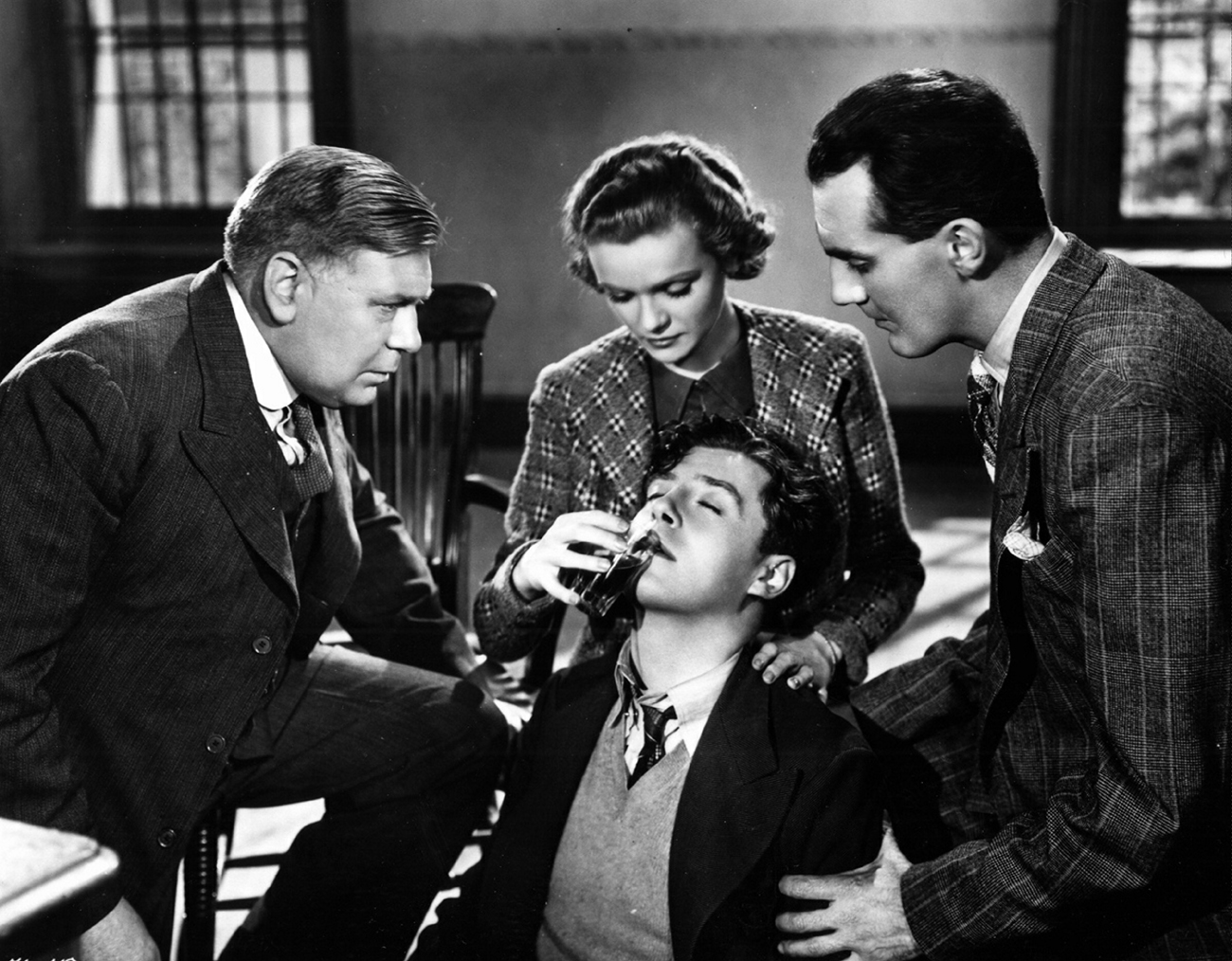
Alfred Hitchcock made some great and not-so-great films in his long career as the Master of Suspense. We often focus on his acclaimed “masterpieces” of suspense cinema: Vertigo, North by Northwest, Psycho, Rear Window – these are the films that many viewers think of when they think of Hitchcock. But Hitchcock was a director in his native Britain long before he came to America, and the films he made during that period sometimes exceed his later works in both humor and suspense.While some film lovers will know The Lady Vanishes, The Man Who Knew Too Much, and The 39 Steps, titles like Rich and Strange, Murder!, and Young and Innocent are routinely ignored. Some of this must have to do with the prevalence of public domain prints, which are often murky and imperfect reproductions of films that deserve much better. But Hitchcock’s British films contain not just the seeds of the style and themes that would come to fruition in his later American career; they are enjoyable, even brilliant works of cinema in their own right.

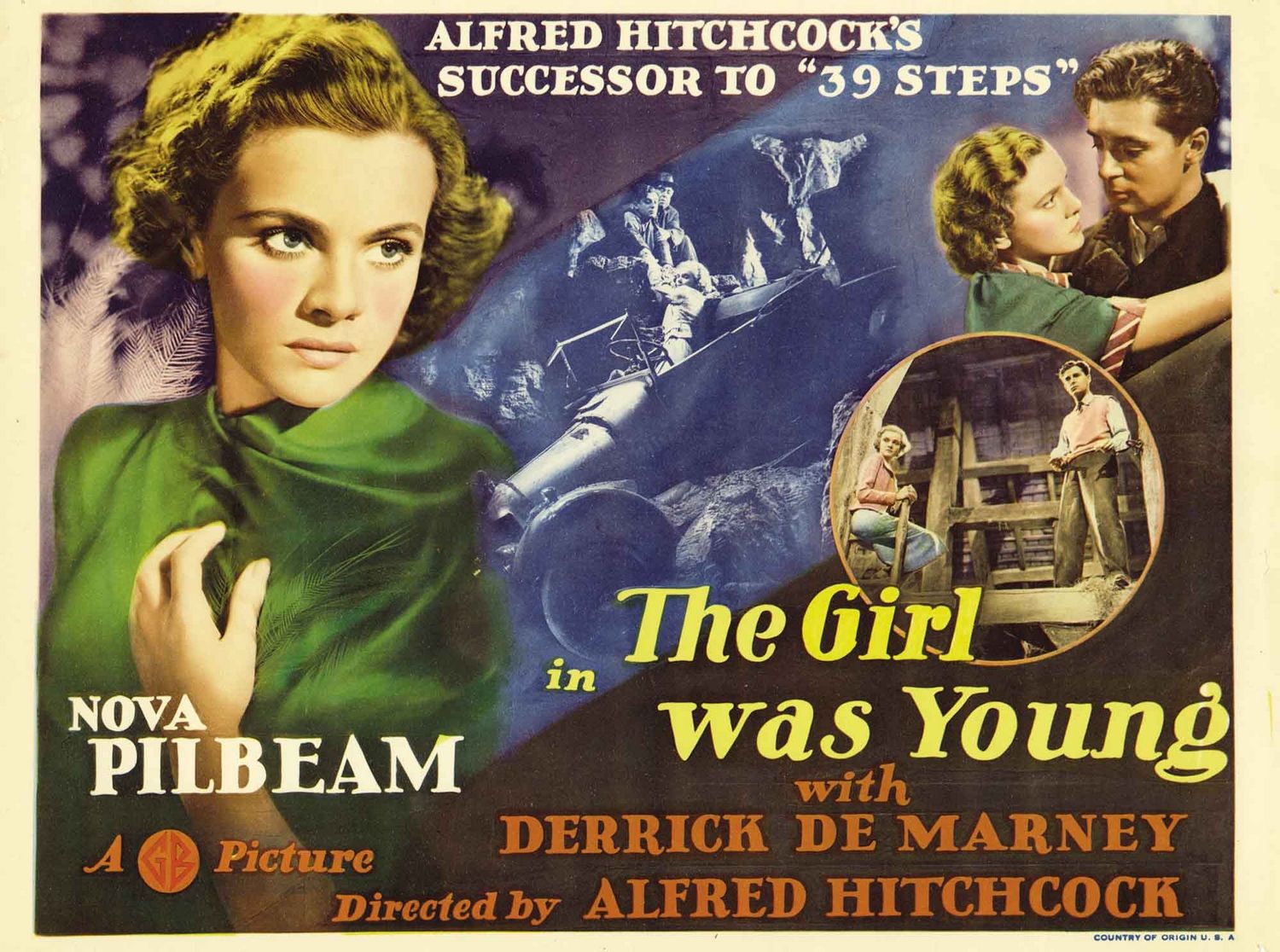
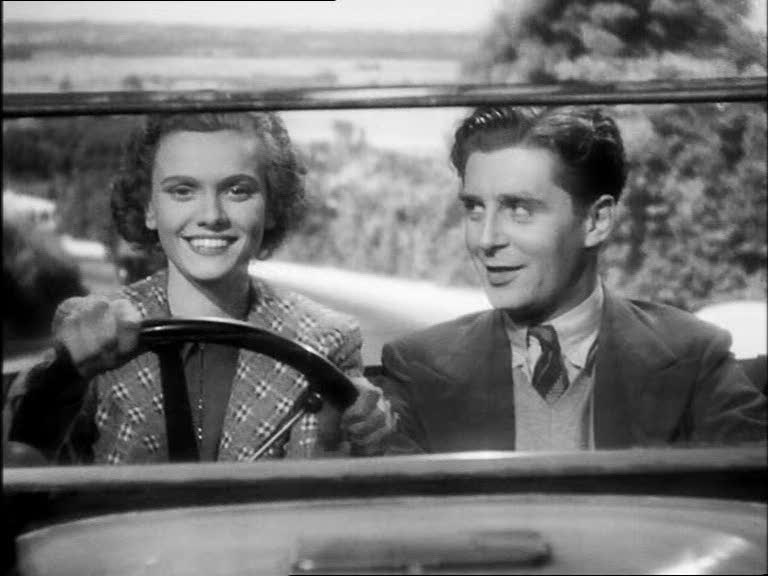
Young and Innocent opens with a stylized murder that we instantly recognize as Hitchcock. After an argument with her husband Guy (George Curzon), actress Christine’s (Pamela Carme) body is washed up on the beach below her home. She’s discovered by Robert Tisdall (Derrick De Marney), who runs off to get help only to be spotted by two young women. When the police arrive they claim that he was running away, and Robert is arrested for Christine’s murder. In the legal farce that follows, the police discover that not only did Robert know the dead woman, but he was also left a hefty sum of money in her will. What’s more, the dead woman was strangled with the belt of a raincoat that Robert claims he has lost. Realizing that he’ll get no justice without that coat. Robert  escapes from the courthouse just before his case is brought up, hiding out in the car of Erica Burgoyne (Nova Pilbeam), the Chief Constable’s (Percy Marmont) daughter. They begin a cross country chase to find Robert’s raincoat and prove that it was not his belt that strangled Christine.

youngandinnocent1

Young and Innocent is the “wrong man” narrative that Hitchcock made a central theme almost from the very beginning of his career. His best known silent film The Lodger operates on the same principles of a falsely accused man who must prove his innocence to both the police and to the girl he loves. The plot brings into relief issues of the justice system –  often shown as ineffective at best – and the vagaries of human nature, as the hero finds help (and hindrance) in some of the oddest place. In the case of Young and Innocent, the audience has no doubt about the veracity of Robert’s story. Without being shown the murder itself, we are given enough information within the first few minutes of the film to determine that Robert had nothing to do with it; it was Christine’s husband Guy, the man with the nasty eye-twitch, that killed her. The crux of the plot then trades on Robert convincing Erica that he’s been falsely accused. It is her story, really, as she comes to maturity via her experience, and her growing conviction that Robert could not have committed the crime.

Erica is on the cusp of womanhood, but she still presides over her father’s table, playing both good daughter and mother to her four brothers. Robert represents adulthood, a mature love, and an implicit threat to the family’s status quo. Erica’s faith in him saves him, just as his gentleness with her hints at an adult world she has never quite touched. Pilbeam and De Marney are excellent together, the latter playing the wry and dashing Hitchcock hero to perfection. Pilbeam looks and acts every bit her age (she was also the young daughter in The Man Who Knew Too Much),  yet manages also to fulfill some of the requirements of a strong Hitchcock heroine. She’s not a pushover and she’s not a victim. The youth of the two leads lends a lightness that might have been missing from older, more experienced actors – there is a sense of play in their friendship and then burgeoning romance, and an atmosphere of fun permeates their scenes together.

YOUNG & INNOCENT

The comedy of Young and Innocent is its most endearing feature. The film contains an extended sequence making fun of the local police (and Scotland Yard), as Robert easily escapes from their clutches after a scene with his venal, incompetent lawyer, resulting in a madcap chase through the English countryside. An element of slapstick runs through the film: police officers are forced to ride in the back of a wagon “with the other pigs,” a child’s party interrupts Robert and Erica’s escape, and Erica causes a slapstick fight at a local truck stop as they try to locate Robert’s missing raincoat. Hitchcock had an innate sensibility and love for British society of all classes, and Young and Innocent is full of British character types, each both endearing and grotesque in their own ways. The most enjoyable of these is Old Will (Edward Rigby), who provides a crucial clue to the identity of the murderer and Robert’s salvation. He’s an endearing character who makes the film even more pleasurable to watch.

This is a Hitchcock movie, though, and Hitchcock movie means at least one feat of camerawork that we might not expect. There are any number of excellently shot and framed scenes throughout Young and Innocent, but the most obvious and influential “Hitchcockian” moment must be the crane shot nearing the end of the film. It begins in a hotel lobby, swoops slowly over a group of dancing couples in a ballroom, down over their heads and to the band playing at the front, coming to rest finally on the twitching eyes of the drummer, whom we know from the start is the real killer. The entire sequence is a single shot, but you almost miss the brilliance of the camerawork until after the fact. If all Young and Innocent had to recommend it was that single shot, it would be enough.

Young and Innocent is less solid than The 39 Steps or The Lady Vanishes, and only hints at some of the greatness that will come along in Hitchcock’s later masterpieces. But it is a light, joyful film, entertaining without being challenging, and with enough depth of plot and characterization that you come away feeling both lightened and intrigued by the outcome. It is a comedic film, but with an undercurrent that acknowledges the seriousness of its subject. Young and Innocent is a work of light, even in the midst of darkness. As Robert says: “I can laugh, because I know I’m innocent.”

The Avengers: The Undertakers

The Undertakers (Episode 03-02, October 1963).

the-undertakers-steed-cathy

The Undertakers is a new kind of episode for The Avengers: one which hints at the slightly madder plots that would be forthcoming into the later seasons. A similar plot will be played out in the Emma Peel episode The Gravediggers, only with a bit more of a spy-fi edge. Think of The Undertakers as a more down to earth version of that increasingly weird little episode.

The Undertakers is also one of the few episodes that have Steed and Cathy stumbling onto a plot almost by accident. Steed has been assigned to accompany one Professor Renter  to America; Renter has “solved the problem of high-speed industrial film,” as the episode informs us more than once, and is heading to America to negotiate for patents, or something to the effect. But when Steed shows up at Renter’s flat, he’s informed by the hilariously flighty Mrs. Renter (Lally Bowers) that the Professor has “gone into retirement” without warning and cannot be contacted. Steed smells a rat and soon discovers that quite a number of millionaires have “gone into retirement” at the same shady community in Adelphi Park. He ropes Cathy in to help out with the investigation, uncovering a dastardly but rather clever little plot involving a funeral home and tax evasion.

The Undertakers has a breezy madness about it often missing from the more serious endeavors of the Cathy Gale seasons. Much of this is the result of Mrs. Renter, who is so apparently daft yet clever that she exasperates Steed within a few seconds of meeting her. There’s an organized crime subplot involving Mrs. Renter’s next door neighbors a bit more in keeping with the noir-ish aspects of the early seasons, highlighting the fact that The Avengers really did trade on stereotypes and unsubtle characterization outside of its leads. But even that cannot take away from the fun of the episode, or the visible enjoyment that Macnee and Blackman are getting out of it. The final outdoor chase sequence makes even some of the more ridiculous twists of the plot worthwhile.

As the relationship between Steed and Cathy goes through its ups and downs, here we see a rather warm domestic connection developing between the pair. Steed shows up at Cathy’s apartment to drop off some things from his pantry in preparation for his departure. As Cathy prowls around cleaning a set of pretty massive guns (why we are never quite sure), Steed attempts to engage her in conversation, telling her how much he’ll miss her and how he’d rather take her along on the ocean voyage. It’s an adorable little scene, augmented later by a visibly intoxicated Steed putting the moves on Cathy in a somewhat unexpected manner.

All in all The Undertakers is just plain fun – it doesn’t drag, the cast is enjoyable without overwhelming the plot, and the plot itself as clever as you can get from this season.

The Tomb of Ligeia (1964)

The Tomb of Ligeia

tomb-of-ligeia

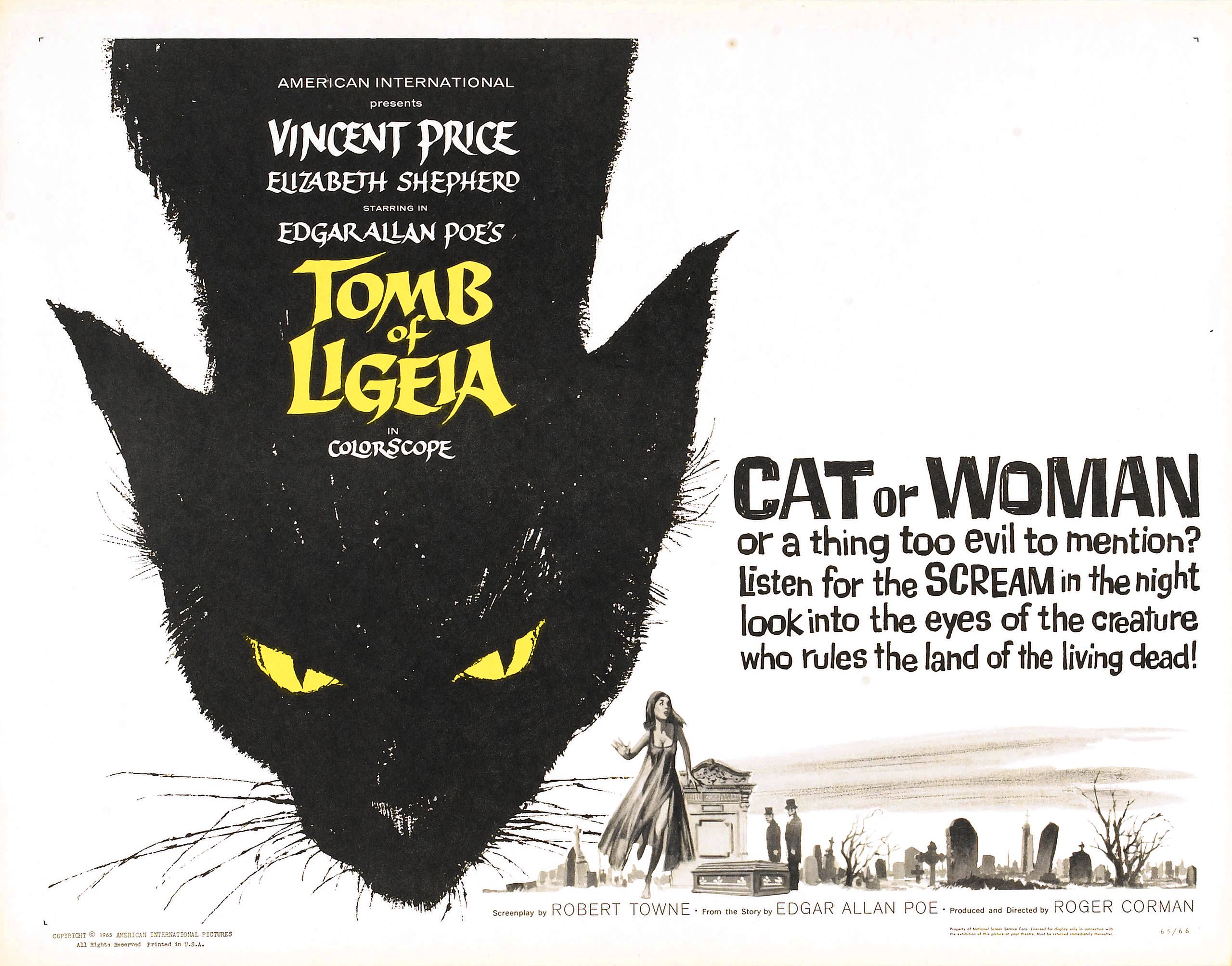
“I just tried to kill a cat with a head of cabbage!” – Verden Fell (Vincent Price)

Vincent Price and director/producer Roger Corman made eight films based on the stories of Edgar Allen Poe, all of them in bright Technicolor with overwrought scripts and hammy performances from a central cast of talented B-movie stars. The Tomb of Ligeia is the last of the cycle and in some ways the best, featuring one of Price’s most effective and pathetic performances.

The story centers around Verden Fell (Price), who opens the film by burying his wife Ligeia (Elizabeth Shepherd). We’re told that Ligeia was a woman of great will and passions, who promises her husband on her death-bed that she will not stay buried. This being an Edgar Allen Poe adaptation, we can expect her to keep that promise. Fast forward several years and Verden is still living at the abbey he shared with his wife (she’s buried in the neighboring churchyard). The arrival of his beautiful neighbor Rowena (also Shepherd) prompts Verden to reevaluate his priorities. He falls for Rowena and the pair embark upon a marriage that everyone pretty much knows is doomed. Ligeia might be dead and buried, but she’s not going to let her husband go that easily.

Like most Corman/Poe stories, The Tomb of Ligeia is less about its plot and more about its aesthetics. The abbey that Verden and his wives inhabit is run-down, strewn with cobwebs, and haunted by a black cat that quickly become a central character to the story. Secret passages, haunted ruins, a bell-tower, winding staircases leading to hidden secrets – it’s all beautifully predictable for this type of film, and we know that before long family secrets will be revealed and some hideous discoveries made.

tomb-of-ligeia-price-shepherd

At the center of the film is the excellent cast, not the least of them being Price and Shepherd. Price is a tad old for the part he plays, but he goes into it with gusto, his sad, haunted expression making the audience feel for a man who might very well have been made out to be a monster. Verden fights desperately to free himself from the morbid obsession with his dead wife, who swore to him on her death-bed that he would always be her husband. In this case, he’s as much a victim of Ligeia’s indomitable will as everyone else, and Price plays him with pathetic beauty.

Elizabeth Shepherd, meanwhile, takes on the dual role of the Lady Rowena and Ligeia herself. Both are headstrong, powerful women, unwilling to sacrifice the man that they love – or, rather, the man that they want. There’s a certain element of power play going on here, and in some way the film is more about the battle between Rowena and Ligeia than it is about Verden. (I can also never pass up an Avengers connection: Shepherd was the first actress cast as Mrs. Emma Peel on The Avengers, and even filmed 1.5 episodes before being dismissed from the production under rather vague circumstances. Watching her here, I couldn’t help but wonder how she might have compared to Diana Rigg).

Where The Tomb of Ligeia fails is in its conclusion. The final sequence, once we get there, is very effective, but the plot feels confused, with much of the exposition packed into the last ten minutes. There we discover the “truth” about Ligeia and Verden’s obsession with her and are subjected to several short climaxes before we get to the real ending. As such, the film feels curiously weighted at the conclusion, as though Corman and scriptwriter Robert Towne (of later Chinatown fame) realized that they didn’t have an ending to the story and so tacked on three. That being said, however, it does provide one of the more epic final battles in any of Corman’s films, vastly outstripping The Pit and the Pendulum for sheer madness.

No one watches a Corman/Poe film for excellent storytelling; we watch it for the crazed camp, the wild-eyed villains and tortured heroes, the heroines bathed in fire and blood. Corman was the King of B-Movies, one of the best directors to tap into Price’s intensity and make even his villains fascinating and sympathetic. The Tomb of Ligeia is not a great film, but it is great fun.

The Avengers: The Golden Fleece

The Golden Fleece (Episode 03-11, December 1963).

steed-cathy-the-golden-fleece

Following my rather violent reaction to The Avengers Lost Episodes yesterday, I thought it a good idea to sit down and watch an episode of my favorite series that I actually like. The Golden Fleece, while far from the greatest of the Cathy Gale era, remains one of my favorites.

Steed and Cathy enter the world of international gold smuggling as they connect a Chinese restaurant and an army base with a gold-smuggling ring run through Hong Kong. Their investigation leads them to three army officers working out of a base in Aldershot, where Cathy obtains a position curating the military museum. The convoluted plot also involves an ex-corporal suspected of funneling the ring’s funds to his own pocket, prompting the arrival of Mr. Lo (Robert Lee), who threatens to shut down the whole operation unless he gets his money back.

The Golden Fleece is a well-balanced episode, letting the viewer in on the machinations of the three army officers and their Hong Kong connections as well as Steed and Cathy’s investigation. The excellent supporting cast includes Warren Mitchell, who will later go on to play the amusing Ambassador Brodny in the Emma Peel era. The three officers, in fact, are among the most sympathetic of Avengers villains (if they can really be called that), and it’s difficult not to cheer for them, even when their activities lead to murder.

The most enjoyable part of this episode is the relationship between Steed and Cathy. They appear to have reached an equilibrium of sorts, dining together, going home together, and spending a great deal of their leisure time in each other’s apartments. Cathy arrives at Steed’s flat one morning just to lie down on his tiger skin rug and read a magazine – an indication of their increasing friendship and domestic relationship.  That Steed still persists in manipulating her is a source of friction, as it appears that Cathy would willingly help him anyways.

There’s also a subtle but poignant moment when Cathy, looking around the military museum, notices a type of gun she used to use in Kenya. Major Ruse (Tenniel Evans) remarks that it was used in the Mau Mau uprising and laments the need for “police actions.” While it is never expressly stated in the series, there are several indications that Cathy’s husband was killed in the uprising, and the faraway expression on Cathy’s face bears that out.

All in all, The Golden Fleece combines drama and comedy that on balance make some of the best Avengers episodes true classics.

The Avengers Lost Episodes

avengersvolume1_cover_large

For those who are unaware, Big Finish has begun to produce full-cast audio shows of the lost Season 1 episodes of The Avengers. Here is my considered first reaction, having listened to the first CD.  (A more complete review shall be forthcoming, but this is my blog and I do what I want.)

The Big Finish radio series is not The Avengers. The removal of the two lead actors, who historically had a huge hand in crafting their characters, is tantamount to removing the heart of the show. At best, this production qualifies as a reboot, with a new cast that do a poor, barely recognizable facsimile of the originals, with little apparent understanding of what made them tick. The audio production values themselves are excellent, as with most Big Finish productions. The problem lies in the casting. Julian Wadham plays Steed as a public-school accented fop with no charisma and no steely undertone in even his most cynical delivery. He’s a secret agent without charm, an undercover man that no one would believe as a criminal, and a ladies’ man that achieves none of the inherent charm that Macnee put into his characterization. This could improve as the series goes on, however establishing one major hero who is neither charismatic nor an interesting rogue means that listeners will be unlikely to return for more. I fear that Wadham has missed the point of Steed, and perhaps the scripts don’t have that point in them. Anthony Howell’s earnest but largely boring Dr. Keel is a tad less offensive than Wadham’s characterization, but does not  make the whole proceeding particularly interesting.

The adaptation of television scripts to radio likewise has serious limitations that are not insurmountable. The difficulty is that in attempting to be loyal to the original series in using the original scripts, the producers have largely ignored the difference between mediums. The scripts are confused, with action taking place via thumping and thudding that poorly stands in for any real tension or scene-building. The closeness of voices between Wadham and Howell, moreover, meant that I was forced to listen to some of their scenes twice and make educated guesses as to who said what.

I find the whole series to be ludicrous and borderline offensive in terms of characterization and casting. This isn’t just about not liking Wadham as Steed (I don’t) but about an inherent respect for the series itself, as a product of its time and, even more importantly, of the people who participated in it. More so than many series, The Avengers was built by the actors as well as the writers, brought to life by them and given a soul by them. Take away Hendry and Macnee and you have a poorly-plotted British noir with plot holes aplenty and no character interest to back them up. While it is a source of great sorrow that we don’t have the original televised episodes of Season 1, this is far from an adequate or even desirable replacement. As far as I’m concerned, Big Finish should have let well enough alone.