The Inessentials: The Chase (1966)

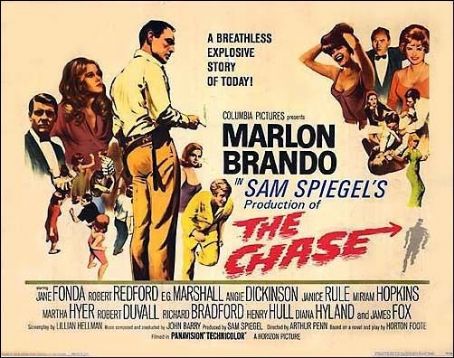
the chase poster

Arthur Penn made a handful of really remarkable films spanning the late 60s and 70s: Bonnie and Clyde and Little Big Man among the most notable.  The Chase comes in third for Penn’s great works, but that’s kind of like admitting that A Midsummer Night’s Dream isn’t quite up to par with Hamlet.

On the surface, The Chase is a standard crime narrative: Bubber Reeves (Robert Redford) has escaped from prison with only a few months left to go on his sentence.  He makes his way back to his Texas hometown, where his wife Anna (Jane Fonda) has been having an affair with his friend Jake (James Fox), the son of Val Rogers, richest man in town (E.G. Marshall).  The hometown sheriff Calder (Marlon Brando) promises to catch Bubber if he comes back.  That’s the basic plot, and it could have turned into a standard wrong man narrative, as Bubber attempts to win back his wife, avoid the sheriff, and expose the corrupt rich man.  Luckily, the film doesn’t go that way at all.  

What we’re treated to instead is a town full of seething animosity, sexual, racial, classist, and generational, that Bubber’s return brings boiling to the surface.  Calder is despised because the townsfolk believe that he’s been bought by Val Rogers.  Rogers in turn is despised by his son, who chafes under his father’s rule without understanding how much his old man truly loves him.  Anna is in love with both Bubber and Jake, imprisoned by her poverty and her stepfather (Bruce Cabot).  Meanwhile, Edwin Stewart (Robert Duvall) is terrified of Bubber’s return for his own reasons, dealing with his drunken and flirtatious wife (Janice Rule).  She, meanwhile, has been carrying on with bank vice-president Damon Fuller (Richard Bradford), a character who becomes increasingly despicable as the film goes on.  In the background lurks the petty racism of mid-60s Texas, as black characters are assaulted by whites, victims of white insecurity.  Into the midst of all these complex, hateful relationships comes poor Bubber, a boy who isn’t as bad as everyone makes him out to be.  There’s no way this is going to end well.the chase redford

The Chase peels back layers of love and animosity, misunderstanding and paranoia, all in the middle of the very drunken Saturday night Bubber has chosen for his return.  From the staid birthday celebration of Val Rogers, we descend the social scale to the more raucous party of the Stewarts, and then the parodic gyrations of the teenage crowd (watch out for young Paul Williams, you really can’t miss him).  There’s no difference between any of them, except perhaps for the veneer of respectability that gradually falls away.  Calder prowls the parties searching for Anna, knowing that if Bubber is going to come back, it will be her he goes to.  But Anna doesn’t trust the sheriff, the sheriff can’t trust his deputies, and the party-goers begin to believe they can take the law into their own hands.

Without going through all the hideous plot machinations that the film goes through – it all tends to the same end, which becomes pretty clear by the time everyone leaves the parties to take to the streets – just let it be said that the film proceeds with a sense of inevitability.  You cannot live in this sort of society without being caught up in the witch-hunt.  We come to understand that Sheriff Calder and his wife (Angie Dickinson) are among the few sensible people in the whole town, the few not stuck in the web of violence and deception.  Calder tries desperately to do what’s right and protect those that need protecting. By the time we come to the fire and blood drenched conclusion, any pretensions to justice or even civilization have fallen away from this sweet little Texan town.  These people are a mob.

What is most disturbing about The Chase is that the mob becomes a mob slowly, drawing us under its influence.  By the end I was reminded of Rebel Without A Cause.  Bubber gives us the clearest indication of generational defiance, as he confesses to his wife and his friend that he escaped because he could not handle prison life any more, and that he would never be told what to do ever again.  It’s as close as The Chase will come to a true act of defiance against the social system, even if it ultimately proves futile.

brando the chase

The Chase has been maligned – I think unfairly – as a potboiler akin to Peyton Place.  It certainly has those elements of sex and violence underlying small town society.  But it rises above that, buoyed by the ability of the actors – what a cast! – and the complexity of the narrative.  Brando anchors the film as the conscience of the town that is habitually insulted and ignored, even lambasted.  Sheriff Calder’s pretended corruption is the cross laid upon him by the society that surrounds him – he must be corrupt, because they are.  They cannot permit the existence of an honest man.

It’s a film about love, hatred, confusion, intolerance, and violence without justice.  Images resonate – there are elements of the Kennedy assassination, of early Vietnam, of social upheaval crushed under the weight of the power structure.  Calder is a sheriff with a conscience, but the town does not deserve the protection he gives it.  Bubber is the wrong man without redemption; Anna the whore who was never a whore; Jake the unspoilt spoiled child.  The price of their rebellion against their proscribed roles is destruction.

The Chase has a similar cadence to Bonnie and Clyde – that generational defiance that must be punished by the powers that be.  If there is hope here, it is in the depiction of Calder as a man who continues to do the right thing, against all odds.  But it’s a very dark film for a multitude of reasons.  It’s very brilliance lies in its lack of compromise.  We all knew how it was going to end, but the film makes us so very angry that it has to end like that.

The Inessentials: The Man Who Knew Too Much (1934)

MV5BMTIwNjAzOTk0OF5BMl5BanBnXkFtZTYwNTUxOTM2._V1._SX450_SY326_

I first saw The Man Who Knew Too Much on a cheaply produced VHS tape that included a good three-quarters of Hitchcock’s British films.  The sound was scratchy, at points indecipherable, the picture grainy and the black and white so contrasted that it was difficult to identify characters without squinting.  I was, to put it mildly, unimpressed, and I more or less forgot about the film, choosing instead to pay attention to the Hitchcocks – most of them from his American period – that I could actually get in good prints.

Thank God for the Criterion Collection.  After gifting me with The Lady Vanishes – a film that reignited my love of Hitchcock and gave me fodder for three graduate papers – and The 39 Steps, they’ve finally fixed The Man Who Knew Too Much and released it on Blu-ray.  Beautiful picture, clear soundtrack, all of the glory of Hitchcock’s British work, up there on the screen.  Finally.  It’s like watching a completely different film.

The Man Who Knew Too Much stands as the only Hitchcock film that Hitchcock himself remade, in 1956 with Jimmy Stewart and Doris Day in the roles originally occupied by Leslie Banks and Edna Best.  The plot is basically the same: vacationing family becomes friends with a man who is subsequently murdered, but not before he can pass on the details of an assassination attempt to them.  To stop them from talking, the baddies kidnap their child (in the original a little girl played by Nova Pilbeam, who would later be a Hitchcock heroine in Young and Innocent).  The conflict lies in the couple trying to decide if the life of a foreign diplomat – and a possible war – is worth the life of their daughter.The-Man-Who-Knew-Too-Much-1934-2

That’s where the parallels between the two films end, however.  I have to say that the original is far and away the better film.  At a punchy 75 minutes, it wastes no time setting up the situation, or the audience’s sympathies.  A few well-placed and economical scenes give us all we need to know – the affection between the parents, the affection between the parents and their daughter, the cost of their silence, and the cruelty of the villains.  There are some truly Hitchcockian set pieces, as the father sets out, in the company of the comic relief Uncle Clive, to find his daughter based solely on an address.  The scene in the dentist’s office must have inspired Marathon Man among others.  It’s a surreal, comical and sinister side-note, to go with the far more serious sequence in a cultish church (The Tabernacle of the Sun, in which old British grandmothers carry around firearms) as the father fights his way to his daughter, only to be captured.  And then there’s the excellent Albert Hall scene, a masterpiece of intercuts, and the final shoot-out.  The whole film is perfectly tailored without sacrificing plot or character.  Coming in at just over an hour, it’s an example of what can be done by a truly great filmmaker.  Any director who thinks they need 2.5 hours to tell a good story should take note.  The Man Who Knew Too Much represents some of the best of Hitchcock’s early work, and that’s saying a lot.

peter lorre man who knew too muchThen there’s Peter Lorre.  The Man Who Knew Too Much was his first English-speaking role – he learned his lines phonetically – but you wouldn’t know it.  He brings the same weird, sadistic vibe that he used with such aplomb in Fritz Lang’s M, but without the sympathetic undertones.  He’s a villain, through and through, and more than that enjoys the suffering he causes.  Yet there are moments of pathos, as when one of his compatriots dies during the shootout, or his humorous introduction.  Leslie Banks anchors the film with a stolid sense of Britishness, honesty and fair play; Lorre provides the chaos.

The film does not hold up as well as The Lady Vanishes or The 39 Steps, widely acknowledged as the best of British Hitchcock.  It’s very sparseness sometimes works against it, leaving certain plot elements under-developed while spending a little too much time on getting characters from point A to point B.  It’s a little rough around the edges, which provides some charm but also a somewhat perfunctory feel.  I found myself longing for a little more emotion on the part of the father – at least earlier on.

But these are minor quibbles in an excellent film.  The Man Who Knew Too Much outstrips its remake in every sense.  It’s a taut, clever masterpiece, finally presented by Criterion in the way it must be seen.

Oh, and the mother? Screw Doris Day; Edna Best wins every time.

2217_011036

Theatre Of Blood (1973)

theatre of blood poster

“It’s him all right. Only Lionheart would have the temerity to rewrite Shakespeare!”

Why was I not informed of this movie’s existence? Have I been so out of the loop? I’d heard of it, naturally, but why did not someone tell me of the exceptional level of awesomeness contained in this one bloody little package? WHY?

I have no one to blame but myself.  At least I have rectified the situation.  This movie has everything: Vincent Price, a cross-dressing Diana Rigg, Shakespeare, dead theatre critics, blood EVERYWHERE.  And, remarkably enough, it’s actually a quality piece of camp cinema.  God, how I wish I’d seen it sooner.

It’s quite similar to The Abominable Dr. Phibes, but with a better script and production values.  Price is once again the sympathetic madman taking revenge on those who wronged him  This time his lovely assistant is his daughter Edwina (Diana Rigg – I’m a straight woman, but my God is she sexy), helped along by a pack of derelicts in the best Shakespearean tradition.  Price plays Edward Lionheart, a ham actor presumed dead who murders his critics by way of Shakespeare. And if you know your Shakespeare, you know there are some really spectacular deaths.

But Theatre of Blood stands a decapitated head about The Abominable Dr. Phibes, and then not just because of the production values.theatre of blood  The cast is a who’s who of British thespians from the 70s: Robert Morley, Coral Browne, Ian Hendry, Jack Hawkins, Dennis Price, Harry Andrews.  If you don’t know the names, you’re likely to recognize the faces. Price and Rigg in particular are more than game for their parts, gnawing the scenery while spouting some overblown Shakespeare.  It helps that both are quite capable of handling the language.  Seeing great actors over-act Shakespeare on purpose is a rare pleasure.

The deaths make better sense than The Abominable Dr. Phibes; the ‘villains’ are quite sympathetic, particularly when their victims are painted in such unflattering light.  I began to think that playing a theatre critic that is venal, snarky and vitriolic is a perfect actor’s revenge.  It’s also delightful for the audience.  The violence is over the top, and in places quite surprising for the early-70s, but it’s off-set by the camp.

At times the Shakespeare angle is strained – the murder from Henry VI Part 1 is hilarious, but hard to place.  There’s a patch in the middle, as Ian Hendry recounts Lionheart’s death, that suffers from inaction.  We’re all just waiting for them to get back to the killings.   At times the film suffers from a confusion of tone – the seriousness of the police jars with the apparent glee that the villains (and the camera and the audience) take in the murders. I did find myself wishing for a more entertaining police investigation a la Trout/Waverley, but perhaps I’ve just been spoiled.  And the ending, while powerful, fell just a little flat, and felt just a little unfair.

But these are minor quibbles in a movie that I loved from beginning to end.  It’s a delicious film that doesn’t overdo the violence – at least, not without injecting it with a heady dose of humor.  I enjoy films where the actors seem to be having fun, and everyone was having fun.  Theatre of Blood is a Jacobean revenge tragedy played the only way Jacobean revenge tragedies should be played: for laughs.

The Inessentials: The Cameraman

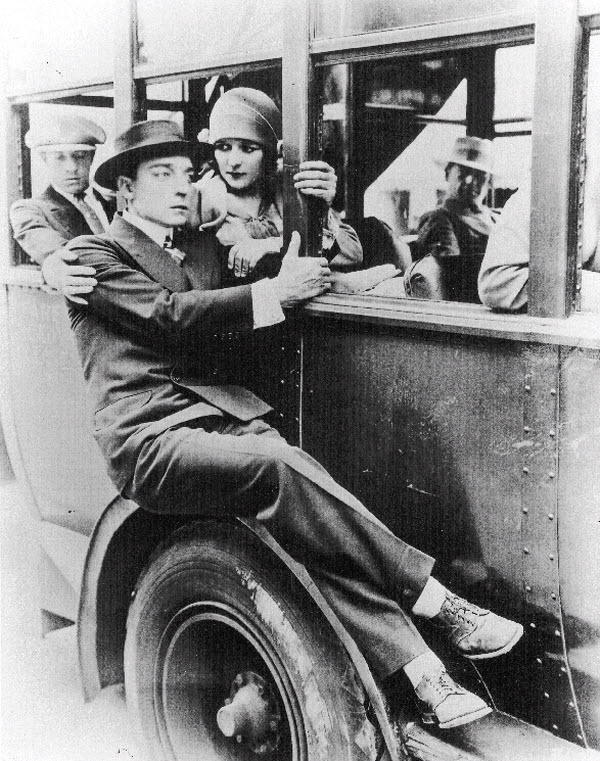
buster keaton busThere’s a friendly rivalry – at least in retrospect – between Buster Keaton and Charlie Chaplin.  Who is the greatest silent clown? Is it the sweet and genial Little Tramp, or the great Stoneface, equally small and lithe and seemingly always behind the eight ball? Every time I watch a Chaplin film, I’m convinced that it must be Chaplin.  But today, I think that Keaton has the edge.  Because I finally watched The Cameraman.  

In contrast to his acknowledged masterpiece The General, Keaton’s The Cameraman is a smaller film, less heavy on the sight gags and insane stunts, and far more reliant on the gentle nature of his protagonist as he attempts to impress a pretty girl.  But it’s also a story of art and moviemaking, of what constitutes ‘good’ cinema.  Where Sherlock Jr. gave us cinema as narrative magic, The Cameraman gives us cinema verite.

The plot could be just about any Keaton (or Chaplin) film: the scrappy little fellow meets a girl, is smitten and immediately sets about trying to win her heart.  In this case, the way to do that seems to be to become a newsreel cameraman.  Naturally enough, this sets up all the gags we might expect: Keaton attempts to film a Yankees game, only to arrive at an empty stadium.  Never one to be outdone, he plays the game himself, acting as pitcher, batter, umpire and fielders.  Then he tries to film a Tong war with hilarious results that include the near destruction of his camera and his friendship with a monkey.  There are other sketches too: Keaton attempts to change his clothes in a swimming pool dressing room also occupied by another, much larger fellow – watch that one closely, because old Stoneface actually cracks up several times; he loses his bathing suit and must obtain another one; displaced from a bus with his lady love, the old boy rides on the side instead.  As with all Keaton gags, the physical comedy is meticulously constructed, such that we’re almost bored by the seemingly meaningless set-up.  Then the gag hits and the man’s true genius – all that build up, for a moment of exceptional acrobatic hilarity – comes through.

The Cameraman is much more than the sum of its gags, however.  The love story, often secondary in Keaton’s work, comes forward.  Never have I cheered so heartily for the little guy.  His sweetness, and the girl’s apparent disregard for his qualities, is heartbreaking.  His attempts to win her have a tentative nature, though.  She really isn’t callous, nor does she fail to understand him; she simply is uncertain of what she wants.  It’s a complex narrative, and one that evinces a much deeper contemplation of human relationships than usually seen in silent comedies.

the cameraman 1

Keaton’s musings on his own art also impress.  The cameraman’s failure to produce ‘usable’ newsreel footage at first is complicated by the quality of what he does produce.  Simply by accident he overlaps frames of a battleship and Broadway, spools a swimmer diving backwards, and creates a pandemonium of traffic in spliced together footage.  These are scenes that are not only hilarious; they would be welcome in European arthouse films of the same period.  But that’s not what newsreel is about, and the cameraman finally learns where the demands of his profession lie.  The footage he takes of the Tong war is GOOD; intense, close-up scenes of mob violence and knife fights.  Throughout the film, we watch a director directing himself, then see the footage that he produces.  Few contemporary musings on the nature of the cinema art come so directly, and poignantly, to the point.

What Keaton has done with The Cameraman is to draw a parallel between the different forms of cinema, from camera tricks and manipulation to the ability of movies to present reality.  It is a movie that finally convinces the girl that she was wrong about him.  His native understanding of what constitutes good cinema gets him his job.  The cameraman will never be rewarded with a ticker-tape parade, but as far as Keaton is concerned, he should be.  In the end, it is cinema, in all its forms, that tells the inherent truth.

The Curse Of Frankenstein

THE CURSE OF FRANKENSTEIN (1957)

peter cushing curse frankenstein

Without really intending to, I seem to be going through a schlocky old-school horror movie phase.  I blame society.

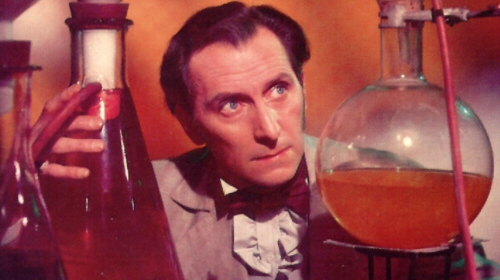
The Curse of Frankenstein was Peter Cushing’s first Hammer film, but he goes into it with all guns blazing.  He’s Baron Victor Frankenstein, the man with the penchant for charnel houses and the creator of one nasty Creature (Christopher Lee).  He’s also perhaps the least sympathetic of Cushing’s roles, a man at once a coward and a villain, coldly sacrificing everyone he’s close to in pursuit of his monomania.

The plot is the familiar one, with a few Hammerian touches to give it extra oomph: Victor’s assistant is Paul Krempe (Robert Urquhart), not Igor; the good doctor is not particularly in love with Elizabeth (Hazel Court), but is having it off with his maid Justine (Valerie Gaunt).  The Creature only shows up part way through the film, and then promptly dies.  There’s plenty of decapitation, heaving bosoms, and bright red blood that we come to expect from a Hammer outing.  Victor’s cruelty is also on display: he viciously murders an old doctor for his brain, he imprisons Justine with the Creature when she reveals that she’s pregnant, and threatens to sacrifice Elizabeth if Urquhart doesn’t help him finish his work.  Gone is the tragic doctor of Mary Shelley; this is Franky as the mad scientist.

And who can object to that? Cushing gives his character a cold, calculating gaze, his clipped accent perfect for a man obviously missing a mirror gene or two.  Unlike some of the other actors – Hazel Court, for instance – Cushing rolls over the more ridiculous dialogue without letting it throw him off.  Despite his cruelty, it’s something of a disappointment when he doesn’t get away with murder in the end.

The Hammer films seemed to get better as the 50s moved along, and finally really hit their stride in the early 60s, and this one still shows signs of being uncertain of itself.  There’s an awful lot of build-up to the introduction of the Creature, and when it arrives I was sort of disappointed.  No rampaging around the village, no angry mobs, no torchlit processions.  The Creature sort of wanders around the woods, kills a blind man and then gets shot in the head. Even his final rampage is perfunctory.  It’s a shame, because behind all that decaying make-up is Christopher Lee and it would have been nice to give him a bit more to do.

At the end of the day, while Curse of Frankenstein is not my favorite Hammer film, or even my favorite Frankenstein film, it’s still good fun.  This was a film that basically resurrected classic horror, and brought Peter Cushing into the Hammer fold.  There’s no way to argue with that one.

Dr. Phibes Rises Again

LAST NIGHT: DR. PHIBES RISES AGAIN (1972)

dr phibes rises again

“Come, Vulnavia!”

*Here thar be spoilers for The Abominable Dr. Phibes*

Oh dear.  I had such high hopes for this one.  First, if you didn’t already know, I loved the original The Abominable Dr. Phibes.  I love Vincent Price.  I so wanted the sequel to be everything the original was and more.  Now I’m sad.

The plot, such as it is, looks promising.  After Dr. Phibes (Vincent Price ) embalmed himself in the tomb of his beloved wife Virginia, we thought that the good doctor was gone for good and all.  How wrong we were.  He’s back, because apparently you can embalm yourself and then totally put your own blood back into your body three years later.  That definitely works.  Resurrecting his lovely assistant Vulnavia (Valli Kemp)  from her home in a mirrored kaleidoscope, Dr. Phibes sets about the second half of his diabolical plot to reunite with Virginia.  This time he’s off to Egypt to find the River of Life and give himself eternal life … or bring back Virginia … or something.  I wasn’t entirely clear on that.  This naturally involves murdering EVERYONE he comes in contact with.  All righty.

As with the original, the murders are pretty unique.  Hawks go after an under-used John Thaw (TVs Inspector Morse), scorpions get some poor young archeologist, and an elaborate mechanical clamp crushes another fellow to death.  But that’s really the most that can be said about this one.  The plot is all right, with Robert Quarry eating the scenery as Phibes nemesis Darrus Biederbeck, a man who wants to find the River of Life for his own purposes.  Inspector Trout and Superintendent Waverley (Peter Jeffrey and John Cater)  are back too; their scenes are among the best and I found myself wishing that they had appeared in their own series.  Peter Cushing appears all too briefly as a ship’s Captain, as does Terry-Thomas in a scene with Trout and Waverley.  The art-deco style of Phibes’s Egyptian tomb – yes, he does have one – and brief scenes of Phibes and Vulnavia experimenting with interior design are fabulous.  Unfortunately these are only bright lights in an otherwise murky film.

Price bears the brunt of the badness, I’m afraid.  His dialogue was purple in the original; here it’s incandescent violet.  He addresses his dead wife far too much, and there are extensive scenes of him recapping for her corpse what’s happened thus far.  So while he’s still Vincent Price, he’s Vincent Price saddled with an unmanageable script.  What’s more, all the sympathy we felt for Phibes in the original rapidly dissipates as he murders one innocent after another.  His revenge seems natural, if extreme, in the first film; in this one it’s basically tangential.

I’m sorry to say not to bother with this one.  Despite some good points, the film as a whole is by turns boring and confusing and underuses the talents of the very talented people involved.  I was hoping that Phibes would try resurrecting Virginia, perhaps harvesting the organs of his victims to rebuild her a la Frankenstein? That would have been interesting.  In this case, I wish that Dr. Phibes had stayed embalmed.

The Abominable Dr. Phibes

LAST NIGHT: THE ABOMINABLE DR. PHIBES (1971)

phibes brussel sprouts

“A brass unicorn has been catapulted across a London street and impaled an eminent surgeon. Words fail me, gentlemen.”

The Abominable Dr. Phibes opens with Vincent Price in a latex hood and cape, playing a lite-brite organ and conducting a clockwork band in an art-deco mansion.  And so I thought, “This is going to be AWESOME.”

Which it was.  The Abominable Dr. Phibes is one of those tongue-in-cheek horror movies from the 1970s that is almost – but not quite – meant to be taken seriously.  The plot follows our mad doctor as he and his lovely assistant Vulnavia (Virginia North) go around murdering a lot of medical doctors, following the Biblical precedent of the plagues of Egypt.  Sort of.  I’m pretty positive there were no unicorns in the Old Testament.  The reason for this? Well, his dear wife Virginia died on the operating table and he’s really, really pissed off about it.  Anywho, he’s chased by Inspector Trout (Peter Jeffrey), who is in turn ably assisted by Dr. Vesalius (Joseph Cotten, in a role that Peter Cushing was supposed to take).  The whole weird plot is really an excuse for Price to be very freaky and concoct some pretty nasty and spectacular deaths for his victims.  His victims, by the way, include a hilarious Terry-Thomas as the libidinal Dr. Longstreet;  if you know anything about British film or TV from this period, this will delight you as much as it did me.

The Abominable Dr. Phibes owes most of its value to Vincent Price, who is evidently having the time of his life as he annihilates one doctor after another.  There are some lovely little asides – applauding the death of a pilot, doing a double-take at a painting in Dr. Longstreet’s office, everything that has to do with Vulnavia – that speak to Price’s charisma and humor.  Few actors can do what he did and still seem so classy.  Phibes is a crazy but sympathetic villain, his passionate love for his dead wife more sad than terrible.

What surprised me more, though, was the humor infused into the police investigation.  Peter Jeffrey’s Inspector Trout is delicious, as is Superintendent Waverley (John Cater).  It’s a very British film with very British humor, despite having an American production company behind it.  As with most films of this type, it’s fun because the cast are game for their parts.  They’re more than aware that it’s all a bit of a joke.

As always, though, there are problems.  Price has one of the most recognizable voices on film and here he’s all but silent, save when he ‘speaks’ through a gramophone attached to his neck (Phibes was horribly injured in a car wreck), and then in such purple prose that you wish he would shut up. There are dull patches, a bit too much build up to the murders, and the characters figure out what’s going on long after the audience.

For all that, it’s a grand piece of camp and worth it for Vincent Price alone.  You’ll never look at brussels sprouts the same way again.

Santa Claus Conquers The Martians

LAST NIGHT: SANTA CLAUS CONQUERS THE MARTIANS (1964)

santa-claus-conquers-the-martians-martians

Well, ’tis the season.

I have sat through Death Bed: The Bed That EatsHell Comes To Frogtown, Space is the Place, Plan 9 From Outer Space and countless lesser Ed Wood films.  I have watched The Room.  I thought I was proof against the truly dreadful.  I was wrong.

Santa Claus Conquers The Martians is probably the worst “Santa Claus gets kidnapped by Martians” movie ever made … and as far as I know, it’s the only one.  Basically, the Martians – who are dudes in green underwear and flight helmets – are all upset because their kids keep watching Earth’s TV programmes and have become despondent.  Why? Well, they don’t have Santa Claus.  And they eat pills instead of food.  And their parents speak in stilted sentences.  And their planet is made of cardboard.  Right.  So, naturally, being concerned parents, the leader of the Martians Kimar (Leonard Hicks) and his rag-tag team of fellow Martians, Voldar, Dropo, Gomar and … someone else, head to Earth to kidnap Santa Claus (John Call) and bring him back to Mars to make the Martian children happy again.  On the way, they pick up Billy and Betty, earth children in the wrong place at the wrong time.  There’s also a robot made of cardboard.  And elves.  And guns that are definitely hair-dryers.

The production values of this film are worse than a high school stage musical.  In fact, I’m pretty positive that the films my friends and I made when we were 15 had better sets and more realistic performances.  But let me give you a run down of some of what is awesomely awful in this movie:

  • Santa winds up running what is tantamount to a sweatshop on Mars.
  • The villain Voldar is defeated by an onslaught of wooden toys, despite being in possession of a gun that can disintegrate people.
  • The robot is made of a cardboard box and a coffee can.
  • There’s a dude in a polar bear outfit at the North Pole.
  • Santa laughs like a cartoon villain and/or pedophile.
  • The Martians can’t quite decide if they’re supposed to be all green or not, so they all just have a smear of green make-up on their faces.
  • Earth apparently has one TV broadcaster.
  • The extensive Defense Department footage of rockets and planes taking off that you’ve seen in every 1960s movie ever.
  • Santa’s workshop consists of 3 elves and Mrs. Claus.  Mrs. Claus is the best actor among ’em.
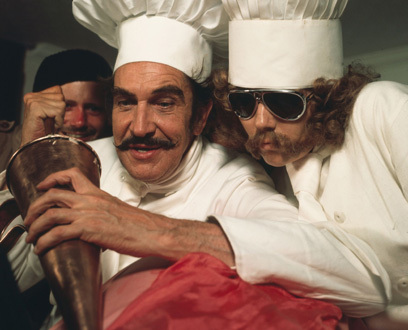
  • You can tell the villain is a villain because he’s the only one with a mustache.

And so forth.  Honestly, I didn’t watch the MST3K version of this because I wanted to experience it in all its unadulterated glory.  This movie is so bad that I laughed all the way through it.

Oh, there’s also the theme song:

You’re welcome.

martian mustache

Frankenstein Created Woman

LAST NIGHT: FRANKENSTEIN CREATED WOMAN, 1967.

frankenstein cw poster

*Well, not quite last night.  But close enough.*

I cannot put into words how much I love 1) Hammer Studios and 2) Peter Cushing.  So there is absolutely no reason for me not to love this movie.

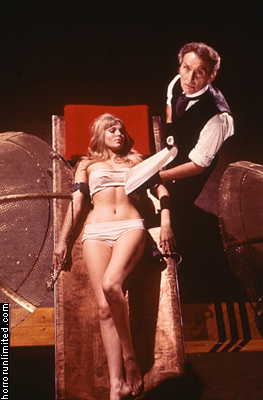
Frankenstein Created Woman is a later entry in Cushing’s extended tenure at Hammer; a 1967 film coming after The Curse of FrankensteinThe Revenge of Frankenstein and The Evil of Frankenstein, making it the fourth (but not the last) time he played the mad doctor.  And while I admit to preferring Cushing’s work as Van Helsing in the Dracula films, the Frankenstein movies have their own deliciously lurid cache, not least because the kindly blue-eyed gent transforms into one cold, evil sonofabitch.

Frankenstein Created Woman takes up about half its running time with the build-up: Hans (Robert Morris), the son of a convicted murderer who watched his father go to the guillotine, has grown up very good-looking but very angry.  He’s Baron Frankenstein’s assistant and in love with the innkeeper’s daughter Christina (Susan Denberg), a lame young lady disfigured by a large mark on one side of her face.  The opening scenes depicting Hans’s nasty temper, Christina’s gentleness, and the cruelty of three dandies, are all well and good, but I admit to waiting for the blood and sewing together of dead bodies.

frankenstein cw
This … never happened.

I should not have worried.  Despite being slow-burning at the beginning, the second half of this one erupts when Hans is wrongfully executed for the murder of Christina’s father – the dandies did it – and Christina kills herself. Enter the Baron, who has been wandering in the background talking about capturing the immortal soul of man and putting it into another body, a latter day expositionist.  With the help of his faithful doctor friend Hertz (Thorley Walters), Frankenstein rebuilds Christina’s body, captures Hans’s soul and presto! We’ve got a dual-personality, bi-gendered and buxom monster!

Frankenstein Created Woman is not quite so lurid as even Horror of Dracula or the original (and best) Curse of Frankenstein.  But it is a satisfying revenge story with the typical combination of very good actors speaking very bad lines that one comes to expect from a Hammer product.  The rest of the film proceeds much as you’d think.  While there are not buckets of blood, there are several shocking and grotesque moments as the new Christina sets about taking revenge for Hans’s death.  The theology and philosophy espoused by the Baron especially and the film in general gets to be quite weird, as the soul of Hans apparently possesses some residual memory that turns Christina into a split personality.  The Baron even begins paraphrasing the Bible, as we should have expected he would.  Much is left unexplained, but if you came for cohesive philosophical constructs, you should really have read the plot synopsis first.

My one real quibble with the film is how long it takes to get going, and how little Cushing is utilized.  Of the handful of British thespians who graced Hammer films – Christopher Lee, Michael Gough, Herbert Lom, Oliver Reed – Cushing stands at the top. It seems criminal to give him so little to do in a film that proclaims our Franky as the creator of life.

That aside, Frankenstein Created Woman is good fun.  I’m sometimes bothered by how much I enjoy Hammer films.  Probably shouldn’t think too deeply about that one.

The Best Of All Possible Mustaches

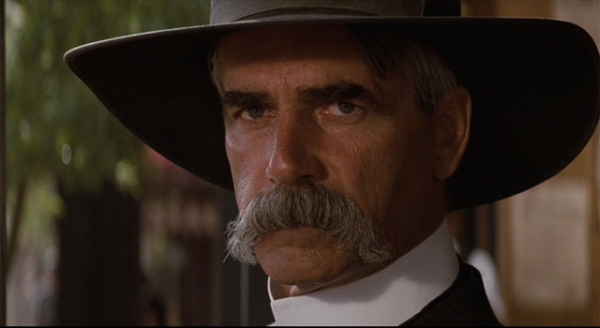
As everyone must know, this is the end of Movember.  And as hundreds as heretofore hirsutely adorned gentlemen prepare their razors to eliminate those hard-won lip jackets that we call ‘mustaches’ and the Victorians called ‘mustachios’, I think we need to take a moment to salute those men for whom every month is Movember.

There have been many great cinematic mustaches over the years.  William Powell, Clark Gable and Errol Flynn made the pencil-stache dashing; Basil Rathbone made it villainous.  Charlie Chaplin’s mustache was great, until it was unfairly maligned by Hitler.  Tom Selleck obviously sports the quintessential mustache.  But of all the mustaches, there is one mustache that can truly be called great; one mustache that exceeds all mustaches, that should have a screen credit of its own.  That is the grandest mustache of all.  I am speaking, of course, of Sam Elliott’s mustache.

Sam Elliott would be a badass all by himself, but the mustache adds that extra layer – that flavor, if you will – of badassery and down-home charm.  It is a mustache of great power and prestige and has adorned the face of Sam Elliott for many many years.  I firmly believe that the reason Elliott dies in Road House is because his mustache was not in full force.  It has been there, through thick and thin, for years.  It charmed Katherine Ross in The Legacy and Conagher.  It pronounced on the future of The Dude in The Big Lebowski. It rode the range with Wyatt Earp in Tombstone.  Although it has appeared in many films with rival mustaches – Tom Selleck’s in The Shadow Riders, just about everybody in Tombstone – it has always held its own like a good mustache should.

So, take a moment.  Bask in the glory of the greatest mustache and know that it will always be there to defend right from wrong, to protect the needy, to guard the homestead.  It is, without doubt, the best of all possible mustaches.

sam elliott mustache