Bloody October: Trick ‘r Treat (2007)

Trick ‘r Treat (2007)

trick-r-treat

Horror has a long and  hallowed tradition of anthology films. Some, like Corman’s Tales of Terror, are tied together by a common writer and repeated appearances of actors as different characters; others, like the recent V/H/S, by a common gimmick or concept. Then there’s Trick ‘r Treat, which utilizes the anthology film subgenre to tell a series of tales from Halloween night and, like a schlock-horror version of Pulp Fiction, interweaves characters to effortless, and surprising, effects.

The action takes place one Halloween night in a small Ohio town that really seems to like the holiday. The usual Halloween shenanigans are afoot, from kids knocking pumpkins off of fence-posts, to grown-ups using costumes as a means of anonymously getting off with strangers. The four main tales comprise a school principal who moonlights as a serial killer, a group of kids paying homage to an old urban legend, a young woman dressed as Red Riding Hood on the search for her Big Bad Wolf, and a curmudgeonly old man who hates Halloween and won’t give out candy. Each story comprises contains a “Halloween infraction,” from poisoned candy to cruel practical jokes, and the presence of “Sam,” a little trick-r-treater wearing orange pajamas and a burlap sack mask who appears at important moments in each vignette. The characters connect and interweave with one another, as one story finishes what another started.

Without giving too much away, Trick ‘r Treat is one of the most entertaining contemporary horror films I’ve seen in a long time. It has its own, warped moral universe that brings each portion of the story to an intense, often funny, and always satisfying conclusion. With an excellent cast full of character actors, including Anna Paquin and Brian Cox, the film brings off its horror without too much recourse to shock tactics or bloody dismemberment. It trades on what makes Halloween so beloved: beneath the jack-o-lanterns and cute costumes is a holiday tradition founded on respect for the dead and the supernatural. Cross the line of tradition, break the rules for your own perversity, and little Sam will be there to punish your wrongdoing. A good lesson, for any Halloween night.

Bloody October: The Birds (1963)

The Birds (1963)

the-birds-poster

While this is the subject of some debate, it is my conviction that Alfred Hitchcock made only one “proper” horror film over the course of his long career. Psycho has often been cited as the first “slasher” film, but I don’t think it’s insane to argue that Hitchcock’s 1963 film The Birds wins the award for inarguable horror.

Tippi Hedren is Melanie Daniels, an apparently frivolous young ingenue who meets and flirts with Mitch Brenner (Rod Taylor) in a San Francisco bird shop. Annoyed by Mitch’s teasing flirtation, Melanie purchases a set of lovebirds and heads to Mitch’s country home in Bodega Bay, to deliver the birds to his little sister Cathy (Veronica Cartwright) for her birthday. There she meets the schoolteacher Annie Hayward (Suzanne Pleshette), and Mitch’s mother Lydia (Jessica Tandy), both major feminine forces in Mitch’s life.  The whole thing is really just an elaborate gag intended to pay Mitch back for his teasing, but things begin to get scary when Melanie is attacked by a seagull. It’s the harbinger of things to come, as the local birds begin attacking and killing humans. The inhabitants of Bodega Bay are eventually forced to hole up in their homes, securing themselves against the constant and apparently purposeless onslaught of avian forces.

Hitchcock spends the first half hour of The Birds establishing the characters, their relationships, and the tensions already underlying Melanie’s interaction with the Brenner family. Mitch’s mother in particular seems to suspect and dislike Melanie, but in an extended conversation with Annie, Melanie learns that it is not as cut and dry as, say, a grasping and jealous woman (words that immediately call to mind Psycho, of three years before). The tensions are more complex, and in some ways more realistic, than that. When the bird attacks do begin, the viewer senses some tenuous and wholly inexplicable connection between the motiveless violence, and the animosities between our human characters. How to define this becomes the question, and the film poses no easy answers.

the-birds-1963

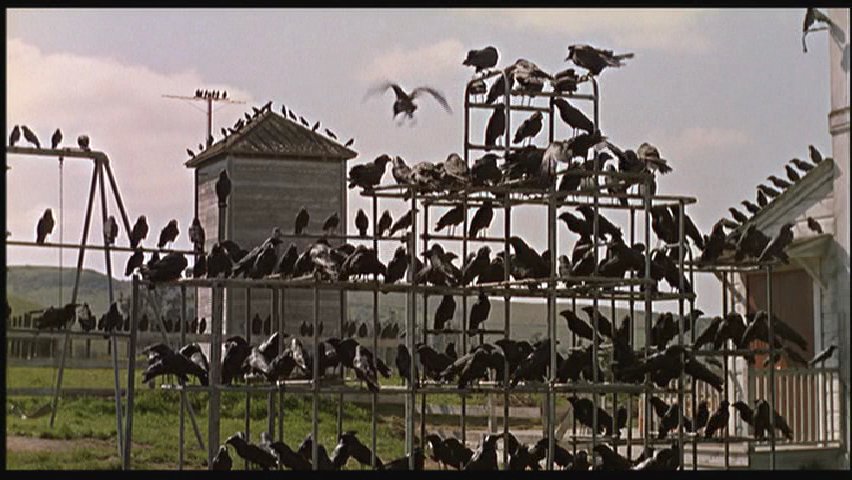
Much of The Birds is about human reaction to purposeless violence. While certain things are established about the attacks – they come in waves, they stop for long intervals, they appear to be concerted attacks by large numbers of animals – there is no apparent purpose behind them. The birds have simply “gone mad,” but it is a universal madness affecting all of them – except for the two lovebirds in a cage. The violence is overwhelming and disturbing, but it is the mad tension, the waiting for something to happen, that truly gives the film its energy. As one ornithologist explains, if birds of a feather truly do flock together, there’s nothing human beings can do to stop them.

For a film made in 1963, the special effects in The Birds hold up rather well. Hitchcock’s camera never lingers for too long on a single animal, making it easier to combine real trained birds with puppets, animation, and even back projection to form a largely seamless horror story. I wish the same could be said for the performances. Although Tippi Hedren’s performance is affecting, she has an aloofness and distance that after awhile becomes grating and makes it difficult for the viewer to sympathize. The same must be said for Rod Taylor’s rather self-satisfied lawyer, who has as much sex appeal as a store mannequin. The strong secondary characters, however, make up for the moments when the leads drag down the dialogue – and Jessica Tandy’s multi-faceted job as Lydia Brenner is a study in restrained acting.

Birds-5

But the real stars here are the birds, and they’re really the ones we came to see. This is more than a “nature gone mad” story, so popular in the 1950s and 60s in the aftermath of World War II and the rise of the Atomic Age. The birds are not really mad, it seems. They know exactly what they’re doing, and that, more than anything human, is terrifying.

Bloody October: The Amityville Horror (1979)

The Amityville Horror (1979)

the-amityville-horror-(1979)-large-cover

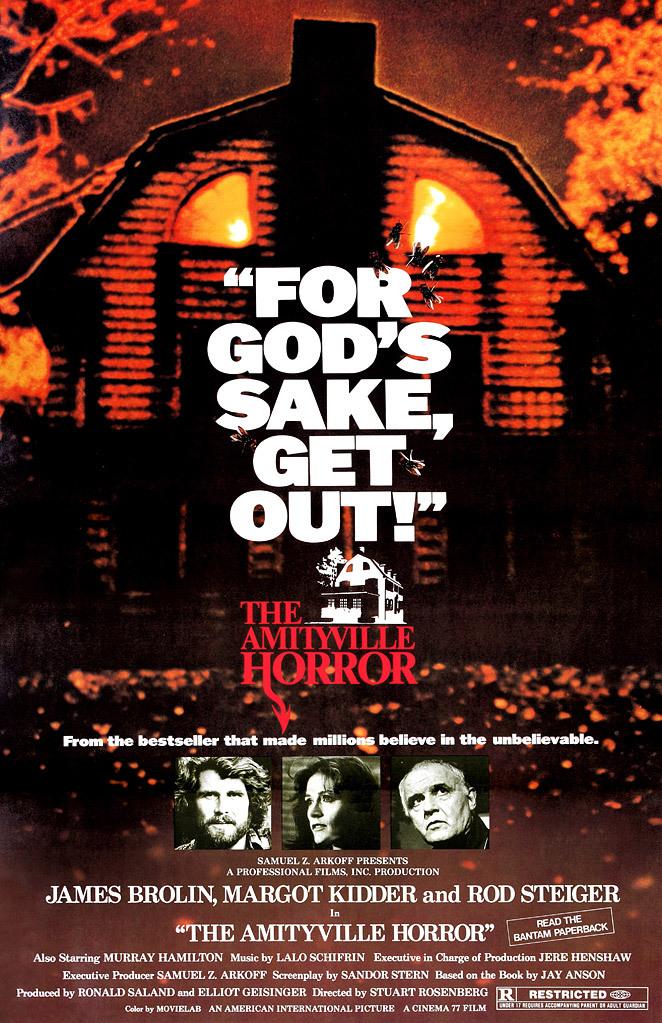
Every October I try to load my Netflix queue with horror films both old and new, focusing as much as possible on the horror classics I have not seen. While there are a few necessary staples of this holiday season (Young Frankenstein, Sleepy Hollow, Abbot and Costello Meet Frankenstein, Hocus Pocus), I am always on the lookout for those movies that have somehow slipped through my horror-loving finger. One of these films is the original The Amityville Horror, a haunted house movie from 1979 that spawned a host of sequels and remakes, one of which (according to Wikipedia) will be coming in 2015.

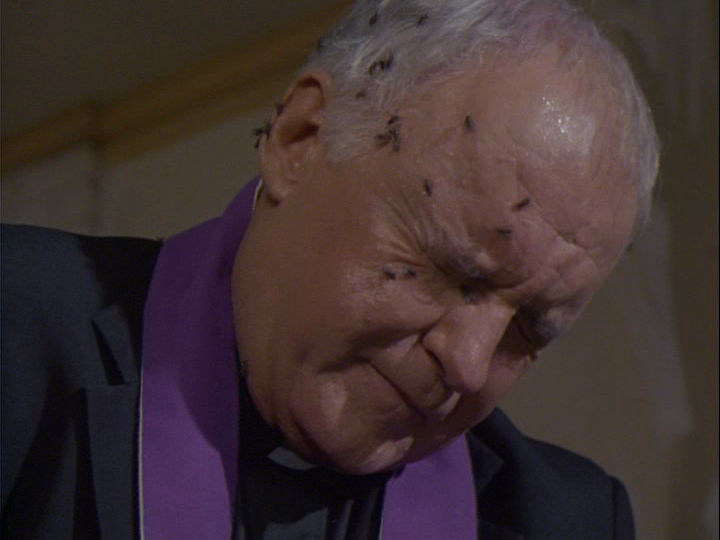
Based on a supposedly true story, The Amityville Horror focuses on the Lutz family, who move into a sinister house where a disturbing mass murder was committed the year before. The price is right, though (isn’t it always?), and so the Lutzes ignore the house’s history and set about unpacking their boxes. Things begin to get very weird, very quickly, which is what we can expect from a house with eye-like windows. When the parish priest Father Delaney (Rod Steiger) arrives to bless the house, he’s swarmed with flies and hears a disembodied voice demanding that he depart. Escaping from the house, he’s later unable to call Kathy Lutz (Margo Kidder) to warn her of the horrors. Not that she should really need any warning: her husband George (James Brolin) is compulsively chopping wood and sharpening his axe, her daughter Amy (Natasha Ryan) has discovered an “imaginary friend” named Jody who never wants them to leave, and anyone of a Catholic or spiritual bent gets violently ill just from approaching the house. But as with most haunted house movies, it takes a long time for the inhabitants to realize just how evil their habitation has become.

amityville-horror-rod-steiger

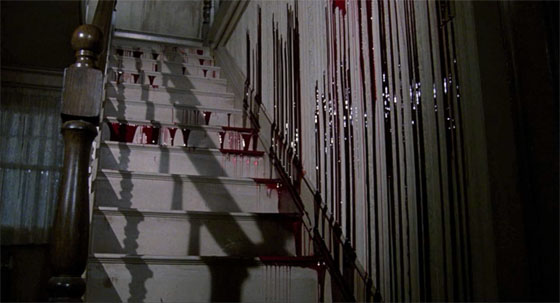
The Amityville Horror boasts of strong production values and scares that depend more on a slow building of tension and practical effects than on blood and gore. There’s very little violence; just bumps, screeches, and a sense of sickness and foreboding that seems just out of reach. When violent things do happen, they are the terrors of a household accident: a window falling on a boy’s hand, a tumble down the stairs, a lightbulb shorting out, and doors banging, or being blown off their hinges.

The Amityville Horror falls short of true greatness, however, largely due to its lack of exposition. The reasons behind the haunting (if haunting it is) remain obscure, with a throwaway scene providing the only explanation for what has hitherto been inexplicable. I would not object to the lack of exposition if the rules of the house were clearer. Whatever evil dwells there seems to have a long reach, able to effect people who come in contact with it from a distance. But the added presences of “Jody” – either a ghost, a spirit, or a manifestation of the house? – along with the apparently random behavior of the house in slamming doors and windows, and possessing people, makes it difficult to establish just what we’re supposed to expect or be frightened of. While individual scenes have punch, the film as a whole lacks direction and, as a result, tension. I am willing to accept that the house is just evil, but even evil (in film at least) has to have some rules to maintain a strong narrative through-line.

The lack of exposition might have been mitigated by a stronger development of character. The psychology of the Lutzes remains largely obscure – the two sons vanish for large sections of the film, while the daughter and her friendship with Jody remain unresolved. George and Kathy, whom the house affects the most, are not drawn out as characters. While there are shades of The Shining in George’s slow descent into madness, his awareness of the house’s evil seems to shift on a scene by scene basis. Following several harrowing events, it strains credulity to believe that this family would stay on in the house.

amityville-horror-6

While The Amityville Horror has its faults, it is still an effective B-grade horror film. You can see its influence in later films like The Shining, Poltergeist, and Paranormal Activity – and while those films were arguably better executions of the same concept, the origins can be found in Amityville. That in itself makes this one worth watching.

Bloody October: The Cat and The Canary (1927)

The Cat and the Canary (1927)

poster-cat-and-the-canary-the-1927_02

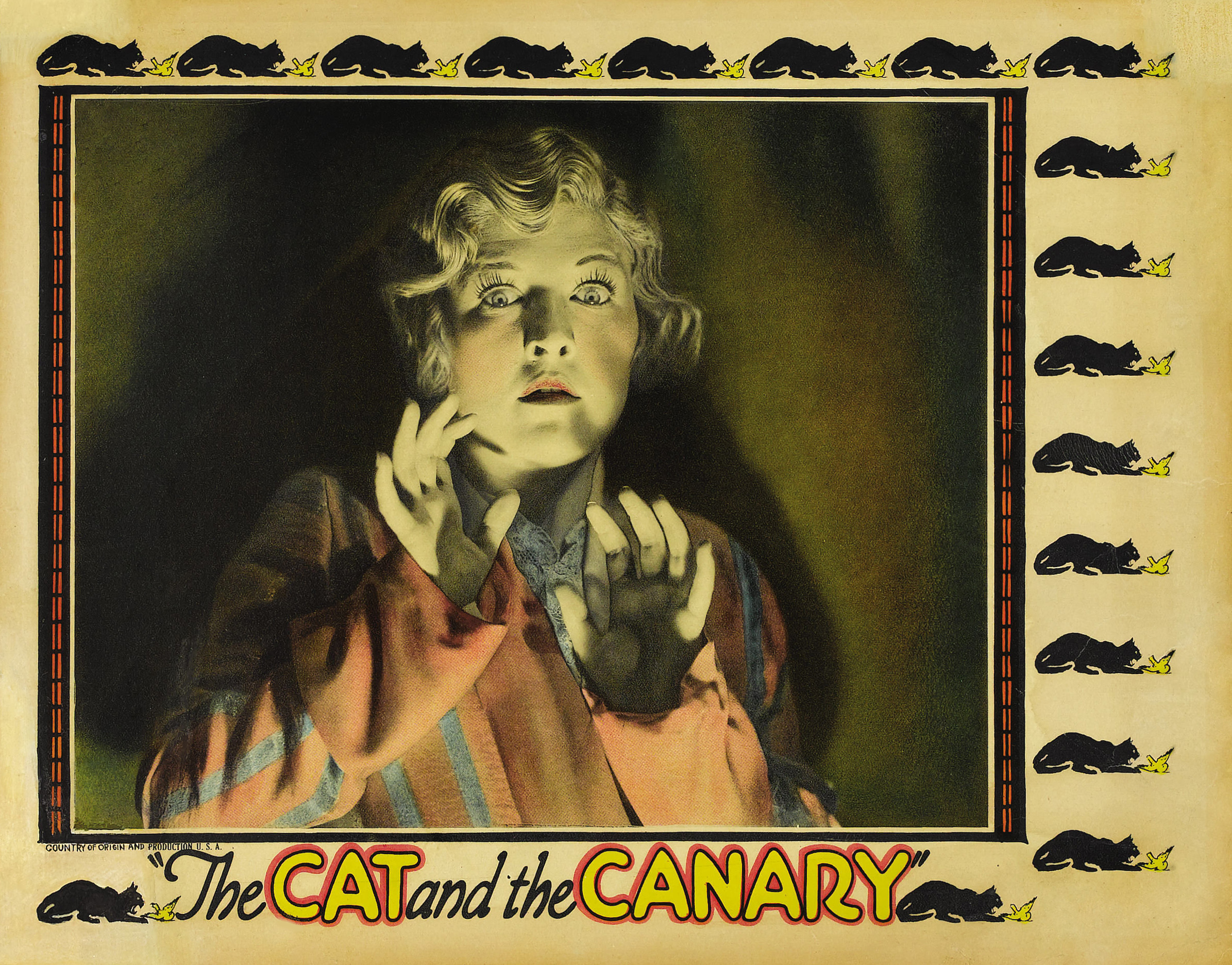
I am a sucker for old dark house stories; the older and darker, the better. These stories were clichéd from practically the moment they were created, but like many clichés, they have a sense of fun to them that few more original narratives manage to approximate. One of the earliest such narratives – on film at least – is The Cat and the Canary, a silent film from director Paul Leni, one of the oft-forgotten masters of German Expressionism.

The film opens with the slow madness and then death of millionaire Cyrus West, who inhabits a multi-turreted Gothic mansion somewhere in the bleak and inaccessible countryside. The intertitles inform us that West was slowly driven mad by his grasping, greedy relatives, as they gathered around him like “cats around a canary.” So West decides to pay them back for their avarice, writing a will to remain locked in a safe until the 20th anniversary of his death, when his lawyer Crosby (Tully Marshall) will open it and announce his heir.

Fast forward those twenty years to one dark and stormy night. The relatives gather for the reading of the will at the Gothic mansion, still presided over by Mammy Pleasant (Martha Mattox), a leering and creepy old housekeeper if ever there was one. When Lawyer Crosby arrives to open the safe, he discovers not one but two wills, with instructions to open the second if the first is not fulfilled. He’s more disturbed by the presence of a moth, indicating that someone has opened the safe in the past twenty years. Then the relatives arrive: Harry Blythe (Arthur Edmund Carewe), Charlie Wilder (Forrest Stanley), Paul Jones (Creighton Hale), Aunt Susan (Flora Finch) and her daughter Cecily (Gertrude Astor), and finally Annabelle West (Laura La Plante). As the family gather round for the midnight reading of the will, the clock strikes for the first time in twenty years and thunder shakes the house.

The heir, of course, turns out to be Annabelle West, the only member of the family who still bears the West surname. Her relatives are predictably disappointed, but things get interesting when Crosby raises a caveat to the will. The heir must be proved to be of sound mind by a doctor arriving that night; if she’s insane, then the fortune passes to the person mentioned in the second will. So with the set-up for potential murder and madness in place, everyone heads off to dinner.

cats

The Cat and the Canary is a surprising film for a number of reasons. Its highly Expressionist opening and rather clichéd structure make it appear like a quintessential early horror film. When a guard from an asylum turns up to warn the house’s inhabitants of a lunatic in the neighborhood – one who “tears his victims apart, like a cat with a canary” – we are solidly in the archetypal realm. Even the characters are less characters and more types: the ingenue, the maiden aunt, the dashing hero, the coward, and the creepy housekeeper. But as the film goes on, the types will be gradually played with and subverted, their roles thrown into relief as the night brings out the madness in them all.

The film manages to hit all the buttons that we might expect from an “old dark house”: a possible ghost, a hidden treasure, a fair maiden in danger, secret passages, vanishing corpses, and a dark and stormy night. It then injects a healthy dose of humor into the mix: cousin Paul is a coward of the first order, diving under tables, and at one point secreting himself beneath Cecily’s bed, where he unfortunately witnesses Aunt Susan and Cecily getting undressed (Wikipedia claims that the pair are mother and daughter, however I always thought that Cecily was just another cousin). As the night drags on and creepy things continue to happen, the extreme reactions of some of the family members provide more humor than fear.

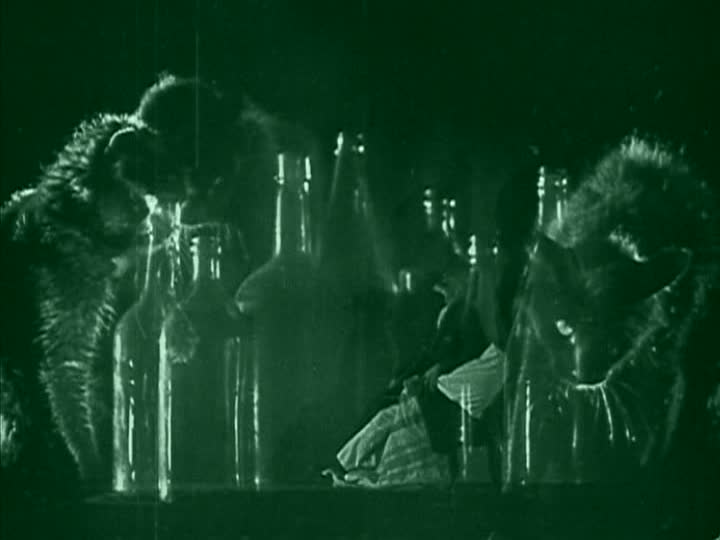
Which is not to say that there aren’t some seriously scary moments in The Cat and the Canary. With the disappearance of Crosby, Annabelle’s sanity comes into question – and only the audience has seen the vague, shadowy figure ducking into secret passageways. It’s amazing what can be done with a long-nailed hand coming out of a wall, or a bizarre shape creeping past a window, made all the more bizarre due to lack of ambient sound.cat-and-canary-1927-imagery

While not exactly a film to provide jump scares or raise your heart-rate, The Cat and the Canary is curiously haunting. It will be remade two more times, once in 1939 and then again 1978, but the silent one is really the best, combining humor and horror, strong practical effects and Expressionist sets. The scares are still there, almost a hundred years later. It’s hard not to shiver when that hand comes out of the wall.

The Dunwich Horror (1970)

The Dunwich Horror (1970)

dunwich_horror_xlg

Adapting the work of horror writer H.P. Lovecraft is a challenge for any screenwriter, or director. Like Poe, much of Lovecraft’s power lies in his verbiage. His horrors are the concealed, obscure terrors of dreams, and his writing chock full of purple prose invoking nameless fears and indescribable stenches from dark Cyclopean caverns. Moving that kind of writing to the big screen is nearly impossible, because Lovecraft trades on things that cannot be seen or, once seen, cannot be described.

The Dunwich Horror makes a good attempt at adapting one of Lovecraft’s better known stories to a visual medium. The film was directed by Daniel Haller from a script co-written by Curtis Hanson, who would go on to direct L.A. Confidential and The Hand that Rocks the Cradle. It was produced for Roger Corman’s American International Pictures, which immediately indicates what we can expect from the production.

Following a bizarre birth sequence and some truly epic opening credits, the film properly begins with the introduction of Wilbur Whateley (Dean Stockwell, looking more 70s than I thought was humanly possible). Whateley wants access to the dangerous and forbidden book of black magic, the Necronomicon, stored in the library of Miskatonic University and owned by Dr. Henry Armitage (Ed Begley, in his final film role). To this end, Wilbur hypnotizes one of Armitage’s students Nancy Wagner (Sandra Dee) into furnishing him with the book. When Armitage appears and refuses to allow Whateley to take the Necronomicon away with him, Whateley puts another plan into action: he has Nancy drive him home to Dunwich, where he lives in a ramshackle old house with his grandfather (Sam Jaffe, having the time of his life) and something vague and rumbly in the attic. It soon becomes clear that the Whateleys are a weird and creepy family (if we didn’t know that already), and Nancy will be their next victim in an arcane ritual designed, as most things are, to bring about the end of the world.Dunwich 05

Anyone who has read the original Lovecraft story will recognize the initial plot about the Whateleys, and also that the whole “sacrifice a virgin to the Old Ones” is nowhere close to that story. The Lovecraft narrative deals more with the birth of Wilbur, his upbringing, and the fear he inspires in the townspeople of Dunwich prior to the arrival of “the horror” in the title. The narrative then shifts to the “Dunwich horror” and how the townspeople discover it and defeat it with the help of Armitage and the local doctor.

The film of The Dunwich Horror ignores most of the first part of the original story and focuses on the underlying theme of sexuality, present in much of Lovecraft’s work. Wilbur’s seduction of Nancy is accomplished through drugging her drink, hypnotizing her, and finally having sex with her on a stone altar – the entire sequence, though not explicit, plays like a soft core porn film that pretty much kills Sandra Dee’s virginal teenage image for good. The point of this part of the plot is unclear, save that the opportunity to show Dean Stockwell and Sandra Dee having kinky altar sex was too good to pass up.

Dean Stockwell takes the lead in this film, his fabulous mustache and 70s perm really hammering home the change of time period from Lovecraft’s – although it does match the “decadence” that Lovecraft finds so horrifying. But he’s also that combination of creepy and charming that makes his eventual seduction of Nancy believable, even if we wonder why any sane young woman would agree to get in the same car with a man who looks and talks like a pimp. Sandra Dee gives a perfectly serviceable performance as Nancy, although not much is demanded of her beyond being innocent and then writhing around on an altar. The elder actors are having a lot of fun with their respective roles, especially Sam Jaffe, who wanders around the house making arcane pronouncements and shouting in the face of his grandson.dunwich-1970-2

The problem with The Dunwich Horror is that there’s not much horror to go around. The film spends more time on the inevitable seduction of Nancy than it does on building up the terror surrounding the thing that rattles the attic door. However, I will give the film praise for creating an invisible “lurking terror” which, when it finally breaks loose, does its evil very effectively. The climax of the film does not quite work, however, as we’ve spent far too much watching Nancy become the vessel of the Old Ones and far too little time with reasons why that is a bad thing. I never thought I’d say this, but they needed to inject a little less attempted subtlety and a little more Lovecraft.

At the end of the day, The Dunwich Horror is a good, but not great, B-level Corman production. It’s never dull, and is actually far better than I expected it to be. Still, I wanted a bit more horror to go with my Dunwich.

1984-a-thon: The Razor’s Edge (1984)

When Todd over at Forgotten Films asked me to participate in the “1984-a-thon,” my first reaction was: “there were good movies made in 1984?” Then I went through the long, long list of films released that year and was pleasantly surprised at the number of excellent films included therein. The 1984-a-thon also meant that I finally got around to watching a film that has been on my queue for too long:

The Razor’s Edge

1984 The razors edge - El filo de la navaja (ing) (hs)

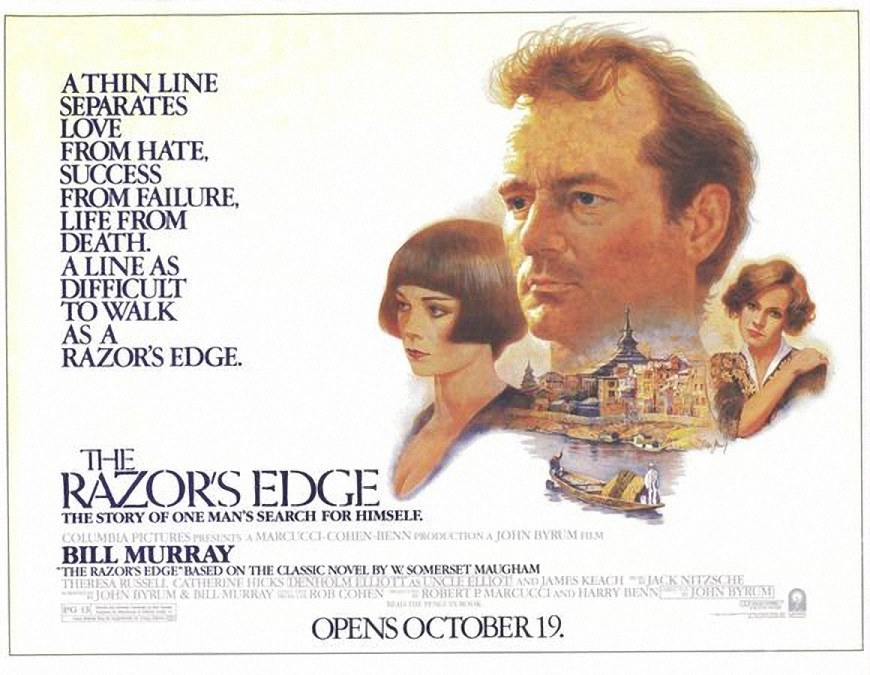
Back before he joined up with Wes Anderson and Jim Jarmusch and went through a dramatic career resurgence, Bill Murray was known first and foremost as a comedian.  Armed with that wry, knowing sense of humor and slapstick that most of us associate with his persona, he appeared in a handful of comedic roles and made a name for himself in films like Meatballs, Caddyshack, Stripes, and, of course, Ghostbusters. But Murray always considered himself more than just a funny guy (not that that’s anything to sneeze at) and so took on his very first dramatic role in an adaptation of W. Somerset Maugham’s The Razor’s Edge. 

The Razor’s Edge was directed by John Byrum from a script written in collaboration with Murray, and bears only a nodding resemblance to the 1946 film with Tyrone Power in the lead. Murray is Larry Darrell, a young man from a small town in Illinois who joins the ambulance corps during World War I, leaving behind his fiancée Isabel (Catherine Hicks). The horrors of war take their toll, opening his eyes to the moral bankruptcy and complacency of the life he left behind. When Larry returns to his hometown he’s unsatisfied with the safe and business-like life offered by post-World War I America and heads to France to “find himself” through hard work and intellectual introspection. Isabel is horrified by the way he chooses to live and leaves him for his erstwhile best friend Gray (James Keach). Larry finally falls for Sophie (Theresa Russell), the girl who always loved him but who remained divided from him by circumstance. The rest of the film meanders through France, Britain, and India as Larry searches for meaning in a life and world that has ceased to make sense to him.

John Byrum only directed a few films in his career; The Razor’s Edge was the third, and unfortunately bears the hallmarks of an inexperienced filmmaker. Most critics of 1984 focused on Murray’s performance as the major problem with the film, but things go much deeper than that. The film has a wandering, episodic structure, as characters move in and out of each other’s lives, yet the audience remains almost aloof from the characters. Larry is the central figure, but the characters who surround him and inform on his existence are so sketchily drawn that they almost become non-entities, figures there for Larry to bounce off of rather than characters in their own right. Murray’s wry, comedic sensibility might be partially to blame here – like the film, he seems aloof from the very beginning.

razors-edge

As Larry moves on to find himself in a Buddhist monastery, the film takes on an Orientalist theme. This is hardly surprising in an adaptation of a Somerset Maugham novel, or in a film of this period – in fact, the DVD version of The Razor’s Edge includes trailers for Seven Years in Tibet and Gandhi. The idea of a Westerner turning to Buddhism to find the meaning of his life is hardly unique, but the film fails to examine the underlying problems of that portion of the plot. In general  The Razor’s Edge is a story about introspection and enlightenment that refuses to examine itself, its superficiality at odds with the growth of its central character.

This superficiality has more to do with the script and direction than anything else. The script and performance styles have a weirdly anachronistic feeling to them; more than once I felt as though I was watching actors from 1984 pretending to be people from 1920. Both Catherine Hicks’s Isabel and Theresa Russell’s Sophie are contemporary characters dropped into another world, their voices, attitudes, and dialogue more in keeping with the America of 1984 than of 1920. Sophie is supposed to be Larry’s “true love,” but Russell’s performance – which should have been affecting – instead comes off as almost callous and unbelievable in her behavior. She’s a Valley girl dropped into the Midwest of the early 20th Century. It was difficult to feel any sort of sympathy for Sophie or for Isabel, both of whom are intended to be damaged and complex characters but lose their complexity in the script.

MSDRAED EC008

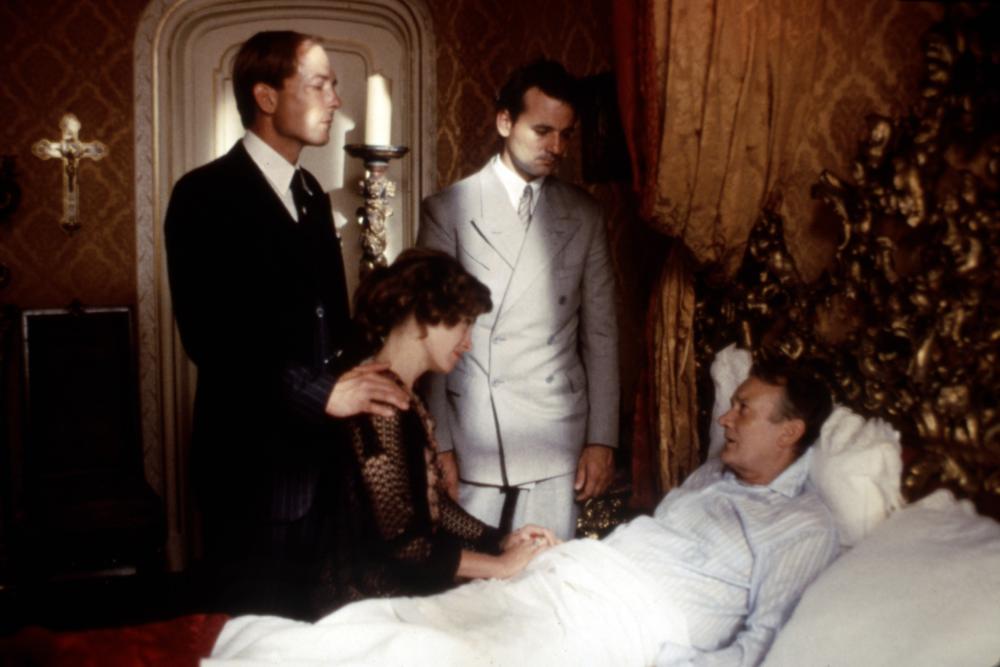
The major exception to this anachronistic tendency is Denholm Elliott, playing “Uncle” Templeton. Templeton is a dandy, a “man-about-town” still trying to live in the society prior to World War I. He is part of a less confusing world, ill-equipped for the changes wrought by the war and its aftermath, and as such feels like a man out of time. Unable to cope with the new society, Templeton tries to retreat to his memories of the past in his opulent Parisian home, stalwartly maintaining his savoir faire in the face of a society he cannot understand. Elliott plays him with a pathos missing from most of the other performances – Templeton is both pathetic and lovable, and you want him to find a place in the gone world. It seems odd that the character most out of touch with his time period should come off as the most believable.

Then there is Murray. While far from pitch-perfect, his performance as Larry has been unfairly maligned. Certainly Larry carries around some of Murray’s trademark sarcasm, but there is an underlying sensitivity and intelligence to the character that hints at the actor’s later ability to walk the line between humor and melancholy. The war does not transform Larry so completely that he fails to retain his fundamental personality – the character keeps a continuity often missing from these tales of transformative experience and the search for meaning. You believe that he can change as he does. Murray is fun to watch in almost any incarnation, but here he proves that he does have a strong dramatic sensibility that does not have to be at odds with his more obvious style of comedy.

The Razor’s Edge is not a bad film, but it squanders the opportunity to be a great one. It hints at a depth and introspection it never quite achieves, burying some excellent ideas (and performances) beneath romantic renderings of a bygone era. The female characters fail to spark, and there is at least one scene where a pivotal moment fails to achieve its emotional aim. At the same time, watching a younger Murray in a rare dramatic role provides a glimpse of the mature actor beneath the immature facade. It’s a shame he wasn’t able to capitalize on that until much later.

The Razor’s Edge actually owes its existence to Ghostbusters. When The Razor’s Edge had difficulty obtaining backing after Murray’s casting, Dan Aykroyd came to the rescue: he convinced Murray to appear in Ghostbusters in exchange for Columbia Pictures greenlighting The Razor’s Edge. Whether or not that was a good exchange must be subject for debate, but it’s likely Murray would never have done Ghostbusters if it had not been for The Razor’s Edge. That in itself might be reason enough to give this film a chance.

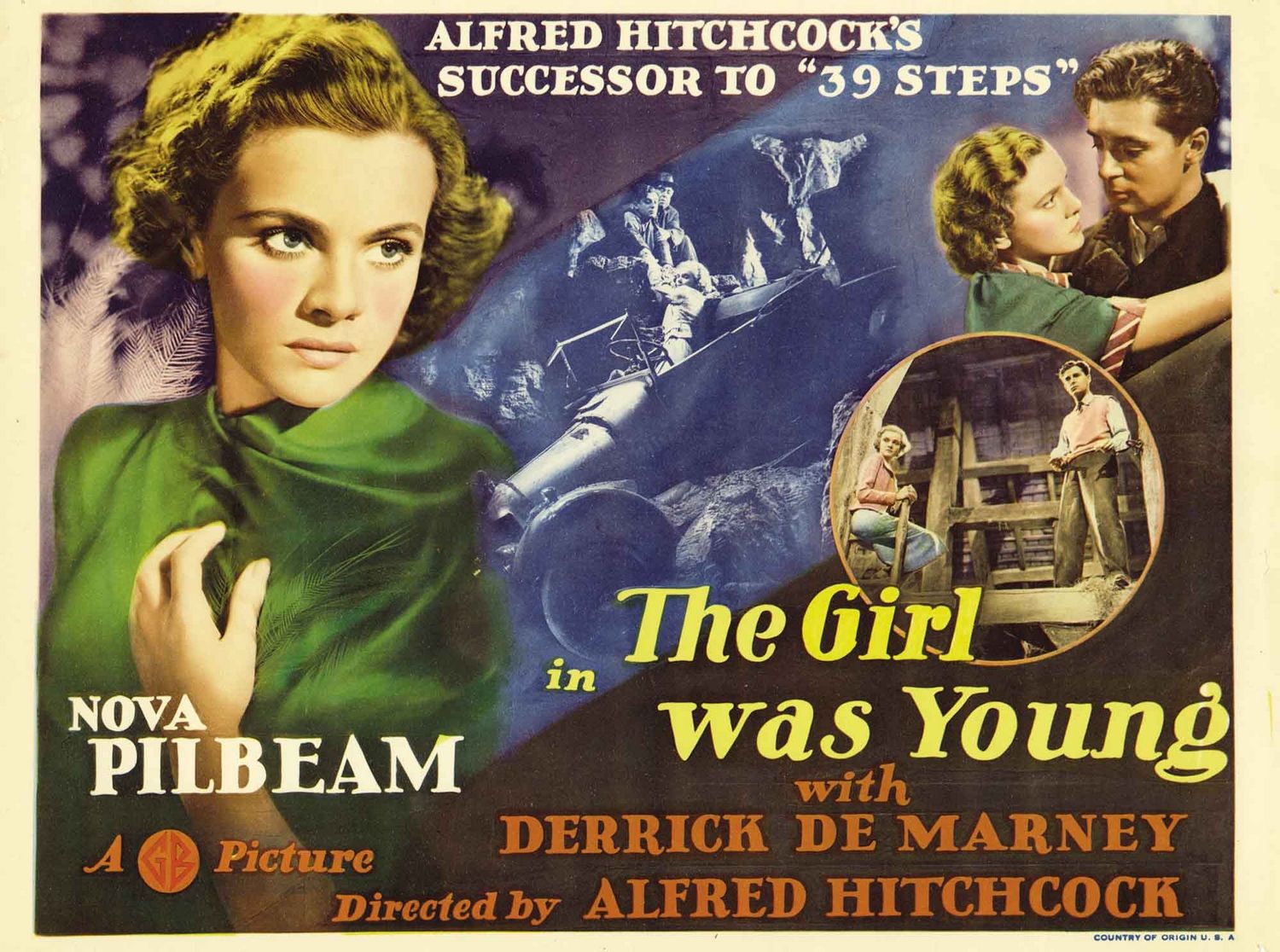
Young and Innocent (1937)

Young and Innocent

girl_was_young_xlg

Alfred Hitchcock made some great and not-so-great films in his long career as the Master of Suspense. We often focus on his acclaimed “masterpieces” of suspense cinema: Vertigo, North by Northwest, Psycho, Rear Window – these are the films that many viewers think of when they think of Hitchcock. But Hitchcock was a director in his native Britain long before he came to America, and the films he made during that period sometimes exceed his later works in both humor and suspense.While some film lovers will know The Lady Vanishes, The Man Who Knew Too Much, and The 39 Steps, titles like Rich and Strange, Murder!, and Young and Innocent are routinely ignored. Some of this must have to do with the prevalence of public domain prints, which are often murky and imperfect reproductions of films that deserve much better. But Hitchcock’s British films contain not just the seeds of the style and themes that would come to fruition in his later American career; they are enjoyable, even brilliant works of cinema in their own right.

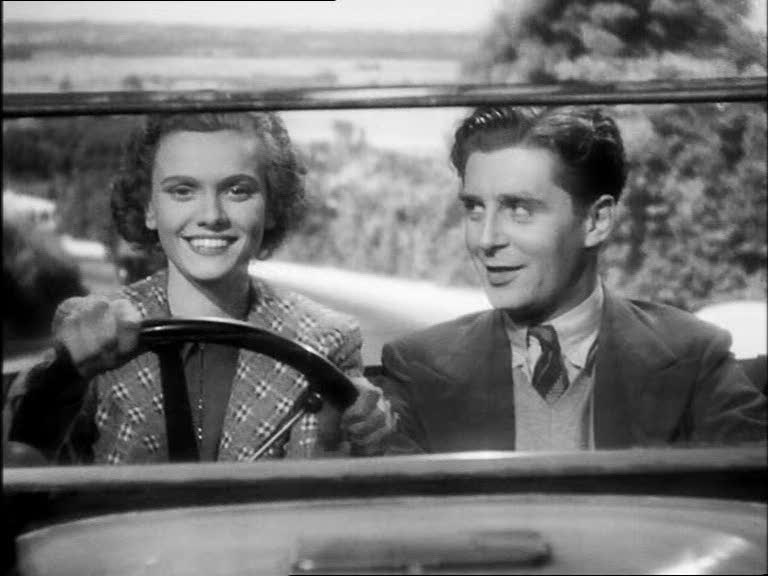
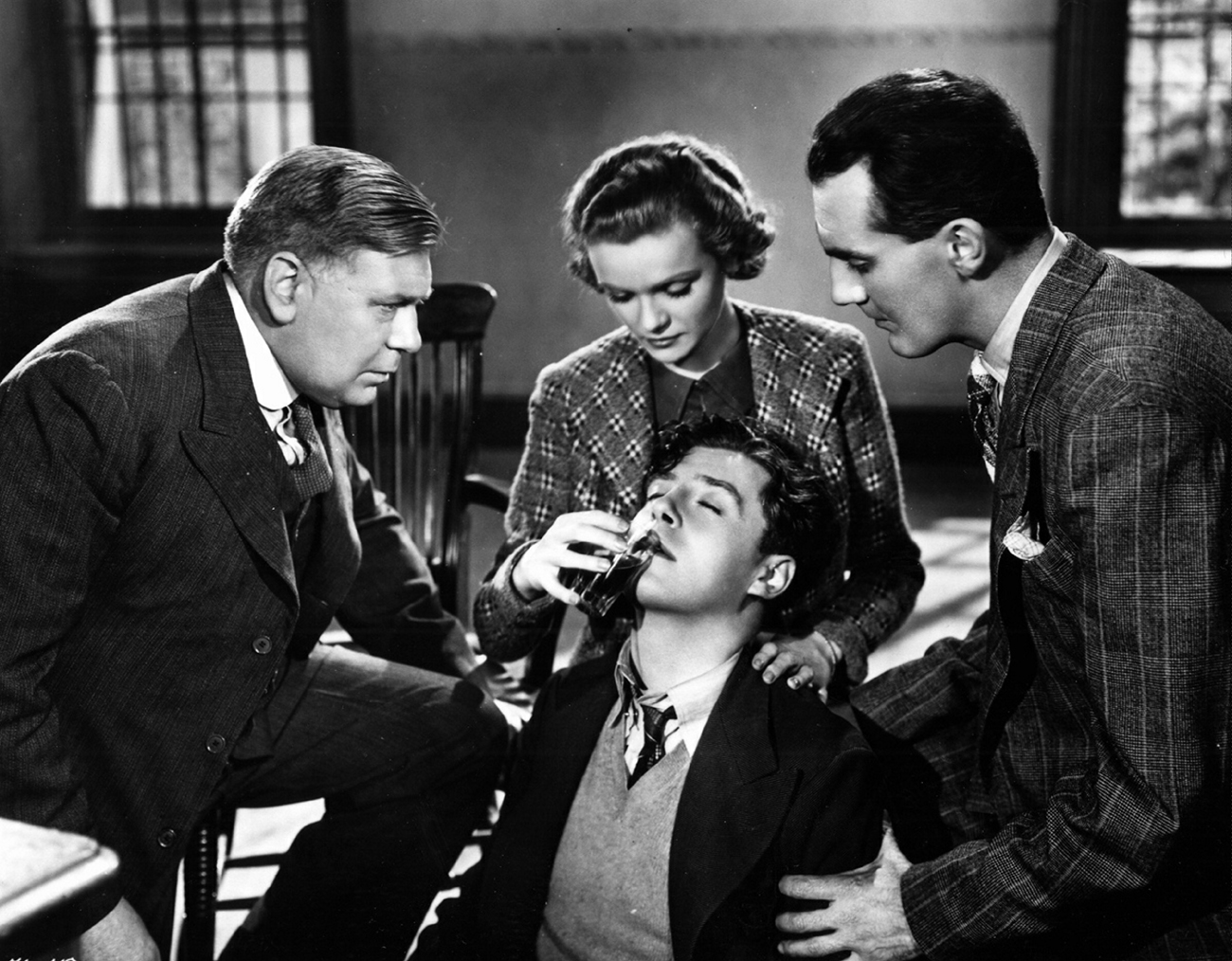
Young and Innocent opens with a stylized murder that we instantly recognize as Hitchcock. After an argument with her husband Guy (George Curzon), actress Christine’s (Pamela Carme) body is washed up on the beach below her home. She’s discovered by Robert Tisdall (Derrick De Marney), who runs off to get help only to be spotted by two young women. When the police arrive they claim that he was running away, and Robert is arrested for Christine’s murder. In the legal farce that follows, the police discover that not only did Robert know the dead woman, but he was also left a hefty sum of money in her will. What’s more, the dead woman was strangled with the belt of a raincoat that Robert claims he has lost. Realizing that he’ll get no justice without that coat. Robert  escapes from the courthouse just before his case is brought up, hiding out in the car of Erica Burgoyne (Nova Pilbeam), the Chief Constable’s (Percy Marmont) daughter. They begin a cross country chase to find Robert’s raincoat and prove that it was not his belt that strangled Christine.

youngandinnocent1

Young and Innocent is the “wrong man” narrative that Hitchcock made a central theme almost from the very beginning of his career. His best known silent film The Lodger operates on the same principles of a falsely accused man who must prove his innocence to both the police and to the girl he loves. The plot brings into relief issues of the justice system –  often shown as ineffective at best – and the vagaries of human nature, as the hero finds help (and hindrance) in some of the oddest place. In the case of Young and Innocent, the audience has no doubt about the veracity of Robert’s story. Without being shown the murder itself, we are given enough information within the first few minutes of the film to determine that Robert had nothing to do with it; it was Christine’s husband Guy, the man with the nasty eye-twitch, that killed her. The crux of the plot then trades on Robert convincing Erica that he’s been falsely accused. It is her story, really, as she comes to maturity via her experience, and her growing conviction that Robert could not have committed the crime.

Erica is on the cusp of womanhood, but she still presides over her father’s table, playing both good daughter and mother to her four brothers. Robert represents adulthood, a mature love, and an implicit threat to the family’s status quo. Erica’s faith in him saves him, just as his gentleness with her hints at an adult world she has never quite touched. Pilbeam and De Marney are excellent together, the latter playing the wry and dashing Hitchcock hero to perfection. Pilbeam looks and acts every bit her age (she was also the young daughter in The Man Who Knew Too Much),  yet manages also to fulfill some of the requirements of a strong Hitchcock heroine. She’s not a pushover and she’s not a victim. The youth of the two leads lends a lightness that might have been missing from older, more experienced actors – there is a sense of play in their friendship and then burgeoning romance, and an atmosphere of fun permeates their scenes together.

YOUNG & INNOCENT

The comedy of Young and Innocent is its most endearing feature. The film contains an extended sequence making fun of the local police (and Scotland Yard), as Robert easily escapes from their clutches after a scene with his venal, incompetent lawyer, resulting in a madcap chase through the English countryside. An element of slapstick runs through the film: police officers are forced to ride in the back of a wagon “with the other pigs,” a child’s party interrupts Robert and Erica’s escape, and Erica causes a slapstick fight at a local truck stop as they try to locate Robert’s missing raincoat. Hitchcock had an innate sensibility and love for British society of all classes, and Young and Innocent is full of British character types, each both endearing and grotesque in their own ways. The most enjoyable of these is Old Will (Edward Rigby), who provides a crucial clue to the identity of the murderer and Robert’s salvation. He’s an endearing character who makes the film even more pleasurable to watch.

This is a Hitchcock movie, though, and Hitchcock movie means at least one feat of camerawork that we might not expect. There are any number of excellently shot and framed scenes throughout Young and Innocent, but the most obvious and influential “Hitchcockian” moment must be the crane shot nearing the end of the film. It begins in a hotel lobby, swoops slowly over a group of dancing couples in a ballroom, down over their heads and to the band playing at the front, coming to rest finally on the twitching eyes of the drummer, whom we know from the start is the real killer. The entire sequence is a single shot, but you almost miss the brilliance of the camerawork until after the fact. If all Young and Innocent had to recommend it was that single shot, it would be enough.

Young and Innocent is less solid than The 39 Steps or The Lady Vanishes, and only hints at some of the greatness that will come along in Hitchcock’s later masterpieces. But it is a light, joyful film, entertaining without being challenging, and with enough depth of plot and characterization that you come away feeling both lightened and intrigued by the outcome. It is a comedic film, but with an undercurrent that acknowledges the seriousness of its subject. Young and Innocent is a work of light, even in the midst of darkness. As Robert says: “I can laugh, because I know I’m innocent.”

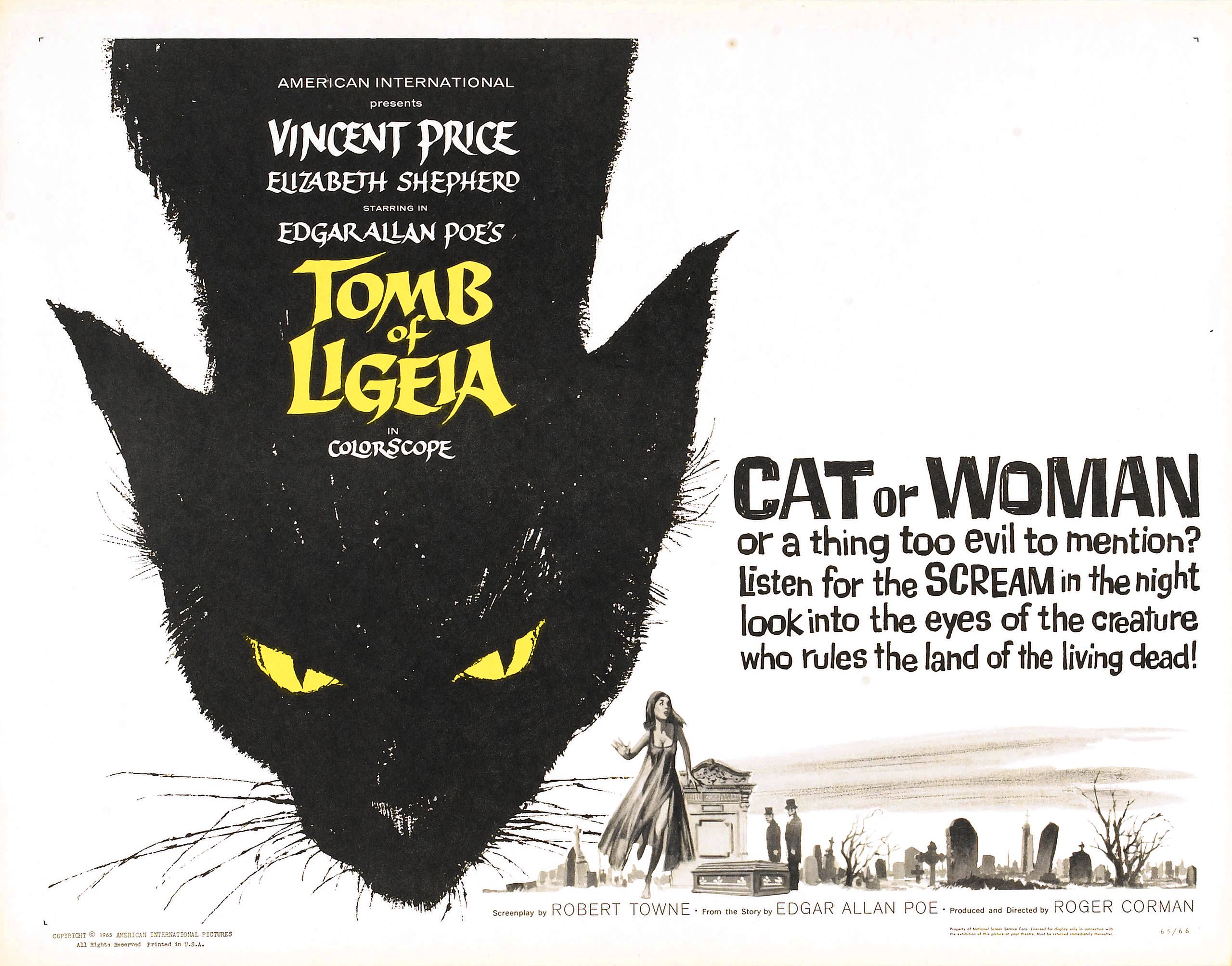
The Tomb of Ligeia (1964)

The Tomb of Ligeia

tomb-of-ligeia

“I just tried to kill a cat with a head of cabbage!” – Verden Fell (Vincent Price)

Vincent Price and director/producer Roger Corman made eight films based on the stories of Edgar Allen Poe, all of them in bright Technicolor with overwrought scripts and hammy performances from a central cast of talented B-movie stars. The Tomb of Ligeia is the last of the cycle and in some ways the best, featuring one of Price’s most effective and pathetic performances.

The story centers around Verden Fell (Price), who opens the film by burying his wife Ligeia (Elizabeth Shepherd). We’re told that Ligeia was a woman of great will and passions, who promises her husband on her death-bed that she will not stay buried. This being an Edgar Allen Poe adaptation, we can expect her to keep that promise. Fast forward several years and Verden is still living at the abbey he shared with his wife (she’s buried in the neighboring churchyard). The arrival of his beautiful neighbor Rowena (also Shepherd) prompts Verden to reevaluate his priorities. He falls for Rowena and the pair embark upon a marriage that everyone pretty much knows is doomed. Ligeia might be dead and buried, but she’s not going to let her husband go that easily.

Like most Corman/Poe stories, The Tomb of Ligeia is less about its plot and more about its aesthetics. The abbey that Verden and his wives inhabit is run-down, strewn with cobwebs, and haunted by a black cat that quickly become a central character to the story. Secret passages, haunted ruins, a bell-tower, winding staircases leading to hidden secrets – it’s all beautifully predictable for this type of film, and we know that before long family secrets will be revealed and some hideous discoveries made.

tomb-of-ligeia-price-shepherd

At the center of the film is the excellent cast, not the least of them being Price and Shepherd. Price is a tad old for the part he plays, but he goes into it with gusto, his sad, haunted expression making the audience feel for a man who might very well have been made out to be a monster. Verden fights desperately to free himself from the morbid obsession with his dead wife, who swore to him on her death-bed that he would always be her husband. In this case, he’s as much a victim of Ligeia’s indomitable will as everyone else, and Price plays him with pathetic beauty.

Elizabeth Shepherd, meanwhile, takes on the dual role of the Lady Rowena and Ligeia herself. Both are headstrong, powerful women, unwilling to sacrifice the man that they love – or, rather, the man that they want. There’s a certain element of power play going on here, and in some way the film is more about the battle between Rowena and Ligeia than it is about Verden. (I can also never pass up an Avengers connection: Shepherd was the first actress cast as Mrs. Emma Peel on The Avengers, and even filmed 1.5 episodes before being dismissed from the production under rather vague circumstances. Watching her here, I couldn’t help but wonder how she might have compared to Diana Rigg).

Where The Tomb of Ligeia fails is in its conclusion. The final sequence, once we get there, is very effective, but the plot feels confused, with much of the exposition packed into the last ten minutes. There we discover the “truth” about Ligeia and Verden’s obsession with her and are subjected to several short climaxes before we get to the real ending. As such, the film feels curiously weighted at the conclusion, as though Corman and scriptwriter Robert Towne (of later Chinatown fame) realized that they didn’t have an ending to the story and so tacked on three. That being said, however, it does provide one of the more epic final battles in any of Corman’s films, vastly outstripping The Pit and the Pendulum for sheer madness.

No one watches a Corman/Poe film for excellent storytelling; we watch it for the crazed camp, the wild-eyed villains and tortured heroes, the heroines bathed in fire and blood. Corman was the King of B-Movies, one of the best directors to tap into Price’s intensity and make even his villains fascinating and sympathetic. The Tomb of Ligeia is not a great film, but it is great fun.

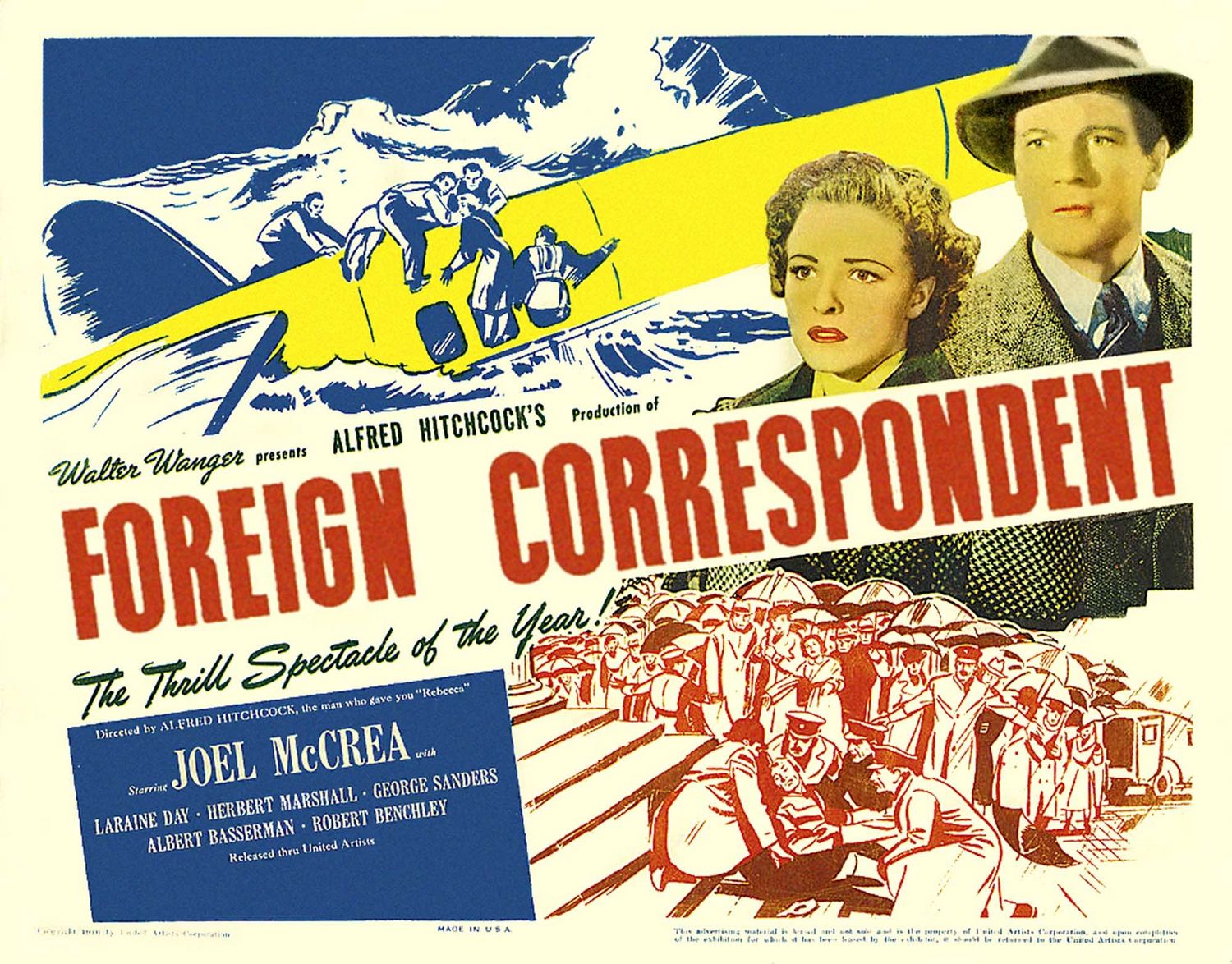
Foreign Correspondent (1940)

foreign_correspondent_xlg

When we discuss the pantheon of great Hitchcock films, we very rarely mention his 1940 war comedy-thriller Foreign Correspondent. There’s good reason for that: in comparison with the rest of Hitchcock’s oeuvre, Foreign Correspondent occupies a lesser category and could be blocked in with such films as Stage Fright, Saboteur, and Dial M For Murder. But even the worst of Hitchcock’s films have something to be said for them, and Foreign Correspondent is a far cry from being the worst. It is neither a great film nor a bad one, neither wholly successful nor a round failure. It has just enough hidden in its depths to make it intriguing, without ever quite making it great.

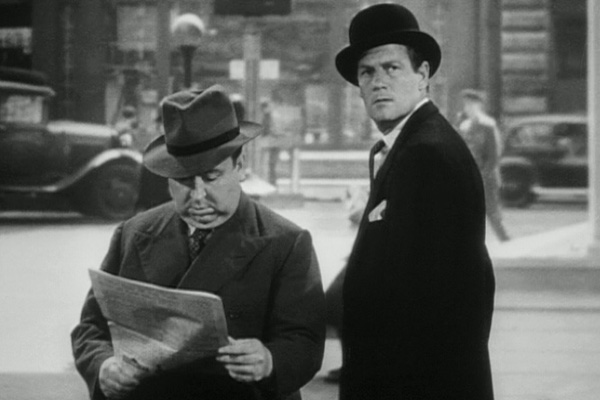
Foreign Correspondent features Joel McCrea as the titular correspondent Johnny Jones, who in the first few scenes changes his name to Huntley Haverstock and becomes the foreign correspondent for the New York Globe. Jones’s editor Mr. Powers (Harry Davenport) send our hero to Europe to drum up some “real news” about the European situation. Once in London, Jones encounters Mr. Van Meer (Albert Bassermann, who earned an Academy Award nomination for his role), a Dutch diplomat who has been trying to keep the peace in Europe. When Van Meer disappears during a luncheon thrown by Fisher (Herbert Marshall), the head of a united peace organization, Jones becomes embroiled in European politics and the machinations of a shadowy group bent on advancing the European war machine and obtaining vital secret information. Things are further complicated with Jones’s burgeoning romance with Fisher’s daughter Carol (Laraine Day) and the timely appearance of fellow newspaperman Scott ffolliett (George Sanders).

The first twenty minutes of Foreign Correspondent play like a wartime screwball comedy, beginning with the re-christening of Jones as Haverstock because his editor doesn’t like his name. Jones encounters Van Meer in a taxi on the way to the luncheon (the film’s MacGuffin, actually), but the political issues are promptly superseded by the adorable love/hate relationship that quickly develops between Jones and Carol. In fact, for much of the film’s opening act we see very little of that so-called Hitchcockian touch, with scenes that might have been shot by Howard Hawks or Preston Sturges. It’s a perfectly entertaining opening, but we’re all waiting for something important to happen.

Foreign-4

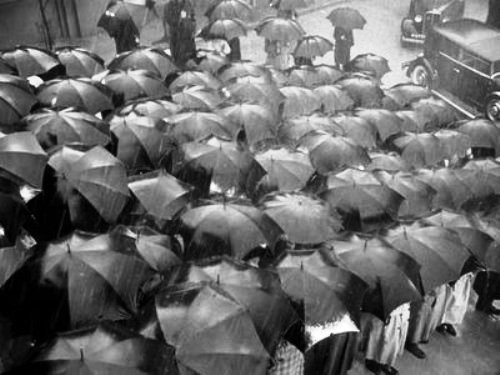
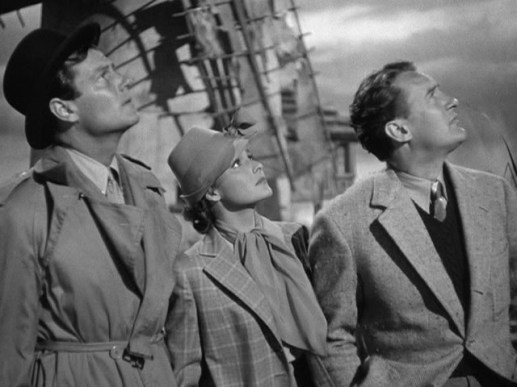
The important event turns out to be the apparent assassination of Van Meer on the steps of a conference building in Holland. The scene has that Hitchcockian feeling, as a beautiful crane shot over a sea of umbrellas establishes an immediate sense of foreboding. That same sea of umbrellas impedes Jones’s pursuit of the assassins through the streets, as bullets fly and at least one innocent bystander loses his life. Jones eventually springs into a car that contains Carol and Scott ffolliett (that’s two small f’s), and a chase through the Dutch countryside ensues. The rightly praised sequence involving a windmill and the uncovering of at least part of the villains’ scheme finally convinces the audience that, yes, we are watching a Hitchcock film. It’s a tense series of events, punctuated by humor from both Sanders and McCrea, and the well-known “Hitchcockian Blot” of a windmill turning against the wind.

From there, the film moves along at a strong pace, mixing the screwball romance with some recognizable “Hitchcockian” set pieces, each grander and more tension-filled than the last. Foreign Correspondent actually has more in common with Hitchcock’s British work than it does with his more famous American movies. The slow-burning screwball opening recalls The Lady Vanishes, while moments of humor provided by British and American character actors highlight moments of tension. Jones is an All-American hero lost in the morass of European politics that he either cannot or does not want to understand – a bit of a change from the stolid British types of Richard Hannay in The 39 Steps.

foreigncorr1

The cast of Foreign Correspondent is an excellent one. McCrea and Sanders set each other off perfectly, a meeting of nationalities attitudes that never veer into caricature. McCrea is a forthright hero with a good heart and a rather narrow vision of politics (his very American “let’s have a showdown” is repeated enough times for it to be taken ironically). But McCrea is a good enough actor to play the part of Jones with a lightness that never becomes silly, and a concern for humanity that supersedes his more naive aspects. His passion for Carol is genuine, as is his desire to tell the truth about what’s happening in Europe, if he can ever figure it out. Meanwhile, Sanders as Scott ffolliett is the unsung hero of the picture, occupying centre-stage for much of the latter part of the film after the director has apparently grown tired with his young lovers. ffolliett is one of Sanders’s most sympathetic and complex roles; yet another proof that Sanders was a very good actor when he put his mind to it.

Herbert Marshall occupies the difficult role of Fisher with a dash of charm and earnestness that we might not expect, his smoothness both charming and suspect from the start. Albert Bassermann’s Van Meer is the philosophical center of the film, a diplomat desperate to keep the peace and recognizing all too well that he shall fail. Laraine Day might come off as a touch too earnest and forgiving, and she has none of the strength of character we usually see in the best Hitchcock heroines, but she’s far from a poor actress and her character, while undemanding, provides a consistent lightness in the midst of the dark that permeates the second half of the film. The all-too-brief appearance of Edmund Gwenn, playing against type as a vile assassin, provides one of the film’s greatest sequences.

Foreign-Correspondent

If Foreign Correspondent does not come off, it’s largely due to a confusion of plot and tone. While Hitchcock regularly blended light comedy with thriller, Foreign Correspondent fails to follow through on some of its promise. The film has several climaxes, and what’s at stake for Jones et al. is not always clear, as though the situation in Europe became more important as the film was being made. The immediacy of the propaganda aspect means that the film becomes heavy-handed with its message, and Jones and Carol become too representative of the earnest young couple trying to survive in a world gone mad.  Several speeches evidently inserted for propagandist effect appear a bit overwrought to modern eyes.

That being said, there are so many wonderful and truly spectacular cinematic moments in this film, it’s a shame that the whole does not perfectly hang together. The scenes at the windmill and at the peace conference I’ve already mentioned; there is also a tense sequence atop a cathedral that perfectly demonstrates Hitchcock’s ability to generate audience suspense. The final sequence aboard an airliner makes for one of Hitchcock’s most visceral, intense moments, but I won’t spoil the surprise.

Foreign Correspondent was made in 1940 and released at the beginning of the Battle of Britain. As such, it is indeed a masterpiece of propaganda – such a masterpiece, in fact, that it received praise from Joseph Goebbels, who remarked that it “will make a certain impression upon the broad masses of the people in enemy countries.” The film ends with a call to America, to realize just what is going on in Europe and to take steps to stop the “lights from going out” all over the world. It has a immediacy to it only present in the best films of the period, a sense that the outcome is uncertain and that war, for America as well as for Europe, is imminent.


Ghostbusters (1984): The Marshmallow Apocalypse

Part II

gatekeeper

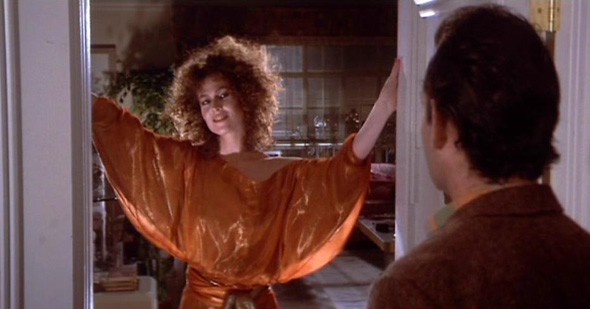
Femininity and sexuality figure into the film in a similar complicated manner.  Dana (Sigourney Weaver) essentially plays the ‘straight man’ to the three Ghostbusters, particularly Peter.  Again taking the Marx Brothers comparison, she is Margaret Dumont or Thelma Todd.  Peter pursues her, erotically, flirtatiously and even in a somewhat predatory manner.  He maintains control of sexuality and the male/female binary until the evil spirit Zuul possesses her.  Her possession transforms her first into a libidinous and sexual character, then into a demon dog.  When Peter arrives at her apartment, he is confronted with not the somewhat reticent woman who has resisted his slightly sarcastic and lascivious advances, but a full-blown sexual creature, complete with make-up and wind-blown hair.  His reaction is discomfort, if not downright terror.  Still, the relationship is not as simplistic as it first appears.  What disturbs Peter is not only Dana’s suddenly intense sexuality; it is also that her sexuality is uncharacteristic of her.  It does not necessarily represent a danger to him, but a danger to her.

Dana: I want you inside me.

Peter: OK.  No, I can’t.  It sounds like you’ve got at least two people in there already.  Might be a little crowded.  C’mon, why don’t you just quit trying to upset and disturb Dr. Venkman and just relax?

Unwilling to take advantage of the situation and actually sleep with her, he rejects her advances and asks to ‘speak to Dana.’  Peter, who makes sexual advances to almost any female throughout the film, is at a loss and disturbed when met with a manifestation of feminine libido.  Simultaneously, however, he acts in the kindest, most moral way possible.  He declines to take advantage of her, recognizing that the woman clinging to him is not Dana at all, but a spirit inhabiting her body.  He finds recourse to jokes, as he does throughout the film, but the scene takes on a new level of discomfort and nervous energy.  Far from the playful tone of sexual innuendo that has been exchanged between them from the beginning, Dana now makes almost violent sexual advances towards him.  Peter, for all his talk, is not a sexual predator.  His reaction is to try to get help and locate the ‘real’ Dana within the false one.  Their relationship will return to a masculine/feminine dialectic in the end, but I would argue that in this case Peter succeeds in recognizing the ‘real’ Peter that would not take advantage of a possessed woman.  His sexuality, despite his lasciviousness, does not extend to actually engaging in illicit or dangerous sexual acts.  He can only make jokes.

Sexuality continues to be a central concern of the film.  The Ghostbusters are associated with a strictly masculine paradigm, represented in the plethora of phallic symbols and innuendo.  The guns they use to capture ghosts, the ever-present PKE meter that Egon likes playing with, and lightly comic jokes about Twinkies and ‘crossing the streams’ punctuate moments of sexual humor throughout the film.  At the same time, Ray and Egon are fairly clueless about women—Ray has one sexual fantasy about a ghost, and Egon cannot seem to recognize it when their secretary Janine (Annie Potts) flirts with him.  Peter, as the only Ghostbuster who has any real heterosexual relationship, nonetheless becomes terrified at the first sight of a truly sexualized woman.  In all of this, however, the film manifests an awareness of the tropes it plays with.
gozer1

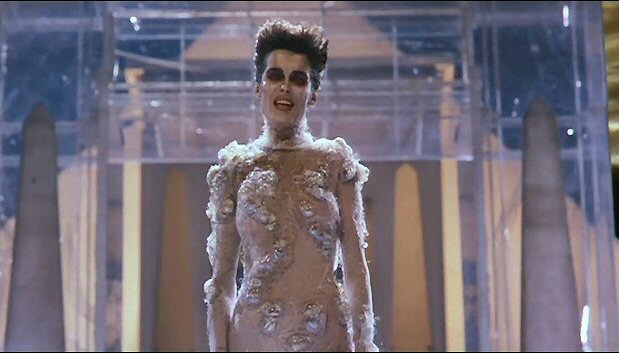
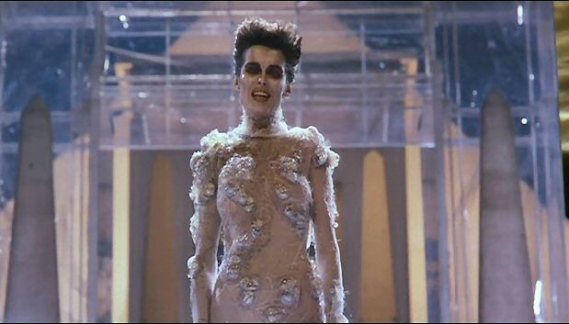
The apocalyptic narrative of the film comes into play through the realm of sexuality.  Gozer, the one who will bring about the apocalypse, can only be summoned through the sexual union of the Gatekeeper and the Keymaster.  The Gatekeeper in this case is a woman, the Keymaster a male, calling attention to the sexual puns inherent in those titles.  The Keymaster controls the phallic; the Gatekeeper controls the feminine.  This references the familiar euphemism for female genitalia as a ‘gate’ that needs a phallic male ‘key’ to unlock it.  Films such as The Devil’s Advocate (Warner Bros., 1997) and Rosemary’s Baby (Paramount, 1968) found their apocalyptic ideology within the necessary joining of masculine and feminine, resulting in the end of the world or the coming of the Anti-Christ.  Ghostbusters subverts these recognizable tropes of the apocalyptic by making them comic.  Even before the appearance of Mr. Stay-Puft, the apocalypse is something to laugh at.  The coming together of the hypersexual Dana as Zuul and Louis Tully (Rick Moranis), the nebbish accountant, as Vinz the Keymaster is a humorous image.  Dana stands head and shoulders above Louis; she literally sweeps him off his feet.  Their embrace is extremely stylized; as they kiss the wind blows, the music swells and the camera swirls around them.  The shot has a self-conscious camp aesthetic, although it avoids total parody.  What in other films is a terrifying, erotic moment becomes a piece of comedy.

Although Winston and Ray engage in the most serious elucidation of the coming apocalypse in their brief scene, the full explanation for what has happened in Dana’s apartment is given by the most intensely intellectual figure in the film:

Egon: It’s not the girl, Peter, it’s the building…The architect’s name was Evo Shandor; I found it in Tobin’s Spirit Guide…After the first World War, Shandor decided that society was too sick to survive.  And he wasn’t alone; he had close to a thousand followers when he died.  They conducted rituals up on the roof.  Bizarre rituals, intended to bring about the end of the world, and now it looks like it may actually happen!

Peter (singing): So be good, for goodness sake! Somebody’s coming…

The scene occurs in a holding cell after the Ghostbusters have been arrested.  Surrounded by prisoners, Egon gives a speech about the sickness of society and the ritualistic desire to bring about the end of the world.  Despite the seriousness of his speech, he keeps a steady smile on his face as he speaks.  The smile, the apparent enjoyment he has out of explaining the coming apocalypse, elucidates the strange festivity, the comedy of death.  The world is going to end; Egon smiles and Peter sings.  When they appear in the Mayor’s office, they again perform a comic apocalypse:

Ray: Real wrath of God type of stuff.  Fire and brimstone coming down from the skies.  Rivers and seas boiling!

Egon: Forty years of darkness, earthquakes, volcanoes!

Winston: The dead rising from the grave!

Peter: Human sacrifice, dogs and cats living together, mass hysteria!

Coupled with the Biblical imagery are the comical aspects of ‘dogs and cats living together.’  While the apocalypse does not seem a completely banal occurrence in this scenario, the comedy of the situation, the gallows humor of laughing at the end of the world, permeates the entire scene.  The subversion of the usual somber tone of apocalyptic films and imagery transforms the apocalypse itself into a farce, something not to be taken seriously.
ghostbusters

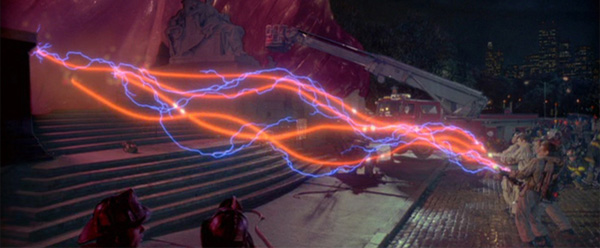
The final sequence of the marshmallow apocalypse brings together the manifestations of the repressed, libidinal impulses, and the dialogues of phallicism and gender into a final festival moment of comic destruction.  Supported finally by the establishment (including the Army, the Police, the Fire Department and the Mayor’s office), the four working class figures arrive to stop the end of the world.  The crowd that stands to greet them and cheer them on is a multicultural, multi-ethnic and multi-classed crowd, come together in festival to watch the Ghostbusters save the world.  Gozer manifests itself initially as a woman, played by supermodel Slavitza Jovan, a deliberately sexualized figure who threatens to destroy the Ghostbusters.  Recovering from her initial attack, the Ghostbusters return to (comical) phallic symbolism:

Peter: Got your stick?

All: Holding!

Peter: Heat ‘em up!

All: Smoking!

Peter: Make ‘em hard!

All: Ready!

The deliberate phallicism of the dialogue again relates the ‘wands’ of the Ghostbusters proton packs to not terribly subtle phallic imagery.  They attack Gozer, but fail to conquer her.  Instead, she demands that they name the ‘form of the Destructor,’ making the choice about what it is that will destroy them.  Here the sexualized figure, un-subdued by phallic masculinity, turns to a chosen apocalyptic image; only the chosen image is a marshmallow man.

Mr. Stay-Puft is the final and most potent manifestation of the repressed libidinal psyche, actually coming from the mind of one of the Ghostbusters.  Ray justifies his choice by saying that he tried to think of something that ‘could never destroy us.’  The apocalypse, then, is going to be wrought not by a sexualized supermodel, or a prehistoric demon dog, but a walking wad of puffed sugar.  The apocalypse thus manifests itself as an empty figure of fun, a sugary concoction that stomps around midtown Manhattan.  The ironic nature of the apocalypse becomes humorous and painful:

‘Sometimes it’s hysterical irony and sometimes it’s a painful irony.  Life has all of these contradictory feelings and contradictory results…We’re always shut off from pure joy’ (Ramis, as qtd. in Spitznagel 4).

The festivity of the apocalyptic scenario in Ghostbusters acts as a manifestation of painful irony: the world is about to end, but how ironic that it will end in a rain of marshmallow.  Mr. Stay-Puft is also a corporate logo, a symbol of consumerism, and therefore a post-modern construction within the cinematic milieu.  Ray does not think of just any harmless character, but a harmless corporate character.  The film proposes destruction based around a literally rampaging consumer product.

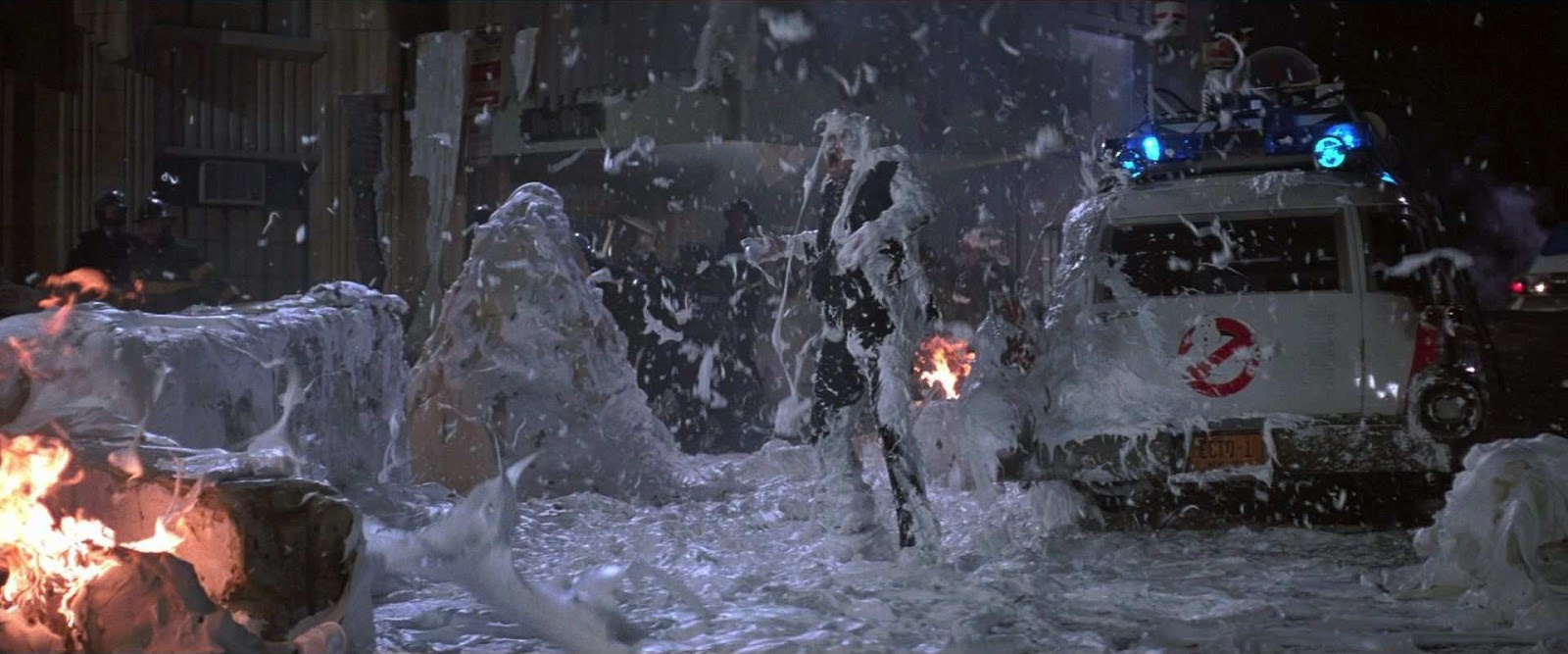
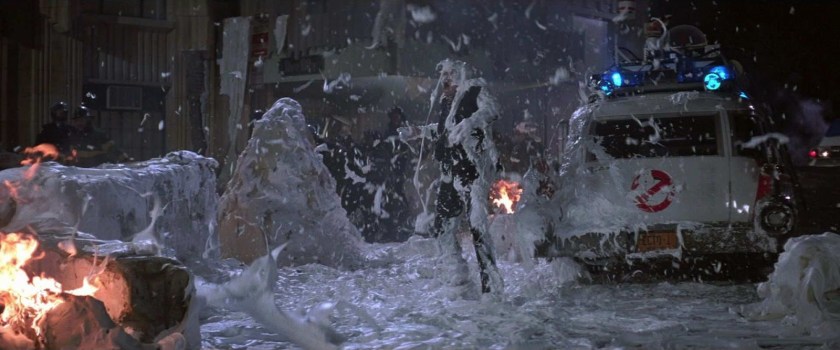
The Ghostbusters defeat Mr. Stay-Puft by doing what has already been stated as dangerous—they cross the streams from their proton packs, apparently reversing the polarity of Gozer’s door and destroying Mr. Stay-Puft.  If we carry through the phallic symbolism already related, the Ghostbusters comically and sexually unite, establishing a homoerotic masculine paradigm that ends with the destruction of first the sexualized Gozer (who is nonetheless also asexual—she need not be male or female), and the freeing of Louis and Dana back into ‘normal’ sexuality.  Mr. Stay-Puft erupts in a rain of marshmallow, covering everyone below.  There is no denying the apparently orgasmic and masturbatory imagery this scene involves, as the four Ghostbusters combine their phallic instruments, resulting in an explosion of white foam that covers them all from head to foot.  Emerging from death, the Ghostbusters establish a new, highly masculine paradigm that nonetheless allows for comic rebirth.  The city and the world are saved through an orgasmic explosion of male sexuality.

This is the ultimate transformative moment of comedy, as the bringer of death appears in a comic form, and death itself explodes in an abject bodily function.  The ending of the world is satirized through Mr. Stay-Puft.  The film satirizes the union of sex, death and destruction through the establishment of a figurative male union and a New York covered in sugar/semen.  Although the images and thematics of Ghostbusters are exceptionally serious, taking on the end of the world, the problems of normative sexual relationships and the eruption of the chaos world in the form of enjoyable but damaging libidinal excess, the comedy of the film subverts the tropes from within, by acknowledging their terror, but also their humor.  In the end, Mr. Stay-Puft explodes and the Ghostbusters save the day, destructors themselves from within the system.  The marshmallow apocalypse is averted, but we are all still covered in sugar.
Ghostbusters1354


Aykroyd, Dan and Harold Ramis.  Making Ghostbusters, ed. Don Shay, Columbia

Pictures Industries, New York: 1985.

Bakhtin, Mikhail.  Rabelais and His World, trans. Helene Iswolsky, Indiana University

Press, Bloomington: 1984.

Hallenbeck, Bruce G.  Comedy-Horror Films: A Chronological History 1914-2008,

McFarland & Company, Inc., London: 2009.

Meehan, Paul.  Cinema of the Psychic Realm: A Critical Survey, McFarland & Company,

Inc., London: 2000.

Paul, William.  Laughing Screaming: Modern Hollywood Horror and Comedy, Columbia

University Press, New York: 1994.

Ramis, Harold.  ‘Commentary on Ghostbusters’ in Ghostbusters, dir. Ivan Reitman,

Columbia Pictures: 2005.

Spitznagel, Eric.  ‘Interview with Harold Ramis’ in The Believer, March 2006.

Tudor, Andrew.  ‘Why Horror? The Peculiar Pleasures of a Popular Genre’ in Horror,

the Film Reader, ed. Mark Jancovich, Routledge, New York: 2002.

Wood, Robin.  ‘The American Nightmare: Horror in the 70s’ in Horror, the Film Reader,

ed. Mark Jancovich, Routledge, New York: 2002.


Hackford, Taylor (dir).  The Devil’s Advocate, Warner Bros., 1997.

Polanski, Roman (dir).  Rosemary’s Baby, Paramount, 1968.

Reitman, Ivan (dir).  Ghostbusters, Columbia, 1984.

Ghostbusters II, Columbia, 1989.