Bloody October: The Last Man on Earth (1964)

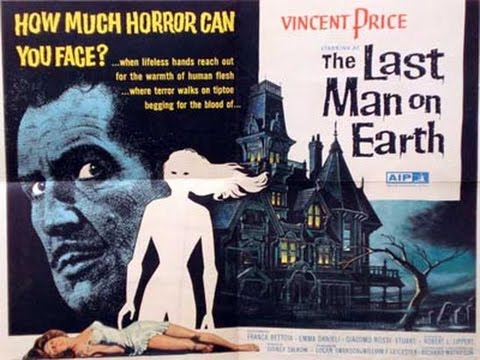
The Last Man on Earth (1964)
the-last-man-on-earth-poster

If humanity were to suddenly be subject to an airborne disease that turns its victims into the walking dead, who do you think would be the last man standing? No, not those idiots on The Walking Dead. Only one man could possibly survive the zombie/vampire apocalypse, and look good doing it too: Vincent Price.

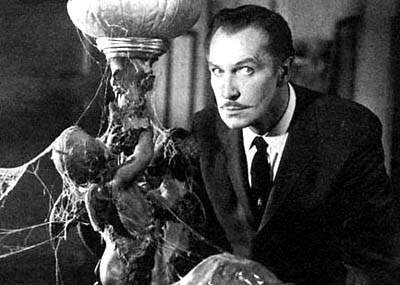
Based on the Richard Matheson novel I Am Legend, The Last Man on Earth stars our Mr. Price as Dr. Robert Morgan, a biologist who has spent three years as the only man on Earth apparently not infected by a horrific airborne plague that claimed his wife, daughter, and best friend. The film takes us through Morgan’s typical day as he awakes, hangs garlic over his doorway, and heads out into the abandoned city with a bag of wooden stakes to find and destroy more of the vampiric creatures that were once the human population. He has to return before the sun goes down, though, for the vampires come banging on his door, threatening to kill him. He spends some time trying to get into radio contact with other living beings, but all to no avail. It appears that he truly is the only man left alive.

the-last-man-on-earth-price

The Last Man on Earth reportedly inspired George Romero to make Night of the Living Dead, so all you Zombie-philes should get down on your knees and praise this weird little movie. This is a zombie movie before there were zombie movies, but the vampiric creatures share much in common with Romero’s later conception of the walking dead. Half brain-dead and only really powerful in numbers, the vampires seem to lack basic organization, banging on Morgan’s door and shouting threats without being able to organize themselves well enough to actually break into his house. Morgan’s contempt for the people that were once his friends is pathetic. In a flashback sequence, we learn of the origins of the plague, and of the slow decay of surrounding civilization as more people fall victim. When Morgan wanders the deserted city in search of vampires, the film provides an effective sense of the desolation and loneliness of streets without people and stores left empty. There is something horribly realistic in the first 3/4s of this tale of worldwide pandemic, the terror and mistrust perhaps all too real in this day and age.

Price gives one of his most affecting performances, at once sympathetic and slightly sinister as he struggles with his day-to-day existence, forced to burn the mutilated bodies of the vampires. He’s the only character on screen for most of the film’s runtime. Despite the somewhat hokey voiceover that was far too common in films of this period, Price’s performance elevates the film (as his performances so often did) – his elation at spotting a dog running loose in the streets is heartbreaking, for here he sees at last some hope of companionship in his long, lonely existence. Morgan is a monster and a hero in the same breath, and his suffering plays out over the contortions of Price’s remarkably expressive face.

The weakness of The Last Man on Earth lies in its denouement, which I won’t spoil for the reader. A relatively effective set-up is punctured in the final act, leading to a curiously unsatisfying conclusion. While miles ahead of its successor I Am Legend, starring Will Smith, The Last Man on Earth does not quite make good on its narrative promises.

Yet for all that, there is much to like about this odd little film. Price here embraces the melancholic suffering so prevalent in many of his best performances. He has taken the world’s cares on his shoulders, and become a monster in the process. Nothing could be so heart-breaking.
Bloody October: Creature from the Black Lagoon (1954)

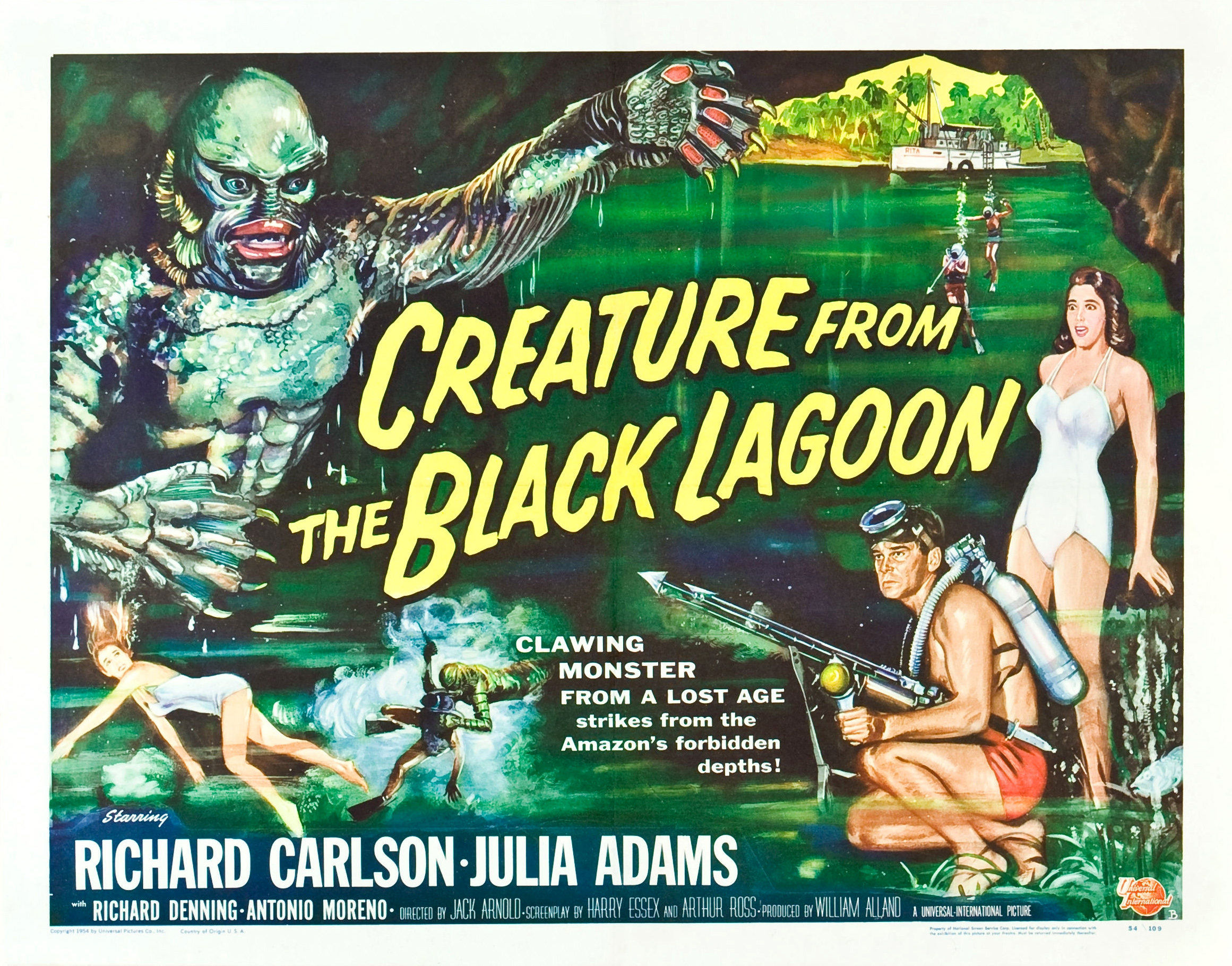
Creature from the Black Lagoon (1954)

Poster - Creature From the Black Lagoon_03

Sure we all make fun of Universal’s weird attempt at creating a new franchise “universe” to rival the Marvel Cinematic Universe (God, I really fucking hate that phrase) and the DC Cinematic Universe. But you know what? Universal actually did have the original multi-film, multi-character, multi-storyline world. It started way back in the 1930s with the rapid-fire release of Universal’s original monster trilogy: Dracula, Frankenstein, and The Mummy. Many years later, The Wolf Man was added to mix, along with some of the “little brothers” of those historic monsters, including The Invisible Man and the subject of this little review: Creature from the Black Lagoon.

As the opening voiceover informs us, evolution has taken some interesting twists and turns, beginning deep in the ocean and proceeding onto land, as human beings eventually emerged from the primordial ooze. But there might still be things out there that defy evolutionary theory, and it is in the depths of the Amazonian jungle we might find them. The film proper begins with Dr. Carl Maia (Antonio Moreno) discovering a fossilized hand in a rock formation somewhere deep in the Amazon. The hand looks almost human, save for webbed fingers and claws, and Maia thinks he may have stumbled upon a missing link – a, uh, missing fish-link, in point of fact. Leaving his native guides to guard the camp, Maia returns to civilization to show off his new find and possibly get together an archaeological team to dig up the rest of the skeleton. He gets his team in the form of ichthyologist Dr. David Reed (Richard Carlson), his boss Dr. Mark Williams (Richard Denning), Dr. Edwin Thompson (Whit Bissell), and their “colleague” Kay Lawrence (Julie Adams) (I could not quite figure out what it was that Kay did, other than go swimming and scream, but she’s supposed to be a scientist-type of some kind). The team head off down the Amazon aboard a fishing boat run by Lucas (Nestor Paiva).

When the group arrives at camp, they discover that it has been destroyed and the two guides killed. Being brave scientists, they carry on with the excavation, only to have it be a bust: the skeleton is nowhere to be found. On a hunch, they travel further down the river to the Black Lagoon to see if they can find pieces of the skeleton there. That’s how they meet the Creature, an amphibious humanoid who just wants to have a pleasant swim, but instead nearly gets harpooned in his first contact with his distant cousins.

creature-from-black-lagoon-swim-a

Like many films of the same period, Creature from the Black Lagoon suffers from an overabundance of exposition, as our scientists explain what we’re supposed to feel as we feel it.  As with Frankenstein and the Wolf-Man, the Creature’s animalistic nature is far more sympathetic than his human counterparts. He has had his Lagoon invaded and been shot several times, prompting a predictable violent reaction. One wonders just want these scientists want with shooting harpoons at a species that they’re supposed to be studying. Even the conflict between David and Mark over how best to go about dealing with the Creature is just about one form of invasion over another: David desires to poke, prod, and study the Creature, while Mark just wants to hang its head over his mantlepiece.

To its credit, Creature from the Black Lagoon features some truly remarkable underwater photography. The Creature’s movements are beautifully performed and detailed – his natural habitat is the water and he understands and moves with it far more fluidly than the divers outfitted with oxygen tanks and goggles. Out of the water, the Creature looks like a big, walking fish – the use of prosthetics remarkable for the period, and still oddly convincing even now.

While far from a great film, Creature from the Black Lagoon is a rightfully iconic one, an interesting variation on the horror stories of radioactive lizards that were cinema’s response to the Atomic Age. Rather than being created out of modern violence, the Creature comes from an evolutionary past, a connection between the human past and the future. That the response is to shoot and flee from it perhaps says more about humanity than the film ever thought to.

Bloody October: In the Mouth of Madness (1995)

In the Mouth of Madness (1995)

in-the-mouth-of-madness-poster

Leave it to horror master John Carpenter to make a film that is part loving homage to H.P. Lovecraft, part parodic social commentary, and part meta-narrational horror. Seriously. While Wes Craven would attempt a similarly themed narrative with his own meta-horror Scream, Carpenter arguably accomplished something weirder, more genre-defying, and more gleefully enjoyable than anything starring Neve Campbell.

Sam Neill is John Trent, an insurance investigator who starts the film being locked in an asylum as he raves about the end of the world. Interviewed by Dr. Wrenn (David Warner), Trent recounts his story. He was hired by a publishing house (run by Charlton Heston, no less) to find the author Sutter Cane (Jurgen Prochnow), a best-selling horror writer whose latest novel In the Mouth of Madness promises to be a ground-breaking work of horror fiction. Accompanied by Cane’s editor Linda (Julie Carmen), Trent embarks on a journey to find Hobb’s End, the supposedly fictional town in New Hampshire where Cane may or may not have disappeared.

Anyone who has read Lovecraft will immediately recognize certain knowing nods and references, from the asylum opening to “Pickman’s Hotel,” from the titles of Sutter Cane’s novel to certain – ahem – old ones. Still, In the Mouth of Madness is by no means strictly for the fans. The story encompasses what it means to love horror, and to indulge in its dark plots of madness and apocalypse. It does this with a strong parodic edge, aware of itself even as it indulges the grotesque and the dark, serious underpinnings of fear. Cane’s novels supposedly drive “susceptible” readers to near frenzy, and Trent is a perfect candidate – a man who doesn’t believe in such things, yet stays up to all hours reading the books. Is the entire story a product of Trent’s madness (remember: he’s telling this from within an insane asylum), or has Cane’s work opened a facet of the human mind and the universe better left closed? As the film develops, layers of fictional and nonfictional worlds begin to overlap, and Trent’s experiences become more and more convoluted.

Neill is an excellent protagonist here: not quite likable, but not inherently unlikable either. Carmen has less to do, and actually gives the impression of being a bit more gone on Cane than she should be. But as with many horror films, the people are really just there to be enacted upon – the real star is horror, and how the film unravels that horror. Making a movie with a Lovecraftian setting is a difficult venture; Lovecraft’s horror usually lies in the unseen and the barely glimpsed. Carpenter manages it, though, giving us just enough fear beyond the realm of conscious thought, interspersed with ghoulish body horror. It’s an effective approximation of Lovecraft’s prose, and a powerful cinematic technique in its own right.

In the Mouth of Madness is like a fever dream, starting out with a certain element of realism and quickly descending into the realms of, well, madness. The conclusion is both chilling and just a little funny, its terror punctuated by a low-level of humor that brings out that fine line between the terrifying and the ridiculous. Carpenter has done right by Lovecraft, and that’s a feat unto itself.

2-in-the-mouth-of-madness

Bloody October: Trick ‘r Treat (2007)

Trick ‘r Treat (2007)

trick-r-treat

Horror has a long and  hallowed tradition of anthology films. Some, like Corman’s Tales of Terror, are tied together by a common writer and repeated appearances of actors as different characters; others, like the recent V/H/S, by a common gimmick or concept. Then there’s Trick ‘r Treat, which utilizes the anthology film subgenre to tell a series of tales from Halloween night and, like a schlock-horror version of Pulp Fiction, interweaves characters to effortless, and surprising, effects.

The action takes place one Halloween night in a small Ohio town that really seems to like the holiday. The usual Halloween shenanigans are afoot, from kids knocking pumpkins off of fence-posts, to grown-ups using costumes as a means of anonymously getting off with strangers. The four main tales comprise a school principal who moonlights as a serial killer, a group of kids paying homage to an old urban legend, a young woman dressed as Red Riding Hood on the search for her Big Bad Wolf, and a curmudgeonly old man who hates Halloween and won’t give out candy. Each story comprises contains a “Halloween infraction,” from poisoned candy to cruel practical jokes, and the presence of “Sam,” a little trick-r-treater wearing orange pajamas and a burlap sack mask who appears at important moments in each vignette. The characters connect and interweave with one another, as one story finishes what another started.

Without giving too much away, Trick ‘r Treat is one of the most entertaining contemporary horror films I’ve seen in a long time. It has its own, warped moral universe that brings each portion of the story to an intense, often funny, and always satisfying conclusion. With an excellent cast full of character actors, including Anna Paquin and Brian Cox, the film brings off its horror without too much recourse to shock tactics or bloody dismemberment. It trades on what makes Halloween so beloved: beneath the jack-o-lanterns and cute costumes is a holiday tradition founded on respect for the dead and the supernatural. Cross the line of tradition, break the rules for your own perversity, and little Sam will be there to punish your wrongdoing. A good lesson, for any Halloween night.

Bloody October: The Birds (1963)

The Birds (1963)

the-birds-poster

While this is the subject of some debate, it is my conviction that Alfred Hitchcock made only one “proper” horror film over the course of his long career. Psycho has often been cited as the first “slasher” film, but I don’t think it’s insane to argue that Hitchcock’s 1963 film The Birds wins the award for inarguable horror.

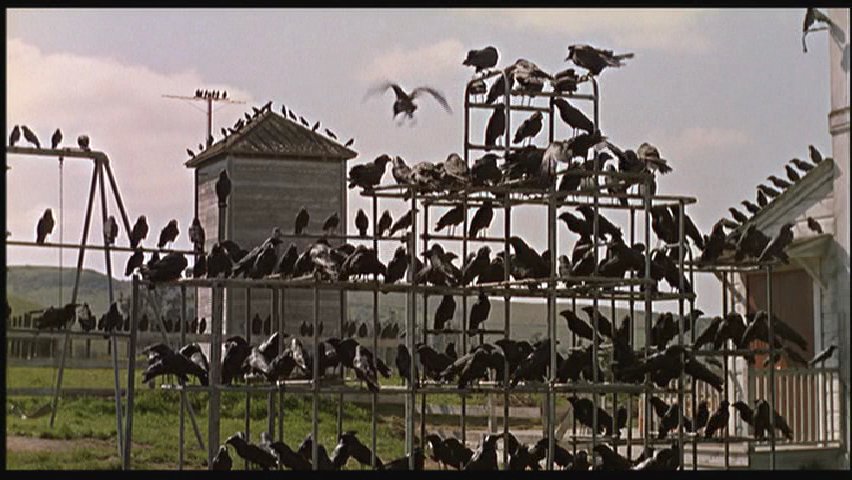
Tippi Hedren is Melanie Daniels, an apparently frivolous young ingenue who meets and flirts with Mitch Brenner (Rod Taylor) in a San Francisco bird shop. Annoyed by Mitch’s teasing flirtation, Melanie purchases a set of lovebirds and heads to Mitch’s country home in Bodega Bay, to deliver the birds to his little sister Cathy (Veronica Cartwright) for her birthday. There she meets the schoolteacher Annie Hayward (Suzanne Pleshette), and Mitch’s mother Lydia (Jessica Tandy), both major feminine forces in Mitch’s life.  The whole thing is really just an elaborate gag intended to pay Mitch back for his teasing, but things begin to get scary when Melanie is attacked by a seagull. It’s the harbinger of things to come, as the local birds begin attacking and killing humans. The inhabitants of Bodega Bay are eventually forced to hole up in their homes, securing themselves against the constant and apparently purposeless onslaught of avian forces.

Hitchcock spends the first half hour of The Birds establishing the characters, their relationships, and the tensions already underlying Melanie’s interaction with the Brenner family. Mitch’s mother in particular seems to suspect and dislike Melanie, but in an extended conversation with Annie, Melanie learns that it is not as cut and dry as, say, a grasping and jealous woman (words that immediately call to mind Psycho, of three years before). The tensions are more complex, and in some ways more realistic, than that. When the bird attacks do begin, the viewer senses some tenuous and wholly inexplicable connection between the motiveless violence, and the animosities between our human characters. How to define this becomes the question, and the film poses no easy answers.

the-birds-1963

Much of The Birds is about human reaction to purposeless violence. While certain things are established about the attacks – they come in waves, they stop for long intervals, they appear to be concerted attacks by large numbers of animals – there is no apparent purpose behind them. The birds have simply “gone mad,” but it is a universal madness affecting all of them – except for the two lovebirds in a cage. The violence is overwhelming and disturbing, but it is the mad tension, the waiting for something to happen, that truly gives the film its energy. As one ornithologist explains, if birds of a feather truly do flock together, there’s nothing human beings can do to stop them.

For a film made in 1963, the special effects in The Birds hold up rather well. Hitchcock’s camera never lingers for too long on a single animal, making it easier to combine real trained birds with puppets, animation, and even back projection to form a largely seamless horror story. I wish the same could be said for the performances. Although Tippi Hedren’s performance is affecting, she has an aloofness and distance that after awhile becomes grating and makes it difficult for the viewer to sympathize. The same must be said for Rod Taylor’s rather self-satisfied lawyer, who has as much sex appeal as a store mannequin. The strong secondary characters, however, make up for the moments when the leads drag down the dialogue – and Jessica Tandy’s multi-faceted job as Lydia Brenner is a study in restrained acting.

Birds-5

But the real stars here are the birds, and they’re really the ones we came to see. This is more than a “nature gone mad” story, so popular in the 1950s and 60s in the aftermath of World War II and the rise of the Atomic Age. The birds are not really mad, it seems. They know exactly what they’re doing, and that, more than anything human, is terrifying.

Bloody October: The Cat and The Canary (1927)

The Cat and the Canary (1927)

poster-cat-and-the-canary-the-1927_02

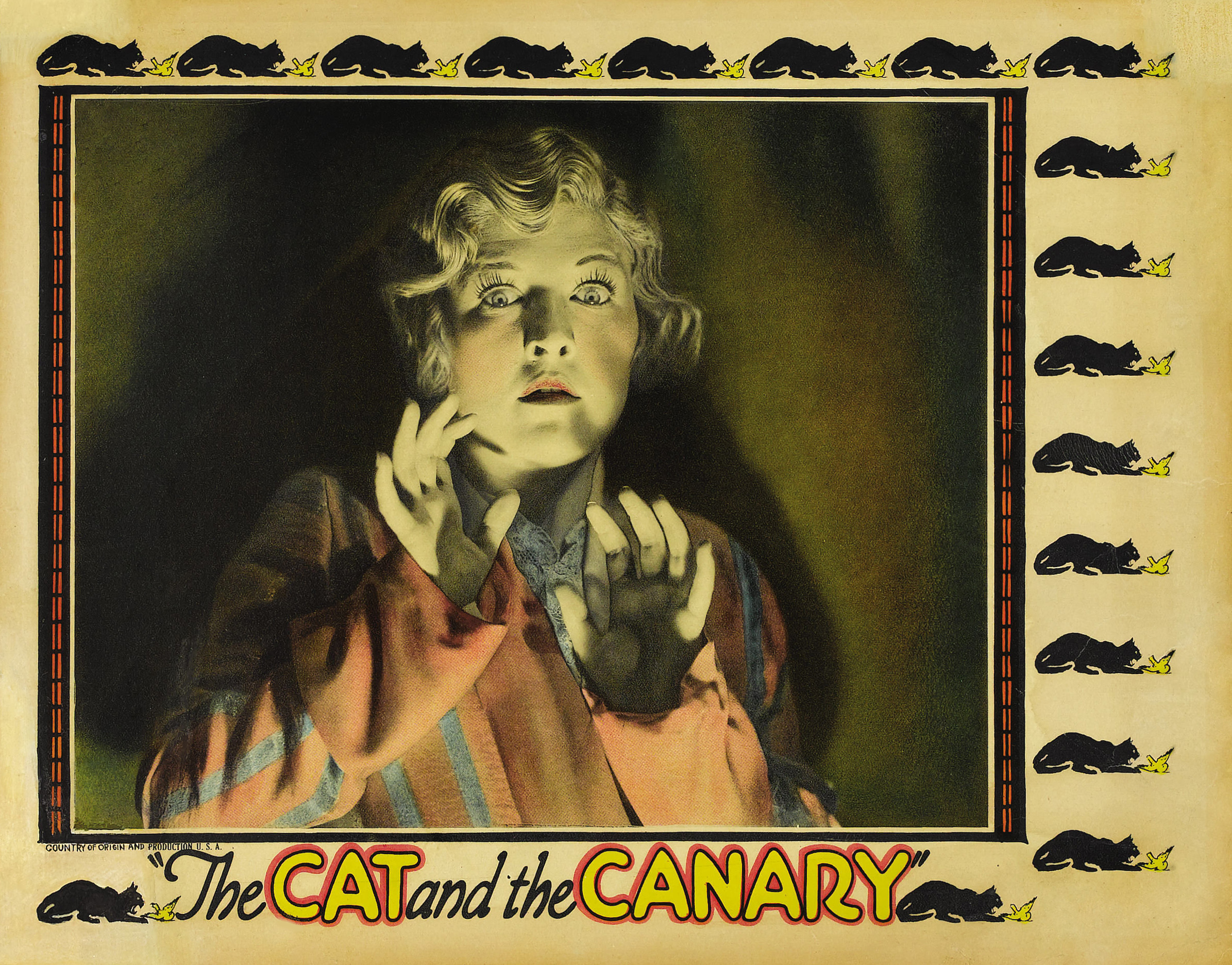
I am a sucker for old dark house stories; the older and darker, the better. These stories were clichéd from practically the moment they were created, but like many clichés, they have a sense of fun to them that few more original narratives manage to approximate. One of the earliest such narratives – on film at least – is The Cat and the Canary, a silent film from director Paul Leni, one of the oft-forgotten masters of German Expressionism.

The film opens with the slow madness and then death of millionaire Cyrus West, who inhabits a multi-turreted Gothic mansion somewhere in the bleak and inaccessible countryside. The intertitles inform us that West was slowly driven mad by his grasping, greedy relatives, as they gathered around him like “cats around a canary.” So West decides to pay them back for their avarice, writing a will to remain locked in a safe until the 20th anniversary of his death, when his lawyer Crosby (Tully Marshall) will open it and announce his heir.

Fast forward those twenty years to one dark and stormy night. The relatives gather for the reading of the will at the Gothic mansion, still presided over by Mammy Pleasant (Martha Mattox), a leering and creepy old housekeeper if ever there was one. When Lawyer Crosby arrives to open the safe, he discovers not one but two wills, with instructions to open the second if the first is not fulfilled. He’s more disturbed by the presence of a moth, indicating that someone has opened the safe in the past twenty years. Then the relatives arrive: Harry Blythe (Arthur Edmund Carewe), Charlie Wilder (Forrest Stanley), Paul Jones (Creighton Hale), Aunt Susan (Flora Finch) and her daughter Cecily (Gertrude Astor), and finally Annabelle West (Laura La Plante). As the family gather round for the midnight reading of the will, the clock strikes for the first time in twenty years and thunder shakes the house.

The heir, of course, turns out to be Annabelle West, the only member of the family who still bears the West surname. Her relatives are predictably disappointed, but things get interesting when Crosby raises a caveat to the will. The heir must be proved to be of sound mind by a doctor arriving that night; if she’s insane, then the fortune passes to the person mentioned in the second will. So with the set-up for potential murder and madness in place, everyone heads off to dinner.

cats

The Cat and the Canary is a surprising film for a number of reasons. Its highly Expressionist opening and rather clichéd structure make it appear like a quintessential early horror film. When a guard from an asylum turns up to warn the house’s inhabitants of a lunatic in the neighborhood – one who “tears his victims apart, like a cat with a canary” – we are solidly in the archetypal realm. Even the characters are less characters and more types: the ingenue, the maiden aunt, the dashing hero, the coward, and the creepy housekeeper. But as the film goes on, the types will be gradually played with and subverted, their roles thrown into relief as the night brings out the madness in them all.

The film manages to hit all the buttons that we might expect from an “old dark house”: a possible ghost, a hidden treasure, a fair maiden in danger, secret passages, vanishing corpses, and a dark and stormy night. It then injects a healthy dose of humor into the mix: cousin Paul is a coward of the first order, diving under tables, and at one point secreting himself beneath Cecily’s bed, where he unfortunately witnesses Aunt Susan and Cecily getting undressed (Wikipedia claims that the pair are mother and daughter, however I always thought that Cecily was just another cousin). As the night drags on and creepy things continue to happen, the extreme reactions of some of the family members provide more humor than fear.

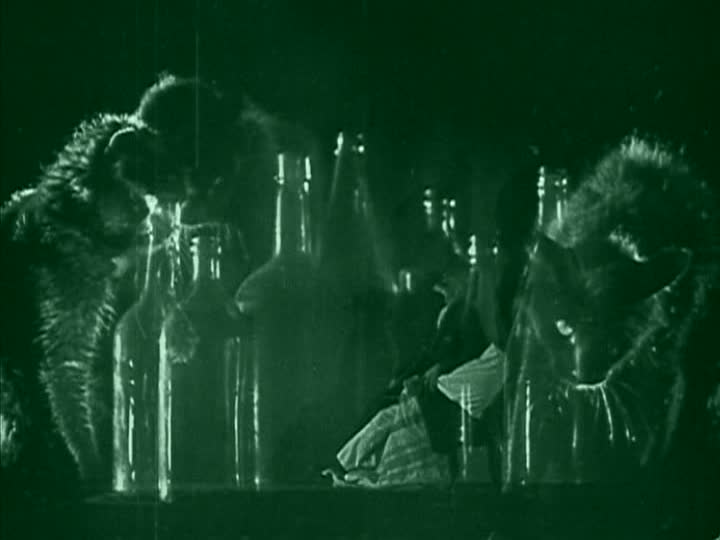
Which is not to say that there aren’t some seriously scary moments in The Cat and the Canary. With the disappearance of Crosby, Annabelle’s sanity comes into question – and only the audience has seen the vague, shadowy figure ducking into secret passageways. It’s amazing what can be done with a long-nailed hand coming out of a wall, or a bizarre shape creeping past a window, made all the more bizarre due to lack of ambient sound.cat-and-canary-1927-imagery

While not exactly a film to provide jump scares or raise your heart-rate, The Cat and the Canary is curiously haunting. It will be remade two more times, once in 1939 and then again 1978, but the silent one is really the best, combining humor and horror, strong practical effects and Expressionist sets. The scares are still there, almost a hundred years later. It’s hard not to shiver when that hand comes out of the wall.

Bloody October: The Shining (1980) and Room 237 (2012)

The Shining (1980) and Room 237 (2012)

the-shining-poster

I’ve decided to combine my reviews of Stanley Kubrick’s The Shining with Room 237, the 2012 documentary about theories surrounding the meaning of The Shining. This is largely because just about everyone and their mother has written a review of The Shining and I have little new to add to the general consensus that it’s one of the scariest movies ever made.

The Shining (in case you’ve managed to miss both it and The Simpsons’ Treehouse of Horror sequence “The Shinning”) is about a nuclear family that decides it’s a good idea to hole up in a massive hotel in the mountains of Colorado, where they will see no one else for five months. The last caretaker happened to chop up his entire family into little tiny pieces, but whatever. Five months rent free!

You know the drill. Jack Nicholson goes all kinds of crazy – as if he wasn’t already – and chases Shelley Duvall and the adorable Danny Lloyd around with an axe after his ghostly friends tell him to. Kubrick creates a deep sense of wrong and foreboding from the very beginning. Subtlety is the name of the game in The Shining; the hotel seems off, with winding corridors that don’t quite make sense, offices with windows where there should be none, shifts in decoration that feel unnatural. The Shining trades on peripheral vision, the sense that something is just not quite right. Kubrick pulls this off by introducing or eliminating small elements in a single frame: a chair that’s there one minute and gone the next; a cigarette with smoke circling inward instead of outward. There are undercurrents of abuse – Danny’s shoulder was once dislocated by his father, though this is claimed as an accident – and unnamed violence. Is the hotel really haunted, or is this Jack having a breakdown? Does Danny cause the madness of his father, a mental projection of anger and hatred? It’s a fascinating, labyrinthine film that gives no real answers or explanations. As Scatman Crothers remarks to Danny, there are just traces left over from the past.

Room237

If The Shining is indeed a movie about traces, Room 237 spins a few convincing (and less convincing) yarns about those traces. Giving voice to some of the interesting, odd and often outlandish theories about the meaning of The ShiningRoom 237 largely avoids passing judgment on the theorists, allowing them to speak for themselves. And the theories are interesting indeed. One presupposes that the whole story is about the genocide of the American Indians, marking out instances of Native American decorations and photographs that dot the hotel. Oddly, the issue of the Calumet baking soda cans prevalent in several shots is dwelt on more than the fact that the Overlook is built on an ‘ancient Indian burial ground,’ that favorite of horror story tropes.

Another less convincing analysis has a German history scholar examining relations of The Shining to the Holocaust – because all post-war violence has something to do with the Holocaust, and Jack totally uses a GERMAN typewriter. A third theorist tries to claim that Kubrick was using The Shining as a way of telling us all that he was involved in faking the moon landing (what?).

Room 237 is not all crazy, though. Most of these theorists have noticed fascinating elements in the film that might otherwise pass unnoticed. All, however, take their analysis just that one step too far, claiming that the film is ABOUT this and only this, and trying – sometimes in very extreme ways – to prove their case.  What none of them focus on, though, are the very disturbing gender relationships, eliding over Jack’s aggression towards his wife and the notion of ‘correcting’ the bad behavior of women and children through physical violence. I’m amazed that anyone can spend twenty minutes proving the genocide of the American Indians via baking soda cans, but miss the whole “I’m gonna bash your fucking brains in”.

The Shining and Room 237 are fascinating to watch together, however, and well worth the time. While none of the proposed explanations are convincing on final analysis, they all pick up on elements within the film that make it so very fascinating to watch.  The Shining is not just a great horror film; it’s a great film, and still has the power to scare the hell out of you.

Bloody October: The Fog (1980)

The Fog (1980)

The-Fog

There are certain gaps in my horror film education that I have struggled to fill. While I’m very good on Roger Corman, James Whale and Tod Browning, I have missed out on the major works of directors like Wes Craven, Dario Argento and, I realize, John Carpenter. Some of this is due to a total lack of interest in slasher films or most body horror, but as a horror fan I cannot run forever. Some films I simply have to see.

The Fog is one of those Carpenter films that I heard good things about and never got around to watching until now. I’m pleased that I did so. It all begins with Mr. Machen (John Houseman) telling a scary story to kids at a campfire. The story sets up the rest of the film, which plays like an urban legend. The town of Antonio Bay suddenly goes crazy one night, with car alarms going off, pieces of stone falling out of walls, and the ground rattling with an unmeasured earthquake. Meanwhile, a glowing fog rolls in across the water, traveling against the wind. The fog, as Mr. Machen tells us, once caused the deaths of ship full of people, crashing them against the rocks in the Bay 100 years ago on that very night. Now it has returned to Antonio Bay, and it brings with it a strange and terrible vengeance.

The Fog really could have gone either way. The notion is a good one – a traveling fog that envelops and murders – but it could easily have slipped into hokey special effects and people running away from a cloud. Carpenter is a better filmmaker than that, thank God. He instills a sense of otherworldly terror in the fog – there are ghosts that come with it, but for the most part they are glimpsed in shadow and profile, announced by a pounding on the door or wall, proceeded by fog and haze. The horror lies in the build-up, not the execution, and there are few filmmakers from the 1980s so capable of building suspense as John Carpenter.

The cast helps too. Jamie Lee Curtis is on hand as a sweet young hitch-hiker who just happens to wind up in Antonio Bay. Her mother Janet Leigh puts in an amusing appearance as one of the town pillars. Adrienne Barbeau is the local radio DJ and as close to a final girl type as we’re going to get. There’s also Hal Holbrook playing a drunken priest who discovers the true story of the founding of Antonio Bay, and the reason why the fog is … really pissed off.

It’s a simple but effective story told in a simple but effective way, which is what good horror filmmaking is all about. Elaborate backstories, big CGI effects and convoluted character development be damned. Horror is about good scares, and The Fog has that in abundance.

Bloody October: Re-Animator (1985)

Re-Animator (1985)

re-animator

I’m a big fan of the works of H.P. Lovecraft, so it was with a feeling of shock and shame that I realized that I had not seen what’s often considered the greatest adaptation of a Lovecraft story ever: Re-Animator, from 1985. So I queued up my Netflix, popped my popcorn, and settled down for what was sure to be a 1980s schlock-extravaganza.

What had I done? I’d been warned about the grossness of Re-Animator, but I did not expect…this. Granted that Lovecraft adores indulging in oozing viscosity and putrid terrors from the beyond, I still did not expect to be translated so very literally to the screen. But my word it was! Re-Animator is one of the grosser, funnier horror films I’ve seen, and I enjoyed every overblown, overheated minute of it.

Re-Animator tells the story of Herbert West (Jeffrey Combs), a brilliant but quite insane medical student who has created a serum capable of bringing the dead back to life. The problem is that the serum mostly just brings back the primitive instincts, not the higher brain functions, effectively turning reanimated corpses into hyper-strong atavistic zombies. It’s a combination of Frankenstein and a zombie movie by way of Lovecraft.

West goes to Miskatonic University (the site of most of Lovecraft’s educational based narrative), where he connects with fellow medical student Dan Cain (Bruce Abbott) and his girlfriend Megan (Barbara Halsey). He also runs afoul of Dr. Hill (David Gale), a doctor whose work on brain death West directly challenged. But all the plot machinations are largely excuses for West and Dan to make some zombies, re-animate some corpses, and explode some body parts in a hail of blood and guts.

The first half of Re-Animator plays like a typical camp 80s horror film; the second half is pure insanity. Staff members are murdered, college deans are turned into zombie slaves, Megan (predictably) loses all her clothes, and severed heads return to life in some of the most hilarious, ridiculous and disgusting ways imaginable. It’s nearly impossible to describe what happens in Re-Animator without resorting to noises of shock and horror, not to mention insane laughter.

There are moments in Re-Animator that would be offensive if they did not take place in such an insane film to begin with. The lengths the film goes to get Megan naked is quite remarkable, but it never quite crosses the line into offensive exploitation. The whole film is so mad that it would be impossible to claim that any one scene goes too far. Props to actress Barbara Halsey, though, for being willing to go the extra mile for … art, I guess.

Jeffrey Combs is the mad center of this mad film, his Herbert West fascinating and repellant and, by the end of it, strangely likable. He’s Dr. Frankenstein on acid, dedicated to his cause and completely without morals. I loved him.

No everyone will love this film. Many will be repelled by the sheer amount of blood and gore, or the sight of a headless man attempting to fellate a girl tied to a morgue slab. But it is, indeed, one of the best, maddest Lovecraft adaptations ever likely to be made. Mr. Lovecraft would be incredibly proud.

Bloody October: House On Haunted Hill

LAST NIGHT: HOUSE ON HAUNTED HILL (1959)

“A woman was just hung in the stairwell; there was a severed head in a girl’s suitcase, we all have loaded guns and Vincent Price is our host.  Well, good night!”

William Castle’s 1959 schlock-fest House on Haunted Hill is iconic and ridiculous.  If Vincent Price offered you $10,000 to spend a night in a haunted mansion, would you go? No, of course you wouldn’t.  Because he’s VINCENT PRICE.  But apparently the five idiots who accompany him didn’t know that.  Thank God, for otherwise this movie would not exist and we would all be the worse for it.

I have no idea what to do with this movie.  It should be terrible – because it is.  The acting is largely atrocious, the plot nonsensical, the script alternately slow and sudden.  And yet…and yet.  I loved it.  Every second of it.  Why? WHY? Well, one why is Vincent Price, who no matter how many bad films he made always injects an edge of class and camp into his performances that made him the go-to guy for schlocky horror.  The other why is the crazy factor of the whole enterprise.  We have seven people locked in a haunted – high modern mansion, and what does their host do? He gives them loaded guns.  There are severed heads that appear randomly in closets which everyone seems to take in stride.  There’s a fucking vat of acid in the basement and this does not cause any great consternation.  These people are insane.

House on Haunted Hill is the best of bad 50s horror – total fun with a few proper scares.