Bloody October: Young Frankenstein

LAST NIGHT: YOUNG FRANKENSTEIN (1974)

Right, so maybe Young Frankenstein isn’t quite a scary movie, but it is a classic in every sense of the word.  Before I ever saw FrankensteinBride of Frankenstein, or Son of Frankenstein, I saw this.

The plot is actually straight from Universal Horror – which is what Brooks is going for, after all.  Frederick von Frankenstein  (It’s pronounced ‘Frahnk-en-steen) (Gene Wilder, insane) goes to Transylvania to take over his family castle.  There he meets Igor (Marty Feldman, hilarious), his lovely assistant Inga (Teri Garr) and Frau Blucher (Cloris Leachman, scaring the horses).  Convinced to begin trying to build his own Creature, Frederick steals a corpse and sets about making his own little Monster.  No way this could possibly go wrong.

It’s the plot of every Frankenstein movie, more or less.  But this is a comedy.  And what a comedy! Brooks is at his best when he’s parodying something he truly loves.  His love of Frankenstein films comes through in every frame.  Whole sections are lifted from Bride of Frankenstein and particularly Son of Frankenstein – like Gene Hackman’s Blindman and Kenneth Mars’s Inspector Kemp – but it never goes over into disrespect or derision.  It’s hilarious because it’s so loving.

Not a little of this has to do with the cast.  Gene Wilder is at his best – alternately wild and balanced, likable and pretentious, with hair that Einstein would have envied.  But everyone is not only game for their roles, but also exceptional comedians.  No one can inject humor into a small role like Madeleine Kahn; she’s resplendent and hilarious as Elizabeth, Frederick’s venal, virginal fiancée.  Likewise Teri Garr, in a role that could have fallen into the ‘dumb blonde’ category.  Then Marty Feldman, Kenneth Mars, Gene Hackman, Peter Boyle as the Monster, the villagers … they’re just all so good. Wilder and Brooks wrote the script, which might have something to do with this film being far and away Brooks’s best work.

In any case, if you haven’t seen it, you need to.  You’ll never look at Franky the same way again.

Bloody October: The Rocky Horror Picture Show

LAST NIGHT: THE ROCKY HORROR PICTURE SHOW (1975)

I’m really behind on these, ’cause I definitely watched this one last Friday.  Anyways:

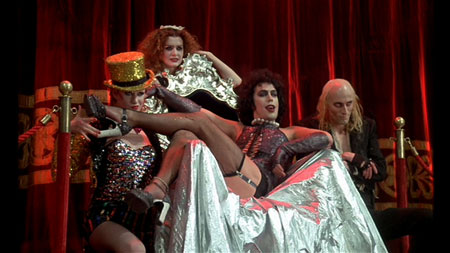
The Rocky Horror Picture Show.  This is one of those films that you either love and indulge in, or you sit there for two hours going: what the fuck is happening? The bare bones of the plot cannot do justice to the supreme campiness of Rocky Horror. Newly engaged young people in Denton, Ohio,  Brad (Barry Bostwick) and Janet (Susan Sarandon) have their car break down on a back road and – of course – wind up in a creepy castle with even creepier inhabitants. Dr. Frank N Furter (Tim Curry), a transvestite mad scientist, his lovely assistants Magenta (Patricia Quinn) and Columbia (Little Nell), and butler Riff-Raff (Richard O’Brien) have come together to throw a party and premiere Frank’s newest (and sexiest) creation Rocky Horror (Peter Hinwood). Brad and Janet have no idea what they’ve gotten into.

There are simply no words. References to 50s and 60s horror films abound, Meat Loaf makes an appearance to sing a song and get murdered; complicated sexuality reigns supreme.  There’s violence, sex, nudity and rock music. Tim Curry is the sexiest transvestite ever, the music is over the top, the ending beyond bizarre.  At the end of the day, Rocky Horror is what Robin Wood would call an ‘incoherent text’.  It begins to ramble in the second act, and finally explodes in the third.  But in between it is so much fun that you just have to sit back and, well, give yourself over to absolute pleasure.

Watching it again reminded me of some parties I’ve gone to: it all begins with a lot of fun, drinking and dancing and ends with the Apocalypse.  Still, you know that you want to do the Time Warp again.

Bloody October: The Wolf Man

Last Night: THE WOLF MAN (1941)

Poor puppy.  The Wolf Man is the saddest of the Universal Monsters, a woefully misunderstood creature who can’t help what he does and just needs his daddy to love him.  Larry Talbot (Lon Chaney Jr.) returns to his family castle in … well, I think it’s England, but the accents are all over the place.  His father Sir John Talbot (Claude Rains) is a kindly but distant fellow who loved Larry’s elder brother much more than his big, cuddly and sad-eyed younger boy.  Larry instantly falls for the pretty girl in the window Gwen (Evelyn Ankers).  But of course, he gets bit by a gypsy werewolf (Bela Lugosi, underused) and descends into the netherworld where he can no longer control his animal urges.

The Wolf Man is the iconic werewolf film, referenced in every single werewolf movie since, and Lon Chaney Jr. is the perfect werewolf.  He’s a large but gentle man, sad-eyed and generous, and does not deserve what becomes of him.  Which is exactly the point.  Unlike many of the wolf men who come after him, Larry really is just in the wrong place at the wrong time.  He’s bitten only because he tries to help a girl, and no one will believe him when he claims to be a danger to himself and others.  The other characters are all archetypes: the hunter (Patric Knowles), the policeman (Ralph Bellamy) and the doctor (Warren William).  The film plays like a gothic fairytale, down to the little old gypsy woman and her poem about pure hearts and wolf bane.  The Wolf Man is a late Universal film, but it deserves to rank up there with Dracula and Frankenstein.

Bloody October: The Exorcist

Last Night: THE EXORCIST (1973)

I’m a terrible horror fan.  26 years old and I had never seen The Exorcist until this week.  Terrible.  I blame the educational system.

You know the plot, but to reiterate: Regan (Linda Blair), a pretty normal adolescent girl and daughter of an actress (Ellen Burstyn), is possessed by … well, by Satan, apparently, although I have my doubts.  Call in Father Damian (Jason Miller) and Father Merrin (Max von Sydow) to exorcise the demon.

The Exorcist is one of those films that I fear has not aged terribly well.  This is not to say that it’s not a great film – it is.  The performances are uniformly excellent, the special effects spectacular for their time period, the script intelligent (and humorous), and the directing above standard.  But for all that, I must admit that I did not find it particularly scary.  The scares have been done so many times, in parody and out of it, that I saw them coming a mile away.  Regan’s spinning head and vomiting green goo are both pretty freaky in terms of effects, but not in terms of scariness.  More troubling is her tendency to swear at everyone and stab herself with a crucifix, but even that, while shocking, is not particularly frightening. What’s more, I was never convinced that this was really Satan.   Doesn’t the Prince of Darkness have better things to do than inhabit a little girl’s body? Shouldn’t he be trying to overthrow the world, or bring about the Apocalypse, or teach people at crossroads how to play guitar?

Perhaps the point is that it’s not Satan, but just a rather mischievous demon who got bored.  In any case, it’s a great film, but it failed to give me even a single bad dream.  I must admit that I expect more from the Fiend.  At least some more colorful curses than just telling priests to fuck off.

The Haunted Feminine Part 1

Several years ago, I wrote a series of papers for a horror and sci-fi class at NYU about the trope of what I called the “haunted feminine” in certain horror/suspense films.  In the spirit of the season, I offer my analysis of some seriously scary movies.

“Supposing it is in my imagination: the knocking, the voices, everything.  Every cursed bit of the haunting.  Suppose the haunting is all in my mind […] I could say all three of you are in my imagination.  None of this is real.” –Eleanor (Julie Harris) to Dr. Markway (Richard Johnson) in The Haunting (MGM, 1963).

In her essay ‘Horror and the Monstrous Feminine: An Imaginary Abjection,’ Barbara Creed examines the horror genre’s construction of the feminine as monstrous and abject.  While she focuses on the more violent and blood-oriented past and contemporary horror films, she does not particularly address the quieter aspects of horror.  Another trope of a sub-genre of horror complicates, perhaps even belies, the concept of the monstrous feminine.  It is what I shall call the haunted feminine, a trope most notably present in Robert Wise’s The Haunting and Jack Clayton’s The Innocents (Fox, 1961).  It consists of the presence of the haunted subject, always a sexually repressed female, through whom the film is primarily focalized.  Eleanor (Julie Harris) in The Haunting is the main target of the ghosts of Hill House, which she interprets as the house ‘wanting’ her.  Only the character of Miss Giddens (Deborah Kerr) in The Innocents actually sees the ghosts she believes possess the two children under her care.  The films do not at all make clear whether the hauntings actually take place in the ‘real’ world.  There are numerous indications that the hauntings may be merely projections of hysterical female minds.

Much horror scholarship rightly addresses the alliance between the feminine and the world of the horrific Other, whether as (complicit) victim or actual monster.  This concept allows for terror to be located in the physical body of the female—whether the monstrous alien mother in Alien (Fox, 1979) and its sequels, the possessed body of Linda Blair in The Exorcist (Warner Bros, 1973), or the powerful, pubescent body of Carrie (Sissy Spacek) in Carrie (United Artists, 1976) (Creed 44-59).  The haunted feminine locates the monstrous in the woman’s mental existence, not her physical one.  She may invent for herself ghosts and haunted houses, constructing narcissistic narratives wherein the house ‘wants’ her (The Haunting), or only she can ‘save the children’ from their ghostly possessors (The Innocents).  The susceptible mind of the woman becomes the site of monstrous apparitions: faces that spring from walls, banging on doors, cold spots, memories of past murders, ghosts walking along dark corridors, etc, etc.  These ‘innocent’ women elucidate their sexual and religious repression in the form of ghosts and possessions; the haunted world quite literally springs from the mind of a woman.

Haunting narratives emphasize female hysteria, connecting them to a sub-genre within film noir, the gothic women’s film, in which a female protagonist suspects her husband/lover of attempting to murder her (Doane 127).  The gothic women’s film narratives are usually focalized through the main female protagonist, establishing viewer identification with the woman’s plight.  The viewer experiences the same fears and doubts of the central protagonist, uncertain about the sanity of the husband and his possible murderous tendencies.  Many of these films show the woman’s terror to be justified.  Secret Beyond the Door (Universal, 1948), Love from a Stranger (United Artists, 1937), Gaslight (MGM, 1944),and Midnight Lace (Universal, 1960) all bring to light a monstrous masculinity.  Other films prove to be nearly hysterical fantasies in which the husband/lover is innocent of murderous impulses: Suspicion (RKO, 1941) and Lured (United Artists, 1947).  The female protagonists are usually active figures who take the initiative to investigate the male psyche, building up evidence for and against their husbands/lovers.  They have an advantage over their haunted counterparts, who face the less tangible possibilities of the supernatural world.  Most of the gothic women’s films come to a defined conclusion in which the mystery of masculine aggression is solved.   (One possible exception is Hitchcock’s Suspicion, depending on how one reads the apparently happy ending).  The wife either exonerates the husband/lover and catches the true murderer, or proves him guilty, to be either destroyed or cured.

The films that examine hauntings are typically more ambiguous and give their protagonists less initiative than their counterparts in gothic women’s films.  The haunting narrative’s emphasis on a woman’s repressed sexuality, and her subsequent Otherness, contributes to the hysterical nature of the narrative.  The main character of Eleanor in The Haunting best represents this repressed, dangerous figure, typing her as Puritanical from the very beginning.  Rejected by her sister, terrified of being left out or left alone, desperate for affection and attention, and finally developing a crush on Dr. Markway, Eleanor poses a perfect hysterical subject.  Her incipient sexuality, at once repressed, Puritanical and seething to escape, finds expression in the events of the haunting.  Freud discusses hysteria in women in Inhibition, Symptom and Fear as a reaction to the sexual act:

In women, direct fear of the sexual function is common.  We class this as a form of hysteria, as we also do in the case of the defensive symptom of disgust (Freud 154).

It is possible to read Eleanor’s persistent experience of the haunting as a manifestation of both her fear and desire for sexuality.  Eleanor violently rejects the coded lesbian Theo (Claire Bloom), who frightens her in virtue of her sexual status as Other, telling her:

“The world is full of inconsistencies, unnatural things.  Nature’s mistakes they’re called.  You, for instance.”

Eleanor’s rejection of Theo is a rejection of Otherness, of ‘unnatural’ sexuality. While the film never fully delineates Theo’s sexuality, her appearance, ambiguous name, jealousy of Eleanor’s relationship to Markway, rejection of the advances of Luke (Russ Tamblyn), as well coded references to her ‘partner’ and lack of marital status, establish her as a lesbian figure, or at least a figure outside established bounds of ‘acceptable’ sexuality.  Eleanor gravitates towards Theo as one who offers an alternative to bound heterosexuality, but turns to Markway as the hero of her dreams.  When Markway turns out to be married, Eleanor shifts sexual allegiance again, expressing a desire to be ‘united’ (read: married or sexually incorporated) with Hill House.  Eleanor’s final descent into madness occurs with the appearance of Markway’s wife Grace (Lois Maxwell), whom Eleanor suggests should sleep in the haunted nursery, the ‘cold heart’ of Hill House.  When Grace disappears during one of the film’s most frightening set pieces, the physical existence of the house and the haunting come together with Eleanor’s psychic breakdown.  Eleanor and the house fall apart together.  The haunting reads as a manifestation of Eleanor’s repressed sexuality.
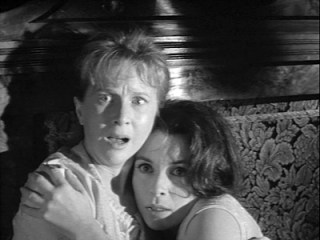
The expressive feminine response to repression that manifests itself in the creation of the monstrous other, whether that other is a physical monster, ghost or a psychic projection induced by hysteria, works both for and against the possibility of claiming these types of films in general, and The Haunting in particular, for feminist or proto-feminist discourse.  Most feminist analysis of the horror film postulates the woman as monster, as sexual aberration, or disturbed victim that must be eradicated.  Linda Williams even goes so far as to claim that

The horror film may be a rare example of a genre that permits the expression of women’s sexual potency and desire […] but it does so in these more recent examples only to punish her for this very act, only to demonstrate how monstrous female desire can be (Williams 32-33).

Williams typifies horror as a genre that permits expression of female desire only to violently quell it in death and blood.  The Haunting and its ilk may fit this discourse to a certain extent: Hill House either kills Eleanor or she commits suicide in order to remain with it.  Eleanor can be read as both the victim of the house, and the cause of the haunting.  She is certainly complicit in her own destruction, as she desires union with the house that at the same time frightens and horrifies her, just as she is repelled and attracted to the sexual act.

The ambiguity of the haunting itself further complicates such analysis.  Director Robert Wise focalizes the majority of the narrative around and through Eleanor, privileging her point of view.  The spectator sees, in certain key scenes, more or less what Eleanor sees, hears and experiences.  The film creates an interior, psychological fear, heard and felt, but rarely visible.  The end leaves the viewer to wonder what was ‘real’ in the world of the film.  Was Eleanor simply a mad woman, projecting her fears and desires onto the surface of an uncanny old house? Or, was the house truly evil, haunted, attempting to keep her there as a wandering victim? Because the film never answers all the questions it posits, and refuses to explain the haunting in full, severe doubts are raised in the viewer’s mind about what is seen and what is not, what has been explained and what has not.  Because of this very ambiguity, the film fails to easily fit into an anti-feminine discourse about monstrosity.  Eleanor is both victim and cause, depending on how one reads the film.  She is sympathetic and unsympathetic—sympathetic if the house is really trying to destroy her, unsympathetic if she has narrated herself into a narcissistic tale of being wanted by the other world.

In the middle of the film, the four main characters crowd around a statue of Hugh Crain and his family.  Each gives their interpretation of the tableau, bending the narrative in one direction, then another.  No narrative construction, however, can fully explain the configuration of the statues.  That which remains unseen, pushed to the peripheries of the frame, becomes difficult to deconstruct and force into a paradigm.  The Haunting may very well be about a narcissistic, repressed young woman descending into suicidal madness.  It may also be about pervasive forces of another world preying on the fears of a susceptible mind. Eleanor is a woman haunted by desire, guilt, fear and loneliness.  Like Irena’s obsession over her village’s curse in Cat People (RKO, 1942), Eleanor becomes obsessed with the conception of the haunting.  The narrative of Hill House as haunted is both a cinematic reality and a projection of her mind.  She wants the haunting to be real because it enables her to belong to something.  Hill House exists in a world where ambiguity reigns, where the trope of the haunted feminine is monstrous and pathetic, the cause and victim of things that go bump in the night.

Creed, Barbara.  ‘Horror and the Monstrous Feminine: An Imaginary Abjection’ in The Dread of Difference: Gender and the Horror Film, ed. Barry Keith Grant, University of Texas Press: 1996.

Doane, Mary Ann.  The Desire to Desire, Indiana University Press, Bloomington: 1987.

Freud, Sigmund.  ‘Inhibition, Symptom and Fear’ in Beyond the Pleasure Principle and Other Writings, trans. John Reddick, Penguin, New York: 2003.

Williams, Linda.  ‘When the Woman Looks’ in The Dread of Difference: Gender and the Horror Film, ed. Barry Keith Grant, University of Texas Press: 1996.

Clayton, Jack (dir).  The Innocents, Twentieth Century Fox, 1961.

Cukor, George (dir).  Gaslight, MGM, 1944.

De Palma, Brian (dir).  Carrie, United Artists, 1976.

Friedkin, William (dir).  The Exorcist, Warner Brothers, 1973.

Hitchcock, Alfred (dir).  Suspicion, RKO Radio Pictures, 1941.

Lang, Fritz (dir).  Secret Beyond the Door, Universal Pictures, 1948.

Lee, Rowland V. (dir).  Love from a Stranger, United Artists, 1937.

Miller, David (dir).  Midnight Lace, Universal Pictures, 1960.

Scott, Ridley (dir).  Alien, Twentieth Century Fox, 1979.

Sirk, Douglas (dir).  Lured, United Artists, 1947.

Tourneur, Jacques (dir).  Cat People, RKO, 1942.

Wise, Robert (dir).  The Haunting, MGM, 1963.

*Paper originally written for Horror and Sci-Fi, Prof. Ed Guerrero.  Copyright Lauren Humphries-Brooks 2009

Bloody October: Poltergeist

LAST NIGHT: POLTERGEIST (1982)

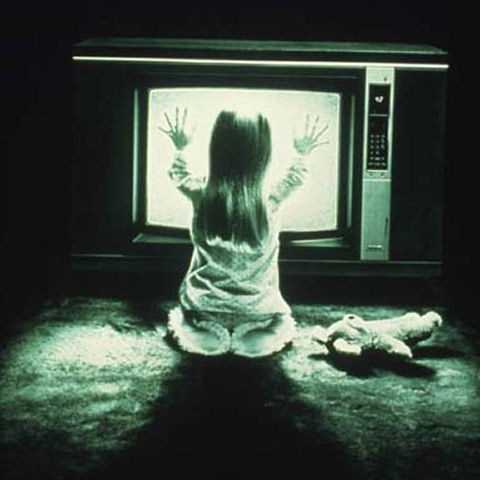
You want to know where Paranormal Activity got it? Poltergeist.  With the combined might of Steven Spielberg (before he got too warm and fuzzy) and Tobe Hooper behind it, Poltergeist is one of the first, and best, of the suburban haunted house films.  A nice suburban house nice suburban neighborhood transforms into a portal to hell.  It all starts out innocently enough, with the little girl Carol Anne (Heather O’Rourke) sleepwalking and talking to the static on the TV.  Then something stacks all the kitchen chairs.  The beginning of the haunting is actually treated with a sort of glee, as the mother Diane (Jobeth Williams) experiments with the moving furniture in the kitchen. Then the “TV people” come and take Carol Anne away through the closet and things get much more serious.

I’ve seen Poltergeist numerous times now and I always forget just how damn good it is.  It’s a commentary on how disrespectful and thoughtless modernity can be.  It calls into question just how safe we are in our planned communities, how little we think of the past and what will burst through at a moment’s notice.  The adults initially treat the haunting as a game, until the most basic fear of every parent – their child being taken – is played upon with brilliant precision.

Poltergeist makes use of all the trappings of suburban life.  The dead come back because they’ve been disturbed when the planned community is  built on top of a cemetery.  It’s the revenge of the ancient on the unthinking, disbelieving modern, and the terrors are as primordial as they come.

There are few viewers who don’t relate to those childish nighttime fears, like your toys are trying to kill you, or the tree outside your window is going to grab you out of bed.  The very fact that the entrance to the other world is in a child’s closet is part of the most basic fears of childhood.  There is something in the closet, and it’s coming for you.

Bloody October: The Cabin In The Woods

Last Night: THE CABIN IN THE WOODS

It’s taken me this long to finally see the Joss Whedon penned The Cabin in the Woods.  Oh, how I wish I had not waited.  It’s … epic.  Somewhere in the vein of Tucker and Dale vs. Evil with a smattering of Scream.  Then again, it really does stand in its own category.  Five college kids go to a cabin in the woods and everything begins to go horribly, hilariously wrong.

My one objection is that it is not really scary.  It’s funny, it’s dark, it’s provoking, but there are few scares, mostly because we know at least part of what’s going on from the very beginning.  It helps if you have a working knowledge of quite a few horror franchises, are apprised of the rules of slasher films, and can recognize certain tropes without having them handed to you.  But there’s so little that can be said about The Cabin in the Woods without giving the game away, so I’ll just say that it’s well worth a watch.  And you don’t even have to keep the lights on.

Bloody October: Sleepy Hollow

Right, so as I have limited time but I really want to keep updating this here blog o’mine, I’m going to start posting short musings uponst the scary movies I watch this October. Why? Because the leaves are falling, the skies are going grey, the wind howls through the skeletal trees and it’s time to consume massive amounts of candy and have bad dreams about werewolves, non-sparkly vampires, haunted houses, nasty ghosts and Vincent Price.  Or Peter Cushing, whoever takes your fancy.

LAST NIGHT: SLEEPY HOLLOW (1999).

Ever will I defend Tim Burton, because of movies like this. To launch my October scary-movie-watching, there’s nothing better than Burton’s somewhat tongue-in-cheek tribute to Hammer horror. Johnny Depp plays Ichabod Crane, a pale-faced New York constable headed upstate to the wilds of the Hudson Valley to investigate several beheadings that have been blamed on the local ghost. He finds, natch, a bunch of weird locals, foggy and twisted woods, a few more beheadings and a lovely Burtonian waif in Christina Ricci. Cue gushing blood, heaving bodices, one hell of a carriage chase and a burning windmill.

Burton and Depp were at their best in the 90s. In some ways, Sleepy Hollow is the icing on the cake of Beetlejuice, Edward Scissorhands and Batman Returns. References to Hammer films abound, from the outlandish blood, spinning heads and dark backstory, to the presences of Michael Gough and Christopher Lee in bit roles. The film doesn’t take itself too seriously, but neither does it turn the gothic and  romantic story into a parody. Depp as Crane is a likable but squeamish detective, tortured by the past and not terribly certain about the future. He avoids the caricature that has sadly colored his latest roles; watching it last night, I was struck with the realization that this might be the last time we see Depp the Actor instead of Depp the Star. The cast surrounding him from Ricci on down is uniformly excellent, all of them sinking their teeth into their parts with gusto – especially Christopher Walken in a non-speaking but pivotal role.

The film bears only a passing resemblance to Washington Irving’s folksy horror story, despite an excellent tribute in the middle of the film as the Horseman rides Ichabod down bearing a flaming pumpkin in his hand.  It does trade in folk tales and cinematic references – the burning windmill will please anyone who has seen the original Frankenstein.  The film looks and feels like a New York horror story with an edge of Hammer and Universal. Burton knows his horror. He does his best work when he tries to make a good story first and layers the Burtonian influences on second.

Sleepy Hollow is the way I always start my Halloween. It’s a more adult film than Beetlejuice or The Nightmare Before Christmas, and miles away from disappointments like Alice in Wonderland. I know viewers who don’t like Tim Burton who love this film. But it helps if you like Tim Burton.

The Inessentials: People Will Talk

Few films have such a hold on my affections as this one.  It is a work of supreme humanism, about a doctor whose purpose in life is to ‘make sick people well’.  What’s more, it carries with it overtones about the roles of women, morality, abortion, the death penalty, the communist witch-hunts of the 40s and 50s, and unfettered capitalism, among other things.  The fact that it was made by a major studio in 1951 speaks to the remarkable nature of the film.  So why don’t more people know, and talk, about People Will Talk? 

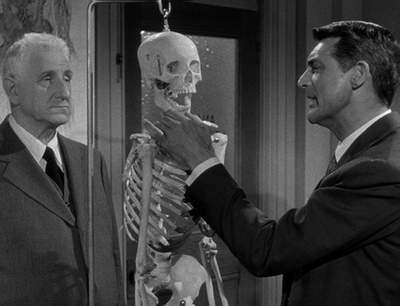
It is not Cary Grant’s most iconic role, but it very well should be.  Grant plays Noah Praetorius, a doctor who teaches at a university and runs a clinic based on the notion that it is the job of a doctor to cure the sick in whatever way possible, holistically and otherwise.  The first section of the film focuses on Praetorius’s relationship with his friends Shunderson (Finlay Currie, in a role that should have received an Oscar nod) and Professor Barker (Walter Slezak), his rival at the university Professor Elwell (Hume Cronyn, as mean a little wretch as ever committed to film), and his growing relationship with Deborah (Jeanne Crain), a medical student, eventual patient and unwed mother.

The relationship between Praetorius and Deborah occupies most of the first half as the film, as Deborah discovers that she’s pregnant by a former flyboy now dead.  She’s checked into Praetorius’s clinic again after she attempts to kill herself, ashamed and terrified of informing her father, whom she insists it will ‘kill’ to know that his daughter is having a baby out of wedlock.  The film addresses the issue of the pregnancy with beautiful humanity.  There is no moralizing – as far as Praetorius can see there is nothing for Deborah to be ashamed of – and no punishment in store for the young woman.  She is not even really afraid of being rejected by her father; her fears are more founded on his dedication to her and his dependence on her.  Even her suicide attempt is not a serious one.  The pregnancy is treated with an equal amount of frankness and delicacy.  When Praetorius finally proposes marriage, as we knew he would, he does so not because he feels sorry for her or because he wants to “save” her.  He’s fallen in love with her.

Praetorius’s conflict with Professor Elwell takes up the second half of the film.  Elwell has spent much of his early scenes trying to discredit Praetorius as a teacher and a doctor, ultimately lighting on the curious relationship between Praetorius and Shunderson, his friend and helper.  The trial sequence takes place on the night of a concert Praetorius is supposed to be conducting.  As Praetorius deftly turns away each of Elwell’s accusations – that he’s a charlatan, a poor doctor, etc. – he exposes the hypocrisy of the whole process.  Elwell’s accusations are hearsay and implications, all tending to try to discredit Praetorius without necessarily settling on anything that is illegal or actionable.  While I won’t go into details about the final revelations about Shunderson, to whom Praetorius is intensely dedicated throughout the film, the conclusion is lovely and affecting.

People Will Talk raises so many interesting issues with such gentle humanity that it’s difficult to pick on any one element.  The trial sequence at the end is meant to mirror the witch-hunts of the Hollywood blacklist, depending as it does on vague implications but no real crime.  Which brings the whole film back around to its title.  From Deborah’s pregnancy, which is not criminal but somehow morally wrong in the eyes of 1950s society, to Shunderson and Praetorius’s relationship, and finally to Elwell’s insinuations about Praetorius’s capabilities as a doctor, the entire film is structured around what is not spoken, what must be implied in order to condemn a person.  But in each case, it is humanity that triumphs.  Deborah has not committed a crime, she is not punished for it, she’s rather rewarded in the person of a loving husband and devoted father.  Praetorius is an immensely capable doctor, superior to Elwell in his abilities but also in his compassion.  The film celebrates compassion and love over propriety and hypocrisy.  And it does so without ever becoming maudlin or melodramatic.

The cast is uniformly superb.  Grant’s biggest challenge in some ways is to keep Praetorius from looking too much like a saint, but he keeps an unearthly man firmly grounded; he’s a boy that plays with trains as well as a kind and dedicated doctor.  He’s a man capable of passion as well as compassion for his future wife.  Grant’s humor keeps him from floating into the stratosphere; Praetorius never ascends to the height of a saint.  Praetorius does not exist, but he really should.

Jeanne Crain likewise gives an excellent, difficult performance, never slipping into sentimentality.  Deborah’s great dilemma is about her unborn child, her relationship with her father and her eventual love for Praetorius, but she is a full, rounded character.  She gives a human account of her relationship with the child’s father, of her reasons for loving him as well as her reasons for falling in love with Praetorius.  She’s believable as both the frightened young mother in a difficult situation, and as the somewhat strong-willed woman who runs away from a clinic in the middle of the night.

I do however give the edge to Finlay Currie as Shunderson.  He’s a large, lumbering man of exceptional gentility, quietly stealing every scene he’s in.  His final story at the trial, when he reveals how he came to know Praetorius, is at once hilarious and moving.  He’s an unknown factor in the film, a lover of animals whose dedication to his friend is equalled only by his absolute love for him.

Filmmakers would do well to take a cue from People Will Talk.  There are few films capable of such humanism, such gentleness and frankness.  There is no preaching, no moralizing, no retribution and no posturing.  Too often films attempt to get their message across by beating you over the head with it.  This film attempts to get its message across by appealing to basic decency and humanity, by giving the viewer the opportunity to recognize that there are ways to live beyond the narrow strictures of proper society.  The point that it makes is that people will talk no matter what; what we need to learn is how to live our lives independent of what they say.  Kindness, love, humanity; these are the things that really matter.  All the rest is just needless gossip.

A Raging Moon

Today is Keith Moon’s birthday and my Facebook friends, I’m certain, are sick to death of hearing about him.  But I can’t help it.  There are a handful of rock musicians that I honestly love: John Lennon, Roger Daltrey, Ringo Starr and Moon.

Moon, because he was crazy.  Because he was the supreme manifestation of the id.  Because … he was a fucking genius.

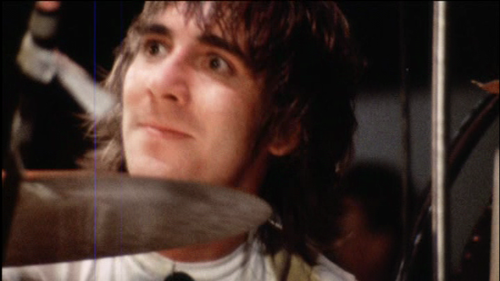
Ringo was the reason I wanted to be a drummer.  Moon is the reason I want to stay one.  Watching videos of him onstage is elevating; he was at once so happy and so mad.  He was a remarkable drummer.  For all his histrionics, you can see the concentration in his face in concerts like the Isle of Wight.  The speed of his hands, the precision of everything he did, even when he fucked up.  He was a serious musician who honestly loved his instrument, who made it an extension of himself.  He was the original showman drummer, but he was not the lesser musician for that.  There’s nothing like the happiness on his face; it’s a release, a channeling of his supposed madness.  He’s having a great time; what’s more, he wants everyone else to have one too.

All too often stars like that vanish underneath the weight of their celebrity.  Moon was a wild man offstage and that sometimes is all we remember.  How he drank himself to death, how he blew up toilets, destroyed hotel rooms, drove cars into pools.  Courted chaos at every turn.  But, if Townshend and Entwhistle and Daltrey and almost anyone else who knew him are to be believed, he was also a genuinely kind, genuinely loving person.

In the end, though, none of us now can know Keith Moon, or assess who he really was.  All we have left is the music.  And what music it is.

Happy Birthday, Moonie.

http://www.youtube.com/watch?v=Hk1ibrnk20Y