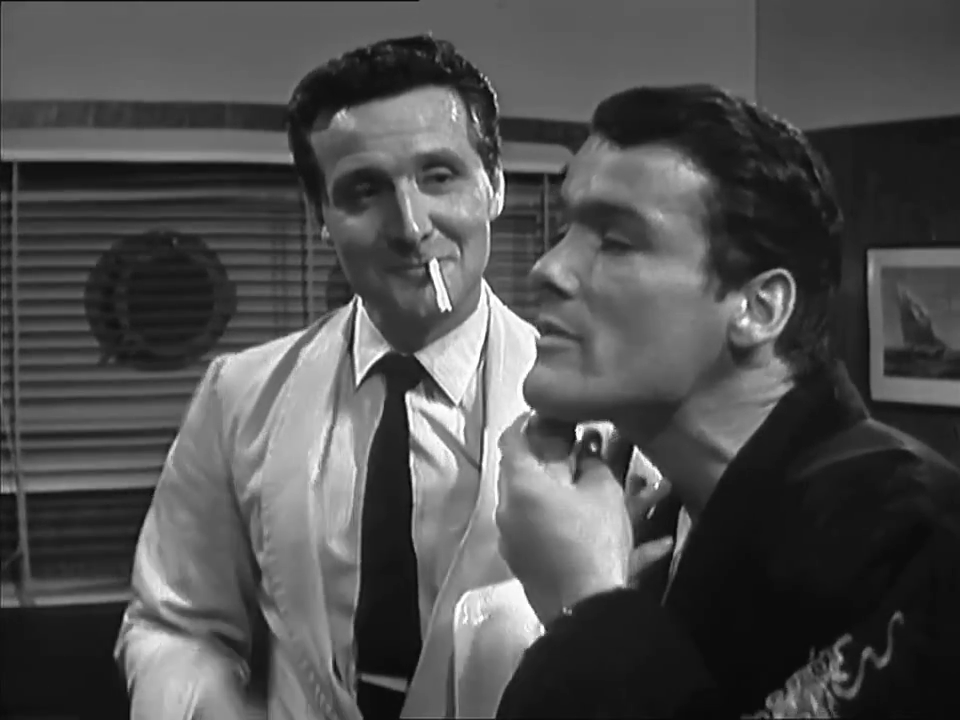
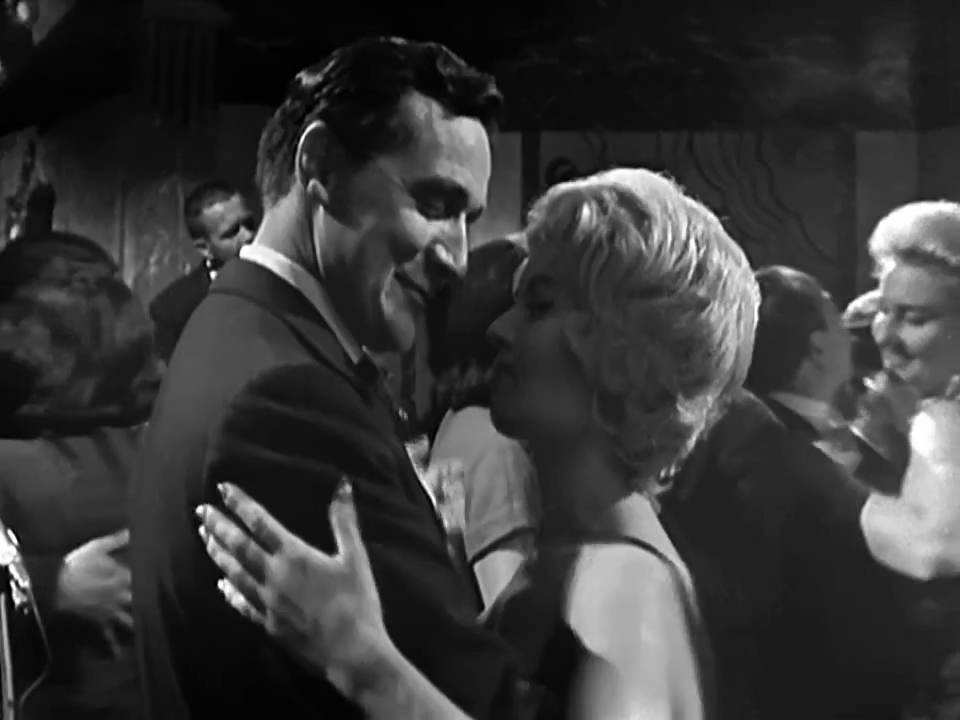
The Avengers: Dead On Course

Dead on Course (Episode 02-14, December 1962).
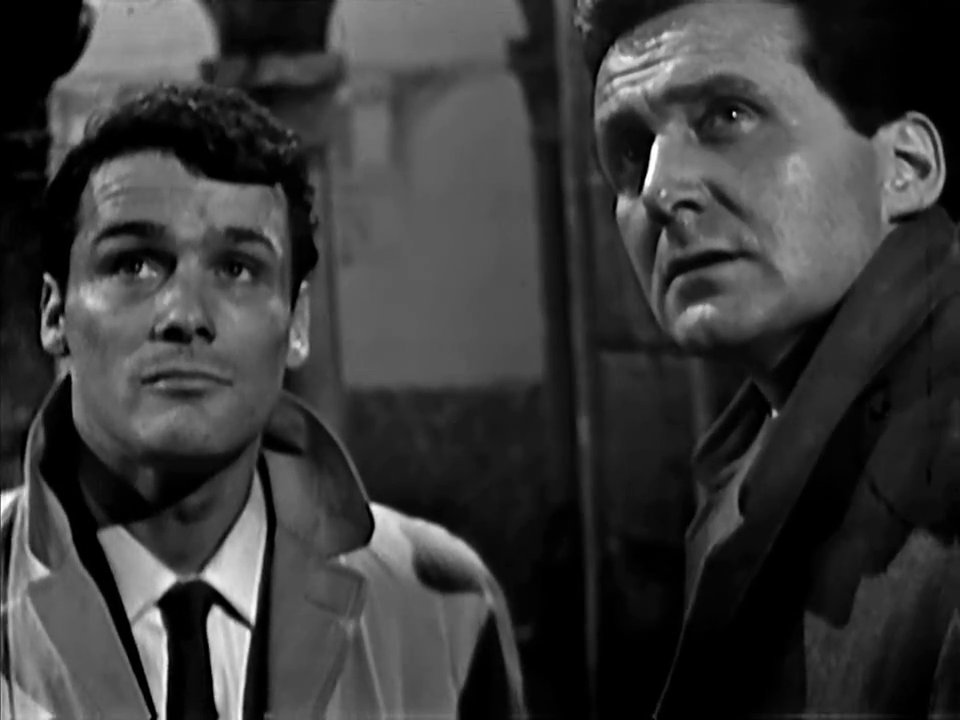
john-steed-dr-king-dead-on-course

In the third and final Dr. Martin King episode Dead On Course, we take a sojourn out of England and head for Ireland. Steed is sent to the Emerald Isle to investigate a plane crash and the disappearance of some bank consignments that happened to be on board. He drags Dr. King along, presumably because Cathy Gale does not have a medical degree (although what I wouldn’t have given to see what Cathy made of this one).

The crux of the script involves a plane crashing apparently off-course, the last in a series of mysterious plane crashes. The multiple dead are taken to a nearby nunnery. There’s a survivor, though: a severely concussed air hostess who might know what’s been happening to the planes. Things are further complicated when Steed discovers that the co-pilot is not numbered among the dead. Bizarre goings on at the local pub, the local airfield, and the local nunnery are all wrapped up in a somewhat confusing script.

Dead On Course is one of the more complex episodes to come out of the second season. It doesn’t much matter what’s actually happening, of course: there are villains with Irish accents, nefarious shenanigans, and Steed flying a plane. It seems safe to presume that this episode is a leave-over from the hard-boiled, more dramatic first season of The Avengers, as it bears little resemblance to some of the weirder-themed episodes featuring Cathy Gale or Venus Smith. Although death tolls in this series are sometimes surprisingly high, this one brings us up close and personal with at least one murder, not to mention the aftermath of a massive air crash. Steed gets very violent with one villain which, while justified, is shocking to those who have only seen him as the bowler-hatted English gentleman.

There’s not a great deal to recommend about Dead On Course, unless you’re a completist (or a Steedophile like myself). It’s a middling little drama with little flair until the end. There is the enjoyable performance of Donal Donnelly as the apparently simple pub worker Vincent O’Brien, but beyond that you might as well skip it. Even nuns with guns cannot make this more than slightly interesting. Good-bye, Dr. King. You probably deserved better.

Q Planes (1939)

Q Planes (Clouds Over Europe)

q-planes

If you thought that British espionage stories started with a certain dry martini-drinking superspy, then you are missing out. Our neighbors across the pond have a long history of some excellent espionage in both film and print, featuring a whole host of literary heroes who were spying for Queen (King) and Country long before Mr. Bond was out of diapers (nappies).

Q Planes (released in America as Clouds Over Europe) is a British spy film made in the early days of World War II. In fact, the film was released mere months before Britain declared war on Germany. As such, there’s an urgency to the film that undercuts its otherwise breezy quality in a charming story of spies, sabotage, and fly-boys.

Q Planes stars Ralph Richardson as the fedora and umbrella-sporting British spy Major Hammond, assigned to figure out just what has happened to a number of planes that keep vanishing on their test flights. These planes are carrying expensive experimental equipment which we are assured another power would be happy to get their greedy little hands on. Hammond heads to the airfields of Barratt & Ward and enlists the aid of dashing pilot Tony McVane (a young and wavy haired Laurence Olivier) to discover just what has happened to those planes. Along for the ride is Hammond’s journalist sister Kay (Valerie Hobson), whom McVane just happens to be falling for.

qplanes1

Despite a middling plot, the film flies along on the strength of its main cast. Olivier plays slightly against type as a brash and noisy young man more likely to run headfirst into trouble than to hang back and make a plan. Hobson, meanwhile, has little to do beyond gazing into Larry’s eyes. She was an interesting, wide-eyed beauty of the time period, perhaps best known in America as Dr. Frankenstein’s titular bride Elizabeth in The Bride of Frankenstein. She does make the most of her screen-time here, though, as noisy and opinionated as her male counterparts.

The star of Q Planes is Ralph Richardson’s dapper Major Hammond, and the reason why I watched this film in the first place. Hammond is a secret agent prototype, waving his umbrella about, making fun of his superiors, insubordinate without being improper. He’s also one of the inspirations for the character of John Steed which, if you pay any attention, might explain why I gravitated towards this film. Hammond’s vitality make the film fun to watch, and you only need to check out any one of his scenes to understand why. What could have been a somewhat stodgy little war thriller is energized through Richardson, a serious actor having a lot of fun.

Q Planes proves that Britain did war thrillers just as well as Hollywood, and sometimes even a bit better. While it shan’t win any awards, it’s a nifty little film, wholly enjoyable for its entire 1 hour 18 minute run-time.

The Avengers: The Big Thinker

The Big Thinker (Episode 02-12, December 1962)

steed-cathy-the-big-thinker

Like Emma Peel after her, Cathy Gale gets a few opportunities to strike out on her own, largely sans a male counterpart. The first such episode is actually Bullseye, which I will get to reviewing one of these days. The Big Thinker is another. I’ll go right ahead and admit that I’m reviewing it instead of Bullseye because it’s a far more enjoyable episode.

The Big Thinker sees Cathy investigating the goings-on at a missile defense computer facility where the main computer “Plato” is being sabotaged. There are a number of suspects, but the main one is resident mathematical genius/total douchebag Dr. James Kearns (Antony Booth), who knows Plato inside and out. Cathy cultivates Kearns’s friendship, even down to going out with him once or twice, in order to discover if he’s the one sabotaging Plato, and why.

The episode belongs to Honor Blackman and, unlike the rather turgid Bullseye, she makes it work. Scenes of bamfery abound, from Cathy handling a few card sharps like a pro to icily tearing down Kearns’s advances with a mere roll of her eyes. She’s helped along by Kearns himself, who’s played with a strong personality (even if he is in the ‘annoying young man’ category). Steed, meanwhile, hangs out in the background, popping up every so often to trade a few sarcastic jibes with Cathy, and dashing in when the going gets really tough.

Although this episode is light on the Steed/Cathy repartee, there are a few moments that exhibit the development of the characters’ relationship. There are shades of jealousy in Steed’s reaction to Kearns – he even shows up in Cathy’s apartment late at night to ‘protect’ her. Another scene highlights the increasing domesticity of Steed and Cathy’s relationship when he attempts cooking an omelette at her apartment. These scenes lend a sense of fun to the episode, and begin to draw out the interesting friendship and tension the characterizes the two main characters. While it’s a matter of conjecture if Steed and Cathy ever crossed the line from friends to lovers, they certainly share some strong sexual tension.

While The Big Thinker wins no awards for clarity – I got halfway through the episode before realizing that I wasn’t entirely clear why anyone would want to sabotage Plato in the first place – it’s a quirky little entry with some fun performances. It’s also a chance to be reminded that while Emma Peel solidified the notion of the intelligent, capable female agent, it was Dr. Catherine Gale that started the ball rolling. 

The Avengers: Mission To Montreal

Mission To Montreal (Episode 02-05, October 1962).

john-steed-dr-king

The Avengers is full of what-if production scenarios. What if Honor Blackman had remained on the show? What if Diana Rigg never left? What if Ian Hendry had not decided to move on after the first season? The latter is perhaps a question Avengers fans seldom ask, as all that remains of Hendry’s stint on the series are three episodes, one of them incomplete (and the bulk of the shooting scripts). But Hendry and Macnee were the original Avengers, and in fact Steed played second-fiddle to Hendry’s Dr. David Keel.

The question of Hendry comes up because of Mission to Montreal, and Hendry’s attempted replacement Dr. Martin King, played by Jon Rollason. The King episodes were scripted for Ian Hendry and underwent little alteration (unlike the Cathy Gale episodes, which obviously had to accommodate the fact that she was a female anthropologist). Maybe Hendry would have made better mileage out of Mission to Montreal,  but with Rollason having to hold the audience’s attention for a good twenty minutes of the episode, it’s rather rough going.

Dr. King travels via steamship to Montreal in attendance on a lovely actress who may or may not be involved with the death of her stand-in, and the smuggling of stolen microfilm plans. The first twenty minutes of the episode are occupied with King and Carla Berotti (early-season doppelgänger Patricia English) making eyes at each other. Carla already a husband, though, as we discover early on – he’s a crew member on the ship, and it seems that he’s the one who got her involved in these nefarious shenanigans. Steed pops up halfway through the episode posing as a steward (and making fun of Dr. King’s dressing gown).

Although there’s something to be said for the setting and intrigue in this episode, the dialogue is turgid, and the pacing hardly worth comment. Rollason has little charisma on his own; his flirtations with Carla are neither interesting nor particularly sexy. While I might be able to see Ian Hendry pulling this one off, it’s a disservice to Rollason to make him carry his first episode.

There are amusing moments, though. Steed and King have a friendly interplay that might have served them well had King’s character been given room to develop. A few sequences, including a party in Carla’s room and the murder of a drunk contain real suspense. By and large, though, this is one of The Avengers most boring episodes. Thank God for Cathy Gale.

The Avengers: The Decapod

The Decapod (Episode 02-03, October 1962).

steed-venus-decapod

The Decapod introduces the world to Miss Venus Smith (Julie Stevens), who will change a great deal over the course of the six episodes she appears in (most notably getting a haircut and acting more and more like a teenager). Here she assists (to use the term loosely) Steed in hunting down a masked assassin out to get Yakob Borb (Paul Stassino), the leader of a Balkan Republic in Britain for trade negotiations. This leads both Steed and Venus into the odd world of amateur wrestling when one of Borb’s bodyguards is murdered in the ring by the mysterious Decapod.

The Decapod represents this season’s first proper descent into the underworld. Venus works at a London nightclub that Steed frequents. He manipulates her into becoming Borb’s secretary (after his first one is murdered) by telling her that Borb wants to sponsor a singing tour. While Venus seems a bit too naive to be believed, she as yet has no reason not to trust Steed, who is at his fast-talking, charming best.  Their relationship is a tad unclear, and will become less so as Julie Stevens’ tenure with The Avengers goes on. This episodes implies a sexual relationship, or at least flirtation, with Steed making very free with the innuendo (and the cards down Venus’s cleavage).

The Decapod is actually a strong episode, despite featuring one of Steed’s most lackluster partners. The wrestling sequences entertain, as does Paul Stassino’s smarmy performance as Borb. Because of the constrictions of live television, most of the actors do their own stunts – including, it seems, Patrick Macnee, who gets thrown about in the wrestling ring quite a bit. Because Venus is so apparently weak and naive, however, it’s difficult to feel anything other than anger with Steed when he effectively prostitutes her to Borb (without telling her). There’s no doubt that, however much danger he puts his partners into, Steed always manages to get them out just in the nick of time. Still, the hardened, manipulative edges of Steed’s character is more on display here than in almost any other episode.

Victim (1961)

Victim_1961_poster

Basil Dearden’s Victim, from 1961, was one of the first British-made films to deal openly and explicitly with (male) homosexuality, and the serious prejudices faced by gay men in the United Kingdom. Couched as a potboiler mystery of sorts, Victim follows successful barrister Melville Farr (Dirk Bogarde), a closeted homosexual who becomes involved with the police following the suicide of a young man with whom he had a romantic (but asexual) relationship.  The source of “Boy” Barratt’s suicide are several photographs of him and Farr sent to him by a blackmailer who demands payment in exchange for the photographs. Discovering that a number of gay men have received similar demands, Farr decides that he’s going to discover who the blackmailer is. The film is complicated by Britain’s anti-homosexuality law, which criminalized homosexual acts between men. This meant that any man found “guilty” of homosexuality could be sent to prison. The blackmailer of the film has, in effect, the law on his or her side.

In Farr’s journey to discover the blackmailer, he comes into contact with a spread of the social classes, all of them containing men forced to live double lives. The film exposes the complicated feelings of both men and women about a taboo subject. Farr is closeted and married, his wife (Sylvia Syms) aware of his homosexuality but hurt when she discovers that he fell in love with Barratt. Her reaction is entirely natural, her love for her husband very real; she seems more betrayed by the fact that he desired someone else than by the fact that the someone else was a man. Nor is his love for her made light of – he does care for her, and is as concerned for her future as he is for his own.

Victim-Bogarde-Syms

As Farr discovers more and more men, some of his own acquaintance, who are being blackmailed, the perversions of the law against homosexuality are revealed. None of the men are willing to go to the police for a multitude of reasons, most of them coming down to fear of arrest and imprisonment. One older man remarks that he has been to prison four times for homosexual acts, and that he will not go back; if that means he has to pay to keep the blackmailer silent, then he will. Fear permeates the film, these men forced to live double lives in denial of their desires.

The standout performance of the film belongs to Bogarde as a man who has lived a life suppressing his most basic desires (there’s an implication that Farr has never actually had sex with men). Farr is not altruistic, and his unwillingness to communicate with the police means that more people are hurt. Farr’s bravery in potentially sacrificing his career and his liberty to bring the blackmailers to justice is further complicated when we learn that the incriminating photographs are not so incriminating – they could not have stood up in court as proof of a homosexual relationship. His pursuit of the case is a way of expatiating his guilt for ultimately rejecting Barratt, not to mention the role he accidentally played in the young man’s suicide.

If the film fails anywhere it is in the too explicit treatment of homosexuality. By daring to discuss the matter openly, it at times sacrifices subtlety, especially in the minor characters. The denouement feels somewhat forced, the revelation of the blackmailer a little too simple in terms of motive.

In the end, Victim remains a distressingly topical film. The homophobia expressed by some of the characters feels all too current when one considers that this was a film made 50 years ago. It was influential in raising discussion of homosexuality in Britain – and probably helped to take down the law that made it illegal. Although some aspects appear dated, Victim remains a powerful and moving look into the cruelty of a culture that requires people to repress a fundamental part of their being, or risk exclusion, ridicule, and even violence.

The Avengers: Box of Tricks

Box of Tricks (Episode 02-17, January 1963).

the-avengers-box-of-tricks

Well, you can’t win them all. While it is a mistake to expect too much from Venus Smith episodes, almost every other episode from her limited run at least has a reasonable plot. This one is so far-fetched, and so apparently dependent on strange coincidence, that I don’t really know what to do with it.

Box of Tricks asks the question: what is the relationship between the death of a magician’s assistant and the apparent leakage of a number of state secrets? Perfectly legitimate question, if there was actually an answer to it. But halfway through the episode the story abandons a somewhat interesting murder mystery to focus on the machinations of a faith healer and his relationship to a high-ranking General’s daughter. The solution to that part of the case is obvious from the beginning, so why it takes Steed and Venus another thirty minutes to figure it all out is anyone’s guess.

But as with even the most risible episodes of The Avengers, this one does have its good points. Steed gives a credible and entertaining performance as a hypochondriac millionaire, while Venus seems to be getting into her role as a secret agent’s girl Friday. The repartee between the pair actually improves, though how Steed figures into Venus’s life is still unclear (he seems to have acted as her agent once or twice, but how he got into that business we shall never know). The noir tone of the nightclub scenes harkens to The Avengers crime drama roots, with Steed putting the moves on some of the girls (or them putting the moves on him). Steed’s hard edges are still there, his character rougher and his ability to traverse the social classes without rumpling his tie make some moments quite enjoyable. The noir quality is actually the most surprising element of these early episodes, especially as we’re used to thinking of The Avengers as a campy spy-fi show. It started as something quite different.

As with most of the Venus Smith episodes, this one is strictly for the die-hard fans. The uninspired plot plods along to a strong if not surprising denouement. While far from a BAD piece of 1960s TV, it isn’t exactly brilliant.

The Avengers: School for Traitors

School for Traitors (Episode 02-20, February 1963)

steed-venus-traitors

Of the handful of Avengers episodes with Venus Smith, School for Traitors I suppose is one of the better entries. This is unfortunately not saying much, as Venus has the distinction of being one of the duller partners to occupy space beside Steed. However, at least in this episode she demonstrates a modicum of competence.

The plot finds Steed at a university following the suicide of a man he went to school with. Miss Smith is on hand in some sort of singing capacity; I’m not entirely sure why she’s performing jazz numbers in a university quad, but at least we don’t have to suffer through more than snippets of songs. Posing as a literary scholar (one of Steed’s many wish-fulfillment covers), Steed uncovers a sinister espionage ring blackmailing students into nefarious activities.

As per usual with these early episodes, this one is decidedly spotty. The bright spots are Melissa Stribling as Claire Summers, a vicious femme fatale if ever there was one, and John Standing as undergraduate Ted East. The rest of the twists and turns are largely predictable when they’re not totally unbelievable – it’s difficult to imagine that any of these undergrads or lecturers would be so easily duped into committing crimes.

I make fun of Venus Smith, but she’s actually not annoying in School for Traitors. There are some lovely little bits with Steed that highlight Venus beginning to get into the fun of being a secret agent. Patrick Macnee is as enjoyable as ever, a breezy and dangerous gentleman often seen without his iconic bowler and brolly in these early episodes. The repartee is easy between him and Venus, but there’s little of that crackling tension that will characterize his relationships with Cathy Gale and Emma Peel. Venus is far too much of a little kid playing spy to be taken seriously.

One of the elements I’ve come to like about the early Avengers episodes is the low-tech nature of live television. The actors do their own stunts, which in itself can be impressive, and there’s the added excitement of the occasional mistaken line or ad-lib. In one memorable scene, Julie Stevens goes up on her lines in introducing Steed and Macnee takes over with a smile, covering for her and interjecting some of his own humor. It’s been said that Macnee created Steed almost from scratch, and School for Traitors highlights how much of his personality he injects into the character.

So while most Venus Smith episodes are strictly for those dedicated Avengers fans, School for Traitors remains one that I return to from time to time. It’s just good fun.

The Avengers: Immortal Clay

Immortal Clay (02-16, January 1963)

immortal-clay-steed-cathy

I mostly prefer to think of this episode as the one with the Turkish Bath, because that’s pretty much the highlight of the whole thing. Steed and Cathy are once more on the job, this time investigating a man’s death in a pottery that has been developing (maybe) an indestructible clay. The danger is that this will fall into the wrong hands, so Steed’s superior dispatches him to learn everything there is to know about pottery in 24 hours. Meanwhile, Cathy already knows everything.

They enter into a family melodrama of epic proportions. The pottery is run by the Marling brothers, one of whom has a wife who may have been having an affair with the dead man. The other is stuck on Mara, a beauty-pageant runner-up who dreams of marrying rich so that she can become an actress. She’s being pursued by one of the potters, who is so violently jealous that he might kill her, himself or anyone else at a moment’s notice.

The plot within itself is a good one – the idea of an unbreakable ceramic with worldwide implications, the little battles of intrigue going on in the pottery – and might have paid off. Unfortunately, far too much time is spent with the frankly dull secondary characters and not enough with Steed and Cathy. The success or failure of an Avengers episode usually depends on how much time the leads spend in the same space, and this one gives them very little to do together. There’s a good villain in the form of De Groot (Steve Plytas, an early-season doppelganger), but he appears late and does not do much until the end.

I mentioned the Turkish bath scene, though, which provides a few minutes of watching Steed strip off and rub himself down with a towel … which for me is worth the price of admission. There are also one or two scenes between Steed and Mara that have a bit of pop. Cathy is sadly underused, doing little aside from smoking a few cigarettes and glaring at Steed when he makes a pun.  Even this late in the game, the uses of her character seem to elude the writers, who sometimes give her plenty to do and other times push her off to the side in favor of other character development that won’t really matter in the long run.

But there is that Turkish bath…

steed-turkish-bath

The Avengers: Intercrime

Intercrime (Episode 02-15, January 1963). 

steed-cathy-intercrime

Intercrime marks The Avengers’ foray into a Murder, Inc. style plot. Steed cons Cathy, as usual, into infiltrating a criminal organization. First he gets her arrested, then she switches places with a vicious German assassin. Her assignment is basically to infiltrate the organization, find out what they’re up to, and report back. This being The Avengers, things get complicated quickly and Cathy finds herself in the middle of an attempted coup by Intercrime’s second-in-command. Steed, meanwhile, gets the easy part, chatting up beautiful blondes and trying to avoid being shot in the head by his own partner. 

Intercrime is (I think) the first appearance of Kenneth J. Warren, who will go on to be one of the most recognizable ‘doppelgängers’ in The Avengers (actors who appear in multiple episodes playing different roles). Warren is Felder, one of the leaders of Intercrime, and a deliciously enjoyable, even likable villain. While he might get more to do in his memorable turn as crazed film director Z.Z. von Schnerk in the Emma Peel episode Epic, he’s still interesting to watch. The entire episode, in fact, boasts of good character performances, particularly Julia Arnall as the assassin Hilda Stern.

Macnee and Blackman are, as always, tons of fun. Blackman gets a bit more to do in this episode, putting on a fake German accent, trying to defend the life of a criminal in trouble with Intercrime, and attempting to bluff her way through when the assassin she’s replaced turns up alive and well. Macnee also gets a few good moments as he tries to convince the girlfriend of one of Intercrime’s leaders that she’s in danger, and laying it on thick as Cathy’s supposed attorney. The episode is nicely balanced between the two of them, although it doesn’t do much to showcase their chemistry.

Intercrime falls short of being a favorite episode of mine – there’s not enough humor or Steed/Cathy repartee, but it’s a fun outing, and a slightly more serious/believable plot line.