The Love Witch (2016)

The Love Witch (2016)
love_witch_poster_final

Every once in a while, a film comes along that defies audience expectations, even when the audience is more than prepared to indulge in whatever it offers. The Love Witch, from writer/director Anna Biller, is such a film: a gleefully malevolent celebration of thrillers and horror films from the 1960s and 70s…and so much more.

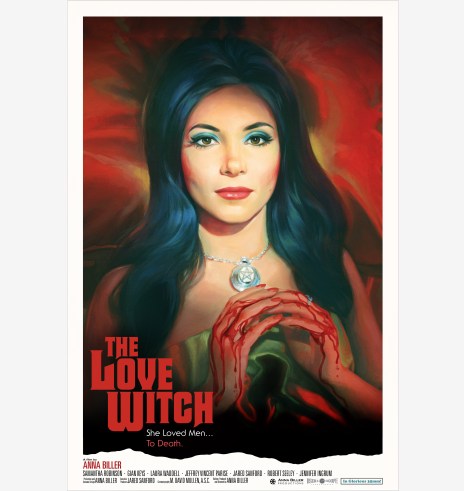
The Love Witch tells the story of Elaine (Samantha Robinson), a young witch who leaves San Francisco after the death of her ex-husband to start life anew in a small California town. Her project? To find a real man, one who embodies all that (she believes) masculinity should be. To do so, Elaine has elected to use “love magic” to become every male fantasy, to embody every dream and desire that an individual man wants, to fulfill his every wish. And she does, seducing a local college professor (Clive Ashborn), a friend’s husband (Jeffrey Vincent Parise), and police detective Griff (Gian Keys). The problem is that Elaine is just too good with her love magic, and the bodies begin to pile up with every lover Elaine takes.

Summarizing The Love Witch oversimplifies it, though, and ignores the extreme aestheticism and referentiality that the film relies on for its ideological outlook. The Love Witch is spectacularly subtle in its lack of subtlety. Elaine waxes eloquent about her philosophy surrounding love and witchcraft, much to the dismay of her friend Trish (Laura Widdell), who finds her attitudes strikingly anti-feminist. But Elaine’s speeches, like The Love Witch itself, conceals a deft sleight of hand as it reinforces and then punctures the male ego. Men are treated as almost childlike, slightly boring, basically useless, whose inability to look at women as people is a failing that they can’t overcome and that will ultimately destroy them. As Professor King sobs about never being able to find a woman to match his fantasy and his pain in remaining unfulfilled, the film punishes his view of women as objects simply by indulging him to the fullest extent.

Elaine’s deceased husband, remembered in voiceover, berates her for not losing weight, for not keeping the house clean enough, for not getting dinner on the table fast enough. In attempting to fulfill his fantasies of what she should be, Elaine ultimately kills him. She internalizes her husband’s psychological and emotional abuse, reconstituting herself as the ultimate female monster. Elaine’s extreme femininity destroys men by fulfilling their desires, by establishing an extreme gender binary in which they will never be “man enough” for the woman that they’ve created. She is a sort of female Frankenstein’s Monster, a creation of masculine hubris, who turns upon her creators and offers them everything they want.

the-love-witch

It soon becomes apparent that all the women of the film are struggling under the weight of male expectations. But the women gain power in taking possession of their own objectification, rendering it a source of strength and directing back towards the dull (and singularly unattractive) men who demand so much from them. The male fantasy is reconstituted as a female one, the finding of a “real man,” with punishment meted out to those who do not fulfill that fantasy. Elaine is not a cypher or an image. She is a full person, wrapped the trappings of seductive femininity – thick makeup, a long black wig, garter belts and stockings – and is fully at home and invested in those trappings as part of her identity. She seeks a man to fulfill her fantasies, to provide her with the completion that men demand from her.

The Love Witch coats its complex battle of the sexes in a lush, referential mis-en-scene. Everything from costuming and makeup to the striking color coordination of its interior design, lighting, and photography interacts so as to produce a sense of a film out of time. While borrowing some of its aesthetic from numerous 1950s and 60s Technicolor films, The Love Witch produces a complex dialogue among those films, undermining their often anti-feminist bent by taking some of their arguments to an extreme.

Direct visual references abound: Alfred Hitchcock’s The Birds appears in the rear-projected driving sequences and the arrival of a “witch” in a small California town, a la Melanie Daniels. The plot nods to Bell, Book, and Candle, the 1958 film starring Kim Novak as a Greenwich Village witch who uses her powers to entrap Jimmy Stewart. Vertigo is another visual and thematic reference point: Elaine fulfills male fantasy in much the same way that Kim Novak’s Madeleine is forced to. But The Love Witch twists the theme, giving Elaine and her fellow witches the power in the relationships, becoming male fantasies only to exact control over those ideals. The shaping of a woman to masculine desires becomes a source of female power, not enslavement. Where Madeleine is punished for her deception, Elaine evades punishment, taking full possession of her sexual and emotional identity.

The Love Witch is a dark and sumptuous film that demands a viewer with a certain experience of retro cinema. It interacts so much with a very specific past that its cinematic antecedents – and therefore its meaning – may easily be lost in the shuffle. It is the male gaze, male control, that brings destruction and death. Elaine becomes every image of femininity, and by controlling that image, destroys the men who demand it. The film has a cinematic purity, so conversant with its own influences, yet so different from all of them that it manages to transcend the labels of pastiche, nostalgia, and parody. The Love Witchmuch like Elaine, both is and is not exactly what it appears to be. And there are very few films that can lay claim to that.

Evil Eye (1963)

Evil Eye (1963)

*Evil Eye is available to stream on Shudder.

the-evil-eye

Continuing my probably unhealthy love affair with the films of Mario Bava: Evil Eye, Bava’s 1963 film that combines psychological horror, sexploitation, and some stylized horror to become the first true giallo. The Italian title is La ragazza che sapeva troppo, or: The Girl Who Knew Too Much, and that actually makes more sense than the American title tacked on, I suppose, to give the film more supernatural horror credentials that it doesn’t really have. The Girl Who Knew Too Much is very much in keeping with the film’s underlying satire on the films of Alfred Hitchcock, who is referenced a few times with tongue quite firmly in cheek.

Evil Eye opens with Nora Davis (Letícia Román) traveling to visit her ailing aunt in Rome. Nora’s obsessed with murder mysteries, turning her life into a romanticized pulp novel. After a rather nightmarish experience at the airport, she arrives at her aunt’s house to find the old lady seriously ill in bed, attended by the good-looking doctor Marcello (John Saxon). During a terrible storm that night, the phone and electricity flickers out just as Nora’s aunt goes into cardiac arrest, leading Nora on a desperate run through the rain down the Spanish steps to contact Marcello at the hospital. She’s mugged and knocked out, and awakens just in time to witness the violent stabbing of a young woman.

Nora spends the next few weeks going in and out of consciousness, attended by the kindly Marcello, who tells her that there was no murder victim: she must have been hallucinating. More or less recovered but still convinced that she witnessed a death, Nora attends her aunt’s funeral, where she runs into Laura Torrani (Valentina Cortese), a friend who lives in the Piazza di Spagna, right where the murder occurred. Rather than cutting Nora’s trip to Italy short, Laura offers to let the young American stay in her house. A series of somewhat confused events prompt Nora to believe that she’s still being pursued by the shadowy murderer she saw the night of the storm. She enlists Marcello’s help in tracking down the killer and possibly saving her life.

evil-eye-giallo

Evil Eye certainly earns its title as the first giallo – not overly bloody, it’s still a bizarre, nightmarish film, full of extreme emotions and stylized cinematography. The imagery emphasizes the psycho-sexual pulp of the details while not being fussed with developing a particularly coherent plot. The film wanders from point to point, introducing weird characters – like a doctor who convinces Nora that she has second sight – who suddenly vanish. Nora’s parade of bizarre experiences have a comedic edge to them, as Bava proves himself aware that this story is really just a ridiculous piece of camp.

The humor is the most unnerving element in Evil Eye. Nora’s hysterical terror is played partially for laughs, as in a scene where she prepares an elaborate trap to catch the killer. She’s also quite right to be scared, as the viewer knows, but Bava punctures some of his own stylization by calling attention to just how silly it all really is. Evil Eye, like Black Sabbath, bears more than passing resemblance to Corman films of the same era, taking the terror seriously while simultaneously allowing the audience to delight in the camp.

Evil Eye is a bit boring spots, especially the transition between Nora witnessing the murder and becoming convinced that she’s actually in danger. The secondary romance with Marcello, while amusing, takes up too much time, as do the pair’s endless investigations into the possibility that Nora actually had a vision of a murder that occurred ten years ago. The meandering, dream-like nature of the film might place it in the giallo tradition (anyone who has watched enough Argento knows that those films aren’t exactly coherent), but unfortunately that doesn’t make it altogether interesting.

I was told that Evil Eye was secondary Bava, and I’ll certainly go along with that assessment. While interesting for those of us who want to trace the foundations of Italian horror traditions, it’s not compelling enough to warrant a second viewing. Still, the combination of humor and the horror is so weird that I found myself giggling about the film long after I’d finished it. That’s as good a recommendation as any.

Evil Eye is streaming on Shudder, so there’s no excuse not to give it a shot.

Off The Rails (2016)

Off The Rails (2016)

*Streaming exclusively on Sundance Now from December 8.

off-the-rails

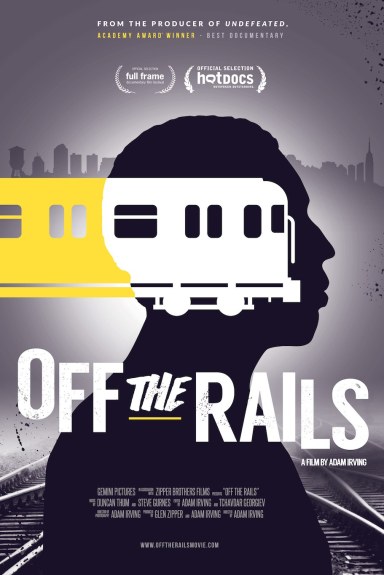
This year has seen a preponderance of excellent documentaries, as no doubt the Oscar race will attest. Many have been all-too-topical, as increasing police violence, hate crimes, and the divide between the rich and poor ever widens. Adam Irving’s Off the Rails joins Ava Duvernay’s 13th and Andrew Cohn’s Night School in an examination of the intersection of poverty, race, and perceived criminality, this time through the singular life and more singular crimes of Darius McCollum.

McCollum’s story is an odd one: born and raised in Queens, he became increasingly fascinated by the New York transit systems, especially the subway, as an escape into the calming world of schedules and time tables that contrasted with the uncertainty of his life above-ground. Transit workers favored him with tours and lessons on the intricate workings of the system, increasing his fascination and plunging him deeper in an obsession. When he was fifteen, McCollum wound up accidentally commandeering a subway train when a transit worker left him in charge. He safely made all the stops along the route until he was caught and arrested. Thus began a so-called “life of crime,” which resulted in his being jailed 32 times for impersonating transit officials and stealing trains and buses. McCollum became what he refers to as a “volunteer” in the MTA, attending trade union meetings, working for workers’ rights, and even successfully impersonating a superintendent. He’s spent twenty-three years in a maximum security facility, despite never injuring anyone.

If ever there was a criminal who shouldn’t be in prison, it’s Darius McCollum. He was eventually diagnosed with Asperger’s Syndrome, though this made little difference to the municipal authorities or the DA’s office. His crimes, while potentially dangerous, are victimless: despite commandeering hundreds of subway trains and buses, McCollum has never injured anyone, and, according to the film, has even been responsible for helping people in crisis. His passion for the MTA is real; his love for it unique among workers. Yet he’s never been employed by the MTA, who views him as a danger and an embarrassment. The news media refers to him as “joy-riding” on trains, labelling him “notorious,” a “transit bandit,” as though his crimes are entirely self-serving and constitute public endangerment.

The film spends most of its runtime in examining McCollum’s character and obsession, conducting long interviews with him, his mother, attorneys, social workers, and psychiatrists. A picture emerges of a bright, capable boy who took to the transit system as a world in which things made sense: trains run on a schedule, there are rules and regulations, structure. Because of his very public arrests, McCollum was barred from working for the MTA (he applied to them twice and was rejected both times). As his crimes mounted up, the MTA continued to decline to employ him. His lack of comfort and direction in life only made him retreat more to the place where things made the most sense, stealing more trains and resulting in a cycle that landed him in increasingly secure facilities until he was imprisoned at Rikers Island, awaiting trial.

But although the film takes McCollum as a very special case, his experience exposes the severe failings of a criminal justice system that is incapable of dealing with a man like him: someone whose crimes are strange, non-violent, and largely non-threatening. Judges refuse to take his Asperger’s into account; he’s left in prison for years awaiting trial; he’s given little social or economic support once he does emerge from prison. Now in his fifties, he’s never held a regular job, never paid rent, never supported himself. Despite a small support network of attorneys, social workers, his mother, and an Imam who worked in his prison, McCollum continues to return to the same behavioral pattern, unable to break the cycle by himself and evidently without the extensive support and therapy that he needs. The system has rejected him, preferring to spend millions of dollars prosecuting and imprisoning him rather than trying to help and understand his problems and find a solution. It is a spectacular failure of the justice system that a non-violent criminal, a man who has never harmed anyone, has spent so much time behind bars.

Off the Rails has a few weaknesses. As McCollum falls in and out of jail, the story itself takes on a cyclical structure, which does become a bit wearing nearing the end. There are also gaps in the narrative: interviews with psychiatrists and Asperger’s advocates are featured, but it’s never explained how long or how often they’ve worked with McCollum, or if they’re simply there as authorities on Asperger’s. The film doesn’t really address the spectacular failure of a transit system with such lax security that someone without licensing or official training can operate a transit vehicle – a brief scene at the MTA bus depot shows that McCollum, or anyone, would easily be able to just drive off with a bus. Brief sequences of animation, as McCollum compares himself to Superman, fall flat and have an edge of unintentional mockery.

But any failings that Off the Rails has falls flat in light of the sorrowful and slightly hopeless story. The film sheds a clear light on the failings of the justice system in the United States, the way in which people are labeled criminals, and the needs for mental health support and therapy. By focusing on a unique story, the film manages to open up a narrative of injustice that spreads far wider than Darius McCollum. If the system has failed him, it has failed thousands of others like him.  We see a justice system that doesn’t seem to want to rehabilitate or help prisoners, but to lock them up, throwing away their lives because they do not fit into prescribed social order. Darius McCollum has been wronged, and the justice system doesn’t seem to care.

Off the Rails is streaming exclusively on Sundance Now from December 8.

Black Sabbath (1963)

Black Sabbath (1963)

black-sabbath-1963

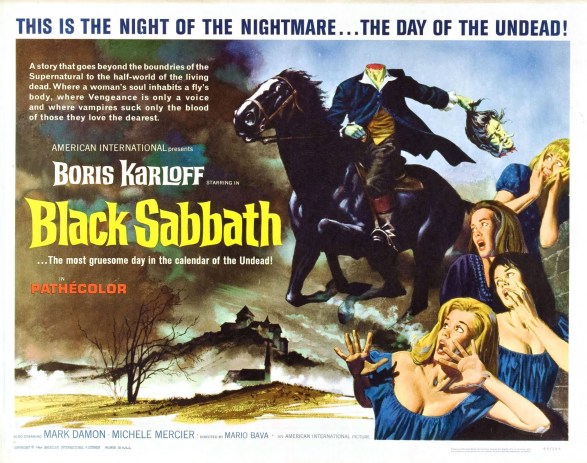
Mario Bava, where have you been all my life? The Italian horror maestro really is just worming his way into my heart, especially after Black Sabbath, his 1963 horror anthology film. When you put Boris Karloff, vampires, and floating corpses in the same film, you’re guaranteed to get my attention.

Black Sabbath comprises three stories of about a half hour each, making up three different subgenres of horror. The first is “The Telephone,” about a young woman who keeps receiving threatening phone calls from a stalker late one night. The second, starring Karloff, is “The Wurdulak,” a vampire story about Gurca (Karloff), the patriarch of a family who has successfully killed a vampire that’s been terrorizing the countryside, only to become a victim of the creature himself. Finally, “The Drop of Water” is a ghost story about a woman who steals a ring from a corpse and is subsequently haunted in the weirdest and creepiest way.

All three stories take fairly standard horror narratives and give them a creepy spin. “The Wurdulak” in particular introduces some interesting elements to the vampire story, with the vampire longing for the blood of those he loved the most during life. Unfortunately, it’s also the dullest of the three episodes, drawing out the narrative to an unnatural length and introducing a mild love story into the mix that fails to summon any heat. “The Telephone” is a precursor to what would become the more prevalent giallo style – deeply stylized with perverse psycho-sexual undertones, it’s a delicious little aperitif before the meat of the other two episodes.

But the best of the three is undoubtedly “The Drop of Water,” a tight, intense piece of horror filmmaking that makes the most out of its short runtime. It’s actually quite a scary episode, showcasing a grotesque narrative quite similar to Corman’s Poe adaptations. And while the conclusion is extreme – even a bit silly by today’s standards – most of the episode is remarkably subdued, relying more on pulsing lights and eerie noises than on cheap jump scares. It’s an excellent piece of horror filmmaking, and could stand on its own as a short without the support of the other two.

Black Sabbath has forced me to appreciate Bava’s work, and to actively seek out more of it. And I’m a bit excited to indulge in the oeuvre of a new director.

Black Sabbath is available to stream via Shudder.

Friday the 13th (1980)

Friday the 13th (1980)

friday-the-13th-1980

October may be over, but my reviews of horror films are not! Next up is one of the seminal slasher films of the 1980s: Friday the 13th, the movie that introduced the world to Camp Crystal Lake and Jason Voorhees (kinda). Along with its fellow creep-outs Halloween and Nightmare on Elm StreetFriday the 13th (and its sequels) are responsible for setting the standard of slashers.

Friday the 13th opens with the murder of two camp counselors at Camp Crystal Lake, in 1958. Shot from the POV of the killer, the two counselors get caught in flagrante, naturally resulting in their bloody deaths. Fast forward many years and Camp Crystal Lake is about to be re-opened for the summer, with a whole new crop of nubile young people to violently slaughter. The group of counselors show up to help get the camp into shape – despite the dire warnings from townsfolk of a horrible curse – and bodies begin to pile up, as the shadowy killer dispatches our young heroes one by one.

The problem with Friday the 13th is that it’s just not a very good slasher film. The set-up itself is strong enough, and the murders appropriately gruesome. But the characters are too sparsely drawn to be interesting – they’re interchangeable faces that could be ranked by degrees of annoyance. The Final Girl (whose role you can guess pretty quickly) is laughably inept at escaping once the killer’s identity has been revealed.

While mulling over why the murders just didn’t up the tension at all, I came to realize that none of them are discovered until the last ten or fifteen minutes of the film. The surviving counselors don’t know they’re in danger at all, and so calmly wander around in the rain and the dark, unaware of an insane killer lurking in the shadows. And because no one else in the film is scared, the audience has no reason to be scared. We know that pretty much everyone is going to die; it’s just a question of how.

The same goes for the killer, whose backstory is never even touched on until an extensive exposition scene nearing the end. The local legend about the camp being cursed is introduced and then rapidly discarded, with nothing to flesh it out. While killers like Freddy Krueger and Michael Myers have fairly intricate backstories that draw out their monstrosity and give it life, the killer of Friday the 13th has no mystique at all. (And there’s little doubt that both Nightmare on Elm Street and Halloween were directed by very talented horror maestros, while Friday the 13th…wasn’t).

I’ve been informed that the better Friday the 13th sequels wind up outweighing the original, but I admit I don’t much care. I’ve got this film under my belt, and I’m OK with letting it rest at that.

Bloody October: Ernest Scared Stupid (1991)

Ernest Scared Stupid (1991)

ernest-scared-stupid-poster

OK, if you don’t adore Ernest P. Worrell, then you obviously have not allowed joy and magic into your life. The creation of Jim Varney, Ernest began life as a character in TV ads, only to become so popular that he got his own TV show and, eventually, his own movie series. Is Ernest stupid? Yes. Are the movies silly? Totally. And therein lies their magic.

Ernest Scared Stupid is a later entry into the Ernest series, but it’s also my favorite. It opens in the late 19th Century with the townsfolk of Briarville, Missouri capturing a troll that has been stealing the souls of the town’s children. As they bury him beneath a sapling tree, the troll curses the town and town elder Phineas Worrell in particular. The troll promises to return, brought back to life by a Worrell. Flash forward to the present day, and Phineas’s descendant Ernest is now the local garbage man, spending his off-hours inventing ever more stupid time-saving devices and hanging out with the local children Kenny, Elizabeth, and Joey (Austin Agler, Shay Astar, and Alec Klapper). When the kids decide to build a treehouse to hide out from the local bullies, Ernest lends them a hand – only to inadvertently awaken the troll that slumbers beneath. Comedy horror ensues as the troll attempts to capture enough souls to awaken his sleeping troll army, and Ernest tries to stop him (with the help of local crazy lady Francis Hackmore, played an epic Eartha Kitt).

Ernest Scared Stupid is a kid’s movie very much in the vein of The Worst WitchThe Witches, and Hocus Pocus. The troll legitimately terrified me as a kid, to the degree that I spent a Halloween season checking under my bed. The film is less scary now, but still pretty funny as long as you’re willing to indulge in Varney’s light, mugging comedy. Ernest is more childlike than really stupid, a companion character to Pee-wee Herman, whose great love in life is his dog Rimshot. Most enjoyable are his secondary “split-personality” characters that he falls into suddenly and often inexplicably (my family still uses the line “Hairspray will fix anything” from this film). The characters lend a burst of surrealism to the film as Ernest does battle with the troll by shifting into the roles of a British explorer, World War II fighter pilot, and elderly grand-dame without blinking an eye.

Every once in a while, it’s nice to get away from dark terror and just watch a silly Halloween movie about candy and pumpkins. Ernest Scared Stupid still reminds me of my childhood, in the best possible way.

Bloody October: Ringu (1998)

Ringu (1998)

ringu

In movies as in life, look for originals. Rather than going for the American remake of The Ring, I decided to read some subtitles and watch the original Japanese Ringu first – mostly because the Japanese generally have a unique and profoundly disturbing outlook on ghosts, curses, and the trappings of horror. I must say that I was not disappointed.

Ringu begins with a surprisingly expositional sequence in which two teenage girls try to scare each other by talking about a mysterious videotape that, once watched, kills you a week later. When one of the girls dies and the other goes mad, it attracts the attention of a news organization and investigator Reiko (Nanako Matsushima), the aunt of Tomoko (Yuko Takeuchi), the girl who died. As Reiko delves into the origins of the curse story, she discovers that Tomoko and each of her friends who supposedly watched the tape died on the same day. This leads her finally to Izu and the cabin where Tomoko discovered the tape. When Reiko watches the strange video, she begins to believe in the curse, and seeks the help of her ex-husband Ryuji (Hiroyuki Sanada), a teacher with ESP, to discover a way to break the curse.

Due to its popularity in and out of Japan, Ringu bears many hallmarks and images that have become ingrained in world cinematic culture. It’s a testament to the film’s brilliance that it’s still scary, almost twenty years on. Although dependent on outmoded technology, the grainy nature of VHS, the ability to record long swathes of programming (or static) and keep it, have a bizarre and frightening quality to them. And Ringu keeps the visual horror to a minimum, relying instead on stories about spirits, whispered threats, vague rumors, and strange noises in the middle of the night to develop the tension. The “monster” of the film doesn’t appear until quite late, and then arrives with such a pop that it’s still impossible not to be frightened.

Japanese culture has a far different relationship to the spirit world than contemporary American culture – like its counterpart Ju-on (The Grudge), Ringu relies on complex concepts of ghosts and vengeful spirits that outstretch the modern period. The horror goes on, because it is based in betrayal or vengeance and not in demand for something that can be appeased. It can attach itself even to those who don’t deserve it, or who aren’t involved in the original violation, and will destroy them just as surely as the violators. That’s a terrifying notion.

Ringu definitely stands as my favorite (thus far) of the films I’ve seen this spooky season.

Bloody October: Black Sunday (1960)

Black Sunday (1960)

black-sunday

Mario Bava is another one of those classic horror filmmakers whose work I have (unforgivably) managed to miss. Considered the grand-daddy of Italian giallo – and one of the most influential of Italian horror artists – Bava married Corman-esque gothic sensibilities with more extreme (for 1960) horror gore. Black Sunday was one of his biggest critical and popular successes, and remains a touchstone for horror filmmakers to this day.

Black Sunday features Barbara Steele as Asa Vajda, a beautiful vampire/witch sentenced to death by her own brother. Following the execution of her lover Javuto (Arturo Dominici), Asa vows vengeance on her brother’s descendants, right before a devil’s mask studded with spikes is pounded into her flesh (the original title of the film was The Mask of Satan). Two hundred years later, we meet the descendants of the cursed family: Katia (Steele again), her father Prince Vajda (Ivo Garrani), and her brother Constantine (Enrico Olivieri). They become acquainted with two traveling doctors who stumble upon Asa’s tomb one stormy afternoon. Investigating the crypt, the elder doctor Thomas Kruvajan (Andrea Checchi) accidentally awakens Asa after cutting his hand and dripping blood on her corpse. This sets off a chain of events as Asa attempts to take back her life – and her beauty – while wreaking horrible vengeance on her descendants.

Black Sunday is very similar to a 60s Corman film, down to the involvement of Steele (who appeared in Corman’s The Pit and the Pendulum one year later), the gothic trappings, and the use of more gruesome violence than we expect from a black and white horror movie. Corpses ooze pus and blood, masks are nailed into living flesh, and witches are burned alive. While the black and white takes away some of the impact, the chiaroscuro is so deep and pulsating that it makes up for the lack of lurid splashes of red and green. The opening execution in particular is perfect horror filmmaking, the camera unflinching in documenting all the nastiness. In some ways, Black Sunday more closely approximates the weird sadism of 18th and 19th Century sensationalist literature than do the more sanitized versions of Frankenstein and Dracula produced by Universal.

Black Sunday fits right into the context of the horror films made by Corman in America and Hammer Studios in England, becoming a precursor to the far nastier films made by Dario Argento and Bava himself. And it’s a good film, if read in that context. But, Black Sunday misses the key ingredient that Corman managed with his Poe adaptations by failing to hire even one competent male actor as a lead. Vincent Price made Corman’s films wild-eyed and palatable, chewing the scenery with such loving gusto that one wants to enjoy the luridness just as much as he does. Neither the romantic lead John Richardson, playing the young doctor Andre, nor the actors in the villainous roles are of any real note. Steele is the real draw here, but a girl can only do so much.

Black Sunday is a perfectly enjoyable horror film. Does it make much sense? No. Is the acting all that great? Not really. But there’s a reason it’s a classic.

Black Sunday is available to stream on Shudder.

Bloody October: Piranha (1978)

Piranha (1978)

piranha1978

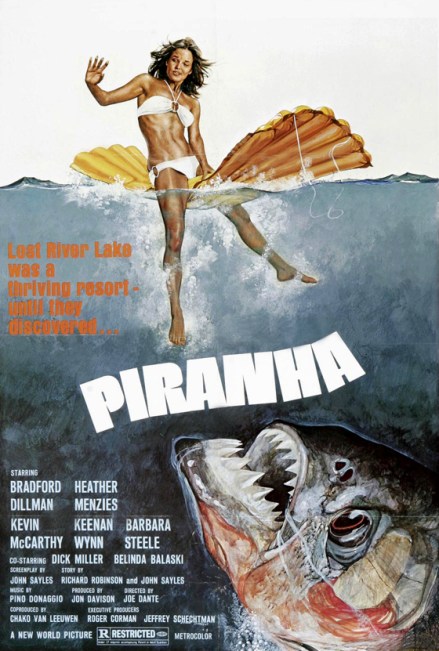
As a self-proclaimed Joe Dante fan, I am heartily ashamed that it took me this long to get around to seeing Piranha. The ridiculous 1978 Jaws rip-off, from a script by John Sayles, is nothing short of delirious monster movie fun that can only come to us from the loving camera of the director of The Howling and Gremlins.

Piranha opens with two teenagers making the unhygienic decision to skinny-dip in a government reservoir near Lost River Lake, surrounded by a massive fence and signs that say “Do Not Enter.” When the teenagers are consumed by underwater forces unknown and vanish without a trace, private insurance investigator Maggie McKeown (Heather Menzies) comes in to look for them. She buddies up with alcoholic curmudgeon Paul Grogan (Bradford Dillman) who lives in the mountains of Lost River, and together they hunt down the government facility where the teenagers went missing. Draining the reservoir to try and locate the bodies, the pair are set upon by Dr. Robert Hoak (Kevin McCarthy), who provides the exposition: they’ve unwittingly released hyper-intelligent, weaponized piranha into the river.

Piranha is spectacularly ludicrous and knows it. Dr. Hoak gives an extensive explanation as to why he’s been weaponizing piranha at a secret government facility, itself just as ridiculous as the idea of creating a breed of carnivorous fish that can now organize themselves, outwit human beings, and survive in fresh and salt water. But while much time is spent on setting up the situation, even more is spent in the gleeful indulgence of B-movie mayhem. The piranha attack without mercy, ripping up fishermen, beach-goers, and innocent campers on their journey downriver. The violence is actually quite gory and very well-done – not exactly Jaws, but good enough to make me cringe quite a bit.

In addition to McCarthy, the film features the always welcome faces of Keenan Wynn and B-movie superstar Barbara Steele (providing probably the best final close-up of any monster movie…ever), as well as Dante’s usual character actors, including Dick Miller and Belinda Balaski. Because the film knows its status as a Jaws rip-off, Dante gets to indulge in subversive humor, weird secondary characters, and ripping on military authority with a loving glee. This is a movie about how amazing horror movies are, and how much fun they should be.

While Piranha is unlikely to replace The Howling in my affections, it comes in a pretty close second. It’s just good fun, right down to the cheesy one-liners and silly open-ending.

Bloody October: Opera (1987)

Opera (1987)

opera_fl

Dario Argento is one of the true greats in horror. And while his films usually produce mixed reactions, there’s no doubt that they’re disquieting products of a unique mind. Opera is not one of his best, but damn it’s got some fine horror in the middle of the morass.

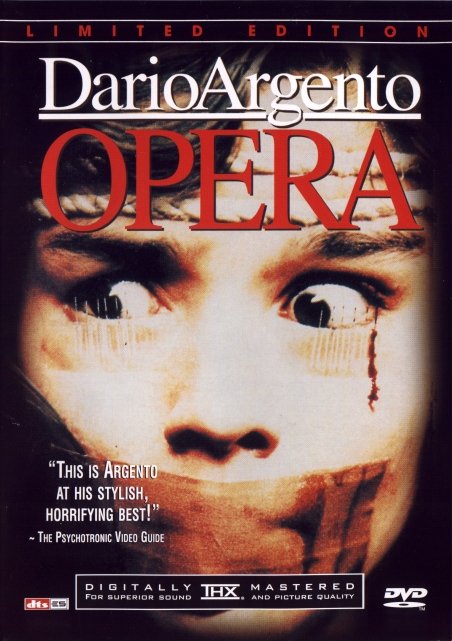
Following the injury of the leading lady in a production of Verdi’s Macbeth, understudy soprano Betty (Cristina Marsillach) finds herself thrust into the lead role. But almost the second that she takes the stage, a masked man begins murdering the cast and crew, forcing Betty to watch by tying her up and propping her eyelids open with pins. The film interweaves numerous POV shots from the killer’s perspective as he pursues Betty in a lethal game of sadistic voyeurism with an operatic soundtrack.

The setting of an opera is tailor-made for Argento, a chance to indulge in the gaudy giallo that made his films famous. And the film’s murders are appropriately extreme and well-done, horrifying without being off-puttingThe use of the POV shots is especially unnerving, the camera jiggling and jerking and bringing us up close to acts of sadistic violence in a way that no other filmmaker has approximated.

Unfortunately, Opera suffers from a lack of coherent plot. While Argento’s favorite themes of sadism, murder, and repressed childhood memories abound, he can’t seem to bring them all together to a clear conclusion. He wastes the central conceit of the opera-which has so many possibilities-by focusing instead on Betty’s bizarre tendency to not report the crimes she’s seen committed. Where Suspiria gave us a plucky heroine plunged into a surreal nightmare world, Opera gives us a disconnected young woman who takes multiple murders in stride. The final act especially is tacked on, a twisty conclusion that actually reminded me of the breakdown at the end of Monty Python and the Holy Grail. While none of Argento’s films hang together in the perfect narrative sense, this one in particular just lacks any notion of coherency.

That being said, Opera does have a nightmarish quality that makes it an enjoyable, if lesser, example of Argento’s work. The violence is so gaudy that it’s almost funny. Imperfect and a lesser film than many an Argento, Opera has enough surreal, nightmarish horror to make for a delirious indulgence.