Bloody October: Re-Animator (1985)

Re-Animator (1985)

re-animator

I’m a big fan of the works of H.P. Lovecraft, so it was with a feeling of shock and shame that I realized that I had not seen what’s often considered the greatest adaptation of a Lovecraft story ever: Re-Animator, from 1985. So I queued up my Netflix, popped my popcorn, and settled down for what was sure to be a 1980s schlock-extravaganza.

What had I done? I’d been warned about the grossness of Re-Animator, but I did not expect…this. Granted that Lovecraft adores indulging in oozing viscosity and putrid terrors from the beyond, I still did not expect to be translated so very literally to the screen. But my word it was! Re-Animator is one of the grosser, funnier horror films I’ve seen, and I enjoyed every overblown, overheated minute of it.

Re-Animator tells the story of Herbert West (Jeffrey Combs), a brilliant but quite insane medical student who has created a serum capable of bringing the dead back to life. The problem is that the serum mostly just brings back the primitive instincts, not the higher brain functions, effectively turning reanimated corpses into hyper-strong atavistic zombies. It’s a combination of Frankenstein and a zombie movie by way of Lovecraft.

West goes to Miskatonic University (the site of most of Lovecraft’s educational based narrative), where he connects with fellow medical student Dan Cain (Bruce Abbott) and his girlfriend Megan (Barbara Halsey). He also runs afoul of Dr. Hill (David Gale), a doctor whose work on brain death West directly challenged. But all the plot machinations are largely excuses for West and Dan to make some zombies, re-animate some corpses, and explode some body parts in a hail of blood and guts.

The first half of Re-Animator plays like a typical camp 80s horror film; the second half is pure insanity. Staff members are murdered, college deans are turned into zombie slaves, Megan (predictably) loses all her clothes, and severed heads return to life in some of the most hilarious, ridiculous and disgusting ways imaginable. It’s nearly impossible to describe what happens in Re-Animator without resorting to noises of shock and horror, not to mention insane laughter.

There are moments in Re-Animator that would be offensive if they did not take place in such an insane film to begin with. The lengths the film goes to get Megan naked is quite remarkable, but it never quite crosses the line into offensive exploitation. The whole film is so mad that it would be impossible to claim that any one scene goes too far. Props to actress Barbara Halsey, though, for being willing to go the extra mile for … art, I guess.

Jeffrey Combs is the mad center of this mad film, his Herbert West fascinating and repellant and, by the end of it, strangely likable. He’s Dr. Frankenstein on acid, dedicated to his cause and completely without morals. I loved him.

No everyone will love this film. Many will be repelled by the sheer amount of blood and gore, or the sight of a headless man attempting to fellate a girl tied to a morgue slab. But it is, indeed, one of the best, maddest Lovecraft adaptations ever likely to be made. Mr. Lovecraft would be incredibly proud.

The House Of The Seven Gables (1940)

seven-gables-poster

Although I am a rather jaded film viewer, there are times when a movie still has the capacity to surprise me. It’s even more remarkable when that movie was made all the way back in 1940, based on a novel written about a hundred years before that.

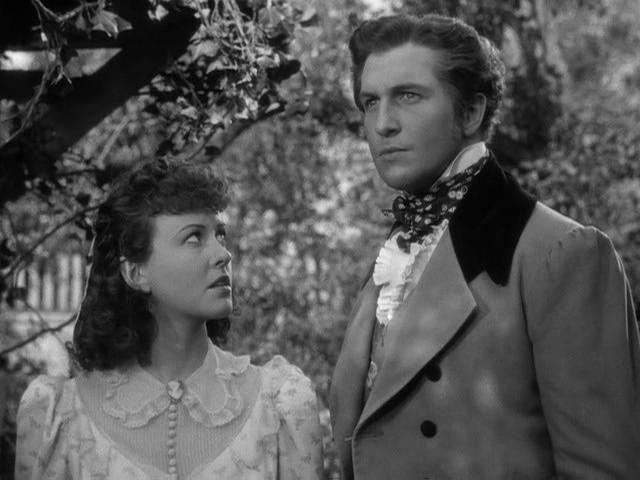
I really should not have been so surprised at The House of the Seven Gables. After all, it stars two of my favorite sinister gentlemen: Vincent Price and George Sanders. They play brothers (of course they do), one good, the other bad. In the surprise of the century, it’s Mr. Price who gets to be the good guy as Clifford Pyncheon, the eldest son of the Pyncheon family. He resides in the House of the Seven Gables with his father Gerald (Gilbert Emery) and his cousin Hepzibah (Margaret Lindsay). Things are not well at Seven Gables, though; Gerald and the younger son Jaffrey (Sanders) have managed to squander the family fortune and Clifford plans to sell Seven Gables and go to New York with his fiancee Hepzibah (this is the Victorian era: that’s totally cool).

Jaffrey’s not a nice man, though – he’s a greedy little rat who believes that there’s a secret treasure hidden somewhere in Seven Gables, and therefore does not want to give up the house. The battle rages between Jaffrey and Clifford, who wants to be out of the house and out from under the weight of his family history. Things go south for poor Clifford when his father suddenly dies during a verbal fight and his brother accuses him of murder.price-gables

The whole of the story is wrapped up in the Pyncheon family history. The first Colonel Pyncheon falsely accused a man of witchcraft in order to obtain his land. Later crimes are committed by the powerful patriarchs of the family – a fact which only Clifford wants to admit to. Clifford and Hepzibah try to escape from the cycle, only to be pulled back in by forces of greed and bitterness.

The actors  anchor The House of the Seven Gables. Price and Sanders are  stars we’re used to seeing in older incarnations, but here (at least at the beginning) they’re young and vibrant. Price especially carries his role off with great aplomb, first as the young joyful Clifford desperate to begin a better life, and then as the down-trodden older man released from prison after almost 20 years.  It’s a testament to Price’s acting ability that this will be the same man who creeps us out in The House on Haunted Hill. In The House of the Seven Gables, he’s never been more likable or attractive.

Sanders has less to do – he does not get to exercise his considerable smarmy charm, although his sardonic baritone is in full force here. He’s an interesting counterpoint to Price’s earnestness, even if the character he plays is largely one-dimensional.

Margaret Lindsay likewise deserves kudos for her role as the patient Hepzibah, who loves Clifford so deeply that she never stops trying to obtain his liberty. Lindsay goes from being a joyous young woman to an embittered matron, but she does not lose either her kindness or her passions. Lindsay gives her a gentility often missing in broader caricatures of the ‘old maid’ – she is a decent, loving person, choosing to live a life of solitude rather than give up on the man she loves. The reunion of Clifford and Hepzibah is perhaps one of the most moving and understated scenes I’ve ever experienced, a result of excellent performances on both the parts of Price and Lindsay. The entire film is worth it just for that one moment of beauty.

I’m surprised and happy that I can recommend this film as highly as I do. While by no means a perfect movie, it’s a remarkably effective one. A Victorian melodrama as only silver-screen Hollywood can make them, it nevertheless transcends the usual sentimental bluster through an excellent cast and a good script. It is moving because it seems so very human.

Something Wicked This Way Comes (1983)

something-wicked-this-way-comes

It’s that time of year again. The days grow shorter, the nights windier, there’s a howling in the North Country, the leaves turn and the Pumpkin Spice Lattes hit your local cafe. Halloween might be more than a month away, but it’s time to start getting the scares out.

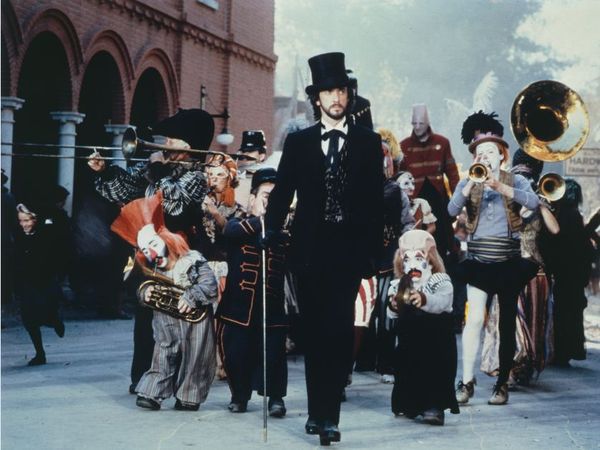
Unintentionally, I began this scary season with my first-time reading of Ray Bradbury’s Something Wicked This Way Comes. While Bradbury may not have invented the ‘evil carnival’ subgenre, his tale of two boys fighting the cotton candy-flavored forces of darkness certainly does it the best. Bradbury’s genius lies not just in the story, but in the language he uses, creating a deep sense of foreboding, an electric energy and excitement for the danger and mayhem to start. He writes the way that Halloween feels.

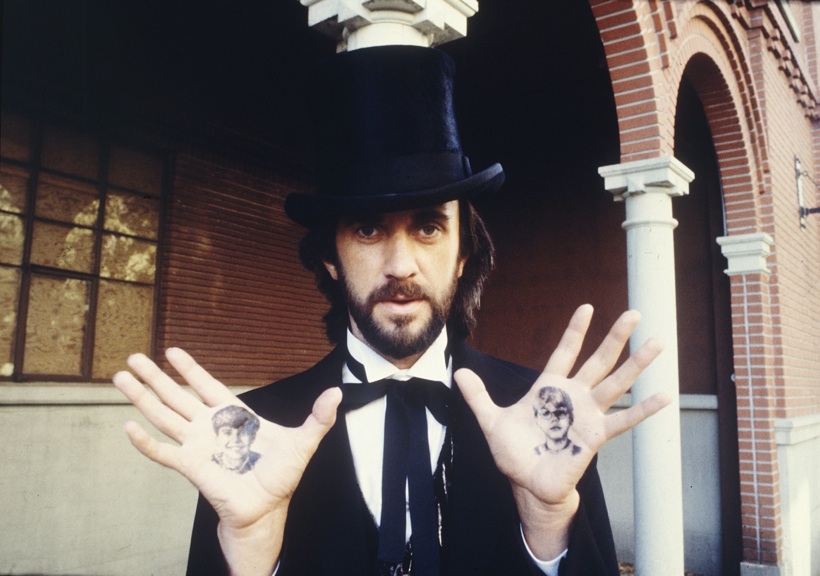
So having read the novel, I decided that it was a good idea to seek out the Disney film of the same name, starring Jonathan Pryce as the illustrated Ringmaster Mr. Dark, Jason Robards as Mr. Halloway and Vidal Peterson and Shawn Carson as the two boys, Will and Jim respectively.

wicked4The film follows Will and Jim, two best friends on the brink of adolescence living in a small Midwestern town that remarkably resembles Vermont. The arrival of Mr. Dark’s Pandemonium Shadow Show in the small hours of the morning precipitates the arrival of Halloween by a week. The carnival offers hopes and dreams to unhappy residents of the little town, and in the process makes them a part of the freak show. Just what Mr. Dark is up to becomes clear, although his motives with regards to the two boys seem somewhat confused.

It’s difficult not to compare the film to the book, of course, but I’ll do my best. This is Disney, after all, and it offers up a fairly clear opposition between the evil of the carnival and the good of the two boys. It largely removes the darkness of Jim’s character, and cuts down the conflict and sympathy between the two friends. The people of the town who join the carnival all have distinct failings: a ladies’ man, a greedy man, a woman wishing for beauty, etc, which the carnival exploits. I was gratified, however, that they did not turn Mr. Dark into a Satan figure, but rather retained the book’s emphasis on the carnival’s love of misery and pain.

The film suffers from a few problems, the biggest of them lack of direction. While I can accept some of the changes to the novel’s structure, they are not replaced by any convincing motives. Mr. Dark appears to go after the boys because of what they see at the carnival, yet his methods largely call more attention to himself as a malevolent force. Mr. Halloway’s unhappiness is likewise a tad confused. The film dwells on his heart condition, but introduces his perceived failure as a father in a rather explicatory scene that doesn’t feel like it fits well with the rest of the narrative. Robards, looks uncomfortable in his part, delivering his lines in a somewhat stilted manner that does nothing to ingratiate him with the audience. Whether this is a fault in direction or in script I cannot tell, for Robards is typically a dynamic actor. But his performance, which should set up a counterpoint to Pryce’s Mr. Dark, lacks conviction. Something-Wicked-s

The highlight of Something Wicked This Way Comes has to be Jonathan Pryce, who imbues his Mr. Dark with all the energy and malevolence we might expect from a good Disney villain. His speech in the library as he searches for Jim and Will comes straight from Bradbury, with Pryce intoning every word with the glee of a carnival barker. He’s thoroughly enjoying himself. While the film tones down some of Mr. Dark’s corrupting influence, Pryce retains his seductive edge. He’s a demonic seducer, offering despair.

I’d love to recommend Something Wicked This Way Comes, and if I’d seen the film before reading the book I might be able to. It’s not the book; the story loses much of its power by establishing a good/evil binary and then wrapping it all up. Aside from Pryce, the performances are stilted – the two boys in particular could have used some acting lessons – and much of the terror falls off after the carnival’s arrival. Being a Disney film, perhaps the director was afraid to really bring the scares. The novel could do with a frightening adaptation that makes use of all the arsenal of horror filmmaking. Something Wicked is a book about Halloween coming early, and it’s more trick than treat.

Bluebeard (1972)

bluebeard_poster_01

Once upon a time, there was a movie. That movie was called Bluebeard and it starred Richard Burton. And I just had to watch it.

What did I get myself into?

Bluebeard was made in 1972; those who know 1970s Richard Burton should know that this is not a good sign. It was directed by Edward Dmytryk, who made a number of excellent films in his career: The Caine Mutiny, Murder, My Sweet, The End of the Affair, and The Young Lions. OK then.

Bluebeard features Burton as Kurt Von Sepper, a Baron, World War I vet and ridiculously rich man (with a blue beard that is never quite adequately explained) who cycles through wives. It’s not touched upon why no one questions the fact that Sepper’s wives and mistresses keep dying violent deaths, but whatever. He’s a Baron and stuff. He’s also a Nazi, this being set in pre-War Germany, and at one point orders (or commands?) the burning of a Jewish ghetto. That will come back to haunt him in the form of a young violinist who otherwise serves no purpose in the narrative.

wife-freezer-bluebeard

What is important is Sepper’s latest wife, the lovely American Anne (Joey Heatherton), who falls for him because he’s a much better actor than she is. Their scenes together are roughly equivalent to watching Richard Burton try to act with a stick of plywood, which is interesting in itself.  Anne comes to live at Sepper’s awesome castle, where she’s given the run of the show…except she cannot go into that room with that one large golden key that he gives her. What does Anne do? What the hell do you think she does? She uses the key and finds all his dead wives in a freezer.

This naturally provokes a little tiff between Sepper and his new bride. Rather than arming herself with a poker and braining the guy as he comes in through the door, Anne decides to have dinner with him. He informs her that he has to kill her, even though he’d really rather not, because she saw his wife-cicles. In a display of cunning that until now I never would have given her credit for, Anne convinces him to tell her the whole story before he murders her, so that he can unburden his soul and maybe discover why he constantly needs to off beautiful women. So Sepper obliges.

Up until this point, Bluebeard has played at least semi-seriously – and that was its major problem. It’s like a Hammer film without the humor, or the camp, despite having Richard Burton with a prosthetic beard and a terrible German accent. Now, however, the film really gets going, and those who stuck with it this far are about to rewarded with a number of WTF moments.

bluebeard-1There’s the wife who won’t stop singing, so Sepper cuts off her head. There’s Raquel Welch as a promiscuous nun, obsessed with recounting every single one of her sexual escapades, then wanting to have sex in a coffin. There’s a crazed suffragette who’s into S&M. There’s a girl who goes to a prostitute to learn how to please a man and winds up in a lesbian encounter. There are also a LOT of breasts. I think that Raquel Welch is the only one who does not show her breasts at least once, and that’s probably because she’s the biggest name in the film besides Burton. The entire time, Burton looks slightly befuddled, as though he’s not quite certain what’s happening or how he got here.

Basically, Bluebeard is a disaster, but it’s an epic one. Scenes are quite obviously cut, with sudden costume changes; plot holes could fit a coach and four. Burton is remarkably game for the whole thing, trying to put some soul into his part as a supremely unsympathetic antagonist, but Heatherton has as much acting ability as most of the ornate furniture. It’s a bright, gaudy, violent and sexually charged disaster of spectacular proportions.

I honestly wish I could recommend Bluebeard on the grounds that it’s hilarious, but I really can’t. It’s far too terrible to be good, despite some truly fascinating moments of madness. If you must watch it, catch select scenes on Youtube.

Never mind Liz Taylor, this was the film that made Richard Burton an alcoholic. It nearly made me one.

Le Doulos (1962)

le-doulos

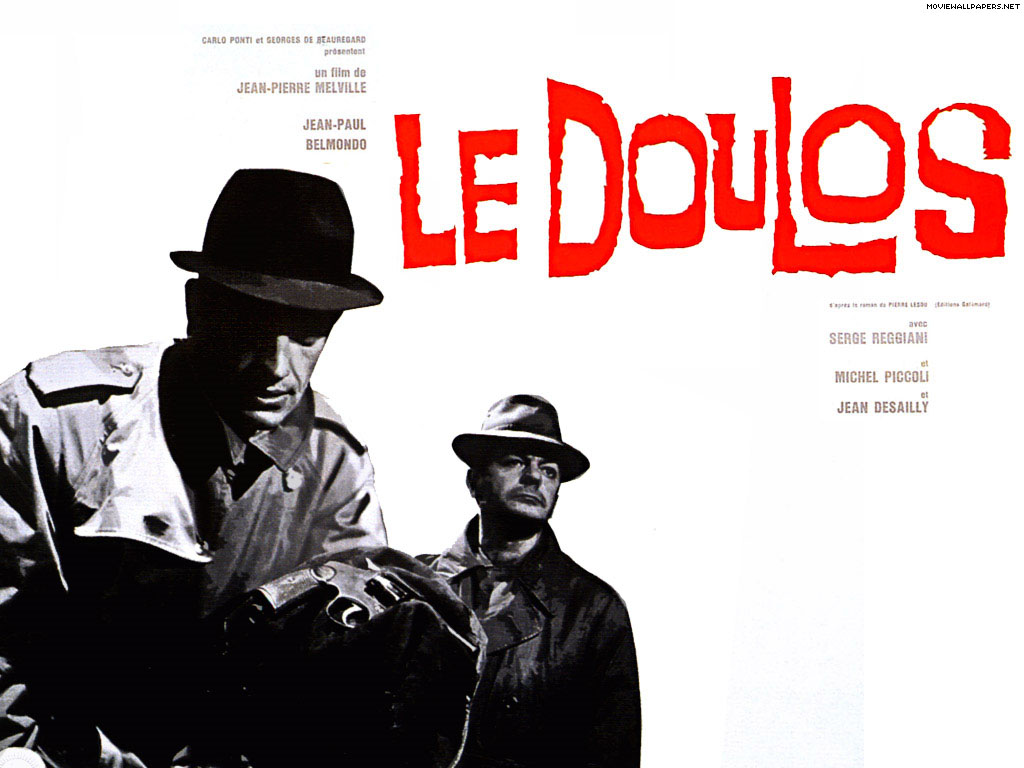
Is there anything that better exemplifies Gallic cool than Jean-Paul Belmondo in a trenchcoat and fedora? No? All right, then, we agree.

Jean-Pierre Melville’s exercise in film noir Le Doulos gives Belmondo ample space to be icy cool, and that’s just the way I like it. The film opens with our main character Maurice (not Belmondo, but Serge Reggiani) walking down suburban streets. He enters a darkly lit house and has a cryptic conversation with an old jewelry fence named Gilbert, the importance of which will only be understood in retrospect. The entire opening sequence sets the tone, though: this is a film of the underground, with gangsters that act like Humphrey Bogart in the midst of an existential crisis.

Maurice is recently out of prison, planning that ever popular ‘final job’ that will enable him to run away with his girl Therese (Monique Hennessey). He involves his friend Silien (Jean-Paul Belmondo), the ‘doulos’ or police informant of the title. Silien’s entrance shows us nothing but an overcoated, hatted figure shrouded in darkness. Belmondo keeps his hat and overcoat on through most of the first hour of the film, only removing them when he enters a nightclub. He wears the costume of his trade.

As expected, the heist goes horribly wrong and Maurice finds himself in the unenviable position of having shot a police officer with his partner’s gun. Things go from bad to worse for Maurice, as we follow Silien – apparently the one who betrayed him – as the police ask their informer about the murder. Silien’s motives are obscured – he beats up and then apparently murders Therese, yet does not tell the cops that Maurice was the other man involved in the robbery.le-doulos-1

Much of the plot is initially confusing, made all the more so by Melville’s roving camerawork. I would have to watch it again, but I’m 95% positive that Silien’s interrogation scene is filmed all in one take. The camera moves rapidly, turning to follow Superintendent Clain (Jean Desailly) as he circumnavigates the room. Belmondo remains the fixed point that occupies the center of the frame, practically stopping the camera’s kinetic movement each time it lights on him.

The audience does not know where their sympathies lie for much of the film, as Silien moves from one inexplicable act to another. Belmondo’s impenetrable gaze and ice-cold stare give nothing away, nor does the somewhat detached nature of Meville’s camera. The script is as dense as a Raymond Chandler novel, the characters flitting in and out and speaking in clipped, arcane tones. There’s almost no music to build the tension or clue the viewer into a sympathy with one character or the other. Belmondo jumps between iciness and sudden, frightening violence, but remains the anchor of the film. This is a gangster flick, after all.

I can’t complain about a single moment in Le Doulos, except to say that the final reveal is a bit of a let down. While it explains everyone’s actions, I confess that I wanted a bit more subterfuge. The film set me up for that, and I would have loved to see it fulfilled.

Le Doulos is an exercise in noir tones, a French version of an American gangster film, but in my opinion better than anything Godard ever came up with. This is post-war French filmmaking at its finest.

Star Trek III: The Search For Spock (1984)

Search-for-Spock

Carrying on with my non-Trekkie viewing of Star Trek films – The Search For Spock!

When we last left our heroes, Spock was dead and I was very upset. Of course we knew that not even crossing to the other life can keep a Vulcan down. With that little teaser of Spock’s coffin landing on the Genesis planet, there was no doubt that he’d come back.

The Search For Spock picks up right where The Wrath of Khan left off. The Enterprise crew return home to get their ship repaired, only to discover that the Enterprise is going to be put out to pasture. It’s a metaphor for the crew, you guys! Then McCoy finds himself with a dual personality. Spock has apparently put his soul into McCoy’s body – nice one, Spock – so that he can have last rites back on Vulcan. The crew figures that they’ve got to give old Spock final peace, and liberate McCoy from the whole ‘having your friend inhabit your body’ thing.

Meanwhile, the Genesis planet is getting all kinds of weird. The whole planet ages and evolves at an alarming rate, producing some pretty fucked up lifeforms. What’s more, a bunch of pissed off Klingons led by Christopher Lloyd have decided that the very existence of Genesis is an act of war. They want the secret for their very own. Predictably, they’re going to have to fight the Enterprise crew to get it.

5b6d38634f7e9865443f4d4355360b0b9d4cae21

The Search For Spock has the feel of a middle film, because that’s exactly what it is. This is the development stage of the arc, between Spock’s death in Wrath of Khan and his re-learning cycle in The Voyage Home. For that, it’s a perfectly enjoyable film, though not a the same level cinematically as Wrath of Khan.

There are some lovely, amusing moments between the Enterprise crew as they make plans to steal their own ship and return to Genesis to find Spock’s body. The reasoning behind this seems a little muddled – if any Trekkies can explain to me why they need Spock’s body, and at what point they realize that they could actually put his soul back into his body, I would be very grateful. But it does give DeForrest Kelly an opportunity to do a quality imitation of Leonard Nimoy. We also learn about the Vulcan aging process, as dead Spock regenerates into a new baby Spock who grows up very quickly. Puberty is very tough on Vulcans.

The biggest problem with the film is the whole Klingon subplot. It would have been fine, even necessary, adding action to what is basically a quest narrative. But why did we need whole swathes of dialogue in Klingon? The version I watched didn’t have subtitles, so there I was, listening to Christopher Lloyd garble on, without the slightest idea of what the hell he was talking about.

The final fight between Kirk and Kruge (Lloyd) seems a wee bit tacked on, as though we really just needed a scene with Shatner getting down and dirty. For awhile the search for Spock takes a backseat to Kirk’s anger at the death of his son, who very stupidly and bravely sacrifices his life for new Spock’s.

In the end, The Search For Spock is a mostly satisfying effort. While it does not stand up to the calibre of Wrath of Khan, or the humor of The Voyage Home, it’s fun and, particularly at the end, moving. Do they find Spock? Does he come back? C’mon. What do you think?

Star Trek II: The Wrath of Khan (1982)

wrath of khan

Full disclosure time: I am not, nor have I ever been, a Trekkie.  It just was never in my genetic make-up to get really into Star Trek.  I always preferred Star Wars, and resisted valiantly any attempts from Trekkie friends to get me to admit that Klingon was a language.  But as a result, I never saw Star Trek II: The Wrath of Khan. And for that, I am truly sorry.

Khan

Most know the plot, but here it goes: James T. Kirk is not a Captain any more, but an Admiral, and apparently going through a mid-life crisis.  He winds up aboard the Enterprise, along with most of his original crew, during a training mission that goes spectacularly wrong.  Because one of Kirk’s old sins has come back to haunt him in the form of Ricardo Montalban as the fabulously bare-chested and feather-haired Khan, who was marooned on a planet many years before.  Khan’s got a chip on his shoulder about old Jim, what with the marooning and the death of his wife and all, and so intends to destroy Kirk no matter what it costs him.  This is all wrapped up in the Genesis project, a scientific endeavor to create life out of lifelessness and run by Kirk’s old flame. Khan wants Genesis, but more than that he wants to make Kirk suffer horribly.

So much, so good.  The Wrath of Khan is perhaps the most recognizable of the Star Trek films – from the introduction of Khan, Shatner’s famous scream and – spoiler! – the death of Spock.  But it’s a just a great film, even if you don’t know Star Trek.  Kirk’s crisis is an understandable one and well-played by Shatner.  He’s in turmoil, missing the energy of being a young man but fully cognizant of the mistakes he’s made and what it meant to his future.  The relationships between all the leads is touching and honest without being overplayed.  It’s a clever film, with clever plot turns, and a testament to why Star Trek has become so iconic.

Having already seen Star Trek Into Darkness, like everyone else I began comparing the original Khan plot arc with the new one.  While a number of scenes are strikingly similar, what struck me most about Wrath of Khan was how understated the emotions of the Starfleet crew really were.  In Star Trek Into Darkness, the emotions are all very surface: Bones, Uhura, Kirk, Khan and even Spock all succumb to tears at some point.  Khan’s driving force in that film is his crew – his love for them, and his willingness to harm anyone who stands between them.  In Wrath of Khan, the driving force is his … well, wrath.  He’s angry; all his love and passions are translated into an obsessive fury.  While that’s played upon in Star Trek Into Darkness – and played very well by Benedict Cumberbatch – Khan’s obsession feels more in line with Kirk’s, rather than the antithesis.  And the tears that accompany ever expression of emotion feel wasted in Star Trek Into Darkness.  By the time we really want to see the characters cry, they’ve done it so much that it loses power.Spocks_death_1

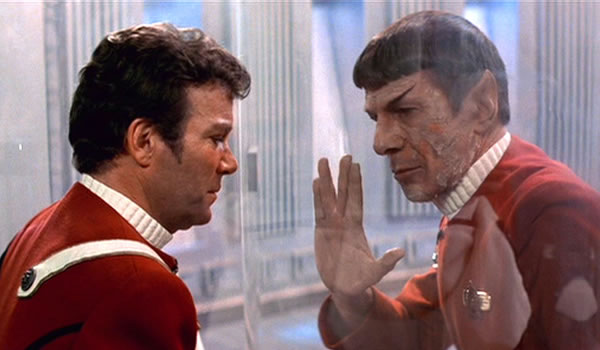
In Wrath of Khan, only one tear is shed and that by a Vulcan.  But while the characters don’t burst into tears, the audience does.  Spock’s death is heart-breaking because you can hear how badly Kirk wants to control his emotions.  Two understated performances  from Shatner and Nimoy make the scene.  It’s heartbreaking because it’s inevitable, and because the emotions are real but never extreme.  You know that these two friends love each other and you know it without either one of them shedding a single tear.

So at the end of the day, this non-Trekkie loved Wrath of Khan. It even made me seek out The Search for Spock, and seriously consider if I shouldn’t give Star Trek the show another chance.

Dragonwyck (1946)

1946dragonwyck3

In case you missed it, I’ve got a bit of thing going on with Vincent Price. It was entirely unintentional, but whenever I want a movie that is guaranteed to be delightful without being too terribly serious, I go for something starring Mr. Price.  Because Vincent Price is cooler than you or me, and he knows it.

So imagine my excitement when I realized that I had not sene THE movie that more or less made Vincent Price into Vincent Price. That is to say, up until Dragonwyck, Price had been a standard supporting player, appearing mostly as second-class villains or smarmy pretty boys (Laura). Despite a pretty creepy turn in Samuel Fuller’s Shock, a non-villainous part in The House Of The Seven Gables with George Sanders, and a few minor villain roles, Price had not quite become the gothic creeper we all know and love.

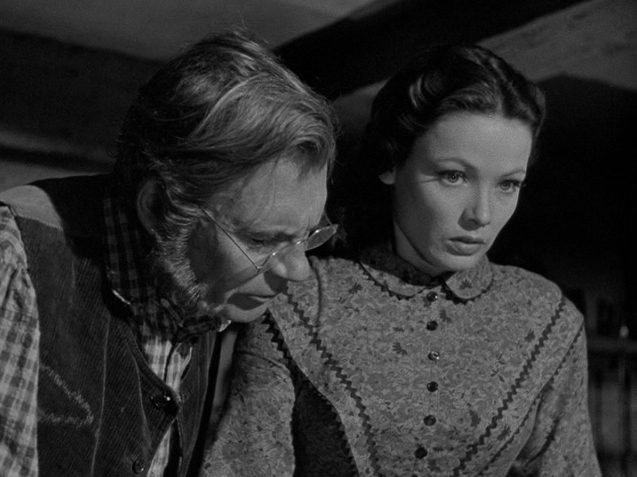
dragonwyck großartigThen along came Dragonwyck.  Price plays Nicholas Van Ryn, a New York landlord with medieval sensibilities who falls (kind of) for his distant cousin Miranda (Gene Tierney). But Van Ryn’s wife (Connie Marshall) is in the way, so he’s got to get rid of her before he can marry his pretty cousin and ruin her life too.  Meanwhile, the tenants of Van Ryn’s land want out of their rather feudal contract with their master – and are trying to get there with the help of the hunky local doctor (Glenn Langan), who’s also falling for Miranda.

Dragonwyck represents Price’s first real foray into the realm of the gothic villain.  His Van Ryn is charming and frigid, a vindictive head-case with delusions about his place in society. He’s a snob, a vicious landlord, a classist, a suppressor of men’s rights, and an apparent believer in the droit de seigneur.  He’s also positively gorgeous in a way that I did not really think Vincent Price was capable of being.

But although I watched Dragonwyck for Price, the movie really belongs to Gene Tierney, who plays a sympathetic and remarkably strong young woman.  It’s understandable how the daughter of a Connecticut farmer and minister (played, by the way, by Walter Huston, just because) could be seduced by her handsome, wealthy cousin.  But at no point does Miranda fall into the common position of gothic heroines.  She stands up to her autocratic husband, despising and loving him at the same time.  As her illusions are stripped away, she does not become less powerful but more so.dragonwyck

Dragonwyck is a surprising film.  It could very easily have fallen into a typical gothic tale of innocence assaulted and corrupted.  But none of the characters are stereotypes.  Miranda’s father preaches at her, then softens, saying, “Indulge me.  You won’t have to put up with me much longer.”  Huston plays him as a decent, God-fearing man who wants very much to give his daughter what she desires, even if it does not tally with his beliefs.  He is in direct contrast with Van Ryn, who does not believe in God but in himself.  This is not just hubris – it is a fundamental aspect of Van Ryn’s character that is more tragic than dangerous.  He’s a man imprisoned by his ancestors and wholly incapable of escaping them.

So Dragonwyck exceeds its gothic underpinnings. While there are the requisite secret rooms, creepy servants and haunting portraits, the film produces a complex tale of power and religion, love and possession, the sickly past and potential for the future.  It’s a fascinating film, and not just because Vincent Price is beautiful.  Although, there’s that too.

1946 Dragonwyck [El castillo de Dragonwyck] - Joseph L. Mankiewicz - [DVDrip] [XviD 640x480x30] [[01-34-05]

The Comedy Of Terrors (1963)

comedy_of_terrors_poster

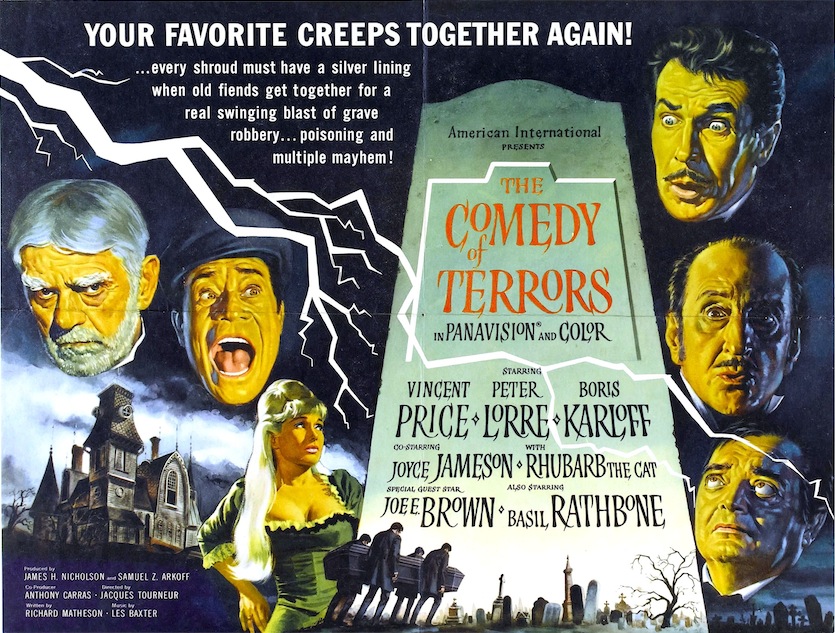
I’ll just leave the cast list right here: Vincent Price, Peter Lorre, Boris Karloff, and Basil Rathbone, in a film directed by Jacques Tourneur (Cat People).

Do you need that repeated? No? Just read it a few more times.  Now inform me of how this movie can possibly go wrong.

The fact is that it can’t.  Price is Waldo Trumbull, an obnoxious and drunken undertaker on the verge of being cast into the street by his landlord John Black (Rathbone).  He has a crazy opera-singing wife he despises (Joyce Jameson), an incompetent assistant named Felix Gillie (Lorre) and a father-in-law who has seen better days (Karloff).  In an effort to buoy his failing business, Trumbull undertakes (HA!) to murder rich elderly men so that he can give them a funeral.

This is a Laurel and Hardy film with four of the finest horror movie actors to step onto a screen.  Price and Lorre bully, shove and tear into each other constantly, Karloff chews the scenery whole and Rathbone … Rathbone has to be seen to be believed.  The plot hinges on Trumbull’s idea to simply knock off his landlord, thus making some ready cash and getting rid of a man he hates into the bargain.  But Rathbone proves (hilariously) hard to kill, prompting the funniest funeral ever.

Comedy of Terrors

The Comedy Of Terrors could not have been performed with any other cast – each actor brings their own inimitable star personas to theirparts, and proves once and for all that they were all capable of playing comedy.  I knew that already about Price and Lorre, but Karloff! Now Karloff was a revelation, giving Rathbone one hell of a eulogy.  The comedy depends on an audience’s awareness of the roles the four men have played in the past – it’s one of the first and finest of the self-referential horror-comedies that Price would cash in on so brilliantly later in his career.

There are things that could be better about The Comedy Of Terrors.  A little less time dwelling on Price and Lorre breaking into houses and a little more time on the plot to kill Rathbone.  Less of Jameson warbling, more of Karloff wandering about looking befuddled.  Price is incredibly unlikable, yet you want him to get away with it just to keep everything moving.  The running jokes get a little wearing after the fourth or fifth repeat, and Price’s vicious hatred of his wife becomes off-putting – however obnoxious she is.  The film really picks up in the second half, once Rathbone has fully committed himself to spouting Macbeth at regular intervals and Karloff begins indulging in histrionics.

I don’t know what else to say about The Comedy Of Terrors, except that I enjoyed just about every minute of it.  Price and Lorre are a great comic team, their differing physicality working very much to their advantage.  Despite some plot holes big enough to fit a horse-drawn hearse, by the end of the film I was laughing so hard I did not care.

The Black Cat (1934)

black cat bottom

I’m back! I know you’ve been waiting with bated breath, but I had … important … things to … stuff.

The Black Cat! How can you go wrong with Karloff and Lugosi? The answer is that you cannot, but there are times when filmmakers do try.   The Black Cat is supposedly based on Edgar Allan Poe’s short story of the same title, but the only resemblance is just that: the title. There is a black cat that shows up at regular intervals – supposedly a representative of undying evil – but that piece of the plot drifts away and never comes back.  So the only thing going for it are the presences of Karloff and Lugosi, and the might of Universal horror in the early 1930s.

Which, let’s face it, is all this film really needs. Lugosi is Dr. Vitus Werdegast, recently released from a prison he languished in for 15 years as a prisoner or war and returning home to find out what has become of the wife and daughter he left behind.  He’s joined by sweet honeymooning couple the Alisons (David Manners and Julie Bishop), the two most boring and useless people on the planet.  The fun starts, though, when circumstances land them all at the high modern home of Hjalmar Poelzig (Karloff), Werdegast’s sworn enemy, a murderer, sadist and Satanist.  Let the games begin!

boris-karloff

This film is simply delicious.  From the instant that Lugosi asks to share the Alisons’ train compartment, you want to start screaming “Holy God, no!”  But for once, Bela is not the one we need to be worried about.  He actually plays Werdegast with great subtlety, as a man possessed by revenge but likewise desperate to pick up his life where he left off.  All he really wants are his wife and daughter back.  One has the impression that he would leave vengeance behind.

The film exploits horror’s roots in German Expressionism, particularly through Poelzig, a villain made up of sinister angles.  Karloff imbues The Black Cat with its menace.  His costuming and style match the high modern house that has become a tomb for past horrors.  He’s a war criminal who escaped judgement, causing the deaths of thousands, and then returning to build his home on their graveyard.  But of course he has not stopped there – the ground below the house is the site of Satanist rituals, and the place where Poelzig keeps his female victims preserved for all eternity; including, of course, Werdegast’s wife.  If all that wasn’t enough to convince you that this guy is seriously fucked up, try this: after marrying Werdegast’s wife, Poelzig went on to marry her daughter too.  Ew.

I will avoid spoiling the ending, except to say that it’s shockingly violent for the time period.  It’s also rushed, which is the biggest problem with The Black Cat.  The film sets up a number of plot threads and conflicts, then speeds through resolving them.  Blink and you’ll miss salient plot points.  Let your attention wander for an instant and characters are suddenly dead.  If it were not for Lugosi and Karloff anchoring the film, it would float off into space.

Both Karloff and Lugosi made better films, but perhaps none pitted them so marvelously against each other as The Black Cat.  Despite dropping some of the more interesting elements – the backdrop of World War I, Satanism and possession – the film succeeds in what it sets out to do.  It wants to give us an hour of two of cinema’s greatest monsters glaring at each other across a chess board, framed in a doorway, or cackling in each other’s faces.  Lugosi and Karloff are possessed of two of the most wonderful voices in early cinema and they dwell on every word of their dialogue, vying for screen-time.  Pleasure in cinema can be found in the weirdest places, and The Black Cat remains one of the more pleasurable experiences for this horror fan.