Ghostbusters (1984): The Marshmallow Apocalypse

gb-marshmallow

*This is a reprint in two parts of a paper I wrote for Ed Guerrero’s “Horror, Sci-fi, and Difference” class during my Master’s degree at NYU. With the 30th Anniversary of the release of Ghostbusters coming up this month, I thought it appropriate to post here. Check back next week for Part II!*

‘Funny us going out like this: killed by a hundred-foot marshmallow man.’ –Ray Stantz (Dan Aykroyd) in Ivan Reitman’s Ghostbusters (Columbia, 1984).

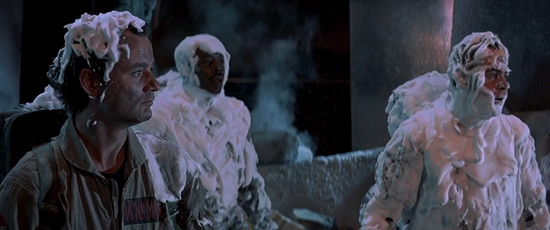
One of the more indelible cinematic images of terror and humor of the late twentieth century is that of a gigantic marshmallow man stomping through New York City like a sugary Godzilla nearing the end of GhostbustersGhostbusters itself is one of the more interesting installments of a subgenre typically referred to as horror-comedies, a combination of the explosion of the chaos world of horror with the carnivalesque humor of the comic tradition.  A film rife with horrific and apocalyptic imagery, it finds both its terror and its humor in the depiction of the end of the world occurring at 55 Central Park West, with the world destroyed not in a rain of blood and fire and terrible vengeance from above, but puffed sugar.

Ghostbusters may appear to be a frivolous work, but it can and should be taken seriously as a depiction of humor within the horrific.  Humor and death are often linked, a way of dealing with the progressively terrifying world.  In Bahktin’s definition of grotesque realism, he identifies the physical world of the comic with the organic transformation of death into life:

The ever-growing, inexhaustible, ever-laughing principle which uncrowns and renews it combined with its opposite: the petty, inert, “material principle” of class society…The grotesque image reflects a phenomenon in transformation, an as yet unfinished metamorphosis, of death and birth, growth and becoming (24).

Death and the comic concept of renewal are inextricably linked; the world must end in order to be reborn.  If we examine Ghostbusters through this lens, as a serious if also comic examination of death and comic transcendence through parodying and satirizing the end of the world itself, we may elucidate how this film, and other horror-comedies, defy the ineluctable nature of death by literally making fun of the repressive as well as the repressed.

Much horror functions as an expression of the repressed in the form of the monster; much comedy too expresses the repressed in the anarchic vision of the comedian or comedians.  The difference is usually that the figure of horror, the monster, is a frightening manifestation of the repressed psyche, a figure that represents gender, class, race or sexual difference that the homogenous society represses.  Comedy, by contrast, revels in anarchic expression, the libidinal impulses of the central comedians and their subversion of the social order.  Both genres represent eruptions of the chaos world in anarchic visions.  They are festive arts that challenge the social order through the creation of fear, laughter, or both.

True festive art…is an art that ultimately celebrates communality, much as any festival does…Festivity is not opposed to depth of meaning.  As Bakhtin has noted, certain truths are only available through festive art.  A worldview that sees a split between body and spirit limits the value of material existence (Paul 71).

When comedy and horror function in tandem with each other, they form a deep expression of what Paul here defines as a ‘festive art:’

The seriousness of this festivity…resides in the extent to which it inverts the most deeply rooted values of Western culture (71).

In exposing and then making fun of what is most terrifying, we acknowledge the fear, but also the absurdity of the fear.  The Ghostbusters participate in a carnivalesque rebellion and joy in destruction usually only open to the monsters of the horror genre.  Acting from within the system, the Ghostbusters succeed in subverting the system.

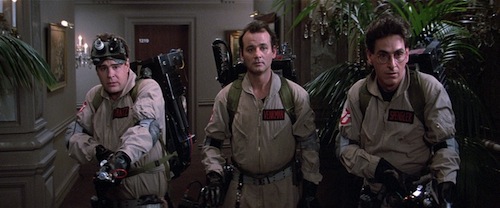
Despite the at times conservative, masculinist nature of its discourse, Ghostbusters inserts its central figures into a material world that refuses to acknowledge the spiritual.  The spiritual then manifests itself as something only they can control because they are capable of recognizing its existence.  The Ghostbusters have a complicated relationship to the ghosts they capture.  They are essentially agents of repression, ‘exterminators’ who arrive to trap and confine the libidinal impulse.  Neither the first film nor its sequel address what happens to the ghosts once they are captured, or the moral and ethical complexity of keeping these spirits within a ‘containment unit.’ The three original Ghostbusters are all white middle-class males, educated and, at the opening of the film, acting from within institutional confinement.  They are representatives of scientific materialism, all doctors dedicated to the trapping of spirits.  They act at the behest of the ruling establishment to arrive and exterminate (or trap) the manifestations of the return of the repressed.  In doing so, however, they subvert the system in acts of anarchic destruction.
ghostbusters1

Athough initially functioning within the establishment, the Ghostbusters come to reject and be rejected by that establishment.  The first fifteen minutes of the film sees them confront their first ghost, and lose their jobs at the university.  Although they may be educated, they nonetheless appear as working class figures.  They are self-described exterminators, essentially the ghost police, identified as such by the uniforms that are janitorial jumpsuits.  They live in an old firehouse somewhere on the Lower East Side; their car is a refurbished ambulance.  Their names are also indicative of class, religion, and immigrant background: Peter Venkman, Raymond Stantz, and Egon Spengler (Harold Ramis).  Throughout the film various members of mainstream WASP society treat them with confusion, contempt and downright aggression.  The villains of the film are all representatives of the WASP establishment: the dean at their university (Jordan Charney) and Walter Peck, a representative of the EPA (William Atherton).  The establishment, although willing to exploit them, is equally unwilling to trust them.  When they are called in, it is unwillingly and with evident embarrassment on the part of the Mayor (David Margulies).  The Ghostbusters stand in a liminal position between the libidinal spirits they trap and the material establishment world.

Many of the ghosts in Ghostbusters function as manifestations of libidinal impulses, grotesque representations of the natural body in their obsessions with food, sex, violence, and destruction.  Freed from their material existences, the spirits are also free to indulge the libidinal impulses they were perhaps denied in life.  The most obvious of these is the famous ‘Slimer’ character, actually referred to as ‘Onionhead’ in the screenplay, the first ghost the Ghostbusters trap (Aykroyd 78).  A floating yet apparently physical being—he comes into physical contact with Peter Venkman (Bill Murray) and ‘slimes’ him—his libidinal drive is to eat and drink.  He first appears consuming plates of food from a service cart, later eating food from a banquet table and drinking bottles of wine that pass through his spiritual body.  His spirit haunts the ‘Sedgwick Hotel,’ an upper class establishment.  The Sedgwick is the site for the ultimate in class gluttony.  Onionhead consumes the remnants of apparently lavish meals; he invades a sumptuous banquet hall and devours food and wine.  We may perhaps view Onionhead as the libidinal manifestation of upper class gluttony, come to revenge itself, a literal return of the repressed.ghostbusters_480_poster

The Ghostbusters tracking and trapping of Onionhead bears closer scrutiny.  They are out of place at the Sedgwick, arriving noisily, dressed outlandishly and carrying gigantic pieces of equipment on their backs.  The hotel manager (Michael Ensign) seems uncomfortable in their presence and asks them if everything can be taken care of ‘quietly.’  Harold Ramis remarks, in the DVD commentary, that the Ghostbusters were conceived as Marx Brother-type characters and the Sedgwick Hotel sequence bears this out (Ramis, ‘Commentary’).  Comically out of place, they are working class figures in an upper-class setting.  Incapable of controlling their equipment, they destroy a large section of the hotel, burning holes in walls, harassing guests, and causing destruction in the banquet hall.  They find humor, if not total release, in this destruction:

Ray: I think we’d better split up.

Egon: I agree.

Peter: Yeah, we can do more damage that way.

In hunting down Onionhead, they destroy a chandelier, a full bar, break several tables, glasses and china, and light things on fire.  At the conclusion of the scene, they charge four thousand dollars for the destruction they have caused, threatening to replace the captured spirit if they do not get their money.

Whether wittingly or unwittingly, the Ghostbusters actually cause more destruction than the ghost they hunt.  Like the Marx Brothers, the Ghostbusters are dependent on the mainstream for their livelihoods; no longer employable as scientists, they have recourse to the working class milieu, but in doing so are able to take revenge, monetary and otherwise, on the system that has rejected them.  They may be dependent on the system itself to support them—they certainly do not try to exist outside of it—but they are able to subvert it from within.  What is more, they make the system pay for its own destruction.  This joy, the humor that comes out of not only Onionhead’s gluttony but the destruction brought about by the Ghostbusters, succeeds in a satiric carnivalesque rebellion that allows the rejected, now working class figures to begin a process of destruction from the inside out.

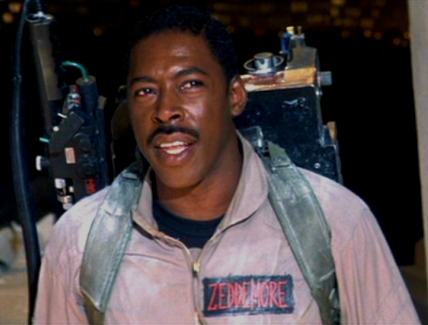
A third of the way through the film, the Ghostbusters are joined by another liminal figure, this one legitimately working class: Winston Zeddemore (Ernie Hudson).  Winston acts as a fourth, lesser figure in the triumvirate, a sort of Zeppo to the Ghostbusters.  Winston is the only solidly working class figure in the film.  He has not lost his class in the way that the other three have.  The fact that he is a black man complicates issues of race, although none of the other characters make reference to his blackness.  Certainly he is demarcated as different from the other three, in class and race background, and in the part he has to play.  The casting of Eddie Murphy, the initial choice for the role, might have resulted in a more equitable balancing of comedy and dialogue between the four men, but as it stands, Ernie Hudson probably has the least input of any character in the film.  Harold Ramis even admitted that the Winston character went through numerous changes and that because they were so concerned about including an African-American and avoiding charges of racism, they created him as almost too good (Ramis, ‘Commentary’).

Winston is one of the few characters to express religious leanings and the first to indicate the possibility of their actions being tied to the apocalypse:

Winston: Do you remember something in the Bible about the last days when the dead rise from the grave?

Ray: I remember Revelation 7:12.  ‘And I looked, as he opened the Sixth Seal and behold there was a great earthquake, and the sun became as black as sackcloth and the moon became as blood.’

Winston: And the seas boiled and skies fell.

Ray: Judgment Day.

Winston: Judgment Day.

Ray: Every ancient religion has its own myth about the end of the world.

Winston: Myth? Ray, has it ever occurred to you that maybe the reason we’ve been so busy lately is that the dead have been rising from the grave?
Zeddemore_01

This is the most serious exchange in the film, one of the few instances when the comedy ceases for a moment and the possibility of the actual ending of the world becomes clear.  By placing the apocalyptic prophecy in the mouth of the most liminal character, a true representative of the working class and the oppressed, the film ties its apocalyptic imagery to the place of the repressed.  Winston stands for practicality (‘Ray, when someone asks if you’re a god, you say YES!’) and a spiritual otherness that counterbalances the intellectual superiority of Egon, the naïveté of Ray and the showmanship of Peter.  The mixture of practicality and spirituality can sometimes smack of stereotyping—of course the black man heralds the coming apocalypse! —despite the concerns of the (white) writers to avoid such stereotypes.  Winston at some level fulfills the stereotype of the ‘magical negro,’ whose connection to the spiritual world is more attuned than that of the white mainstream figures.  His practicality, however, subverts and complicates this archetypical characterization.  He acts within a more complex racial climate that, while it does not fully equalize the role of the black man, avoids making him a stereotype.  For the film at least, blackness is a non-issue.  Given the apparent liminality of the other three Ghostbusters in terms of class and ethnic background, the film does not easily fall into a black/white binary.  Winston actually has the last line in the film, and while this does not fully restore him to equality with the other three, it does at least give the most practical and most liminal figure the last word.  Far from viewing Winston as the ‘black servant’ of the white males, he acts as a down-to-earth character that represents the blending of practicality and spirituality that the others lack (Paul 128).
The Invisible Woman (2013)

The Invisible Woman

2.JPG

We often acknowledge Charles Dickens as one of the finest writers of the 19th Century. Certainly he was one of the most influential, developing the three volume novel as a work both of art and entertainment, and the novelist as a celebrity and public figure with moral and ethical responsibility to his public. Like many great public figures, though, Dickens’s private life was less than stellar, wrapped up in Victorian social and sexual mores. He was, in short, no better than most people, and at times perhaps a great deal worse.

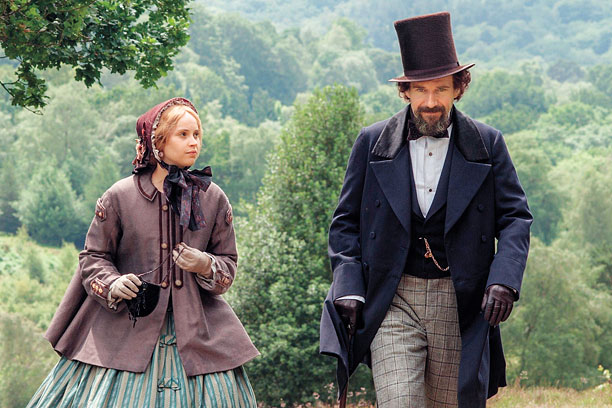
The Invisible Woman claims to tell the story of Dickens’s semi-public relationship with Ellen Ternan, a young actress whose relationship with Dickens would last the rest of his life. Because of both the extreme secrecy of the relationship – Dickens was still married – and the fact that Dickens burned his entire correspondence with Ternan, the actual circumstances of much of their relationship remains largely hearsay and speculation. Dickens had already engaged in a fairly public infatuation with his wife Catherine’s sister Mary earlier in his life, and it is true that he separated from his wife around the same time he’s believed to be involved with Ternan. As with most biographical or semi-biographical films, The Invisible Woman should probably not be taken as “the truth,” but rather a speculative version of it.

The film opens with the first appearance of Ellen “Nelly” Ternan (Felicity Jones), long after her affair with Dickens has ended. A married woman, she still harbors fond and not-so-fond memories of the man she loved. The film rolls us back to their first meeting during a production of The Frozen Deep, a joint play by Dickens (Ralph Fiennes, who also directs) and Wilkie Collins (Tom Hollander). Nelly is the youngest in a family of actresses headed by Frances Ternan (Kristin Scott Thomas); she’s also the least talented, with difficulty projecting beyond the footlights. She and Dickens share an immediate attraction and rapport, however, and their relationship progresses from a great man and his acolyte to a great man and his somewhat recalcitrant mistress.

The Invisible Woman thankfully avoids some of the cliches that could have marred its project. Fiennes’s Dickens is not a seducer, but neither is he wholly sympathetic – he’s a talented author and celebrated philanthropist who cannot bear not to be adored. His attraction to Nelly is both that of an older man falling for an attractive younger woman who obviously venerates him, and as a man who believes he’s found someone who understands him. His treatment of his long-suffering wife (Joanna Scanlan) is reprehensible, yet we do not fully condemn his character. The whole plot becomes bound in the mores of Victorian society, which permits a man to have an affair but condemns the woman with whom he has it.

Felicity Jones plays Nelly as a woman in a relationship she both desires and wishes to end. All but sold by her mother, who believes she will never be able to support herself as an actress, Nelly falls for Dickens but does not really wish to be his mistress, condemned by the culture that surrounds her. A painful scene between Nelly and Catherine Dickens shows both women as victims of their society. They caught in love for a man who will always, as Catherine says, choose his public above any woman.

If The Invisible Woman fails anywhere, it is in the somewhat lax use of the framing narrative. This is meant to be something of a flashback and something of a mystery. There’s a lack of clarity in the connection between Nelly’s persistent unhappiness in her current life and her complicated experiences in the past. Jones plays even the younger Nelly as a somewhat unhappy and certainly a troubled young woman, giving her little space to change over the course of the narrative. While I never doubted her passion for Dickens was sincere, I did doubt its depth – she seems to worship him as a writer, conflating the man and the public figure. As such, the emotional connection between them feels shallow where it should, in my view, have been more complicated. The ending of the film is abrupt and a little unsatisfying, as though there was no way to bring the narrative to any kind of a round conclusion for either character.

Despite one or two shortcomings, however, The Invisible Woman is one of the better semi-biographical films about the time period. The Victorian era tends to either be romanticized or treated with undue harshness on film – The Invisible Woman avoids these pitfalls by approaching its characters as human beings, good people who sometimes behave badly. At the heart is the mystery of the human experience, and a sense of both profound joy and deep melancholy. When looked at in that light, one might imagine that Charles Dickens would be proud.

Fear Strikes Out (1957)

Fear Strikes Out (1957)

fear-strikes-out-poster

Fear Strikes Out might be one of the few baseball movies to feature very little baseball. No games are depicted in full; there are no exciting montages of teams winning or losing, and there’s little romantic aggrandizement of America’s pastime. Yet the film also purports to tell the true story of a great ball-player, and deals openly and honestly with the pressure that comes with being a sports star.

Fear Strikes Out tells the story of real-life outfielder Jimmy Piersall (Anthony Perkins), who played for the Boston Red Sox from 1953-58. Piersall had a public breakdown during the 1952 season, entering a mental hospital where he was finally diagnosed with bipolar disorder. The film is based on Piersall’s autobiography, and elides over some of the less charming aspects of his personality (including one instance where he spanked a teammate’s four year old child in the Red Sox clubhouse). This is perhaps the story as Piersall would like it to be known, about a talented outfielder beset by familial pressures and mental illness. As such, it might behoove us to take the historical accuracy of the film with a grain of salt.

Passing the sketchy biographical details, what we have left is a drama with a baseball background. The film opens with the adolescent Piersall at home in Waterbury, Connecticut, where he’s already a driven baseball player. He’s both encouraged and dominated by his father (Karl Malden), a former ball player who never made it to the majors. Raised with only baseball on his mind, Jimmy grows up to be a socially awkward young man but a brilliant player, attracting the attention of Red Sox scouts during his senior year of high school. He’s drafted and heads off to Scranton to learn how to play in the majors, where he meets apparently the only positive force in his life: Mary (Norma Moore), who becomes his wife.

As Jimmy moves towards the majors, though, his nervousness and self-criticism (fueled by his father) become more pronounced. Terrified of failure, he also cannot celebrate his own success – he loves baseball, but does not seem to have any fun on or off the field. His constant refrain is that he’s not good enough. He fails to make the Red Sox right out of Scranton, but when he’s finally drafted as a shortstop (instead of an outfielder, which he was trained for), he nearly has a breakdown. The paranoia only increases when he actually becomes a major league player, clashing with his teammates and coaches, constantly frightened of judgement and inadequacy.

fear-strikes-out-breakdown

The center of the film is of course Tony Perkins, who plays Piersall with the same haunted gaze and tragic aura that would make him so effective as Norman Bates, three years later. Jimmy never seems relaxed, standing or playing with hunched shoulders, his body tight and face taut with controlled emotion. He builds slowly from a nervous boy to a man in the throes of total collapse without overacting the part – and his breakdown, when it comes, is both expected and heartbreaking, as he shrieks into the stands, begging to be told he’s good enough.

Karl Malden as John Piersall has the unenviable task of making a controlling man into more than caricature. He pulls it off though, imbuing the domineering father with a sense of tragedy all his own. The viewer never doubts that he loves his son, or that he is the main actor in Jim’s mental collapse. He and Jim share an intense, co-dependent relationship that luckily never makes one or the other of them overly sympathetic. It would have been easy to turn John Piersall into the villain of the piece, and Malden helps to keep that from happening.

The women of the film are minor characters, and as such are fairly lackluster. Jimmy’s mother, whose own mental illness is briefly hinted at, is a non-entity, while his wife Mary is both his major supporter and a little too forgiving of all the men around her. One has the impression that she recognizes the over-dominance of the father early on, but seems incapable of even suggesting to her husband that he sever ties.

The only truly glaring flaw in Fear Strikes Out comes when Jimmy finally makes it to the Red Sox. The movie makes it appear as though the Red Sox manager is taking a lot from a rookie ballplayer – a young man who cannot get through a game without insulting or instructing his own teammates, and even begins a fight in the dugout. We’re made to understand that the Red Sox continue to put up with Jimmy because he’s a brilliant ballplayer, but his brilliance is rarely in evidence on the field. A few longer sequences of Piersall actually playing ball, proving just how good he really is, and it would have been easier to accept that a major league team would keep him for as long as they did.

FearStrikesOut

The flaws of the film could be put down to the relative inexperience of director Robert Mulligan. Fear Strikes Out was his first feature film in a career primarily focused on television. Mulligan would go on to direct some excellent, if maudlin, films, including To Kill A Mockingbird and Inside Daisy Clover. He makes excellent use of aural and visual cues that set the viewer on the field beside Jimmy, focalizing scenes through him in an experience of nerves and paranoia. Unfortunately, his directing does nothing to expand upon an understanding of Jimmy’s talents as well as his fatal flaws.

An early and honest examination of mental illness, in the context of one of America’s most beloved sports, Fear Strikes Out largely avoids maudlin sentimentality or easy answers. It also reminded me that baseball is the most individual of team sports. We focus on stats of individual players as much as we focus on whole teams, and scream to take players out of the game. Attention falls onto a batter, a pitcher, a fielder, and a single mistake can make or break a game (and a career). It’s an aggressive, quiet, strange sport, and aggressive, quiet, strange men have to play it.


Mister Jerico (1970)

Mister Jerico

mister-jerico-movie-poster-1970-1020363566

Following the conclusion of The Avengers in 1969, a number of the cast and crew decided it was a good idea to take themselves off to the sea and sand and make a movie. The result was Mister Jerico, intended as a TV pilot that never got off the ground. It was released theatrically in the United Kingdom, and then as a TV movie in the U.S.

Patrick Macnee is Dudley Jerico – whose theme song leaves a little to be desired – a thief/con-man (with scruples) out to con a nasty millionaire Russo (played by the always nasty, always enjoyable Herbert Lom) out of a few million dollars. Jerico’s pal Wally (Marty Allen) helps with the endeavor – and there is of course the lovely Susan Grey (Connie Stevens), Russo’s secretary and Dudley’s love interest. Things get complicated when a mysterious French woman pops up trying to pull the same caper, involving the theft and sale of a rare diamond.

Mister Jerico is one of those charming and fluffy capers that the 1960s did well, quite similar to the higher- budgeted Gambit or How to Steal a Million. The palette is sun-soaked, the plot buoyant and just this side of ridiculous. The second half of the film in particular moves along at a nice pace, complicating matters without making anything seem too serious. If you think too deeply about the story, it will all appear very nonsensical, but this is a stylized caper film not intended for deeper scrutiny. It’s a surface film and as such it’s quite enjoyable.

macnee-stevens-jerico

Patrick Macnee is a likable screen presence and good light comedian, playing Jerico with the same dash of wit and energy that he possessed as John Steed. He’s a somewhat limited actor, but works within those limitations to create a charming, erudite con man.  His wardrobe is also nothing short of spectacular – if that’s the word for it – with bright prints, flashy trousers, and a blue velvet fedora that Superfly would be proud of. Herbert Lom is an excellent counterpoint: a sharp, venal heavy, who fully deserves anything the cons can throw at him.

Connie Stevens meanwhile seems a touch out of place as Susan. While she and Macnee have heat, her somewhat breathy line delivery and slight air-headedness don’t quite gel with her role, which becomes more complex  as the film goes on. Still, she’s not an uninteresting leading lady, though I could name about ten actresses that might have played the light part with a bit more depth.

Mister Jerico is the height of 1960s silliness, and as long as one expects nothing more it makes for a diverting few hours. While I understand why it was never picked up as a pilot, it’s no less ridiculous than The PrisonerThe Persuaders, or any other stylized TV show from the same period. I have a soft spot for stylized films – all the more so if they happen to feature actors and actresses I enjoy. While not quite high camp, Mister Jerico is a lot of fun.

Green Grow The Rushes (1951)

green-grow-the-rushes-hulu

Green Grow The Rushes (1951) represents an odd little subgenre of post-war British filmmaking that does not really have an American equivalent of which I am aware. I’m not certain what to call it (although perhaps someone has already coined a term), but it was a specialty of studios such as Ealing. It usually involves the coming together of a British country community – either a village, a town, or a county – in a bid to maintain their independence and resist the oncoming tide of modernization and government control. In films like The Titfield Thunderbolt and Passport to Pimlico, these communities are faced with incorporation and by extension an assault on their solidarity and their uniqueness. It’s an interesting subgenre because it combines that British spirit of community with some not very subtle Socialist undertones, all wrapped up in the charm and quirkiness of the English countryside.

Green Grow The Rushes is just such a film. The coastal community of Anderida Marsh is “invaded” by three government inspectors from the Ministry of Agriculture, out to discover why the area’s open farmland is not being cultivated (and where, exactly, the inhabitants are making their money). Anderida claims that it is independent from the rest of England due to an ancient charter granted them by Henry III. Their resistance to government interference is further complicated by the fact that the community largely makes its money from smuggling liquor in and hiding it in the marshes, something which they don’t want the officials to discover.

roger-livesey-green-rushesAt the head of the smugglers is the odd and wholly amusing Captain Biddle (Roger Livesey), and his compatriot Robert (a very young Richard Burton). When an attractive newspaperwoman Meg Cuffley (Honor Blackman) discovers what the smugglers are up to, she wants a piece of the story and the action (not to mention a piece of Robert). Meanwhile, the smugglers and those in the town aware of their shenanigans must continue to cover up their activities from the government inspectors. It’s a somewhat complicated set-up, and it gets even more complicated when Biddle’s boat runs ashore during a storm, stranding the crew (and the liquor) in a duck pond belonging to Bainbridge (Russell Waters), a farmer with strong resistance to anyone trespassing on his land. Faced with threats from the inspectors, the coast guard, and the local officials, the smugglers have to find a way to get the liquor off the boat before they’re boarded and their contraband discovered.

While Green Grow The Rushes will receive no awards, it is one of the more enjoyable little films from a time period that produced its share of enjoyable films. This is in no small measure the responsibility of the cast, a veritable who’s who of British leads and character actors. Livesey is the delightful and acerbic lead, dispensing homespun wisdom to his friend Robert about women (“lily whites”) and how to keep out of trouble with them. Not that Biddle took his own advice, entangling himself with a charming lass who ran off on him and married another (without actually divorcing him).honor-blackman-green-rushes

Richard Burton, meanwhile, does not get a great deal to do with his leading man part, but he fulfills the role admirably and with great charm. The same must go for Honor Blackman, in full English Rose mode, who nonetheless shows signs of the total disregard for social and gender roles that will make her so very effective in her later career. Both lift what could otherwise be a dull romantic subplot to a charming, if airy, love story. It’s always a pleasure to see good actors working together, even more so when they are so very young.

But it is really the English country community that makes this film so endearing. The film is full of little touches: the petty bureaucratic wars between various government officials, the coy flirtation of Robert and Meg, Captain Biddle’s plot to dislodge his ship. As Anderida Marsh joins together to celebrate their charter day – complete with a reenactment of Henry III signing the charter to grant them basic independence – a screwball comedy of bureaucracy and drunkenness ensues. All in all, Green Grow The Rushes is wholly enjoyable, from start to finish.

You can watch Green Grow The Rushes on Hulu+ or for free on YouTube.

Q Planes (1939)

Q Planes (Clouds Over Europe)

q-planes

If you thought that British espionage stories started with a certain dry martini-drinking superspy, then you are missing out. Our neighbors across the pond have a long history of some excellent espionage in both film and print, featuring a whole host of literary heroes who were spying for Queen (King) and Country long before Mr. Bond was out of diapers (nappies).

Q Planes (released in America as Clouds Over Europe) is a British spy film made in the early days of World War II. In fact, the film was released mere months before Britain declared war on Germany. As such, there’s an urgency to the film that undercuts its otherwise breezy quality in a charming story of spies, sabotage, and fly-boys.

Q Planes stars Ralph Richardson as the fedora and umbrella-sporting British spy Major Hammond, assigned to figure out just what has happened to a number of planes that keep vanishing on their test flights. These planes are carrying expensive experimental equipment which we are assured another power would be happy to get their greedy little hands on. Hammond heads to the airfields of Barratt & Ward and enlists the aid of dashing pilot Tony McVane (a young and wavy haired Laurence Olivier) to discover just what has happened to those planes. Along for the ride is Hammond’s journalist sister Kay (Valerie Hobson), whom McVane just happens to be falling for.

qplanes1

Despite a middling plot, the film flies along on the strength of its main cast. Olivier plays slightly against type as a brash and noisy young man more likely to run headfirst into trouble than to hang back and make a plan. Hobson, meanwhile, has little to do beyond gazing into Larry’s eyes. She was an interesting, wide-eyed beauty of the time period, perhaps best known in America as Dr. Frankenstein’s titular bride Elizabeth in The Bride of Frankenstein. She does make the most of her screen-time here, though, as noisy and opinionated as her male counterparts.

The star of Q Planes is Ralph Richardson’s dapper Major Hammond, and the reason why I watched this film in the first place. Hammond is a secret agent prototype, waving his umbrella about, making fun of his superiors, insubordinate without being improper. He’s also one of the inspirations for the character of John Steed which, if you pay any attention, might explain why I gravitated towards this film. Hammond’s vitality make the film fun to watch, and you only need to check out any one of his scenes to understand why. What could have been a somewhat stodgy little war thriller is energized through Richardson, a serious actor having a lot of fun.

Q Planes proves that Britain did war thrillers just as well as Hollywood, and sometimes even a bit better. While it shan’t win any awards, it’s a nifty little film, wholly enjoyable for its entire 1 hour 18 minute run-time.

Victim (1961)

Victim_1961_poster

Basil Dearden’s Victim, from 1961, was one of the first British-made films to deal openly and explicitly with (male) homosexuality, and the serious prejudices faced by gay men in the United Kingdom. Couched as a potboiler mystery of sorts, Victim follows successful barrister Melville Farr (Dirk Bogarde), a closeted homosexual who becomes involved with the police following the suicide of a young man with whom he had a romantic (but asexual) relationship.  The source of “Boy” Barratt’s suicide are several photographs of him and Farr sent to him by a blackmailer who demands payment in exchange for the photographs. Discovering that a number of gay men have received similar demands, Farr decides that he’s going to discover who the blackmailer is. The film is complicated by Britain’s anti-homosexuality law, which criminalized homosexual acts between men. This meant that any man found “guilty” of homosexuality could be sent to prison. The blackmailer of the film has, in effect, the law on his or her side.

In Farr’s journey to discover the blackmailer, he comes into contact with a spread of the social classes, all of them containing men forced to live double lives. The film exposes the complicated feelings of both men and women about a taboo subject. Farr is closeted and married, his wife (Sylvia Syms) aware of his homosexuality but hurt when she discovers that he fell in love with Barratt. Her reaction is entirely natural, her love for her husband very real; she seems more betrayed by the fact that he desired someone else than by the fact that the someone else was a man. Nor is his love for her made light of – he does care for her, and is as concerned for her future as he is for his own.

Victim-Bogarde-Syms

As Farr discovers more and more men, some of his own acquaintance, who are being blackmailed, the perversions of the law against homosexuality are revealed. None of the men are willing to go to the police for a multitude of reasons, most of them coming down to fear of arrest and imprisonment. One older man remarks that he has been to prison four times for homosexual acts, and that he will not go back; if that means he has to pay to keep the blackmailer silent, then he will. Fear permeates the film, these men forced to live double lives in denial of their desires.

The standout performance of the film belongs to Bogarde as a man who has lived a life suppressing his most basic desires (there’s an implication that Farr has never actually had sex with men). Farr is not altruistic, and his unwillingness to communicate with the police means that more people are hurt. Farr’s bravery in potentially sacrificing his career and his liberty to bring the blackmailers to justice is further complicated when we learn that the incriminating photographs are not so incriminating – they could not have stood up in court as proof of a homosexual relationship. His pursuit of the case is a way of expatiating his guilt for ultimately rejecting Barratt, not to mention the role he accidentally played in the young man’s suicide.

If the film fails anywhere it is in the too explicit treatment of homosexuality. By daring to discuss the matter openly, it at times sacrifices subtlety, especially in the minor characters. The denouement feels somewhat forced, the revelation of the blackmailer a little too simple in terms of motive.

In the end, Victim remains a distressingly topical film. The homophobia expressed by some of the characters feels all too current when one considers that this was a film made 50 years ago. It was influential in raising discussion of homosexuality in Britain – and probably helped to take down the law that made it illegal. Although some aspects appear dated, Victim remains a powerful and moving look into the cruelty of a culture that requires people to repress a fundamental part of their being, or risk exclusion, ridicule, and even violence.

Dracula A.D. 1972 (1972)

Dracula A.D. 1972

dracula-ad-1972

Hammer Studios went into decline as they skated into the 1970s. Their returns would rapidly diminish; they would begin replacing their brand of well-made camp horror with ever greater exposure of skin, blood and pointless violence. But there were a few remnants of the old Hammer as the studio went into the 70s, and none is weirder, or more enjoyable than Dracula A.D. 1972.

The year is 1972 (in case you missed it) and Count Dracula has been dead for 100 years. But his acolytes live on, and it’s time for the King of Vampires to return to wreak havoc on the groovy chicks of swinging London. Dracula is resurrected by a bunch of bored hippies, led by the nasty Johnny Alucard (Christopher Neame). While the others take the whole satanist ritual as a big joke, Johnny is dead serious. Dracula returns from the dead, looking pretty damn good for being dust and ash for the past 100 years. He wants blood, and he wants it now; cue Johnny running around procuring sexy girls to satisfy Dracula’s bloodlust. But Dracula is particularly interested in chowing down on Jessica Van Helsing (Stephanie Beacham), one of Johnny’s friends and the youngest descendant of Laurence Van Helsing, who staked the undead Count. Meanwhile, Jessica’s grandfather Lorrimer Van Helsing (Peter Cushing) and a police inspector (Michael Coles) investigate the mysterious deaths of the young maidens that Dracula has been draining.

Dracula A.D. 1972 is the height of Hammer camp, with a groovy go-go soundtrack, crazy clothes and drug-addled hippies (what with their loose morals and blood-sacrificing ways). There are some uncomfortable parallels between Dracula’s murders and the Manson family killings that only took place a few years before; the film trades on the mainstream fear of the new generation, with the group of friends always looking for a new thrill. There’s an added fluid sexuality – Dracula’s acolytes are all men instead of brides – and, as always, the heaving bosoms and red-paint blood we all expect from Hammer.

But when you come down to it, no Dracula film works without Peter Cushing and Christopher Lee. Lee thankfully does not have to wander around swinging London or board a bus in his cape; he instead sticks to the de-sanctified churchyard while Johnny does his dirty work. Cushing and Lee are excellent adversaries, even when they barely spend a moment on-screen together: Cushing’s slight physicality, his solid Englishness, the quiet intensity with which he tries to protect those he loves, juxtaposed against Lee, tall, elegant, with booming voice and nearly black eyes. They make a great team, and Dracula A.D. 1972 brings them together once more.

Dracula A.D. 1972 might be the last great Hammer film. While it shows signs of wear and tear – and foreshadows the studio’s decline – it still has enough campy fun to go around, punctuated by some serious moments of true horror.

Bloody October: The Shining (1980) and Room 237 (2012)

The Shining (1980) and Room 237 (2012)

the-shining-poster

I’ve decided to combine my reviews of Stanley Kubrick’s The Shining with Room 237, the 2012 documentary about theories surrounding the meaning of The Shining. This is largely because just about everyone and their mother has written a review of The Shining and I have little new to add to the general consensus that it’s one of the scariest movies ever made.

The Shining (in case you’ve managed to miss both it and The Simpsons’ Treehouse of Horror sequence “The Shinning”) is about a nuclear family that decides it’s a good idea to hole up in a massive hotel in the mountains of Colorado, where they will see no one else for five months. The last caretaker happened to chop up his entire family into little tiny pieces, but whatever. Five months rent free!

You know the drill. Jack Nicholson goes all kinds of crazy – as if he wasn’t already – and chases Shelley Duvall and the adorable Danny Lloyd around with an axe after his ghostly friends tell him to. Kubrick creates a deep sense of wrong and foreboding from the very beginning. Subtlety is the name of the game in The Shining; the hotel seems off, with winding corridors that don’t quite make sense, offices with windows where there should be none, shifts in decoration that feel unnatural. The Shining trades on peripheral vision, the sense that something is just not quite right. Kubrick pulls this off by introducing or eliminating small elements in a single frame: a chair that’s there one minute and gone the next; a cigarette with smoke circling inward instead of outward. There are undercurrents of abuse – Danny’s shoulder was once dislocated by his father, though this is claimed as an accident – and unnamed violence. Is the hotel really haunted, or is this Jack having a breakdown? Does Danny cause the madness of his father, a mental projection of anger and hatred? It’s a fascinating, labyrinthine film that gives no real answers or explanations. As Scatman Crothers remarks to Danny, there are just traces left over from the past.

Room237

If The Shining is indeed a movie about traces, Room 237 spins a few convincing (and less convincing) yarns about those traces. Giving voice to some of the interesting, odd and often outlandish theories about the meaning of The ShiningRoom 237 largely avoids passing judgment on the theorists, allowing them to speak for themselves. And the theories are interesting indeed. One presupposes that the whole story is about the genocide of the American Indians, marking out instances of Native American decorations and photographs that dot the hotel. Oddly, the issue of the Calumet baking soda cans prevalent in several shots is dwelt on more than the fact that the Overlook is built on an ‘ancient Indian burial ground,’ that favorite of horror story tropes.

Another less convincing analysis has a German history scholar examining relations of The Shining to the Holocaust – because all post-war violence has something to do with the Holocaust, and Jack totally uses a GERMAN typewriter. A third theorist tries to claim that Kubrick was using The Shining as a way of telling us all that he was involved in faking the moon landing (what?).

Room 237 is not all crazy, though. Most of these theorists have noticed fascinating elements in the film that might otherwise pass unnoticed. All, however, take their analysis just that one step too far, claiming that the film is ABOUT this and only this, and trying – sometimes in very extreme ways – to prove their case.  What none of them focus on, though, are the very disturbing gender relationships, eliding over Jack’s aggression towards his wife and the notion of ‘correcting’ the bad behavior of women and children through physical violence. I’m amazed that anyone can spend twenty minutes proving the genocide of the American Indians via baking soda cans, but miss the whole “I’m gonna bash your fucking brains in”.

The Shining and Room 237 are fascinating to watch together, however, and well worth the time. While none of the proposed explanations are convincing on final analysis, they all pick up on elements within the film that make it so very fascinating to watch.  The Shining is not just a great horror film; it’s a great film, and still has the power to scare the hell out of you.

Bloody October: The Fog (1980)

The Fog (1980)

The-Fog

There are certain gaps in my horror film education that I have struggled to fill. While I’m very good on Roger Corman, James Whale and Tod Browning, I have missed out on the major works of directors like Wes Craven, Dario Argento and, I realize, John Carpenter. Some of this is due to a total lack of interest in slasher films or most body horror, but as a horror fan I cannot run forever. Some films I simply have to see.

The Fog is one of those Carpenter films that I heard good things about and never got around to watching until now. I’m pleased that I did so. It all begins with Mr. Machen (John Houseman) telling a scary story to kids at a campfire. The story sets up the rest of the film, which plays like an urban legend. The town of Antonio Bay suddenly goes crazy one night, with car alarms going off, pieces of stone falling out of walls, and the ground rattling with an unmeasured earthquake. Meanwhile, a glowing fog rolls in across the water, traveling against the wind. The fog, as Mr. Machen tells us, once caused the deaths of ship full of people, crashing them against the rocks in the Bay 100 years ago on that very night. Now it has returned to Antonio Bay, and it brings with it a strange and terrible vengeance.

The Fog really could have gone either way. The notion is a good one – a traveling fog that envelops and murders – but it could easily have slipped into hokey special effects and people running away from a cloud. Carpenter is a better filmmaker than that, thank God. He instills a sense of otherworldly terror in the fog – there are ghosts that come with it, but for the most part they are glimpsed in shadow and profile, announced by a pounding on the door or wall, proceeded by fog and haze. The horror lies in the build-up, not the execution, and there are few filmmakers from the 1980s so capable of building suspense as John Carpenter.

The cast helps too. Jamie Lee Curtis is on hand as a sweet young hitch-hiker who just happens to wind up in Antonio Bay. Her mother Janet Leigh puts in an amusing appearance as one of the town pillars. Adrienne Barbeau is the local radio DJ and as close to a final girl type as we’re going to get. There’s also Hal Holbrook playing a drunken priest who discovers the true story of the founding of Antonio Bay, and the reason why the fog is … really pissed off.

It’s a simple but effective story told in a simple but effective way, which is what good horror filmmaking is all about. Elaborate backstories, big CGI effects and convoluted character development be damned. Horror is about good scares, and The Fog has that in abundance.