Horror Express (1972)

Horror Express (1972)

horror-express-poster

Peter Cushing and Christopher Lee made a remarkable 22 films together over the course of four decades – the first being one where they never even appeared in the same scene, as the pair actually appeared in Laurence Olivier’s Hamlet in 1948. More often than not they were antagonists, pitted against one another in a series of Dracula films from Hammer Studios and as Victor Frankenstein and his Monster. It’s a pleasure to come across a film where the two friends share the screen and are (mostly) friendly with one another.

Horror Express is not a Hammer film, but it certainly looks and sounds like one.  The film features Lee as Sir Alexander Saxton, an archaeologist and scientist who discovers a “missing link” in a cave in Manchuria. Returning to England with the specimen via the Trans-Siberian Express, Saxton hopes to change the face of science with his mummified creature. They’re joined Saxton’s friendly rival Dr. Wells (Cushing), his assistant Miss Jones (Alice Reinhea), and a whole gang of suspicious characters that include a Polish Countess and her husband, a lovely stowaway, and a mad monk.  Also on board is Inspector Mirov (Jose Pena), a police officer following Saxton around after the sudden and inexplicable death of a thief in close proximity to Saxton’s mummy.  As soon as the train starts moving, people start dying. It rapidly becomes clear that the thing Saxton has in that case is not quite as dead as it appears, and is capable of murdering with one glance of its shimmering red eyes.

lee-cushing-horror-express

Horror Express is something like The Mummy meets Murder on the Orient Express with a healthy overtone of Italian giallo. The influence of the latter becomes obvious during the murder sequences, a bit more violent and disturbingly realistic than your usual horror fare of the time period. The violence is not overdone, however, and the film relies more cleanly on the slow realization of who, and what, is doing the killing. An abrupt shift halfway through the film makes for some excellent tension, while Saxton and Wells join forces to stop the creature and protect as many people as they can.

Cushing and Lee are enjoying themselves here, as perhaps the only English speakers in a Spanish/British horror film with a primarily Spanish cast. They begin initially as rivals and quickly become buddies, facing the monstrous horror with two very stiff upper lips. The pair are always fun to watch together; their chemistry tends to leap off the screen, even when the surrounding events might make lesser actors into hams. The rest of the cast is quite impressive on the whole, with no one standing out as a poor performer among the rest. You have to be willing to enter into the madhouse spirit of a film like this to get any enjoyment out of it, but at least the cast seem game, taking their parts seriously without overacting.

There’s really not much to complain about with Horror Express, so long as you accept the initial and rather silly premise. The denouement does feel rushed, however, and raises a number of questions of plotting that are never satisfactorily answered. The sudden introduction of Telly Savalas as a Cossack commander is jarring, not least because Savalas does not even attempt to sound like a Cossack. The final showdown comes off as perfunctory, especially after some strong tension building over the rest of the film.

I would not put Horror Express forward as the best film Cushing and Lee made together, but it is very far from the worst. It’s a solid, enjoyable hour and a half spent in the company of one nasty monster, and two of the finest horror actors to ever haunt the screen. As we mourn Lee’s passing, we can find a bright spot in the idea that he’s still stalking monsters with Cushing, on the screen and, perhaps, elsewhere as well.
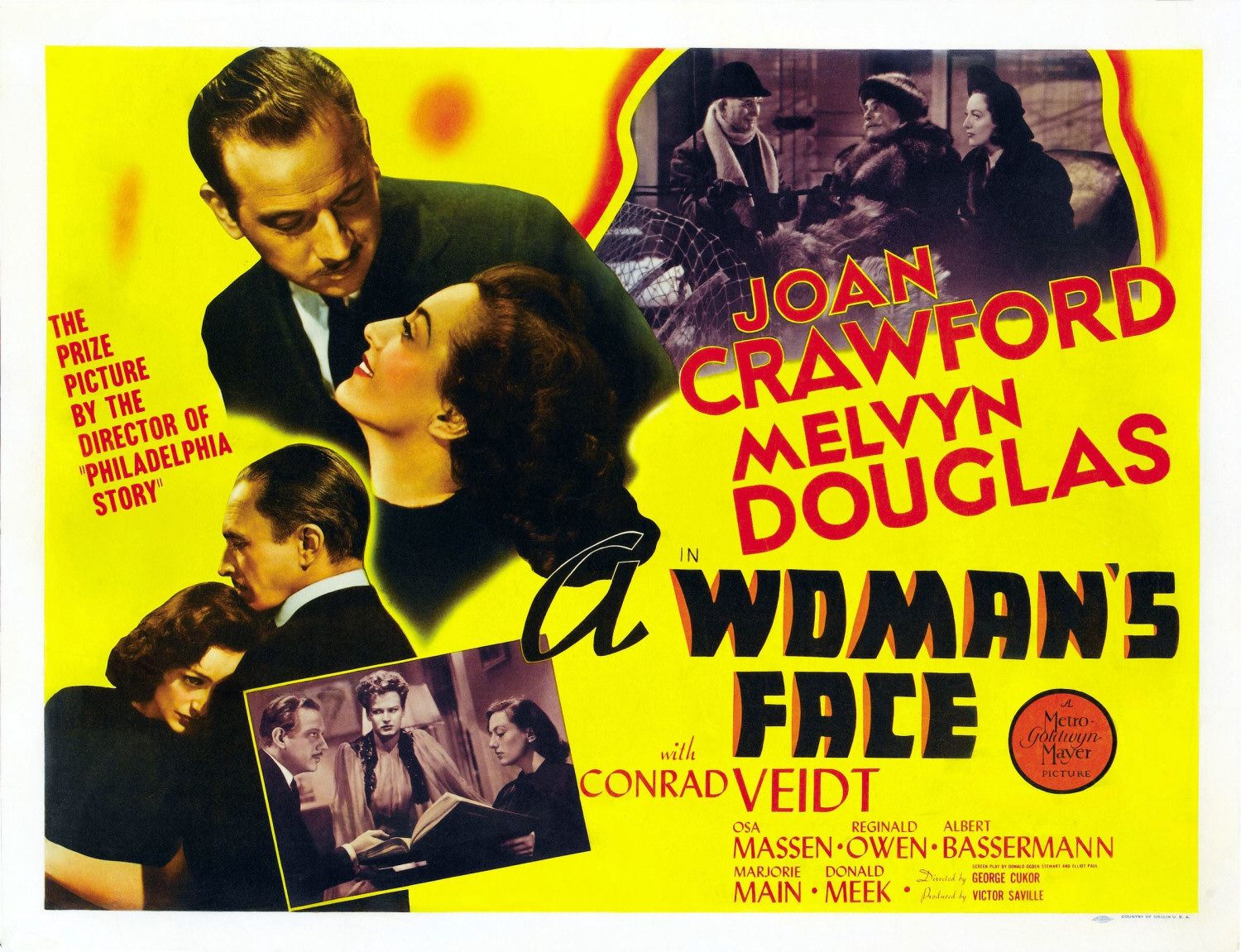
A Woman’s Face (1941)

A Woman’s Face (1941)

womans_face_ver5_xlg

Over the course of a long career, George Cukor made any number of excellent films. While he delved into melodrama (and made some great pre-Code films like The Animal Kingdom), he was primarily known as a director of light drama and even lighter comedy like Dinner at Eight and The Philadelphia Story. A Woman’s Face is an anomaly in Cukor’s career: a noir-ish thriller with undercurrents of psycho-sexual tension, mental trauma, and physical abuse.

The film begins with witnesses coming forward at the murder trial of Anna Holm (Joan Crawford). As each character tells their version of the story, the film develops a strikingly serious and personal narrative. Following a childhood trauma that left the side of her face horribly scarred, Anna becomes a blackmailer and the leader of a criminal ring. She meets Torsten Barring (Conrad Veidt), the first man to look at her with no horror and no pity, seeing a woman as outwardly and inwardly corrupt as himself. After falling in love with him and becoming his partner in crime, Anna comes across a doctor (Melvyn Douglas) who believes that he can repair the damage done to her face. Her physical transformation begins to transform Anna’s psychology and she finds herself torn between her desire for a normal life, and her continued attraction to the criminal world.

While the film largely follows a linear narrative, despite the numerous narrators, it cannily avoids revealing too much at a time. Who it was that Anna actually killed – there are at least two candidates for murder as the film proceeds – and whether she is guilty of the crime plays second fiddle to the development of Anna’s psychological state. Her scar covers several symbolic layers: at first an apparent indication of evil, then a tragic example of violated innocence, and finally a physical manifestation of the world’s cruelty. Its removal does not really change the person that Anna is, but the way that the world treats her, as she finds the tenderness and acceptance she always craved. Yet one wonders if the scar was used more as a guard against emotional understanding and involvement, an excuse for evil rather than the cause of evil in itself.

awomansface6

The cast of A Woman’s Face are a combination of 1940s character actors and stars. I’ve never been a big fan of Joan Crawford, but she plays Anna with a mixture of pathos and defiance that made me side with her even when she was doing awful things. Her anger at the world is understandable, as is her underlying desperation to simply be loved. She has a perfect counterpart in Conrad Veidt as Torsten Barring, a man for whom cruelty and sadism is an expression of love. Veidt is as terribly fascinating as a sleek jungle cat, slinking across the screen and offering one hell of an argument for the dark side. Set against him, physically and morally, is Melvyn Douglas, as earnest and likable a lead actor as you can come by. The three form a moral triangle with Anna at the apex; it’s anyone’s guess which side she’ll finally belong to.

There are missteps in A Woman’s Face, however. Several comic moments feel out of place, as though Cukor was trying to inject some lightness into a very serious script. The film is occasionally predictable – I could tell you the ending halfway through, though not necessarily the exact form it would take. Cukor seems a trifle uncertain how to handle the subject matter – the most intense example of chiaroscuro taking place during an extended conversation between Barring and Anna, as the former finally expresses his nascent madness and fascist tendencies. Barring’s implied fascism might not surprise (this is 1941, after all), but it does rather puncture some of the intense psychological sparring that the film took such pains to set up. It smacks of an attempt to bring current historical concerns into the film, but comes off feeling a bit clumsy and a little too pat.

Mild flaws aside, A Woman’s Face is a fascinating film, by turns surprising and curiously satisfying. I left the film with a sense of having seen something unique, something unexpected from a Hollywood of 1941. There are some films that have you saying that they don’t make ’em like this anymore. A Woman’s Face had me wishing that they made more of ’em.

Le Samourai (1967)

Le Samourai (1967)

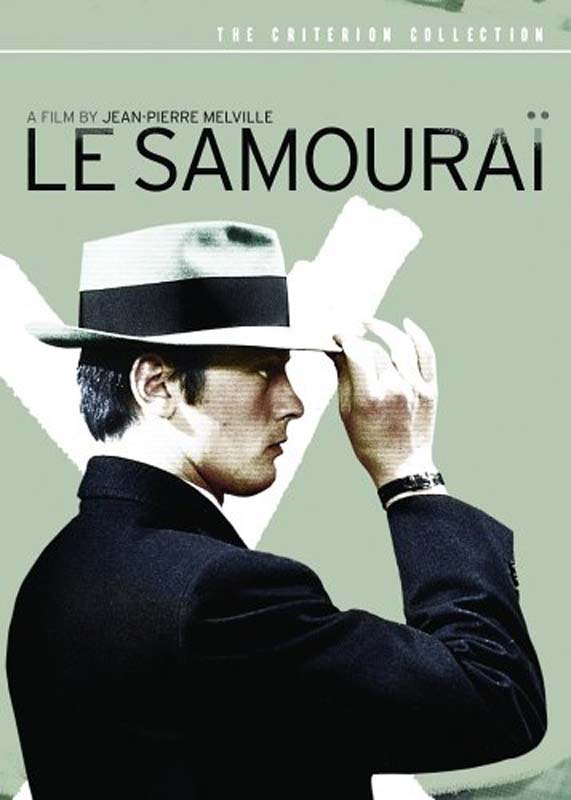
le-samourai-dvd-cover

There are two actors who represent the epitome of “Gallic cool” in the 1960s: one is Jean-Paul Belmondo, and the other Alain Delon. Belmondo was the French Bogart: a true tough guy (or at least one who thought he was tough), cigarette poised in the corner of his mouth, rumpled and just slightly the worse for wear. Delon was the Alan Ladd of the French New Wave: cold, calculating, beautiful, and psychotic.

Jean-Pierre Melville’s Le Samourai has Delon at his ice-cold best. He’s Jef Costello, a hitman who dresses (and kills) as befits a Japanese warrior. Hired by an unknown organization to kill the owner of a Parisian nightclub, the film follows Jef as he prepares for and completes his assignment. A chance encounter with pianist Valerie (Cathy Rosier) following the murder places Jef in danger, and the police are soon on his trail. Determined to prove Jef guilty, the investigating officer (Francois Pelier) goes to all lengths, threatening witnesses, trailing suspects, and bugging Jef’s flat.

Le Samourai is part crime thriller, part police procedural, and occupies that curious position of 1960s films with few, if any, sympathetic characters. Jef is a detached, unsmiling figure, his methodical killing abilities hinting at that edge of sociopathy that Delon played with great aplomb in Purple Noon. Yet the world that surrounds him permits no attachment, even if he was capable of one: his girlfriend Jane (Nathalie Delon) is a “kept woman” who gives him his alibi and with whom he never even manages to take off his coat. Each character fits their surroundings like pieces of furniture: Jef in his spartan apartment, Jane in her more opulent flat, Valerie in her black and white art deco apartment and night club.

le-samourai

The key here is style: Jef’s clothing and physicality are precise and a perfect match to the surroundings in which we first encounter him. His apartment is spartan to an almost absurd degree, the only point of color or activity occupied by the small bird in a cage that provides Jef with his most poignant relationship. As he rises and dresses to go out, fixing his hat and coat in the mirror as though fitting himself for battle, the film has established its argument without a line of dialogue. This is about style and style is about fate: each character moves along their established lines and either cannot or will not deviate from the future set out for them.

Le Samourai might almost be termed a nihilistic film; it’s certainly a cold one. Human connection does not exist, nor is the viewer asked to sympathize with Jef beyond the fact that he is our central character. No one else is even likable, least of all the investigating officer who pursues Jef with a mania bordering on obsession. This could be read as an indictment of France’s surveillance society, if the film made any move to establish a political argument. But that is not Melville’s project; the bugging of Jef’s apartment and relentless pursuit by the police is simply another form of fate.

Le Samourai is not a lovable film, but it is a great one. It offers no explanation for its events and barely any character motivation, yet it is not therefore inexplicable or dull. Delon conjures a fascinating character without making him sympathetic. As the film proceeds to its inevitable conclusion, the viewer is drawn into rooting for Jef without being allied to him. We know how this is going to end, though, because there is no other ending.

Seven Days In May (1964)

Seven Days in May (1964)

seven-days-may

Burt Lancaster and Kirk Douglas had a friendship that spanned decades, during which they made seven films together, playing heroes, villains, friends, and enemies. They were among that generation of actors that started their careers in the midst of the Studio System and managed to find their way out of it again, producing some truly remarkable films under their own production banners. Among these is 1964’s Seven Days in May, a political thriller about the near-overthrow of the United States by a military coup.

Lancaster is General James Mattoon Scott, the chairman of the Joint Chiefs of Staff who is in direct disagreement with President Jordan Lyman (Frederic March) over a missile treaty recently signed with Russia. The U.S. and Russia have agreed to disarm their nuclear warheads, effectively bringing the Cold War standoff to an end and avoiding any future nuclear war. The decision is unpopular with America at large, but none more so than General Scott, who believes that the President is setting the U.S. up for an attack when the Russians fail to honor the agreement. What few realize, and what Scott’s aide ‘Jiggs’ Casey (Kirk Douglas) soon discovers, is that Scott and several other high-ranking commanders of the Army, Navy, and Marines have been setting up a military coup aimed at killing the President and taking over the U.S. government. When Casey stumbles across information about the coup, he’s placed in a position of defying his commanding officer, whom he greatly admires, in order to stop it.

The film is directed by John Frankenheimer (Birdman of Alcatraz, The Manchurian Candidate) and scripted by Rod Serling (The Twilight Zone) for Kirk Douglas’s own production company. The script is taut and topical, dealing with the Cold War and arms race to immediate and chilling effect.  The first half of the film is primarily concerned with the discovery of the coup and Jiggs’s crisis of conscience. He has to do the right thing and report his suspicions, but he doesn’t particularly want to. The mis-en-scene in this section is all lights and darks, as the chiaroscuro mirrors Jiggs’s increasing suspicions and divided loyalties. As we head into the second half of the film, occupied with proving and preventing the coup, the pacing picks up significantly, moving away from the conflict between Jiggs and Scott and into the attempts of various members of the President’s staff to find something concrete on Scott.

Seven-Days-in-May

Seven Days in May is chock full of excellent performances: everyone from Lancaster and Douglas to Martin Balsam and Ava Gardner, who plays Scott’s former lover with more on the General than she realizes. It becomes increasingly clear that Scott is a self-obsessed sociopath who believes that what he’s doing is not for personal aggrandizement but the good of the United States. Few actors can portray the intensity of the fanatic and still remain firmly grounded, but Lancaster pulls it off. His General Scott is a true-believer, logical and totally terrifying.

If Seven Days in May has a flaw it is in the few speeches handed to its characters, particularly Frederic March’s President Lyman. While March’s performance is a strong one, he has at least two speeches intended to provide the film’s already obvious message about the dangers of Cold War rhetoric and nuclear armament. The speeches are largely unnecessary and do somewhat date an otherwise topical film.

Far more chilling are the moments that hammer home how prescient this film is. Scott gives a speech about patriotism and freedom that eerily reminds one of some pundits we typically hear on Fox News…and in Congress. The coup relies on a belief that Scott and his compatriots know the will of the people, and will force that will on the country irrespective of democracy. The continuous refrain of jingoistic patriotism is as recognizable today as it was in 1964. Seven Days in May is frightening because it is so believable.

While firmly embedded in Cold War mentality, Seven Days in May should be an iconic film because it is still so universal. Strong performances and script keep things moving along, though really the whole film is held on two sets of very broad shoulders. Lancaster and Douglas would make other films together, but none perhaps quite so prescient.

All Night Long (1962)

All Night Long (1962)

all-night-long-poster

Shakespeare has been retold, re-adapted, modernized; he has been edited for length and subject, retold to fit high school love triangles, Miami street gangs, and even animated lions. Ubiquitous as Shakespeare is, it should come as no surprise that someone along the line decided to retell Othello as a (then) modern tale of love and race among drunk and disorderly jazz musicians in 1960s London.

Basil Dearden’s All Night Long takes the plot of Othello and adds some needed jazz scoring. Aurelius Rex (Paul Harris) is the leader of a major jazz ensemble that includes his passionate sax player Cass (Keith Mitchell) and brilliant drummer Johnny Cousins (Patrick McGoohan). Rex is married to Delia (Marti Stevens), a beautiful blonde chanteuse who quit her night job to be his wife. On the eve of their one-year wedding anniversary, music promoter Rod Hamilton (Richard Attenborough) throws the happy couple a big party, complete with fellow jazz musicians Dave Brubeck, Johnny Dankworth, and Keith Christie to keep the music and spirits flowing. Things are not well in paradise, however: Johnny Cousins wants a band of his own, with Delia at the head. To this end, he employs any nefarious means necessary to get Delia away from Rex and back in the spotlight.

all-night-long-mcgoohan

There are two real stars in All Night Long, and the first is the music. The likes of Brubeck and Dankworth lend some serious musical talent to the proceedings, punctuating the backstage manipulations, petty jealousies, and passionate love affairs with piano solos and drum kicks. The non-musical lead actors do a credible job of miming their instruments, but give wide range to the real jazz performers to do what they do best. Even if the film was unsuccessful in other ways, the sheer virtuosity of the jazz would be enough to make me watch it all again.

The other star is Patrick McGoohan. His Johnny Cousins is the perfect Iago: a blend of malevolence and desperation, a pathetic sociopath incapable of loving anyone, including himself. Johnny makes his entrance with a slew of drum cases bearing his name, bruiting both his self-involvement and his desperation to be recognized as someone important. His manipulation of Delia, Rex, and just about everyone else at the party starts out as calculated and self-serving, but it soon becomes apparent that, like Iago, Johnny does what he does out of pure spite. McGoohan has never been one of my favorite actors, but his intensity is perfect for the part. (As, indeed, are his formidable drumming skills. It’s difficult to mime drumming chops, and as far as I could tell McGoohan was doing his own work).

One of the more interesting elements of All Night Long is the racial aspect – or rather, the lack thereof. Despite the setting of London in the early 1960s, the marriage of Rex and Delia does not seem to raise any eyebrows. Other musicians are critical of Rex for making his wife quit working (though he constantly reiterates that she made the choice herself), but no one remarks on the social difficulties of a marriage between a black man and a white woman. Johnny’s malevolence has no hint of racial motivation, as it does to some degree in Othello – gone are Iago’s racial epithets, replaced by Johnny’s painful inability to love. We should note that Dearden was also the man behind films like Sapphire (about a racially motivated murder in 1960s London) and Victim, both unflinching in their examination of British intolerance. Yet in All Night Long, there is much being said in no one saying anything.

All Night Long has its failings, however. The trope of marijuana causing people to behave violently and erratically was a recognizable one in the 1960s, but is pretty laughable in 2015. The jazz lingo employed by our (predominantly British) musicians falls harshly on contemporary ears, making some lines impossible to listen to without cracking a smile. Finally, there is the confusion of British actors playing Americans, with McGoohan especially having difficulty maintaining a clear-cut accent. While far from a deal-breaker, some elements of All Night Long have dated rather badly, making the film more a product of its period than a universal classic.

Basil Dearden is one of finest and least recognized directors coming out of Britain in the 1960s. Here he makes excellent use of an excellent cast, highlighting some of his favorite social issues without shining a spotlight too fully on them. Patrick McGoohan in particular gives a fascinating performance, as Johnny’s cruelty runs hand in hand with his pathetic psychology. Othello was never as swinging as this.

The Haunted Palace (1963)

The Haunted Palace (1963)

the_haunted_palace_poster

The Haunted Palace combines four – FOUR! – of my favorite things: Edgar Allan Poe, H.P. Lovecraft, Roger Corman, and Vincent Price. As such, there’s almost no place that this film can go wrong.

With a title and epigraph lifted from Edgar Allan Poe’s poem, The Haunted Palace is actually based on the Lovecraft story The Case of Charles Dexter Ward, about a man possessed by the evil spirit of his long-dead relative (a gross oversimplification of the story, but bear with me). Roger Corman’s adaptation takes a remarkably faithful approach to that story; which, given the serious problems with adapting Lovecraft, is quite impressive for a 1963 film. Vincent Price opens the film as Joseph Curwen, a suspected warlock living in a massive palace above the village of Arkham. Young girls begin vanishing during the night, only to reappear again the next day with no memory of where they’d been. The latest abduction results in the town rising up against Curwen and his unnatural necromantic tendencies. They burn him in his own front yard, but not before he’s placed a curse upon their children and their children’s children, promising to return to wreak terrible vengeance.

Moving forward about a hundred years and Charles Dexter Ward, Curwen’s great-great-grandson, reappears in Arkham to take over the lease on his relative’s estate. Along with his wife Anne (Debra Paget, Ward is met with violent hostility from the townsfolk, all of whom bear remarkable resemblances to their great-great-grandfathers. As explained by the kindly Dr. Willet (Frank Maxwell), Curwen’s curse and Ward’s uncanny resemblance to his forebear is just the tip of the eldritch iceberg. Curwen was apparently trying to summon the Elder Gods, his activity taking the form of drawing creatures out of the abyss and mating them with the local girls, resulting in children with bizarre deformities (whose descendants at one point menace Ward and Anne). Now the town fear that Curwen has returned in the form of Ward to take vengeance and begin his work again – a fear eventually realized when Ward moves into the palace and Curwen begins taking over the body of his relative.

the haunted palace 05

The Haunted Palace follows at least some of the plot of Lovecraft’s novella fairly closely, albeit with some notable changes. The action centers on Curwen’s slow possession of Ward, with the help of his partner-in-necromancy Simon Orne (Lon Chaney Jr.). The film introduces the very Lovecraftian themes of violation, degeneracy, family curses and, of course, the Elder Gods, all mixed together in a hodge-podge of lurid detail. The only truly sympathetic characters in the film are Ward, Anne, and Dr. Willet; the townspeople are venal and cruel, though they might not deserve the fate that Curwen eventually dishes out to them. Under Corman’s direction, The Haunted Palace draws out the sexual underpinnings of the story without veering into exploitation. In a movie that includes roasting people alive and offering women up to creatures from the abyss, the most disturbing scene is Curwen’s attempted rape of Anne while in the body of Ward.

Supported by a uniformly excellent cast, Vincent Price is of course the star of the show – and how he seems to enjoy it! His transformation between Ward and Curwen is effected with minimal make-up, instead relying on Price’s remarkable expressiveness of face and voice. Though Price has often been maligned as a ham actor, his ability to summon sympathy for villains and horror for heroes is a talent that Corman honed in the Edgar Allan Poe adaptations. Here it is on full display, to excellent and chilling effect.

The other actors are almost as enjoyable as Price, although they have considerably less to do. Paget deserves her share of the accolades, playing Anne as a damsel in distress still able to operate on some of her own initiative. There’s a wonderful and heart-breaking pathos to Ward and Anne’s relationship, as Anne is forced to deal with a husband who looks like himself and demonstrably is not. Then there’s Lon Chaney Jr. (here billed just as Lon Chaney), whose sad-eyes and sympathetic face conceal a true monster this time around.

The Haunted Palace does exactly what it sets out to do, and is successful as far it goes. While some of the opening sequences drag a little, particularly Ward and Anne’s arrival in the village, the narrative bounces along at a good pace, with little additional flourishes to distract from the central thrust of the story. It’s an early Lovecraft adaptation, but a remarkably successful one. Besides, how often do you get to see Vincent Price psychologically torturing Vincent Price?

the-haunted-palace-price-portrait

Bloody October: Fright Night (1985)

Fright Night (1985)

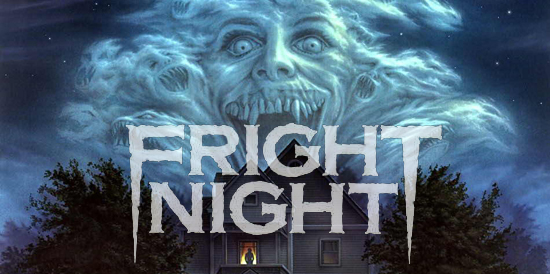
fright_night_1985

Yet again, I am a big horror fan and yet, somehow, I have managed to miss seeing the original Fright Night before now. This has been properly rectified, and I am pleased to say that the hype was not misplaced.

Fright Night tells the story of Charley (William Ragsdale), a high school student who decides that he’d rather watch the weird neighbors next door than have sex with his girlfriend Amy (Amanda Bearse). Although I know that subsequent events were largely out of Charley’s control, there still seems to be a moral in that story: sex first, vampires later. What Charley does see that fateful night are his new neighbors moving a coffin into the basement; this, in addition to the appearance on the TV screen of Fright Night, a late-night spookfest featuring “vampire killer” Peter Vincent (Roddy McDowall), provokes Charley to believe that his neighbor might be a vampire. This is later confirmed by the arrival and subsequent disappearance of a prostitute, whom Charlie sees going into the house. When the prostitute later winds up dead, Charley’s suspicions are confirmed. Consulting his friend “Evil” Ed (Stephen Geoffreys), Charley learns about the best way to fight against vampires – but not before his mother has invited the offending creature into the house. And no wonder! Our vampire is dashing Jerry Dandridge (Chris Sarandon), by whom most of us would not object to being bitten. Will sexy vampire triumph over horny teenager? We’ll just have to wait and see!

fright-night-1

Fright Night makes excellent use of the vampire mythos we all know so well – and anyone who has ever watched a vampire movie, from Dracula to Dracula Untold, will recognize certain important rules that are made, subverted, and at times even broken. The film melds tradition with a unique story, as the vampire moves in next door and heads to dance clubs. Dandridge is a charming but wholly unsympathetic villain, avoiding at every turn the pitfalls of modern vampires that are just “misunderstood.” He’s not misunderstood – he’s an evil lord of the undead, taking sadistic pleasure in torturing Charley (whom no one will believe) and seducing fair young maidens. While I cannot avoid thinking of Chris Sarandon as Prince Humperdinck from The Princess Bride, he makes a credible vampire.

Roddy McDowall is the other major force at work here, channeling everyone from Peter Cushing to Vincent Price (Peter Vincent, anyone?), with a smattering of Elvira. He’s an actor playing a vampire killer, now faced with an actual vampire – and when he finally gets into the swing of things, it’s a pleasure to watch. The other actors in the group are a cut below McDowall’s hamming, the most obnoxious being Evil, who shouts and giggles like a demented Renfield to no apparent purpose. Charley and Amy are likably bland, as are most heroes and heroines in vampire stories.

My sole objection to Fright Night is a reveal nearing the end, where a rule hitherto established and accepted is bent and then broken with little to no explanation. Vampire movies depend upon their rules: if your vampire is repelled by crucifixes but not by garlic, can’t cast a reflection in glass but can in water, all well and good. But you don’t introduce a new and non-traditional rule at the eleventh hour and then fail to explain it. That’s just bad form.

But for that single caveat, Fright Night is a glorious love letter to the vampire genre and a classic in its own right. There are no sparkly vegetarian vamps here: these guys are strictly carnivores.

fright-night-1985-jerry-dandridge-charley-brewster-vampire-chris-sarandon-william-ragsdale

Bloody October: The Last Man on Earth (1964)

The Last Man on Earth (1964)

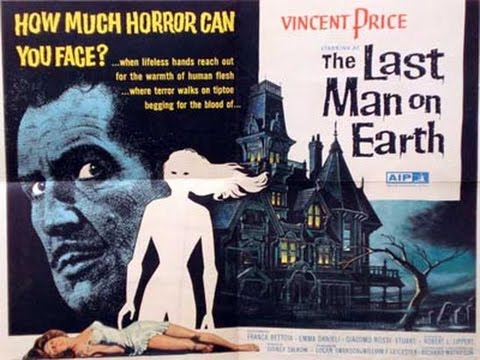
the-last-man-on-earth-poster

If humanity were to suddenly be subject to an airborne disease that turns its victims into the walking dead, who do you think would be the last man standing? No, not those idiots on The Walking Dead. Only one man could possibly survive the zombie/vampire apocalypse, and look good doing it too: Vincent Price.

Based on the Richard Matheson novel I Am Legend, The Last Man on Earth stars our Mr. Price as Dr. Robert Morgan, a biologist who has spent three years as the only man on Earth apparently not infected by a horrific airborne plague that claimed his wife, daughter, and best friend. The film takes us through Morgan’s typical day as he awakes, hangs garlic over his doorway, and heads out into the abandoned city with a bag of wooden stakes to find and destroy more of the vampiric creatures that were once the human population. He has to return before the sun goes down, though, for the vampires come banging on his door, threatening to kill him. He spends some time trying to get into radio contact with other living beings, but all to no avail. It appears that he truly is the only man left alive.

the-last-man-on-earth-price

The Last Man on Earth reportedly inspired George Romero to make Night of the Living Dead, so all you Zombie-philes should get down on your knees and praise this weird little movie. This is a zombie movie before there were zombie movies, but the vampiric creatures share much in common with Romero’s later conception of the walking dead. Half brain-dead and only really powerful in numbers, the vampires seem to lack basic organization, banging on Morgan’s door and shouting threats without being able to organize themselves well enough to actually break into his house. Morgan’s contempt for the people that were once his friends is pathetic. In a flashback sequence, we learn of the origins of the plague, and of the slow decay of surrounding civilization as more people fall victim. When Morgan wanders the deserted city in search of vampires, the film provides an effective sense of the desolation and loneliness of streets without people and stores left empty. There is something horribly realistic in the first 3/4s of this tale of worldwide pandemic, the terror and mistrust perhaps all too real in this day and age.

Price gives one of his most affecting performances, at once sympathetic and slightly sinister as he struggles with his day-to-day existence, forced to burn the mutilated bodies of the vampires. He’s the only character on screen for most of the film’s runtime. Despite the somewhat hokey voiceover that was far too common in films of this period, Price’s performance elevates the film (as his performances so often did) – his elation at spotting a dog running loose in the streets is heartbreaking, for here he sees at last some hope of companionship in his long, lonely existence. Morgan is a monster and a hero in the same breath, and his suffering plays out over the contortions of Price’s remarkably expressive face.

The weakness of The Last Man on Earth lies in its denouement, which I won’t spoil for the reader. A relatively effective set-up is punctured in the final act, leading to a curiously unsatisfying conclusion. While miles ahead of its successor I Am Legend, starring Will Smith, The Last Man on Earth does not quite make good on its narrative promises.

Yet for all that, there is much to like about this odd little film. Price here embraces the melancholic suffering so prevalent in many of his best performances. He has taken the world’s cares on his shoulders, and become a monster in the process. Nothing could be so heart-breaking.

Bloody October: Creature from the Black Lagoon (1954)

Creature from the Black Lagoon (1954)

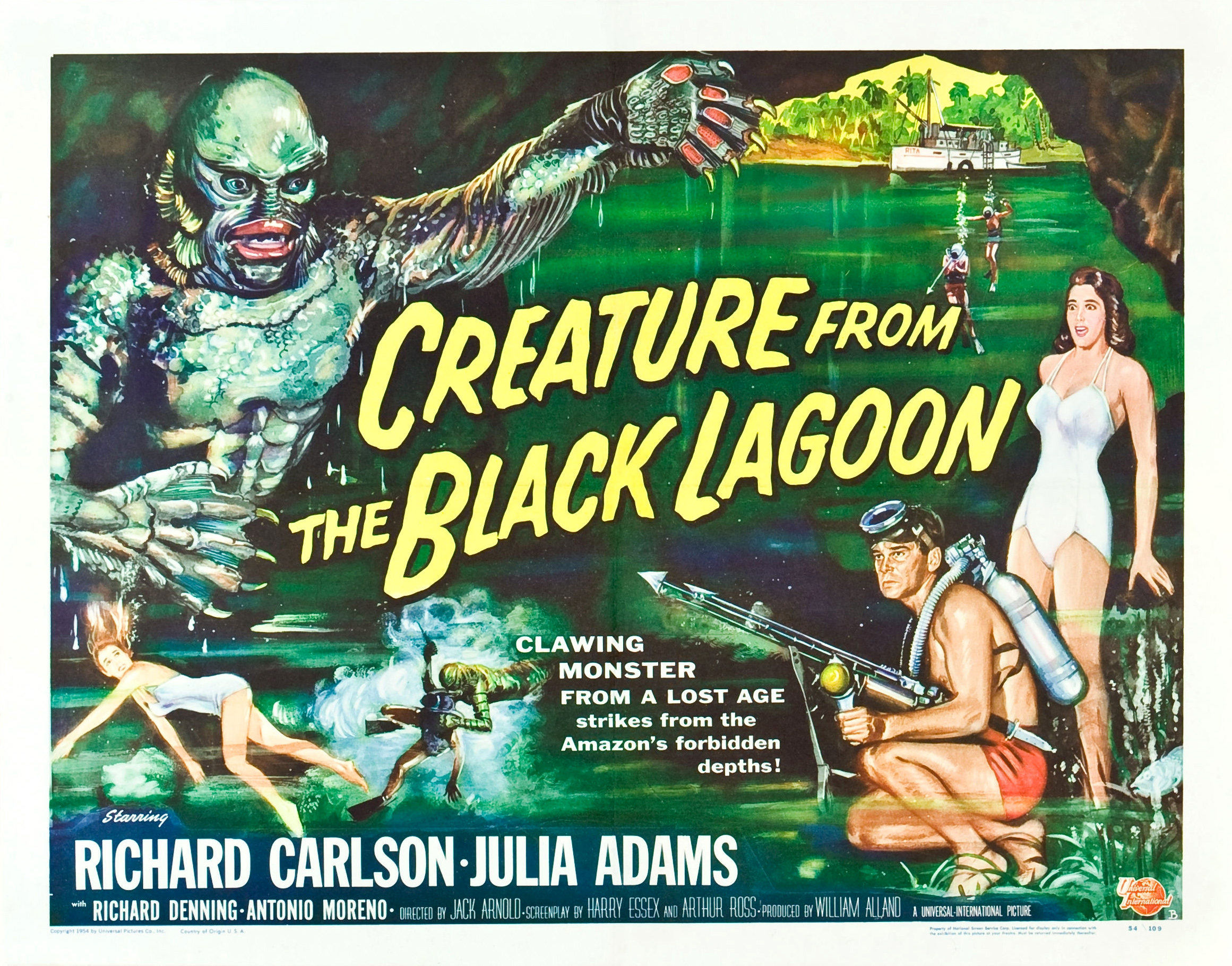
Poster - Creature From the Black Lagoon_03

Sure we all make fun of Universal’s weird attempt at creating a new franchise “universe” to rival the Marvel Cinematic Universe (God, I really fucking hate that phrase) and the DC Cinematic Universe. But you know what? Universal actually did have the original multi-film, multi-character, multi-storyline world. It started way back in the 1930s with the rapid-fire release of Universal’s original monster trilogy: Dracula, Frankenstein, and The Mummy. Many years later, The Wolf Man was added to mix, along with some of the “little brothers” of those historic monsters, including The Invisible Man and the subject of this little review: Creature from the Black Lagoon.

As the opening voiceover informs us, evolution has taken some interesting twists and turns, beginning deep in the ocean and proceeding onto land, as human beings eventually emerged from the primordial ooze. But there might still be things out there that defy evolutionary theory, and it is in the depths of the Amazonian jungle we might find them. The film proper begins with Dr. Carl Maia (Antonio Moreno) discovering a fossilized hand in a rock formation somewhere deep in the Amazon. The hand looks almost human, save for webbed fingers and claws, and Maia thinks he may have stumbled upon a missing link – a, uh, missing fish-link, in point of fact. Leaving his native guides to guard the camp, Maia returns to civilization to show off his new find and possibly get together an archaeological team to dig up the rest of the skeleton. He gets his team in the form of ichthyologist Dr. David Reed (Richard Carlson), his boss Dr. Mark Williams (Richard Denning), Dr. Edwin Thompson (Whit Bissell), and their “colleague” Kay Lawrence (Julie Adams) (I could not quite figure out what it was that Kay did, other than go swimming and scream, but she’s supposed to be a scientist-type of some kind). The team head off down the Amazon aboard a fishing boat run by Lucas (Nestor Paiva).

When the group arrives at camp, they discover that it has been destroyed and the two guides killed. Being brave scientists, they carry on with the excavation, only to have it be a bust: the skeleton is nowhere to be found. On a hunch, they travel further down the river to the Black Lagoon to see if they can find pieces of the skeleton there. That’s how they meet the Creature, an amphibious humanoid who just wants to have a pleasant swim, but instead nearly gets harpooned in his first contact with his distant cousins.

creature-from-black-lagoon-swim-a

Like many films of the same period, Creature from the Black Lagoon suffers from an overabundance of exposition, as our scientists explain what we’re supposed to feel as we feel it.  As with Frankenstein and the Wolf-Man, the Creature’s animalistic nature is far more sympathetic than his human counterparts. He has had his Lagoon invaded and been shot several times, prompting a predictable violent reaction. One wonders just want these scientists want with shooting harpoons at a species that they’re supposed to be studying. Even the conflict between David and Mark over how best to go about dealing with the Creature is just about one form of invasion over another: David desires to poke, prod, and study the Creature, while Mark just wants to hang its head over his mantlepiece.

To its credit, Creature from the Black Lagoon features some truly remarkable underwater photography. The Creature’s movements are beautifully performed and detailed – his natural habitat is the water and he understands and moves with it far more fluidly than the divers outfitted with oxygen tanks and goggles. Out of the water, the Creature looks like a big, walking fish – the use of prosthetics remarkable for the period, and still oddly convincing even now.

While far from a great film, Creature from the Black Lagoon is a rightfully iconic one, an interesting variation on the horror stories of radioactive lizards that were cinema’s response to the Atomic Age. Rather than being created out of modern violence, the Creature comes from an evolutionary past, a connection between the human past and the future. That the response is to shoot and flee from it perhaps says more about humanity than the film ever thought to.

Bloody October: In the Mouth of Madness (1995)

In the Mouth of Madness (1995)

in-the-mouth-of-madness-poster

Leave it to horror master John Carpenter to make a film that is part loving homage to H.P. Lovecraft, part parodic social commentary, and part meta-narrational horror. Seriously. While Wes Craven would attempt a similarly themed narrative with his own meta-horror Scream, Carpenter arguably accomplished something weirder, more genre-defying, and more gleefully enjoyable than anything starring Neve Campbell.

Sam Neill is John Trent, an insurance investigator who starts the film being locked in an asylum as he raves about the end of the world. Interviewed by Dr. Wrenn (David Warner), Trent recounts his story. He was hired by a publishing house (run by Charlton Heston, no less) to find the author Sutter Cane (Jurgen Prochnow), a best-selling horror writer whose latest novel In the Mouth of Madness promises to be a ground-breaking work of horror fiction. Accompanied by Cane’s editor Linda (Julie Carmen), Trent embarks on a journey to find Hobb’s End, the supposedly fictional town in New Hampshire where Cane may or may not have disappeared.

Anyone who has read Lovecraft will immediately recognize certain knowing nods and references, from the asylum opening to “Pickman’s Hotel,” from the titles of Sutter Cane’s novel to certain – ahem – old ones. Still, In the Mouth of Madness is by no means strictly for the fans. The story encompasses what it means to love horror, and to indulge in its dark plots of madness and apocalypse. It does this with a strong parodic edge, aware of itself even as it indulges the grotesque and the dark, serious underpinnings of fear. Cane’s novels supposedly drive “susceptible” readers to near frenzy, and Trent is a perfect candidate – a man who doesn’t believe in such things, yet stays up to all hours reading the books. Is the entire story a product of Trent’s madness (remember: he’s telling this from within an insane asylum), or has Cane’s work opened a facet of the human mind and the universe better left closed? As the film develops, layers of fictional and nonfictional worlds begin to overlap, and Trent’s experiences become more and more convoluted.

Neill is an excellent protagonist here: not quite likable, but not inherently unlikable either. Carmen has less to do, and actually gives the impression of being a bit more gone on Cane than she should be. But as with many horror films, the people are really just there to be enacted upon – the real star is horror, and how the film unravels that horror. Making a movie with a Lovecraftian setting is a difficult venture; Lovecraft’s horror usually lies in the unseen and the barely glimpsed. Carpenter manages it, though, giving us just enough fear beyond the realm of conscious thought, interspersed with ghoulish body horror. It’s an effective approximation of Lovecraft’s prose, and a powerful cinematic technique in its own right.

In the Mouth of Madness is like a fever dream, starting out with a certain element of realism and quickly descending into the realms of, well, madness. The conclusion is both chilling and just a little funny, its terror punctuated by a low-level of humor that brings out that fine line between the terrifying and the ridiculous. Carpenter has done right by Lovecraft, and that’s a feat unto itself.

2-in-the-mouth-of-madness