Bloody October: In the Mouth of Madness (1995)

In the Mouth of Madness (1995)

in-the-mouth-of-madness-poster

Leave it to horror master John Carpenter to make a film that is part loving homage to H.P. Lovecraft, part parodic social commentary, and part meta-narrational horror. Seriously. While Wes Craven would attempt a similarly themed narrative with his own meta-horror Scream, Carpenter arguably accomplished something weirder, more genre-defying, and more gleefully enjoyable than anything starring Neve Campbell.

Sam Neill is John Trent, an insurance investigator who starts the film being locked in an asylum as he raves about the end of the world. Interviewed by Dr. Wrenn (David Warner), Trent recounts his story. He was hired by a publishing house (run by Charlton Heston, no less) to find the author Sutter Cane (Jurgen Prochnow), a best-selling horror writer whose latest novel In the Mouth of Madness promises to be a ground-breaking work of horror fiction. Accompanied by Cane’s editor Linda (Julie Carmen), Trent embarks on a journey to find Hobb’s End, the supposedly fictional town in New Hampshire where Cane may or may not have disappeared.

Anyone who has read Lovecraft will immediately recognize certain knowing nods and references, from the asylum opening to “Pickman’s Hotel,” from the titles of Sutter Cane’s novel to certain – ahem – old ones. Still, In the Mouth of Madness is by no means strictly for the fans. The story encompasses what it means to love horror, and to indulge in its dark plots of madness and apocalypse. It does this with a strong parodic edge, aware of itself even as it indulges the grotesque and the dark, serious underpinnings of fear. Cane’s novels supposedly drive “susceptible” readers to near frenzy, and Trent is a perfect candidate – a man who doesn’t believe in such things, yet stays up to all hours reading the books. Is the entire story a product of Trent’s madness (remember: he’s telling this from within an insane asylum), or has Cane’s work opened a facet of the human mind and the universe better left closed? As the film develops, layers of fictional and nonfictional worlds begin to overlap, and Trent’s experiences become more and more convoluted.

Neill is an excellent protagonist here: not quite likable, but not inherently unlikable either. Carmen has less to do, and actually gives the impression of being a bit more gone on Cane than she should be. But as with many horror films, the people are really just there to be enacted upon – the real star is horror, and how the film unravels that horror. Making a movie with a Lovecraftian setting is a difficult venture; Lovecraft’s horror usually lies in the unseen and the barely glimpsed. Carpenter manages it, though, giving us just enough fear beyond the realm of conscious thought, interspersed with ghoulish body horror. It’s an effective approximation of Lovecraft’s prose, and a powerful cinematic technique in its own right.

In the Mouth of Madness is like a fever dream, starting out with a certain element of realism and quickly descending into the realms of, well, madness. The conclusion is both chilling and just a little funny, its terror punctuated by a low-level of humor that brings out that fine line between the terrifying and the ridiculous. Carpenter has done right by Lovecraft, and that’s a feat unto itself.

2-in-the-mouth-of-madness

Bloody October: Trick ‘r Treat (2007)

Trick ‘r Treat (2007)

trick-r-treat

Horror has a long and  hallowed tradition of anthology films. Some, like Corman’s Tales of Terror, are tied together by a common writer and repeated appearances of actors as different characters; others, like the recent V/H/S, by a common gimmick or concept. Then there’s Trick ‘r Treat, which utilizes the anthology film subgenre to tell a series of tales from Halloween night and, like a schlock-horror version of Pulp Fiction, interweaves characters to effortless, and surprising, effects.

The action takes place one Halloween night in a small Ohio town that really seems to like the holiday. The usual Halloween shenanigans are afoot, from kids knocking pumpkins off of fence-posts, to grown-ups using costumes as a means of anonymously getting off with strangers. The four main tales comprise a school principal who moonlights as a serial killer, a group of kids paying homage to an old urban legend, a young woman dressed as Red Riding Hood on the search for her Big Bad Wolf, and a curmudgeonly old man who hates Halloween and won’t give out candy. Each story comprises contains a “Halloween infraction,” from poisoned candy to cruel practical jokes, and the presence of “Sam,” a little trick-r-treater wearing orange pajamas and a burlap sack mask who appears at important moments in each vignette. The characters connect and interweave with one another, as one story finishes what another started.

Without giving too much away, Trick ‘r Treat is one of the most entertaining contemporary horror films I’ve seen in a long time. It has its own, warped moral universe that brings each portion of the story to an intense, often funny, and always satisfying conclusion. With an excellent cast full of character actors, including Anna Paquin and Brian Cox, the film brings off its horror without too much recourse to shock tactics or bloody dismemberment. It trades on what makes Halloween so beloved: beneath the jack-o-lanterns and cute costumes is a holiday tradition founded on respect for the dead and the supernatural. Cross the line of tradition, break the rules for your own perversity, and little Sam will be there to punish your wrongdoing. A good lesson, for any Halloween night.

Bloody October: The Birds (1963)

The Birds (1963)

the-birds-poster

While this is the subject of some debate, it is my conviction that Alfred Hitchcock made only one “proper” horror film over the course of his long career. Psycho has often been cited as the first “slasher” film, but I don’t think it’s insane to argue that Hitchcock’s 1963 film The Birds wins the award for inarguable horror.

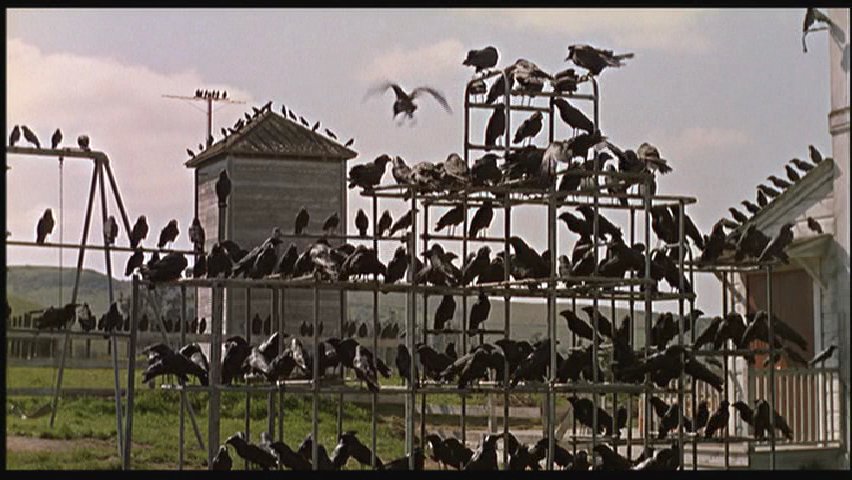
Tippi Hedren is Melanie Daniels, an apparently frivolous young ingenue who meets and flirts with Mitch Brenner (Rod Taylor) in a San Francisco bird shop. Annoyed by Mitch’s teasing flirtation, Melanie purchases a set of lovebirds and heads to Mitch’s country home in Bodega Bay, to deliver the birds to his little sister Cathy (Veronica Cartwright) for her birthday. There she meets the schoolteacher Annie Hayward (Suzanne Pleshette), and Mitch’s mother Lydia (Jessica Tandy), both major feminine forces in Mitch’s life.  The whole thing is really just an elaborate gag intended to pay Mitch back for his teasing, but things begin to get scary when Melanie is attacked by a seagull. It’s the harbinger of things to come, as the local birds begin attacking and killing humans. The inhabitants of Bodega Bay are eventually forced to hole up in their homes, securing themselves against the constant and apparently purposeless onslaught of avian forces.

Hitchcock spends the first half hour of The Birds establishing the characters, their relationships, and the tensions already underlying Melanie’s interaction with the Brenner family. Mitch’s mother in particular seems to suspect and dislike Melanie, but in an extended conversation with Annie, Melanie learns that it is not as cut and dry as, say, a grasping and jealous woman (words that immediately call to mind Psycho, of three years before). The tensions are more complex, and in some ways more realistic, than that. When the bird attacks do begin, the viewer senses some tenuous and wholly inexplicable connection between the motiveless violence, and the animosities between our human characters. How to define this becomes the question, and the film poses no easy answers.

the-birds-1963

Much of The Birds is about human reaction to purposeless violence. While certain things are established about the attacks – they come in waves, they stop for long intervals, they appear to be concerted attacks by large numbers of animals – there is no apparent purpose behind them. The birds have simply “gone mad,” but it is a universal madness affecting all of them – except for the two lovebirds in a cage. The violence is overwhelming and disturbing, but it is the mad tension, the waiting for something to happen, that truly gives the film its energy. As one ornithologist explains, if birds of a feather truly do flock together, there’s nothing human beings can do to stop them.

For a film made in 1963, the special effects in The Birds hold up rather well. Hitchcock’s camera never lingers for too long on a single animal, making it easier to combine real trained birds with puppets, animation, and even back projection to form a largely seamless horror story. I wish the same could be said for the performances. Although Tippi Hedren’s performance is affecting, she has an aloofness and distance that after awhile becomes grating and makes it difficult for the viewer to sympathize. The same must be said for Rod Taylor’s rather self-satisfied lawyer, who has as much sex appeal as a store mannequin. The strong secondary characters, however, make up for the moments when the leads drag down the dialogue – and Jessica Tandy’s multi-faceted job as Lydia Brenner is a study in restrained acting.

Birds-5

But the real stars here are the birds, and they’re really the ones we came to see. This is more than a “nature gone mad” story, so popular in the 1950s and 60s in the aftermath of World War II and the rise of the Atomic Age. The birds are not really mad, it seems. They know exactly what they’re doing, and that, more than anything human, is terrifying.

Bloody October: The Amityville Horror (1979)

The Amityville Horror (1979)

the-amityville-horror-(1979)-large-cover

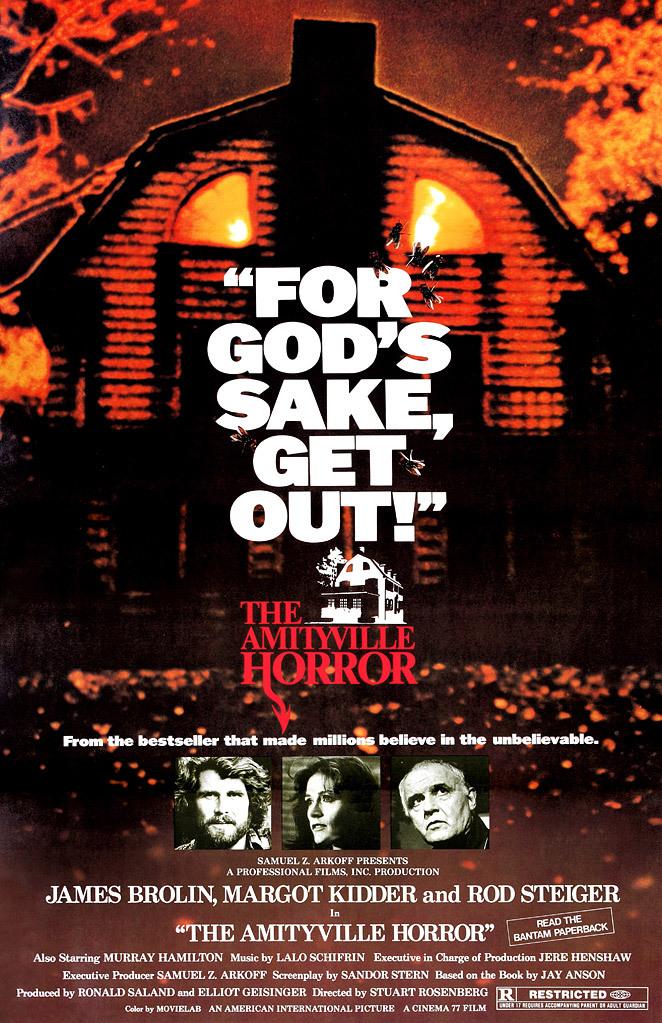
Every October I try to load my Netflix queue with horror films both old and new, focusing as much as possible on the horror classics I have not seen. While there are a few necessary staples of this holiday season (Young Frankenstein, Sleepy Hollow, Abbot and Costello Meet Frankenstein, Hocus Pocus), I am always on the lookout for those movies that have somehow slipped through my horror-loving finger. One of these films is the original The Amityville Horror, a haunted house movie from 1979 that spawned a host of sequels and remakes, one of which (according to Wikipedia) will be coming in 2015.

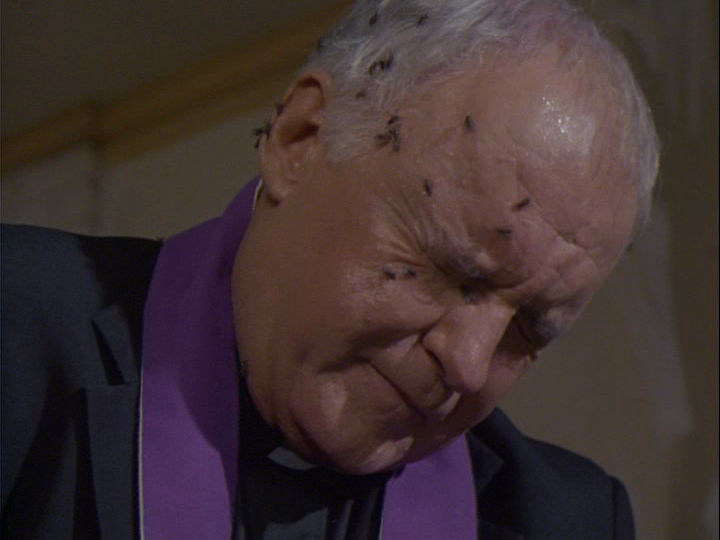
Based on a supposedly true story, The Amityville Horror focuses on the Lutz family, who move into a sinister house where a disturbing mass murder was committed the year before. The price is right, though (isn’t it always?), and so the Lutzes ignore the house’s history and set about unpacking their boxes. Things begin to get very weird, very quickly, which is what we can expect from a house with eye-like windows. When the parish priest Father Delaney (Rod Steiger) arrives to bless the house, he’s swarmed with flies and hears a disembodied voice demanding that he depart. Escaping from the house, he’s later unable to call Kathy Lutz (Margo Kidder) to warn her of the horrors. Not that she should really need any warning: her husband George (James Brolin) is compulsively chopping wood and sharpening his axe, her daughter Amy (Natasha Ryan) has discovered an “imaginary friend” named Jody who never wants them to leave, and anyone of a Catholic or spiritual bent gets violently ill just from approaching the house. But as with most haunted house movies, it takes a long time for the inhabitants to realize just how evil their habitation has become.

amityville-horror-rod-steiger

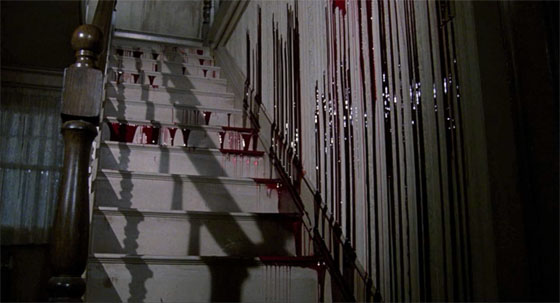
The Amityville Horror boasts of strong production values and scares that depend more on a slow building of tension and practical effects than on blood and gore. There’s very little violence; just bumps, screeches, and a sense of sickness and foreboding that seems just out of reach. When violent things do happen, they are the terrors of a household accident: a window falling on a boy’s hand, a tumble down the stairs, a lightbulb shorting out, and doors banging, or being blown off their hinges.

The Amityville Horror falls short of true greatness, however, largely due to its lack of exposition. The reasons behind the haunting (if haunting it is) remain obscure, with a throwaway scene providing the only explanation for what has hitherto been inexplicable. I would not object to the lack of exposition if the rules of the house were clearer. Whatever evil dwells there seems to have a long reach, able to effect people who come in contact with it from a distance. But the added presences of “Jody” – either a ghost, a spirit, or a manifestation of the house? – along with the apparently random behavior of the house in slamming doors and windows, and possessing people, makes it difficult to establish just what we’re supposed to expect or be frightened of. While individual scenes have punch, the film as a whole lacks direction and, as a result, tension. I am willing to accept that the house is just evil, but even evil (in film at least) has to have some rules to maintain a strong narrative through-line.

The lack of exposition might have been mitigated by a stronger development of character. The psychology of the Lutzes remains largely obscure – the two sons vanish for large sections of the film, while the daughter and her friendship with Jody remain unresolved. George and Kathy, whom the house affects the most, are not drawn out as characters. While there are shades of The Shining in George’s slow descent into madness, his awareness of the house’s evil seems to shift on a scene by scene basis. Following several harrowing events, it strains credulity to believe that this family would stay on in the house.

amityville-horror-6

While The Amityville Horror has its faults, it is still an effective B-grade horror film. You can see its influence in later films like The Shining, Poltergeist, and Paranormal Activity – and while those films were arguably better executions of the same concept, the origins can be found in Amityville. That in itself makes this one worth watching.

Bloody October: The Cat and The Canary (1927)

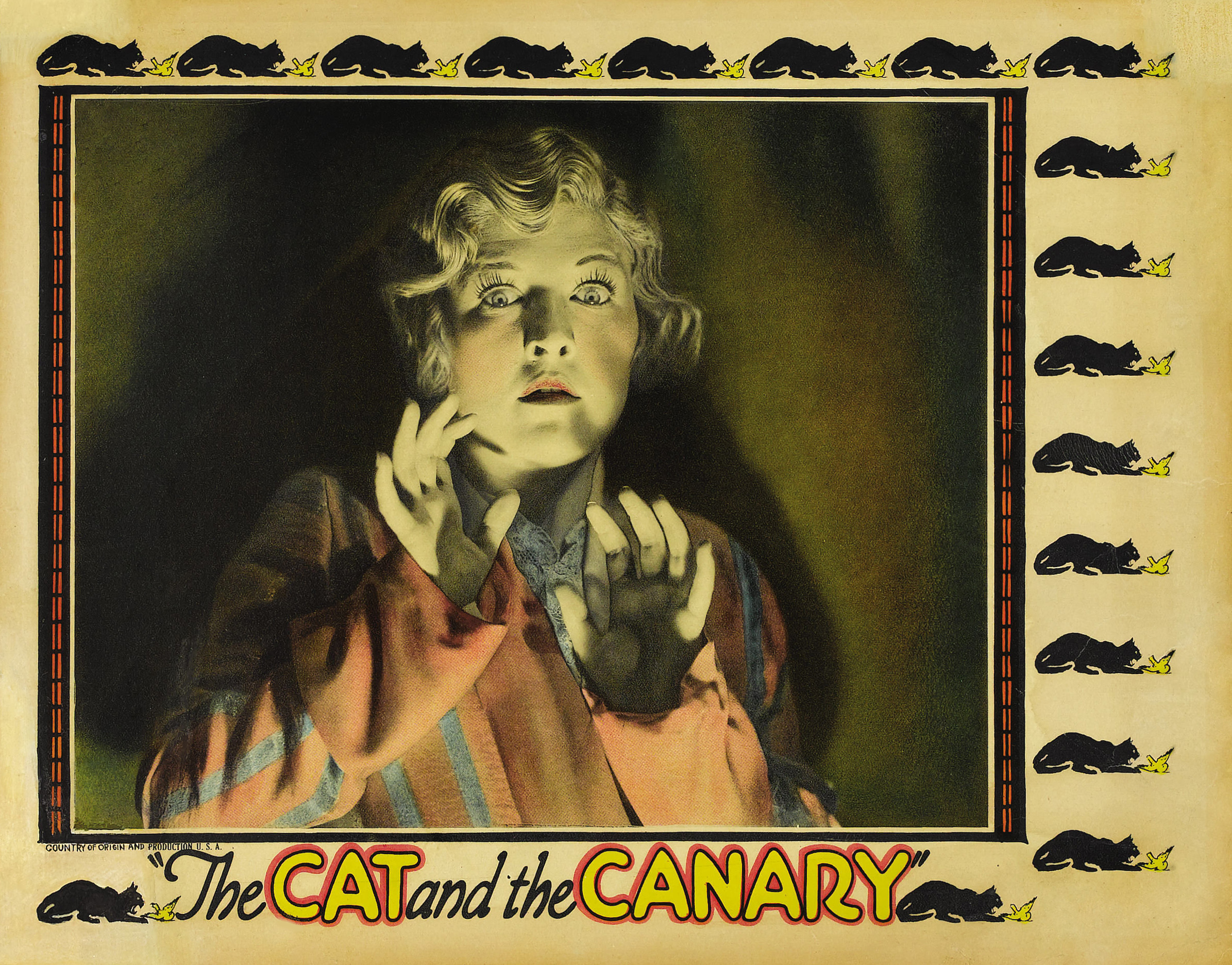
The Cat and the Canary (1927)

poster-cat-and-the-canary-the-1927_02

I am a sucker for old dark house stories; the older and darker, the better. These stories were clichéd from practically the moment they were created, but like many clichés, they have a sense of fun to them that few more original narratives manage to approximate. One of the earliest such narratives – on film at least – is The Cat and the Canary, a silent film from director Paul Leni, one of the oft-forgotten masters of German Expressionism.

The film opens with the slow madness and then death of millionaire Cyrus West, who inhabits a multi-turreted Gothic mansion somewhere in the bleak and inaccessible countryside. The intertitles inform us that West was slowly driven mad by his grasping, greedy relatives, as they gathered around him like “cats around a canary.” So West decides to pay them back for their avarice, writing a will to remain locked in a safe until the 20th anniversary of his death, when his lawyer Crosby (Tully Marshall) will open it and announce his heir.

Fast forward those twenty years to one dark and stormy night. The relatives gather for the reading of the will at the Gothic mansion, still presided over by Mammy Pleasant (Martha Mattox), a leering and creepy old housekeeper if ever there was one. When Lawyer Crosby arrives to open the safe, he discovers not one but two wills, with instructions to open the second if the first is not fulfilled. He’s more disturbed by the presence of a moth, indicating that someone has opened the safe in the past twenty years. Then the relatives arrive: Harry Blythe (Arthur Edmund Carewe), Charlie Wilder (Forrest Stanley), Paul Jones (Creighton Hale), Aunt Susan (Flora Finch) and her daughter Cecily (Gertrude Astor), and finally Annabelle West (Laura La Plante). As the family gather round for the midnight reading of the will, the clock strikes for the first time in twenty years and thunder shakes the house.

The heir, of course, turns out to be Annabelle West, the only member of the family who still bears the West surname. Her relatives are predictably disappointed, but things get interesting when Crosby raises a caveat to the will. The heir must be proved to be of sound mind by a doctor arriving that night; if she’s insane, then the fortune passes to the person mentioned in the second will. So with the set-up for potential murder and madness in place, everyone heads off to dinner.

cats

The Cat and the Canary is a surprising film for a number of reasons. Its highly Expressionist opening and rather clichéd structure make it appear like a quintessential early horror film. When a guard from an asylum turns up to warn the house’s inhabitants of a lunatic in the neighborhood – one who “tears his victims apart, like a cat with a canary” – we are solidly in the archetypal realm. Even the characters are less characters and more types: the ingenue, the maiden aunt, the dashing hero, the coward, and the creepy housekeeper. But as the film goes on, the types will be gradually played with and subverted, their roles thrown into relief as the night brings out the madness in them all.

The film manages to hit all the buttons that we might expect from an “old dark house”: a possible ghost, a hidden treasure, a fair maiden in danger, secret passages, vanishing corpses, and a dark and stormy night. It then injects a healthy dose of humor into the mix: cousin Paul is a coward of the first order, diving under tables, and at one point secreting himself beneath Cecily’s bed, where he unfortunately witnesses Aunt Susan and Cecily getting undressed (Wikipedia claims that the pair are mother and daughter, however I always thought that Cecily was just another cousin). As the night drags on and creepy things continue to happen, the extreme reactions of some of the family members provide more humor than fear.

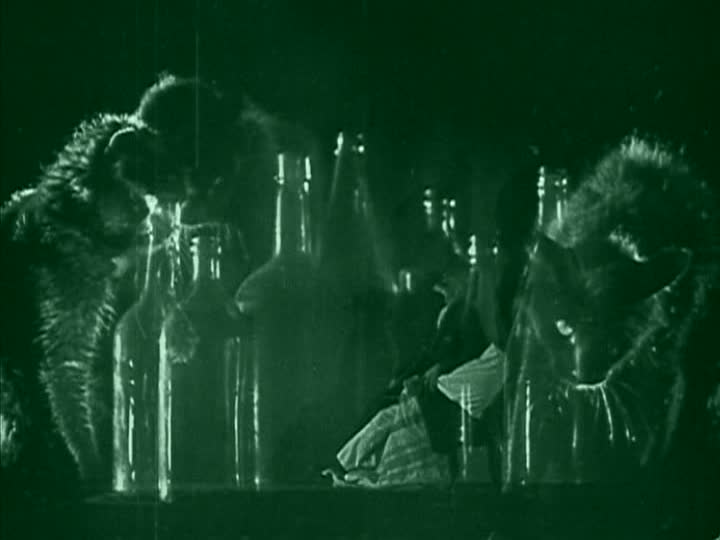
Which is not to say that there aren’t some seriously scary moments in The Cat and the Canary. With the disappearance of Crosby, Annabelle’s sanity comes into question – and only the audience has seen the vague, shadowy figure ducking into secret passageways. It’s amazing what can be done with a long-nailed hand coming out of a wall, or a bizarre shape creeping past a window, made all the more bizarre due to lack of ambient sound.cat-and-canary-1927-imagery

While not exactly a film to provide jump scares or raise your heart-rate, The Cat and the Canary is curiously haunting. It will be remade two more times, once in 1939 and then again 1978, but the silent one is really the best, combining humor and horror, strong practical effects and Expressionist sets. The scares are still there, almost a hundred years later. It’s hard not to shiver when that hand comes out of the wall.

The Dunwich Horror (1970)

The Dunwich Horror (1970)

dunwich_horror_xlg

Adapting the work of horror writer H.P. Lovecraft is a challenge for any screenwriter, or director. Like Poe, much of Lovecraft’s power lies in his verbiage. His horrors are the concealed, obscure terrors of dreams, and his writing chock full of purple prose invoking nameless fears and indescribable stenches from dark Cyclopean caverns. Moving that kind of writing to the big screen is nearly impossible, because Lovecraft trades on things that cannot be seen or, once seen, cannot be described.

The Dunwich Horror makes a good attempt at adapting one of Lovecraft’s better known stories to a visual medium. The film was directed by Daniel Haller from a script co-written by Curtis Hanson, who would go on to direct L.A. Confidential and The Hand that Rocks the Cradle. It was produced for Roger Corman’s American International Pictures, which immediately indicates what we can expect from the production.

Following a bizarre birth sequence and some truly epic opening credits, the film properly begins with the introduction of Wilbur Whateley (Dean Stockwell, looking more 70s than I thought was humanly possible). Whateley wants access to the dangerous and forbidden book of black magic, the Necronomicon, stored in the library of Miskatonic University and owned by Dr. Henry Armitage (Ed Begley, in his final film role). To this end, Wilbur hypnotizes one of Armitage’s students Nancy Wagner (Sandra Dee) into furnishing him with the book. When Armitage appears and refuses to allow Whateley to take the Necronomicon away with him, Whateley puts another plan into action: he has Nancy drive him home to Dunwich, where he lives in a ramshackle old house with his grandfather (Sam Jaffe, having the time of his life) and something vague and rumbly in the attic. It soon becomes clear that the Whateleys are a weird and creepy family (if we didn’t know that already), and Nancy will be their next victim in an arcane ritual designed, as most things are, to bring about the end of the world.Dunwich 05

Anyone who has read the original Lovecraft story will recognize the initial plot about the Whateleys, and also that the whole “sacrifice a virgin to the Old Ones” is nowhere close to that story. The Lovecraft narrative deals more with the birth of Wilbur, his upbringing, and the fear he inspires in the townspeople of Dunwich prior to the arrival of “the horror” in the title. The narrative then shifts to the “Dunwich horror” and how the townspeople discover it and defeat it with the help of Armitage and the local doctor.

The film of The Dunwich Horror ignores most of the first part of the original story and focuses on the underlying theme of sexuality, present in much of Lovecraft’s work. Wilbur’s seduction of Nancy is accomplished through drugging her drink, hypnotizing her, and finally having sex with her on a stone altar – the entire sequence, though not explicit, plays like a soft core porn film that pretty much kills Sandra Dee’s virginal teenage image for good. The point of this part of the plot is unclear, save that the opportunity to show Dean Stockwell and Sandra Dee having kinky altar sex was too good to pass up.

Dean Stockwell takes the lead in this film, his fabulous mustache and 70s perm really hammering home the change of time period from Lovecraft’s – although it does match the “decadence” that Lovecraft finds so horrifying. But he’s also that combination of creepy and charming that makes his eventual seduction of Nancy believable, even if we wonder why any sane young woman would agree to get in the same car with a man who looks and talks like a pimp. Sandra Dee gives a perfectly serviceable performance as Nancy, although not much is demanded of her beyond being innocent and then writhing around on an altar. The elder actors are having a lot of fun with their respective roles, especially Sam Jaffe, who wanders around the house making arcane pronouncements and shouting in the face of his grandson.dunwich-1970-2

The problem with The Dunwich Horror is that there’s not much horror to go around. The film spends more time on the inevitable seduction of Nancy than it does on building up the terror surrounding the thing that rattles the attic door. However, I will give the film praise for creating an invisible “lurking terror” which, when it finally breaks loose, does its evil very effectively. The climax of the film does not quite work, however, as we’ve spent far too much watching Nancy become the vessel of the Old Ones and far too little time with reasons why that is a bad thing. I never thought I’d say this, but they needed to inject a little less attempted subtlety and a little more Lovecraft.

At the end of the day, The Dunwich Horror is a good, but not great, B-level Corman production. It’s never dull, and is actually far better than I expected it to be. Still, I wanted a bit more horror to go with my Dunwich.

Dracula A.D. 1972 (1972)

Dracula A.D. 1972

dracula-ad-1972

Hammer Studios went into decline as they skated into the 1970s. Their returns would rapidly diminish; they would begin replacing their brand of well-made camp horror with ever greater exposure of skin, blood and pointless violence. But there were a few remnants of the old Hammer as the studio went into the 70s, and none is weirder, or more enjoyable than Dracula A.D. 1972.

The year is 1972 (in case you missed it) and Count Dracula has been dead for 100 years. But his acolytes live on, and it’s time for the King of Vampires to return to wreak havoc on the groovy chicks of swinging London. Dracula is resurrected by a bunch of bored hippies, led by the nasty Johnny Alucard (Christopher Neame). While the others take the whole satanist ritual as a big joke, Johnny is dead serious. Dracula returns from the dead, looking pretty damn good for being dust and ash for the past 100 years. He wants blood, and he wants it now; cue Johnny running around procuring sexy girls to satisfy Dracula’s bloodlust. But Dracula is particularly interested in chowing down on Jessica Van Helsing (Stephanie Beacham), one of Johnny’s friends and the youngest descendant of Laurence Van Helsing, who staked the undead Count. Meanwhile, Jessica’s grandfather Lorrimer Van Helsing (Peter Cushing) and a police inspector (Michael Coles) investigate the mysterious deaths of the young maidens that Dracula has been draining.

Dracula A.D. 1972 is the height of Hammer camp, with a groovy go-go soundtrack, crazy clothes and drug-addled hippies (what with their loose morals and blood-sacrificing ways). There are some uncomfortable parallels between Dracula’s murders and the Manson family killings that only took place a few years before; the film trades on the mainstream fear of the new generation, with the group of friends always looking for a new thrill. There’s an added fluid sexuality – Dracula’s acolytes are all men instead of brides – and, as always, the heaving bosoms and red-paint blood we all expect from Hammer.

But when you come down to it, no Dracula film works without Peter Cushing and Christopher Lee. Lee thankfully does not have to wander around swinging London or board a bus in his cape; he instead sticks to the de-sanctified churchyard while Johnny does his dirty work. Cushing and Lee are excellent adversaries, even when they barely spend a moment on-screen together: Cushing’s slight physicality, his solid Englishness, the quiet intensity with which he tries to protect those he loves, juxtaposed against Lee, tall, elegant, with booming voice and nearly black eyes. They make a great team, and Dracula A.D. 1972 brings them together once more.

Dracula A.D. 1972 might be the last great Hammer film. While it shows signs of wear and tear – and foreshadows the studio’s decline – it still has enough campy fun to go around, punctuated by some serious moments of true horror.

Bloody October: The Shining (1980) and Room 237 (2012)

The Shining (1980) and Room 237 (2012)

the-shining-poster

I’ve decided to combine my reviews of Stanley Kubrick’s The Shining with Room 237, the 2012 documentary about theories surrounding the meaning of The Shining. This is largely because just about everyone and their mother has written a review of The Shining and I have little new to add to the general consensus that it’s one of the scariest movies ever made.

The Shining (in case you’ve managed to miss both it and The Simpsons’ Treehouse of Horror sequence “The Shinning”) is about a nuclear family that decides it’s a good idea to hole up in a massive hotel in the mountains of Colorado, where they will see no one else for five months. The last caretaker happened to chop up his entire family into little tiny pieces, but whatever. Five months rent free!

You know the drill. Jack Nicholson goes all kinds of crazy – as if he wasn’t already – and chases Shelley Duvall and the adorable Danny Lloyd around with an axe after his ghostly friends tell him to. Kubrick creates a deep sense of wrong and foreboding from the very beginning. Subtlety is the name of the game in The Shining; the hotel seems off, with winding corridors that don’t quite make sense, offices with windows where there should be none, shifts in decoration that feel unnatural. The Shining trades on peripheral vision, the sense that something is just not quite right. Kubrick pulls this off by introducing or eliminating small elements in a single frame: a chair that’s there one minute and gone the next; a cigarette with smoke circling inward instead of outward. There are undercurrents of abuse – Danny’s shoulder was once dislocated by his father, though this is claimed as an accident – and unnamed violence. Is the hotel really haunted, or is this Jack having a breakdown? Does Danny cause the madness of his father, a mental projection of anger and hatred? It’s a fascinating, labyrinthine film that gives no real answers or explanations. As Scatman Crothers remarks to Danny, there are just traces left over from the past.

Room237

If The Shining is indeed a movie about traces, Room 237 spins a few convincing (and less convincing) yarns about those traces. Giving voice to some of the interesting, odd and often outlandish theories about the meaning of The ShiningRoom 237 largely avoids passing judgment on the theorists, allowing them to speak for themselves. And the theories are interesting indeed. One presupposes that the whole story is about the genocide of the American Indians, marking out instances of Native American decorations and photographs that dot the hotel. Oddly, the issue of the Calumet baking soda cans prevalent in several shots is dwelt on more than the fact that the Overlook is built on an ‘ancient Indian burial ground,’ that favorite of horror story tropes.

Another less convincing analysis has a German history scholar examining relations of The Shining to the Holocaust – because all post-war violence has something to do with the Holocaust, and Jack totally uses a GERMAN typewriter. A third theorist tries to claim that Kubrick was using The Shining as a way of telling us all that he was involved in faking the moon landing (what?).

Room 237 is not all crazy, though. Most of these theorists have noticed fascinating elements in the film that might otherwise pass unnoticed. All, however, take their analysis just that one step too far, claiming that the film is ABOUT this and only this, and trying – sometimes in very extreme ways – to prove their case.  What none of them focus on, though, are the very disturbing gender relationships, eliding over Jack’s aggression towards his wife and the notion of ‘correcting’ the bad behavior of women and children through physical violence. I’m amazed that anyone can spend twenty minutes proving the genocide of the American Indians via baking soda cans, but miss the whole “I’m gonna bash your fucking brains in”.

The Shining and Room 237 are fascinating to watch together, however, and well worth the time. While none of the proposed explanations are convincing on final analysis, they all pick up on elements within the film that make it so very fascinating to watch.  The Shining is not just a great horror film; it’s a great film, and still has the power to scare the hell out of you.

Bloody October: The Fog (1980)

The Fog (1980)

The-Fog

There are certain gaps in my horror film education that I have struggled to fill. While I’m very good on Roger Corman, James Whale and Tod Browning, I have missed out on the major works of directors like Wes Craven, Dario Argento and, I realize, John Carpenter. Some of this is due to a total lack of interest in slasher films or most body horror, but as a horror fan I cannot run forever. Some films I simply have to see.

The Fog is one of those Carpenter films that I heard good things about and never got around to watching until now. I’m pleased that I did so. It all begins with Mr. Machen (John Houseman) telling a scary story to kids at a campfire. The story sets up the rest of the film, which plays like an urban legend. The town of Antonio Bay suddenly goes crazy one night, with car alarms going off, pieces of stone falling out of walls, and the ground rattling with an unmeasured earthquake. Meanwhile, a glowing fog rolls in across the water, traveling against the wind. The fog, as Mr. Machen tells us, once caused the deaths of ship full of people, crashing them against the rocks in the Bay 100 years ago on that very night. Now it has returned to Antonio Bay, and it brings with it a strange and terrible vengeance.

The Fog really could have gone either way. The notion is a good one – a traveling fog that envelops and murders – but it could easily have slipped into hokey special effects and people running away from a cloud. Carpenter is a better filmmaker than that, thank God. He instills a sense of otherworldly terror in the fog – there are ghosts that come with it, but for the most part they are glimpsed in shadow and profile, announced by a pounding on the door or wall, proceeded by fog and haze. The horror lies in the build-up, not the execution, and there are few filmmakers from the 1980s so capable of building suspense as John Carpenter.

The cast helps too. Jamie Lee Curtis is on hand as a sweet young hitch-hiker who just happens to wind up in Antonio Bay. Her mother Janet Leigh puts in an amusing appearance as one of the town pillars. Adrienne Barbeau is the local radio DJ and as close to a final girl type as we’re going to get. There’s also Hal Holbrook playing a drunken priest who discovers the true story of the founding of Antonio Bay, and the reason why the fog is … really pissed off.

It’s a simple but effective story told in a simple but effective way, which is what good horror filmmaking is all about. Elaborate backstories, big CGI effects and convoluted character development be damned. Horror is about good scares, and The Fog has that in abundance.

Bloody October: Re-Animator (1985)

Re-Animator (1985)

re-animator

I’m a big fan of the works of H.P. Lovecraft, so it was with a feeling of shock and shame that I realized that I had not seen what’s often considered the greatest adaptation of a Lovecraft story ever: Re-Animator, from 1985. So I queued up my Netflix, popped my popcorn, and settled down for what was sure to be a 1980s schlock-extravaganza.

What had I done? I’d been warned about the grossness of Re-Animator, but I did not expect…this. Granted that Lovecraft adores indulging in oozing viscosity and putrid terrors from the beyond, I still did not expect to be translated so very literally to the screen. But my word it was! Re-Animator is one of the grosser, funnier horror films I’ve seen, and I enjoyed every overblown, overheated minute of it.

Re-Animator tells the story of Herbert West (Jeffrey Combs), a brilliant but quite insane medical student who has created a serum capable of bringing the dead back to life. The problem is that the serum mostly just brings back the primitive instincts, not the higher brain functions, effectively turning reanimated corpses into hyper-strong atavistic zombies. It’s a combination of Frankenstein and a zombie movie by way of Lovecraft.

West goes to Miskatonic University (the site of most of Lovecraft’s educational based narrative), where he connects with fellow medical student Dan Cain (Bruce Abbott) and his girlfriend Megan (Barbara Halsey). He also runs afoul of Dr. Hill (David Gale), a doctor whose work on brain death West directly challenged. But all the plot machinations are largely excuses for West and Dan to make some zombies, re-animate some corpses, and explode some body parts in a hail of blood and guts.

The first half of Re-Animator plays like a typical camp 80s horror film; the second half is pure insanity. Staff members are murdered, college deans are turned into zombie slaves, Megan (predictably) loses all her clothes, and severed heads return to life in some of the most hilarious, ridiculous and disgusting ways imaginable. It’s nearly impossible to describe what happens in Re-Animator without resorting to noises of shock and horror, not to mention insane laughter.

There are moments in Re-Animator that would be offensive if they did not take place in such an insane film to begin with. The lengths the film goes to get Megan naked is quite remarkable, but it never quite crosses the line into offensive exploitation. The whole film is so mad that it would be impossible to claim that any one scene goes too far. Props to actress Barbara Halsey, though, for being willing to go the extra mile for … art, I guess.

Jeffrey Combs is the mad center of this mad film, his Herbert West fascinating and repellant and, by the end of it, strangely likable. He’s Dr. Frankenstein on acid, dedicated to his cause and completely without morals. I loved him.

No everyone will love this film. Many will be repelled by the sheer amount of blood and gore, or the sight of a headless man attempting to fellate a girl tied to a morgue slab. But it is, indeed, one of the best, maddest Lovecraft adaptations ever likely to be made. Mr. Lovecraft would be incredibly proud.