Bluebeard (1972)

bluebeard_poster_01

Once upon a time, there was a movie. That movie was called Bluebeard and it starred Richard Burton. And I just had to watch it.

What did I get myself into?

Bluebeard was made in 1972; those who know 1970s Richard Burton should know that this is not a good sign. It was directed by Edward Dmytryk, who made a number of excellent films in his career: The Caine Mutiny, Murder, My Sweet, The End of the Affair, and The Young Lions. OK then.

Bluebeard features Burton as Kurt Von Sepper, a Baron, World War I vet and ridiculously rich man (with a blue beard that is never quite adequately explained) who cycles through wives. It’s not touched upon why no one questions the fact that Sepper’s wives and mistresses keep dying violent deaths, but whatever. He’s a Baron and stuff. He’s also a Nazi, this being set in pre-War Germany, and at one point orders (or commands?) the burning of a Jewish ghetto. That will come back to haunt him in the form of a young violinist who otherwise serves no purpose in the narrative.

wife-freezer-bluebeard

What is important is Sepper’s latest wife, the lovely American Anne (Joey Heatherton), who falls for him because he’s a much better actor than she is. Their scenes together are roughly equivalent to watching Richard Burton try to act with a stick of plywood, which is interesting in itself.  Anne comes to live at Sepper’s awesome castle, where she’s given the run of the show…except she cannot go into that room with that one large golden key that he gives her. What does Anne do? What the hell do you think she does? She uses the key and finds all his dead wives in a freezer.

This naturally provokes a little tiff between Sepper and his new bride. Rather than arming herself with a poker and braining the guy as he comes in through the door, Anne decides to have dinner with him. He informs her that he has to kill her, even though he’d really rather not, because she saw his wife-cicles. In a display of cunning that until now I never would have given her credit for, Anne convinces him to tell her the whole story before he murders her, so that he can unburden his soul and maybe discover why he constantly needs to off beautiful women. So Sepper obliges.

Up until this point, Bluebeard has played at least semi-seriously – and that was its major problem. It’s like a Hammer film without the humor, or the camp, despite having Richard Burton with a prosthetic beard and a terrible German accent. Now, however, the film really gets going, and those who stuck with it this far are about to rewarded with a number of WTF moments.

bluebeard-1There’s the wife who won’t stop singing, so Sepper cuts off her head. There’s Raquel Welch as a promiscuous nun, obsessed with recounting every single one of her sexual escapades, then wanting to have sex in a coffin. There’s a crazed suffragette who’s into S&M. There’s a girl who goes to a prostitute to learn how to please a man and winds up in a lesbian encounter. There are also a LOT of breasts. I think that Raquel Welch is the only one who does not show her breasts at least once, and that’s probably because she’s the biggest name in the film besides Burton. The entire time, Burton looks slightly befuddled, as though he’s not quite certain what’s happening or how he got here.

Basically, Bluebeard is a disaster, but it’s an epic one. Scenes are quite obviously cut, with sudden costume changes; plot holes could fit a coach and four. Burton is remarkably game for the whole thing, trying to put some soul into his part as a supremely unsympathetic antagonist, but Heatherton has as much acting ability as most of the ornate furniture. It’s a bright, gaudy, violent and sexually charged disaster of spectacular proportions.

I honestly wish I could recommend Bluebeard on the grounds that it’s hilarious, but I really can’t. It’s far too terrible to be good, despite some truly fascinating moments of madness. If you must watch it, catch select scenes on Youtube.

Never mind Liz Taylor, this was the film that made Richard Burton an alcoholic. It nearly made me one.

The Avengers: Death On The Rocks

Death on the Rocks (Episode 2-10, December 1962).

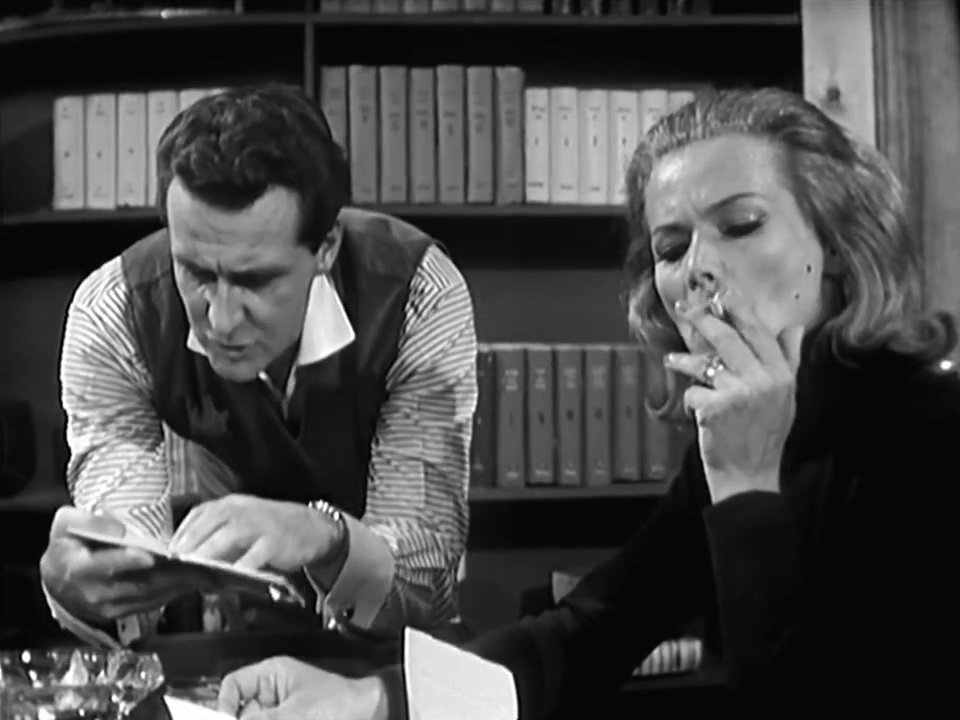
cathy-gale-john-steed-marriage

Death on the Rocks is a highly entertaining episode for two reasons: good writing, and the added value of Steed and Cathy posing as a husband and wife.

For once in this second series, the plot is actually a pretty good one. A ring of diamond smugglers attempt to control diamond trade in London by lethally enforcing their wills against family members of resisting merchants. This naturally means that Steed must pose a man just getting into the diamond trade, and that Cathy must pose as his wife. Hilarity ensues, although I halfway expected Steed to make greater use of the fact that they ‘need to be convincing.’ Ah, well. We will have to wait until series 3 for a Steed/Cathy kiss, I’m afraid.

Meanwhile, Steed’s partner Samuel Ross (Meier Tzelniker), whose wife died at the beginning of the episode, has problems of his own. His daughter Jackie (Toni Gilpin) is dating Nicky (David Sumner), a young jeweler gone bad who is a sort of point man for the smuggling ring. Nicky is what I like to call the ‘overconfident young man’ category; a type that Steed, as resident Alpha male, regularly has to put in his place. And he is an obnoxious, overbearing character, talking big but ultimately a coward. While we do not get a good rough fight between Nicky and Steed, there are a few moments when the older man simply smiles and waves Nicky aside like a particularly obnoxious dog. I’m sorry to say that the entire final fight sequence is somewhat ruined by someone crashing into the camera, visibly rattling it. By the time we get things back into focus, Steed and one of the baddies are on the floor and someone else has fired a gun.

Death on the Rocks rises to the top of the early Gale episodes. Cathy and Steed are equal partners in this one, and seem to be enjoying one another for the most part. There’s an entertaining subplot concerning the redecoration of Cathy’s apartment, although few chances for Honor Blackman to show off her live-television judo skills. But their interplay is marvelous, from Steed carrying Cathy around on his shoulders, to her justified anger when she discovers that he hasn’t been totally honest about the danger of the case. Cathy has not yet become Steed’s regular partner and the rough edges of their relationship still show. I admit that in some way I prefer the intensity of their early relationship, which is softened by the time we get to the end of the Cathy Gale series. Steed’s roughness makes his character incredibly dynamic – a well-dressed and honorable gentleman who will smile and cut your throat. His final words to Cathy seem to take her aback; Steed has begun to prove that he really does care.

The Avengers: The Removal Men

The Removal Men (2-06, November 1962)

vlcsnap-2013-07-29-23h39m21s8

Introducing: Venus Smith!

OK, not quite. Venus Smith first shows up in The Decapod, which I’ll probably cover at some point. But this is my blog and I do what I want!

The Removal Men marks the second episode to feature Venus Smith (Julie Stevens), a nightclub singer and Steed’s other female partner. She appears  a handful of times in the second series, before Honor Blackman’s Cathy Gale was a solidified second-in-command. Stevens is a likable enough actress, but the Venus episodes usually give her little to do beyond a few musical numbers and a few damsel-in-distress routines. It’s hard to believe that the same people capable of creating the tough-as-nails Cathy Gale could also create Venus Smith.

The Removal Men follows Steed on vacation of sorts, as he attempts to infiltrate a Murder Inc.-style ring that assassinates high-profile people for money. This is a chance for Steed to do his ‘bad Steed’ impression, first breaking into Jack Dragna’s (Reed de Rouen) flat and locking his wife in the bathroom. Steed is finally hired to murder a French film star (Edina Ronay), but it all goes wrong when Venus happens to recognize him. As is usual with the second series, the plot plays second fiddle to the characters, but the plot here is stronger than many others.

That being said, I’ve warmed far more to the Venus Smith episodes than I did on first viewing. Although Venus can be grating at times, she really is just an innocent who gets caught in the middle of Steed’s machinations. Unlike Tara King, who bears a strong resemblance to her in the final Avengers series, Venus really isn’t a spy and never wanted to be. She’s given more to do in her later episodes, but in this one she’s mostly window-dressing.

Without a strong female counterpart to buoy him, Patrick Macnee bears much of the burden of moving the story along. For those who enjoy Steed at his roughest (and I do), that’s just fine. He’s a fast-talking antihero here; he’s remarkably cool at the climax. This is one of those eps that highlights the hard-boiled nature of the early series – shadowy nightclubs, smoky rooms and grinning villains aplenty.

While not recommended for a first-time viewer, The Removal Men has some really excellent points.

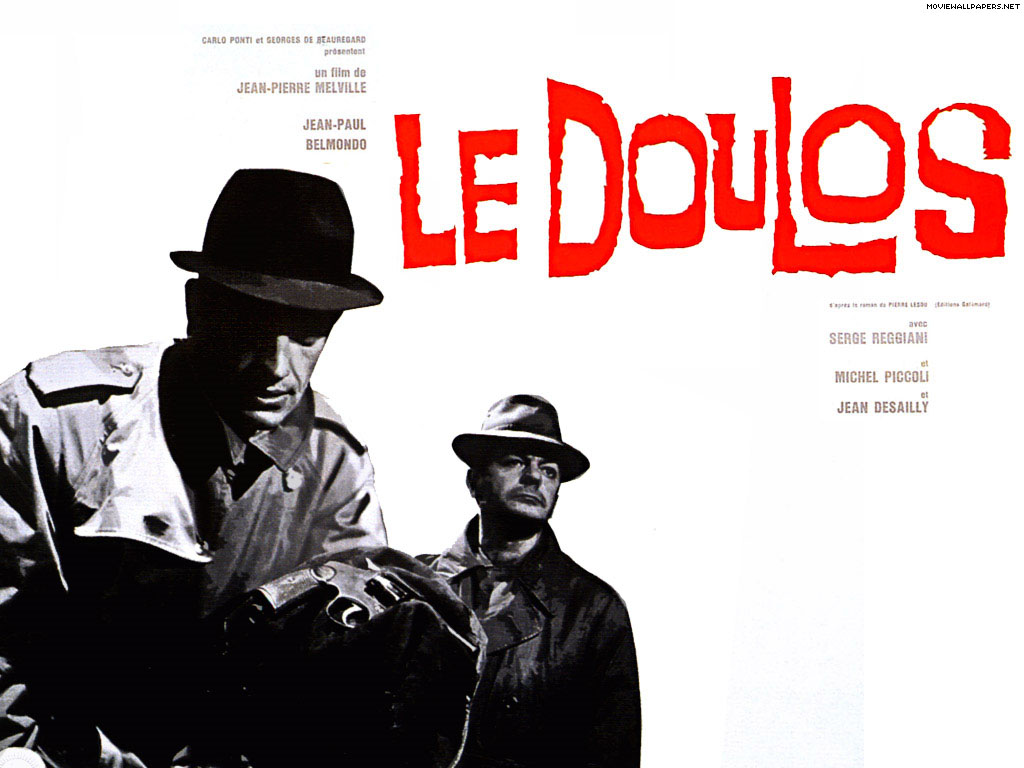
Le Doulos (1962)

le-doulos

Is there anything that better exemplifies Gallic cool than Jean-Paul Belmondo in a trenchcoat and fedora? No? All right, then, we agree.

Jean-Pierre Melville’s exercise in film noir Le Doulos gives Belmondo ample space to be icy cool, and that’s just the way I like it. The film opens with our main character Maurice (not Belmondo, but Serge Reggiani) walking down suburban streets. He enters a darkly lit house and has a cryptic conversation with an old jewelry fence named Gilbert, the importance of which will only be understood in retrospect. The entire opening sequence sets the tone, though: this is a film of the underground, with gangsters that act like Humphrey Bogart in the midst of an existential crisis.

Maurice is recently out of prison, planning that ever popular ‘final job’ that will enable him to run away with his girl Therese (Monique Hennessey). He involves his friend Silien (Jean-Paul Belmondo), the ‘doulos’ or police informant of the title. Silien’s entrance shows us nothing but an overcoated, hatted figure shrouded in darkness. Belmondo keeps his hat and overcoat on through most of the first hour of the film, only removing them when he enters a nightclub. He wears the costume of his trade.

As expected, the heist goes horribly wrong and Maurice finds himself in the unenviable position of having shot a police officer with his partner’s gun. Things go from bad to worse for Maurice, as we follow Silien – apparently the one who betrayed him – as the police ask their informer about the murder. Silien’s motives are obscured – he beats up and then apparently murders Therese, yet does not tell the cops that Maurice was the other man involved in the robbery.le-doulos-1

Much of the plot is initially confusing, made all the more so by Melville’s roving camerawork. I would have to watch it again, but I’m 95% positive that Silien’s interrogation scene is filmed all in one take. The camera moves rapidly, turning to follow Superintendent Clain (Jean Desailly) as he circumnavigates the room. Belmondo remains the fixed point that occupies the center of the frame, practically stopping the camera’s kinetic movement each time it lights on him.

The audience does not know where their sympathies lie for much of the film, as Silien moves from one inexplicable act to another. Belmondo’s impenetrable gaze and ice-cold stare give nothing away, nor does the somewhat detached nature of Meville’s camera. The script is as dense as a Raymond Chandler novel, the characters flitting in and out and speaking in clipped, arcane tones. There’s almost no music to build the tension or clue the viewer into a sympathy with one character or the other. Belmondo jumps between iciness and sudden, frightening violence, but remains the anchor of the film. This is a gangster flick, after all.

I can’t complain about a single moment in Le Doulos, except to say that the final reveal is a bit of a let down. While it explains everyone’s actions, I confess that I wanted a bit more subterfuge. The film set me up for that, and I would have loved to see it fulfilled.

Le Doulos is an exercise in noir tones, a French version of an American gangster film, but in my opinion better than anything Godard ever came up with. This is post-war French filmmaking at its finest.

The Avengers: Death Dispatch

Death Dispatch (Episode 2-13, December 1962).

steed-cathy-bedroom

*I’m going a bit out of order, but eventually will get around to most of the good ones.

The Cathy Gale series can be very spotty on quality. For every truly stellar episode, there are several mediocre ones and at least one or two terrible ones. Thank God for the good ones, though, because when they’re good, they’re very good. Which is where we stand with Death Dispatch.

The plot follows Steed and Cathy investigating the murder of a British courier carrying special dispatches. When the courier is found dead in his Jamaican hotel, Steed heads off with the dispatches in tow and Cathy close behind. I’m still not 100% clear on the importance of the dispatches to the diabolical mastermind behind the murder – something to do with a South American coup – but only rarely does the plot matter in this series.

What does matter is how much fun the entire episode is. Steed lounges onto the screen, flirting with girls by the pool while his superior One-Ten (one of the few appearances of Steed’s superior in the entire show) explains the basic plot. Then enter Cathy Gale, enjoying her Jamaican vacation immensely. There’s a marvelous scene between the pair when Steed invades her hotel room dressed only in a bathrobe. They banter, they flirt, they evidently enjoy each other’s company for the first time in the whole Cathy Gale series. Up until Death Dispatch, Cathy has been a distant, hard-edged and slightly cold character, unimpressed by Steed’s antics but equally unwilling to enter into the fun of espionage. She must have been deficient in vitamin D or something, because her mood obviously improves the second she gets into the sun. She actually seems to be having fun with him.

Death Dispatch also includes some of the best secondary characters to jump into The Avengers. The scene between Steed and the assistant British consul is one the funniest in the entire series. The villains all pop, and the danger Cathy gets into (which she finally does) is tense and well-shot. Steed also has his chance to let some of the darker elements of his character through, as he bludgeons and threatens his way to rescuing Cathy the moment he realizes she’s in danger.

All in all, I would probably recommend Death Dispatch as the place to start with the Cathy Gale series. Although you won’t get the development of Steed and Cathy’s relationship, you will get one of the best, most tightly written and well-acted episodes. This is 60s cool at its finest.

The Avengers: Propellant-23

Propellant-23 (Episode 2-02, October 1962)

tumblr_mq4zewjYTs1s2hz1mo4_1280

Oh boy. Let’s talk about Propellant-23. On second thought, let’s not. I’m sorry to say that it is one of the weaker entries in the Cathy Gale episodes. It has such promise too.

The whole thing begins with Steed planning to meet a courier getting off a plane in France. Even Steed doesn’t know what the guy is carrying, but it’s so important that several other rival agents are after it too. The courier is murdered (of course) and Steed finds himself  trying to infiltrate French customs in order to secure the courier’s briefcase and whatever is in it. Cathy meanwhile hangs out in a car outside the airport, ruminating on how she managed to get involved with a secret agent.

A Steed-heavy episode. Patrick Macnee appears to be on some kind of stimulant for the first half, talking a mile a minute, getting into fistfights, and lying his way into and out of trouble. For those that only know Steed from the Emma Peel series, where he’s far calmer and smoother, Propellant 23 is good fun for an introduction to Steed’s more manic side. There’s also a great set of character actors running around the place, including Geoffrey Palmer (you may know him from the BBC series As Time Goes By) to Catherine Woodville (Macnee’s second wife, don’t get me started on her). The French officials are all amusing, and somewhat make up for the rather thin plot.

There are also some great Steed/Cathy moments, both out in the car as they flirt (or Steed does) and a slightly inexplicable scene in a lingerie shop, where we learn that Steed likes shopping for lingerie and Cathy thinks that black is ‘a bit obvious.’ Propellant-23 builds their relationship nicely. Cathy is a humanist, concerned about her charity work, while Steed obviously does not understand her dedication to helping people. He hasn’t yet begun to learn either, although they quite obviously like and loathe each other in equal measure.

Despite its occasional good points, Propellant-23 does not measure up to some of the far more interesting and well-made Cathy Gale eps. Live television strikes again, with actors going up on their lines and a few scenes that are just confusing, I think because someone lost their script. The final fight in a bakery could have been cool but for weak writing and a rather flailing form of fighting that seems more like amateur theatrics. Steed’s manic style of talking in this one gets grating after awhile, as does his apparent incompetence from beginning to end. He does not usually fuck up this spectacularly. Cathy likewise seems cold, even mean at times, which is the side of her character that annoys me the most. Later episodes in this season will better meld their personalities, and give them something to do together. It’s far more fun when they’re bickering, but not at odds with each other.

BEST LINE:

Cathy: Do you always take your calls in a lingerie department?

Steed: If humanly possible.

Star Trek III: The Search For Spock (1984)

Search-for-Spock

Carrying on with my non-Trekkie viewing of Star Trek films – The Search For Spock!

When we last left our heroes, Spock was dead and I was very upset. Of course we knew that not even crossing to the other life can keep a Vulcan down. With that little teaser of Spock’s coffin landing on the Genesis planet, there was no doubt that he’d come back.

The Search For Spock picks up right where The Wrath of Khan left off. The Enterprise crew return home to get their ship repaired, only to discover that the Enterprise is going to be put out to pasture. It’s a metaphor for the crew, you guys! Then McCoy finds himself with a dual personality. Spock has apparently put his soul into McCoy’s body – nice one, Spock – so that he can have last rites back on Vulcan. The crew figures that they’ve got to give old Spock final peace, and liberate McCoy from the whole ‘having your friend inhabit your body’ thing.

Meanwhile, the Genesis planet is getting all kinds of weird. The whole planet ages and evolves at an alarming rate, producing some pretty fucked up lifeforms. What’s more, a bunch of pissed off Klingons led by Christopher Lloyd have decided that the very existence of Genesis is an act of war. They want the secret for their very own. Predictably, they’re going to have to fight the Enterprise crew to get it.

5b6d38634f7e9865443f4d4355360b0b9d4cae21

The Search For Spock has the feel of a middle film, because that’s exactly what it is. This is the development stage of the arc, between Spock’s death in Wrath of Khan and his re-learning cycle in The Voyage Home. For that, it’s a perfectly enjoyable film, though not a the same level cinematically as Wrath of Khan.

There are some lovely, amusing moments between the Enterprise crew as they make plans to steal their own ship and return to Genesis to find Spock’s body. The reasoning behind this seems a little muddled – if any Trekkies can explain to me why they need Spock’s body, and at what point they realize that they could actually put his soul back into his body, I would be very grateful. But it does give DeForrest Kelly an opportunity to do a quality imitation of Leonard Nimoy. We also learn about the Vulcan aging process, as dead Spock regenerates into a new baby Spock who grows up very quickly. Puberty is very tough on Vulcans.

The biggest problem with the film is the whole Klingon subplot. It would have been fine, even necessary, adding action to what is basically a quest narrative. But why did we need whole swathes of dialogue in Klingon? The version I watched didn’t have subtitles, so there I was, listening to Christopher Lloyd garble on, without the slightest idea of what the hell he was talking about.

The final fight between Kirk and Kruge (Lloyd) seems a wee bit tacked on, as though we really just needed a scene with Shatner getting down and dirty. For awhile the search for Spock takes a backseat to Kirk’s anger at the death of his son, who very stupidly and bravely sacrifices his life for new Spock’s.

In the end, The Search For Spock is a mostly satisfying effort. While it does not stand up to the calibre of Wrath of Khan, or the humor of The Voyage Home, it’s fun and, particularly at the end, moving. Do they find Spock? Does he come back? C’mon. What do you think?

The Avengers: The Mauritius Penny

The Mauritius Penny (Episode 2-07, November 1962)

the mauritius penny

The Mauritius Penny did not start at the top of my favorite Cathy Gale episodes, but has recently worked its way up there. Here’s why.

The episode has Steed and Cathy investigating the seemingly pointless murder of the owner of a stamp shop…and uncovering a fascist conspiracy in the process. As usual with the Cathy Gale episodes, the plot is a little nonsensical, with holes a-plenty. But the actors roll right over the holes by speaking very quickly, exchanging charming banter and a few kickass judo moves.

Cathy Gale often comes in second to Emma Peel in fan favorites. Although the Emma Peel series is better written and more uniform in quality – due largely to a higher budget and the switch from live television to film – I think that Cathy is sometimes underrated. She’s one of the first female badasses to grace television screens. Like Mrs. Peel, Cathy has an almost endless array of talents that include judo, gunplay, anthropology and just about any other scientific endeavor the show demands of her. Cathy cuts through some of Steed’s bullshit, calling him out on his casual misogyny and blatant manipulation of others. She humanizes Steed by declining to idolize him (a problem which pops up in the Tara King era). He, meanwhile, visibly enjoys the verbal and physical sparring.

The Mauritius Penny is a prime example of the pair working together. There are some moments of entertaining exchange between them, and it’s evident that they’re coming to trust and understand one another. Steed does not miss out on a few opportunities to check Cathy out, while Cathy seems a little more amenable to his advances.  Steed and Emma Peel achieve a symbiosis in their relationship, while Steed and Cathy are almost perpetually at odds. It means there’s some pretty exciting sexual chemistry at times.

At the beginning of the episode, Steed inexplicably decides to don horn-rimmed glasses as part of his disguise as a philatelist (stamp collector), which makes for some entertaining facial expressions from Patrick Macnee. There are excellent secondary characters moving in and out of the scenes, from the earnest delivery man to Lord Matterley (Richard Vernon, who you may recognize from A Hard Day’s Night). They serve to flesh out a slightly thin script. Then there’s the scene in the dentist’s office, which owes much to Alfred Hitchcock’s The Man Who Knew Too MuchThe Avengers is a very cinematically literate show.

The climax of the episode, where Cathy and Steed succeed in infiltrating a fascist organization, makes for some seriously entertaining viewing. It also serves to highlight the position that the pair occupy as heroes, as the camera draws back to reveal two people standing against an entire organization.

The Mauritius Penny stands as one of the better Cathy Gale episodes – tense without being overblown, well-acted and utterly enjoyable from start to finish.

Star Trek II: The Wrath of Khan (1982)

wrath of khan

Full disclosure time: I am not, nor have I ever been, a Trekkie.  It just was never in my genetic make-up to get really into Star Trek.  I always preferred Star Wars, and resisted valiantly any attempts from Trekkie friends to get me to admit that Klingon was a language.  But as a result, I never saw Star Trek II: The Wrath of Khan. And for that, I am truly sorry.

Khan

Most know the plot, but here it goes: James T. Kirk is not a Captain any more, but an Admiral, and apparently going through a mid-life crisis.  He winds up aboard the Enterprise, along with most of his original crew, during a training mission that goes spectacularly wrong.  Because one of Kirk’s old sins has come back to haunt him in the form of Ricardo Montalban as the fabulously bare-chested and feather-haired Khan, who was marooned on a planet many years before.  Khan’s got a chip on his shoulder about old Jim, what with the marooning and the death of his wife and all, and so intends to destroy Kirk no matter what it costs him.  This is all wrapped up in the Genesis project, a scientific endeavor to create life out of lifelessness and run by Kirk’s old flame. Khan wants Genesis, but more than that he wants to make Kirk suffer horribly.

So much, so good.  The Wrath of Khan is perhaps the most recognizable of the Star Trek films – from the introduction of Khan, Shatner’s famous scream and – spoiler! – the death of Spock.  But it’s a just a great film, even if you don’t know Star Trek.  Kirk’s crisis is an understandable one and well-played by Shatner.  He’s in turmoil, missing the energy of being a young man but fully cognizant of the mistakes he’s made and what it meant to his future.  The relationships between all the leads is touching and honest without being overplayed.  It’s a clever film, with clever plot turns, and a testament to why Star Trek has become so iconic.

Having already seen Star Trek Into Darkness, like everyone else I began comparing the original Khan plot arc with the new one.  While a number of scenes are strikingly similar, what struck me most about Wrath of Khan was how understated the emotions of the Starfleet crew really were.  In Star Trek Into Darkness, the emotions are all very surface: Bones, Uhura, Kirk, Khan and even Spock all succumb to tears at some point.  Khan’s driving force in that film is his crew – his love for them, and his willingness to harm anyone who stands between them.  In Wrath of Khan, the driving force is his … well, wrath.  He’s angry; all his love and passions are translated into an obsessive fury.  While that’s played upon in Star Trek Into Darkness – and played very well by Benedict Cumberbatch – Khan’s obsession feels more in line with Kirk’s, rather than the antithesis.  And the tears that accompany ever expression of emotion feel wasted in Star Trek Into Darkness.  By the time we really want to see the characters cry, they’ve done it so much that it loses power.Spocks_death_1

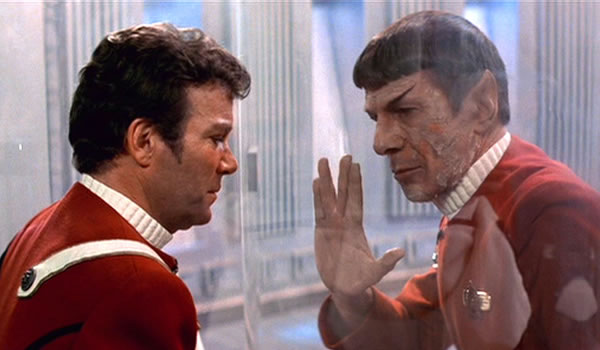
In Wrath of Khan, only one tear is shed and that by a Vulcan.  But while the characters don’t burst into tears, the audience does.  Spock’s death is heart-breaking because you can hear how badly Kirk wants to control his emotions.  Two understated performances  from Shatner and Nimoy make the scene.  It’s heartbreaking because it’s inevitable, and because the emotions are real but never extreme.  You know that these two friends love each other and you know it without either one of them shedding a single tear.

So at the end of the day, this non-Trekkie loved Wrath of Khan. It even made me seek out The Search for Spock, and seriously consider if I shouldn’t give Star Trek the show another chance.

The Avengers: Mr. Teddy Bear

I get really easily and wildly obsessed with things.  Case in point: my current adoration for the TV show The Avengers.  There are few TV shows from the 1960s that so easily and effortlessly marry entertainment, feminism and badass spy-fi plots. So, because this is my blog and I do what I want, I’m gonna start posting brief reviews of episodes as I watch, or re-watch, them.

If you want to get a basic idea of the outline of the show, the Wikipedia page gives a great overview.

Let’s begin at the (kind of) beginning with the first episode to introduce Cathy Gale (Honor Blackman), the first tough female partner of secret agent extraordinaire John Steed (Patrick Macnee).

MR. TEDDY BEAR (Episode 2-01, September 1962).

vlcsnap-2013-06-18-17h13m02s174

Steed and Cathy face off against a villain known as Mr. Teddy Bear – and he’s not particularly soft or cuddly.  He’s an assassin for hire, murdering people with some pretty clever booby-traps.  The set-up? Cathy will pretend to take out a contract on Steed’s life in order to draw Mr. Bear out into the open.  The plan backfires and Steed ends up dead.  Kind of.  Not really.  He does get badly burnt, though.

For the first episode with Cathy – Steed had already been paired with a male partner for the entire first season, which is now lost to us except in script form – this one features some entertaining exchanges between the two.  From their first verbal sparring session as Steed debriefs Cathy, to their actual sparring sessions as Steed tries to debrief her in a different way, the set-up of the relationship of the two characters is what makes the episode pop.  And it needs a pop, because the camera work is low-budget and the sets quite obviously cardboard.  Already you can see where The Avengers exceeds many shows of its day – the quality of the actors is superb and the chemistry between Macnee and Blackman is sexual without quite crossing the line.  Steed’s established as a bit of a letch who nonetheless already has a dawning respect for his female partner. And Cathy … well, Cathy’s a badass, insulting her official superior, calling out an assassin, and generally expressing disapprobation when Steed survives the murder attempt.

So while the best part of this episode is Steed and Cathy, the writing is also quite excellent.  Mr. Teddy Bear is an admirable and creepy villain, while Steed’s posturing and overconfidence is nicely matched by Cathy’s quiet resolve.  If you must start somewhere with The Avengers, start here.