Bloody October: Beyond The Walls (2016)

Beyond The Walls (2016)

lisa-beyond-the-walls

It’s always exciting to discover an interesting and evocative horror story that manages to do something new with a potentially tired sub-genre. The French miniseries Beyond the Walls, directed by Herve Hadmar and now airing on AMC’s Shudder, is exactly that.

Beyond the Walls is a three-part miniseries about a lonely young French woman named Lisa (Veerle Baetens) who suddenly inherits the strange house across the street from her apartment building. A man’s body was recently discovered in the house, which hasn’t been opened for thirty years – no one seems to know who he is, or where he came from, and Lisa has no idea why she was made his heir. Detached from her life and her friends, Lisa moves into the derelict house, throwing down most of her stuff in a single room and wandering the place in search of things to do. One night, she hears weird noises coming from beyond the walls, and promptly smashes a hole in the plaster to investigate. She wanders down winding corridors and through broken doorways until she realizes, all too late, that she doesn’t know her way back. Stumbling upon Julien (Francois Deblock), another lost soul in the walls, Lisa tries to find her way out and evade the weird Others who threaten to keep her in the house forever.

Beyond the Walls interweaves some standard horror narratives into a new, complex mythology that the series manages to keep mysterious without sacrificing coherency. The story begins like a twisted Alice in Wonderland, with Lisa plunging into the house within the house largely because she’s curious about what lies beyond. But as the film proceeds and the layers of the house deepen into something darker and more meaningful, an interesting – if occasionally confusing – philosophy begins to emerge. What opens as a straight haunted house horror story becomes a truly complex narrative, replete with tenderness, desire, and the need to accept both guilt and redemption.

Aesthetically, Beyond the Walls occasionally relies too much on what are becoming common horror tropes: a man with the head of a pig, zombie-like creatures twisting their way down corridors, men with blackened eyes. The house is in a constant state of decay and acts as a labyrinthine metaphor for the complex interaction of guilt and love. Julien inscribes a map of the house on the walls of a hidden cellar, and writes cryptic symbols all over his body, as though reminding himself who and what he is as the house threatens to take more of him.

There’s an episodic, video-game feel to some of the sequences, as Lisa collects more stories, rules, and information that will enable her to escape the house, but these are all brought together in the final act. The final episode is intense and lyrical, drawing together the strands that have been slowly revealed over the course of the previous two into a moving and terrifying conclusion (one that features Geraldine Chaplin, no less). Although I watched it as three separate episodes, it’s really an extended film and should be experienced as such.

Beyond the Walls contains much, but explains very little – the meaning behind the house and the connections of the characters are not fully elucidated by the conclusion. Yet, it still satisfies. It’s a surprising story, mixing common themes together in a haunting melody that echoes long after it has ended.

Beyond The Walls is available exclusively on Shudder.
Bloody October: The Host (2006)

The Host (2006)

the-host-bong-joon-ho

While a South Korean monster comedy might seem a contradiction in terms, The Host proves itself both unique and of its time, a mocking commentary on the depredations of toxic waste in South Korea and the government mistreatment of its own people.

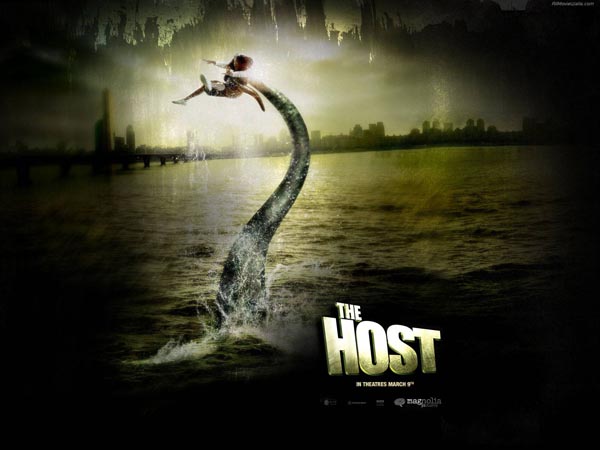
The film opens with an American military scientist instructing his South Korean assistant to dump bottles of formaldehyde down the drain, where it will eventually flow in the Han River. Many years later, a deformed fish-monster, mutated from the toxic waste, crawls from the river and runs amok, killing and consuming. The film zeroes in on the Park family who run a noodle stand by the Han. The monster grabs Hyun-seo (Go Ah-sung) and drags her down into the river, while her horrified father Gang-du (Song Kang-hu) and grandfather Hee-bong (Byun Hee-bong) look on. But the nightmare is only beginning: Gang-du and his family must face off against government officials, the American military, and even Korean businessmen to escape from a government containment facility to search the sewers for Hyun-seo.

Rather than a straight monster movie for the 00s, The Host veers into comedic territory whenever it has the chance, mocking the incompetent government forces and increasingly dangerous attempts to eradicate the monster through biological warfare. Like many of the kaiju and Atomic Age monsters, The Host‘s monster is brought to life by scientific hubris and inattention – and was, in fact, inspired by an actual incident in 2000 when a Korean mortician working for the Americans admitted to dumping formaldehyde down a drain and poisoning the river. The efforts of the Park family to recover their daughter are met with absurd bureaucracy and manipulation, to the degree that the family actually resorts to criminals to escape a government facility. The heroes are all members of the underclass – shop owners, criminals, poor children, students, and the homeless – while government, military, and business forces (American and Korean) are at best sycophantic and at worst diabolical.

The Host is a deceptively complex monster movie. Monstrosity itself is neither good nor evil – the monster is simply an animal attempting to survive, and the Parks a family who don’t care about government bureaucracy and only want to rescue their child. Monster movie tropes are subverted and new ones introduced, making the film unpredictable and phenomenally entertaining. I only wish I spoke Korean.

The Host is happily available to watch on AMC’s Shudder streaming service.

(Incidentally, director Bong Joon-ho was also behind the spectacular Memories of Murder, a very different kind of horror film, more than worth checking out).

Bloody October: The Shallows (2016)

The Shallows (2016)

shallows

The Shallows is certainly the most contemporary film you’re going to see on my Bloody October list (and it probably wouldn’t be on here at all save for my roommate reminding me of its existence). The Shallows hit cinemas this past summer, shocking everyone by being a “decently scary shark” movie instead of a “Blake Lively in a bathing suit, with a shark” movie. And while it ain’t Jaws, I’d say that The Shallows is a damn enjoyable film.

The plot is lovely in its simplicity. Surfer-girl and medical student Nancy (Lively) goes to Mexico to decompress from the emotions following the death of her mother. Heading to a “secret beach,” she has a nice day of surfing and sun. But when she tries to catch her final wave back to shore, a shark knocks her from her surfboard and takes a bite out of her leg. Bleeding and succumbing to shock, Nancy manages to pull herself onto a jutting rock in the middle of the shallows. She’s trapped there, hunted by a shark with a taste for human flesh, with no rescue in sight.

The Shallows hits all the right notes for a menacing monster movie without banking on complicated twists or needless exposition. All of the necessary elements are introduced early on: Nancy goes to the beach alone because her sister was supposed to go with her and bailed at the last minute; her medical training is established long before it becomes a necessary plot point; the presence of fire corral and jellyfish, which will figure into her attempts at escape, are points clearly dropped in without making an issue out of them. The leanness of the plot means that the film can focus on the trials of Nancy, for awhile the only character on the screen.

Lively makes for a sympathetic protagonist, pulling The Shallows away from a gimmick-laden genre film to an honestly decent movie that understands its predictability and revels in it. Without descending to parody, the film manages to be tense and frightening. Neither Nancy nor the shark strain credulity with their abilities – the latter is just an animal looking for food, the former prey trying to escape. While the film does hint at some deeper meaning – Nancy questions what’s the point of fighting when it’s all going to end the same anyways – it thankfully shies away from giving too much importance to philosophical life lessons.

The weakest point of The Shallows is the CGI shark, which makes its appearance way too early and takes away some of the menace. One of the strengths of Jaws was not showing too much of an animatronic animal, allowing the unseen evil to suffice for horror. The Shallows’ shark appears several times, and at each appearance becomes less believable. It’s so obviously CGI that it dissipates the menace of an actual animal hunting an injured woman.

Despite a few shortcomings, The Shallows is an effective film, never trying to be more than it is. This is a movie about woman vs. shark, and it’s allowed to be just that.

Bloody October: It (1990)

It (1990)

it-1990

I will confess something: I’m not a fan of Stephen King. I’ve read a few of his novels and there’s always a point at which he becomes sadistic in the treatment of his characters. I had to finally abandon Salem’s Lot for just this reason, and Pet Sematary stands as one of my least favorite books. But somehow, I’ve always enjoyed the adaptations of King’s books far more than the books themselves.

The 1990 miniseries It is based on King’s 1000+ page novel of the same name. It tells the story of a group of kids in Derry, Maine who face a nameless evil in the form of the diabolical clown Pennywise (Tim Curry). Pennywise has been slowly picking off the kids of the town one by one, luring them down into the sewers with promises of balloons and cotton candy. The Losers Club – seven kids who face different kinds of bullying from the local toughs – band together to stop Pennywise once and for all.

Like the novel, the miniseries spans thirty years. The final member to join the club Mike (Tim Reid) is also the only one to stay in Derry, acting as the local librarian. He’s the one who calls them all back together when a series of killings reminds him of Pennywise. As each member of the group filters back to town, their stories are revealed.

It suffers somewhat from its overlong, episodic structure. Rather than going in chronological order, the constant flashbacks as each Loser remembers his or her past becomes a wearing device, bouncing the viewer back and forth between the past and present day. It also slightly confuses some of the plot elements that are deemed important in the second half of the miniseries, when the Losers finally get back together in Derry. They all claim to have limited memories of what happened, yet the flashbacks, told from the perspective of each character, are very clear.

It might have worked better as a shorter film, cutting down on some of the episodes and allowing the story of friendship and loss of innocence to develop over time. There are quite a lot of themes that are only cursorily touched on here – including what “It” is, exactly, and why it has chosen Derry – yet the miniseries still feels overlong. Nor is it always clear that It manifests itself as something that each child fears. Apparently Beverly is afraid of sinks backing up?

The first half of It is saved by the presence of Tim Curry, who makes one hell of a scary clown. Curry’s peculiar brand of indulgent, delicious evil is well-suited to Pennywise, a sadistic trickster as well as a manifestation of evil. Pennywise isn’t just content with eating children every thirty years – he wants to scare the bejeezus out of them first. As he torments the children and their adult selves alike, his presence becomes something to look forward to. It’s rather disappointing, in fact, when It’s true form is revealed…

It is a serviceable film that nonetheless would play better, with all its flaws, as a two hour movie and not a 3+ hour miniseries. A little whittling down of the story – or at least making it less episodic – would have gone a long way to making even this TV version higher quality. To that end, a new version of It is currently being produced as a two-part film, which is both interesting and a little worrying. I’m not sure that clowns need any more bad rap at the moment.

Bloody October: Night of the Demon (1957)

Night of the Demon (1957)

nightofthedemonposter

There are surprisingly few film adaptations of M.R. James’s short stories – I assume because many of James’s stories are more creepy than they scary. His works are populated with professors, researchers, and antiquarians digging up weird myths, creepy factoids, and bizarre histories, but – unlike fellow acronym H.P. Lovecraft – very often that’s where the stories end. Night of the Demon, however, takes the basis of James’s short story “Casting the Runes” and builds a more complex narrative around it, with Dana Andrews in the professorial lead.

Andrews is John Holden, professional skeptic, who arrives in London to attend a convention with the purpose of exposing a devil cult run by former magician Dr. Karswell (Niall MacGinnis). When Holden arrives, he finds that one member of the convention, Professor Harrington (Maurice Denham), is already dead, while the others are troubled by weird reports surrounding his death. Enter Harrington’s niece Joanna (Peggy Cummins), not nearly as skeptical as Holden, who believes that her uncle was cursed by Karswell. When Karswell informs Holden that he must cease his investigations or be subject to the curse, Holden refuses. Karswell tells him told that he will have three days to live before the demon comes for him.

Night of the Demon is directed by Jacques Tourneur, perhaps best known for Cat People, another horror film that pits skepticism against belief. That dynamic is – a bit more annoyingly – on display in Night of the Demon, with Andrews playing a man so skeptical that he’d probably deny the existence of gravity because he can’t actually see an apparatus that produces it. As Joanna leads Holden around to seances and even scientific demonstrations in an attempt to convince him to take the curse seriously, she and the audience become increasingly exasperated. This reaches its height when Holden actually sees the demon begin to manifest in the woods, and subsequently concludes that it must be a magician’s trick.

Belief and skepticism fuel this film, with the usual arguments about mass hysteria and psychological experience becoming more diabolical as Karswell’s own fears are revealed. MacGinnis is delicious as the devil-bearded magician whose apparent faith in himself conceals a slightly hysterical nature. The film, in fact, is populated with excellent character actors of the period, including Athene Seyler as Mrs. Karswell (you’ll recognize her as one of the old ladies in the Avengers episode “Build a Better Mousetrap”), and Richard Leech (of “Traitor in Zebra”) as a police inspector.

I heard someone refer to this as “horror noir,” and it’s an apt description. As with Cat People, the use of chiaroscuro makes every-day scenes take on demonic significance. Hotel hallways stretch off into the dark unknown, POV shots create a wobbly world of demoniacal interference. The only blot on Night of the Demon’s escutcheon is the rather hokey appearance of the actual demon (which occurs within the first five minutes, so I promise I’m not spoiling anything). Part wolfman and part Muppet, the demon unfortunately removes a bit of the mystery and some of the argument of the film by externalizing the evil. I was reassured, however, to learn that this element was actually forced on Tourneur by producer Hal E. Chester, who inserted the monster over the objections of director, writer Charles Bennett, and Dana Andrews. I don’t have to blame Tourneur for this one, then.

Night of the Demon is a very enjoyable piece of British horror, straddling the divide between studio filmmaking of the 1950s and the more location-heavy horrors of the 1960s. If one ignores the hokey-ness of the actual demon and the occasional pedantry of Dana Andrews, it’s a film that stands right up there with Cat People. 

Bloody October: The Blair Witch Project (1999)

The Blair Witch Project (1999)

blair-witch-project

Every year in the run-up to Halloween, I watch as many horror movies as my little horror-loving brain can stand. I also attempt to rectify the oversights of past years and see some classics (cult or otherwise) that have somehow managed to escape notice. This year, the first up is The Blair Witch Project, the horror smash from 1999 that inaugurated our ongoing obsession with the found-footage sub-genre.

Contrary to popular belief, The Blair Witch Project is not the first found-footage horror film. That distinction goes to Cannibal Holocaust, the controversial Italian cannibal film made in 1980. But Blair Witch definitely established some of the hallmarks of the sub-genre that we now see today.

The story is pretty simple: three student filmmakers (Heather, Mike, and Josh) embark on a documentary trip into the woods near Burkittsville, Maryland to make a movie about the local “Blair Witch” legend. After they vanish, their footage is discovered and edited into the film we see. The film combines the faux documentary made by the students – including talking-head interviews with local residents to establish the Blair Witch legend – and the “real-life” footage the students take as they get lost in the woods, stalked by an unseen force.

The conceit of The Blair Witch Project is provocative in itself: the documentary footage feels very much like a student film project, with leading questions to residents and silly, posed scenes at cemeteries. As the students head into the woods, the documentary elements are slowly abandoned and the students become the subjects of their own work. They fight among themselves, breaking down psychologically as they wander off map and bizarre things begin to happen. Some of the film’s more iconic images, like stick-dolls hanging in the trees, are incredibly creepy, while others – the POV camera shots of trembling hikers – have become so iconic as to lose their power.

The Blair Witch Project is a weak film in many ways. While it has some good ideas, the conceit begins to strain credulity. Although some excuse is made for Heather’s obsession with continuing to film even in the direst of circumstances, it feels just like that: an excuse. As time goes on, the conceit itself began to pull me out of the film and remind me that these were not actually documentarians lost in the woods, but fiction-filmmakers pretending to be lost in the woods.

The found-footage concept is a difficult one to pull off for just that reason, and it’s to Blair Witch’s credit that they manage to keep it going as long as they do. Still, the shaking camera and heavy breathing does become wearing after a while. Rather than creating horrific tension, it becomes an exercise in trying to understand just what is going on. What am I supposed to be afraid of and why? After all, this is a fiction film; it does need some kind of coherent arc and coherent horror. Not being able to see the monster can often be terrifying, but The Blair Witch Project does not manage to create tension surrounding it.

I also struggled with understanding the actual legend behind the Blair Witch, and the film doesn’t take many pains to establish why certain elements are important. The dolls hanging in the trees, the piles of rocks, the weird abandoned house that makes up the film’s denouement…what are we really supposed to get from all this? I don’t insist that all elements of a film be explained – and a film like this has difficulty providing exposition without it coming off as an info drop – but there was still a sense that the characters knew more than they ever explain.

I’m glad that I have The Blair Witch Project under my belt – it’s a seminal horror film, and influenced quite a few of my favorite contemporary horror films. But it’s far less successful in 2016 than it was in 1999.

Popstar: Never Stop Never Stopping [Blu-Ray Review]

Popstar: Never Stop Never Stopping (2016)

popstar

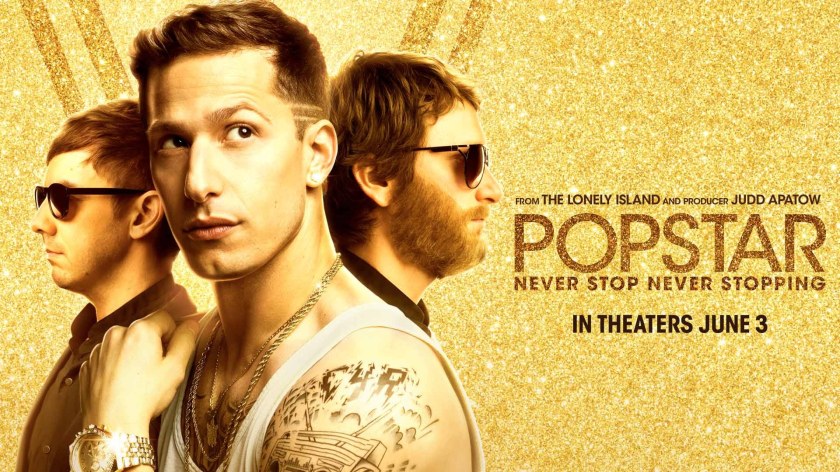
Popstar: Never Stop Never Stopping is one of the more surprisingly funny comedies to come to cinemas in recent years. A Spinal Tap for the digital media age, Popstar makes use of internal references and celebrity cameos while not solely relying on them, producing a comedy that will, I think, stand the test of time.

Popstar takes the format of a tour documentary covering the rise and eventual fall of Conner Friel, or “Conner4Real” (Andy Samberg), a combination of Justin Bieber and Macklemore with the ego of Kanye West. Having just come off of a massive worldwide tour, Conner goes back into the studio to record his sophomore album, only to have it – and his subsequent tour – flop big time. The film takes us the behind-the-scenes of Conner’s eventual meltdown, introducing us to his roadies, managers, hangers-on, and former bandmates from The Style Boyz (Akiva Schaffer and Jorma Taccone), at least one of whom has not forgiven Conner for going solo. The film is a mash-up of styles that does more than just parody Bieber – it creates a recognizable character in his own right, driven by ego and a desperate need to be liked by everyone, as he comes to the realization that he was happier making music with his pals.

Samberg is weirdly sympathetic as the delusional Conner, a talented kid who has bought into his own hype. He’s horrified to learn that the fleeting nature of celebrity means that the beloved superstar of one minute is the derided YouTube flop of the next. While the faux earnestness of every minute threatens to grate, Samberg gives his character an underlying likability where he might otherwise have been repellant. By the time we get to his inevitable downfall and desperate attempts to revitalize his flagging celebrity, we feel more sympathy than not for Conner. We root for him to get back on his feet and rediscover the things that he loved, with the friends he should have valued.

Popstar is a mashed-up parody of pop music and cultural trends that eventually transcends simple referentiality. Celebrity cameos from the media world come in and out of the film without derailing it – it’s amusing to watch Usher, Adam Levine, and Ringo Starr wax eloquent on the influence of Conner and the Style Boyz, while Sarah Silverman, Bill Hader, and Tim Meadows play it straight for some of the biggest laughs. The expert handling of the cameos is one of the elements that lifts Popstar above what it could have been – a bargain-basement parody – by creating a believable world for Conner and his bandmates to inhabit. Conner is integrated into this universe, rather than a commenter on it.equal-rights

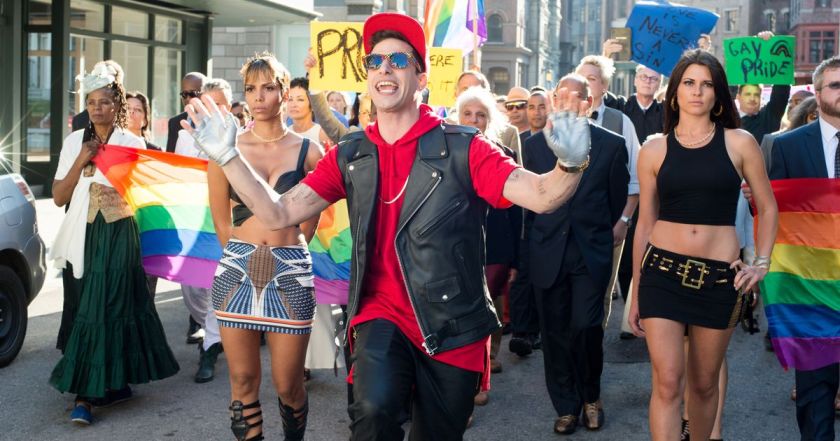
Then, of course, there’s the music. Popstar has the heavy musical talent of Lonely Island evident in every track. One of the funniest is the Macklemore parody Equal Rights, in which Conner advocates for gay marriage while loudly proclaiming that he’s definitely not gay. Like the best of Weird Al (who also has a cameo), the songs are entertaining and hilarious even if you’re unaware of the internal references, and actually catchy pieces of music beyond their parody.

This Blu-ray release boasts a host of special features, including a series of deleted scenes that flesh out some of the secondary characters, including Joan Cusack’s epic turn as Conner’s mom. It’s a shame that some of these were cut out, especially as they provide a showcase for a number of the talented female comedians who are reduced to mere walk-ons in the actual film. Sarah Silverman and Maya Rudolph both get their moments in the sun, while several of the other characters – like Tim Meadows as Conner’s manager – receive greater character development.

Further special features include “Fun at CMZ!”, the brilliant TMZ parody spots peppered throughout the film that at times hit a little too close to the reality of tabloid coverage. A gag reel – too short, but hilarious – outtakes, extended scenes, and an extensive filmmaker commentary round out the disc. A series of full-length music videos provides even more Lonely Island, if you just want to get your fix.

Despite a strong critical reception, Popstar didn’t do the business at the box office that it might have hoped for. But this film has staying power. It succeeds at both being a commentary on contemporary celebrity culture, and an entertaining comedy unlikely to get tired. Put the Blu-ray on your shelf next to This is Spinal Tap and Best in Show. And remember to never stop never stopping.

Fantastic Planet (1973)

Fantastic Planet (1973)

fantastic-planet-1973

Until recently, we’ve tended to associate animated films with children, and treated animated films that deal with adult subjects as anomalies, or at best new discoveries. But animation has been around as long as cinema, and for much of its history it has been directed toward adult audiences as much as children. The French/Czech co-production Fantastic Planet, directed by Rene Laloux, is one of many animated films from the 1970s that deals with adult and oft-disturbing subject matter in a unique, complex way.

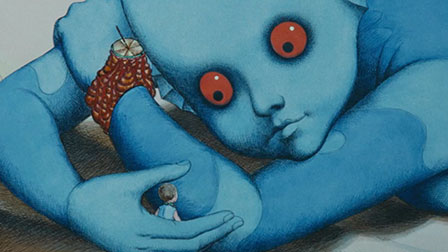
Fantastic Planet takes place on the planet Ygam, inhabited by a race of blue humanoids called Draags. Draags keep human beings, called Oms (in French, literally homme or man), as pets, putting them in collars, dressing them in little costumes, and playing with them. But Draags also view wild Oms as dangerous, vicious creatures that must be eradicated. The film centers around one Om named Terr, a pet of Tiwa, the daughter of a senior Draag leader. Through an error in his collar, Terr begins to learn Draag language, culture, and planet knowledge from a pair of headphones that project Tiwa’s school lessons directly into his brain. Finally sick of being treated like an animal, Terr escapes, fleeing into the wilderness with Tiwa’s headphones. He meets up with a band of wild Oms to whom he offers Draag knowledge, but incurs danger both from the frightened Oms and the increasingly malevolent Draags.

Fantastic Planet’s sci-fi plot is somewhat simplistic, enhanced by the surreal imagery that creates a strange, unique culture and experience. The film ostensibly was meant to reflect the Russian occupation of Czechoslovakia, but it has greater resonance than that, dealing with issues of dehumanization, genocide, and the complex philosophy that puts one people (or species) above another. The Oms are ignorant because their overlords have kept them ignorant, but the Draags also have no apparent awareness that their pets are anything more than dumb animals. Terr provides a bridge, imparting knowledge that proves to be a danger to himself, to the Oms, and to the Draags.

Fantastic Planet is more about image than about plot, the creation of a fascinating, bizarre world that is about cinematic experience creating meaning. While firmly set in its Cold War mentality, it nevertheless succeeds in being universal, in saying something about the way humanity treats that which it does not understand, about belief in superiority and the dangers that creates for all creatures, Draags and Oms alike.

Don Verdean (2015)

Don Verdean (2015)

don-verdean

Apparently I am into films about faith-based charlatans. Unlike Elmer Gantry, however, Don Verdean is a comedy about what it means to believe, even in the face of such difficult things like “evidence” and “historical fact.” Don Verdean focuses on the attempts of a “Biblical archaeologist” to pass off artifacts discovered in Israel as proofs of the reality of the Bible. The bizarre thing about it? He really believes in what he’s selling.

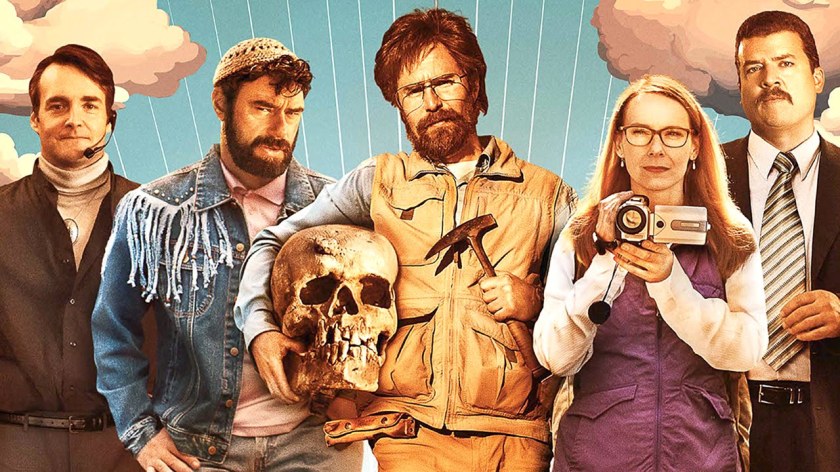
Don Verdean (Sam Rockwell) makes a questionable living as a self-titled Biblical archaeologist, traveling to Israel and unearthing artifacts based on a combination of Bible verses, historical knowledge, and his professed belief in God’s guidance. He meets with pastor Tony Lazarus (Danny McBride), who wants Don’s help in bringing more people into his rapidly diminishing congregation. Don has the solution: he’s discovered Lot’s Wife on a cliff in the Holy Land, and has the statue shipped over from Israel with the help of his friend and local guide Boaz (Jemaine Clement). But Lazarus isn’t satisfied with just one piece of Biblical history, and Don promises to find an even more astounding artifact: the skull of Goliath. So off Don goes, with his faithful secretary Carol (Amy Ryan), to try and discover the last resting place of David’s nemesis. When it becomes clear that the Israeli government will not let Don dig where he wants to, the desperate archaeologist does something he’s never done before: he fakes it, digging up the grave of a boxer afflicted with gigantism to pass off as Goliath’s skull. But Boaz knows what he did, and Don is now in way over his head.

Don Verdean could have been a lot of things: a satire on the faithful, a parody of people stupid-or desperate-enough to believe in the reality of the Bible that they can be sucked in by obvious fakes and questionable historical practices. But while the film is certainly satirical, it does not fall into the trap of feeling contempt for those it satirizes. Don is a true believer – he really does think that he can find artifacts by using the Bible and that he’s receiving guidance from God. The Goliath skull scam is not for money, but a desperate move to help people maintain their faith by giving them something tangible to hold onto. As Boaz sucks him deeper into the vortex, trying to convince him to make money by scamming people, Don becomes legitimately distressed. This is not what he does, and not the meaning of his work.

Unfortunately Don Verdean sacrifices some of its thoughtfulness in the second half, relying instead on some cheap shots to draw out the humor of the situation. Initially an interesting character, Boaz falls quickly into the stereotype of the money-hungry Jew – that’s bad enough, even if you don’t add in the depiction of a Chinese businessman whose accent is hard to understand. The stereotyping rather takes away from Don Verdean‘s otherwise unique take on faith and charlatanism – while all the characters are stereotyped to a degree, the other shoe never really drops with Boaz, who becomes just a problematic stereotype rather than a well-rounded character. Other jokes, including a former Satanist turned evangelical pastor played by Will Forte, never fully come to fruition, their potential abandoned for a rather rote heist narrative at the end.

Yet there is still so much to like about Don Verdean. The film is surprisingly thoughtful when it comes to the nature of faith – does it matter if the salt pillar is just a salt pillar, or the skull is just a skull? If you believe it to be Lot’s Wife, or the skull of Goliath, if it makes a difference in your life and in your faith, then what does it matter if it’s historically verifiable or not? Don’s secretary Carol becomes the central pillar around which this film is built – her faith encouraged by Don’s questionable findings, her life made more meaningful by being with him. It doesn’t much matter whether the findings are true or not – their truth is in belief, and belief is sometimes all we have.

The Faculty (1998)

The Faculty (1998)

the-faculty-1998

The 90s were a time of some high quality horror movie…somethings. I hesitate to say parodies, because that conjures images of the Scary Movie franchise, so let us say horror movie metas. The first Scream film hit cinemas in 1996, bringing with it a simultaneous celebration and critique of the slasher subgenre, and of the movie brat culture spawned by a generation of fans who knew just a little too much about genre. In Scream’s wake came The Faculty, Robert Rodriguez’s delirious salute to alien invasion films that engages with sci-fi tropes in much the same that Scream did slashers.

The Faculty hits the ground running. We open on Herrington High School during football practice, where Coach Willis (Robert Patrick) loudly abuses his team and flips a table. That’s about all we get to know about the coach, because he’s immediately possessed by a weird alien lifeform. A bit of a bloodbath later, and the opening credits actually roll. The rest of the film hits first on all of the typical high school movie tropes before we return to the aliens: we meet the captain of the football team Stan (Shawn Hatosy), the clever geek Casey (Elijah Wood), the bad boy drug dealer Zeke (Josh Harnett), the bitchy head cheerleader Delilah (Jordana Brewster), the new girl Marybeth (Laura Harris), and the goth girl Stokes (Clea DuVall). As the film goes on, each trope is carefully subverted, fleshing the characters into existence outside of their generic markers. It’s a clever conceit in itself, but one that couldn’t be sustained without those aliens and some good body horror to back it up.

As more and more faculty members fall prey to the parasite, our small band of clichés must come together to defeat the alien menace. A good part of this is figuring out the rules by which the parasites operate, which is where Stokes comes in: a sci-fi geek, she knows everything from The Thing to Invasion of the Body Snatchers and the books on which they are based. With her guidance and a bit of luck, the students navigate the changing school and try to suss out how to kill the aliens…preferably without killing everyone else in the process.

While the notion of rules is more thoroughly played out in ScreamThe Faculty is all that it sets out to be. There’s a healthy dose of body horror, indulged in with all the delicious glee that one expects from Rodriguez. The plot certainly borrows heavily from the films that it’s referencing, but that’s to be expected: if you go into The Faculty with the expectation that it will fail to fulfill generic expectations, you will be disappointed. The actors are all game for their roles, but the adults appear to be having a lot more fun than the young people. If you thought you didn’t need Robert Patrick and Piper Laurie as a tag team of malevolence, you were very wrong – they’re delightful. Bebe Neuwirth, Jon Stewart, and Selma Hayek all get in on the action, with Famke Janssen’s mousey English teacher finally letting go in a scene that probably most put-upon professors have dreamt of once in a while. The Faculty gleefully lets the teachers take revenge against bullying students, and then gives the students their chance as well.

While never quite rising to the heights of its meta-movie counterparts, The Faculty succeeds in its project to make an alien invasion film with a difference. It’s simply entertaining, an enjoyable diversion that hits all the right notes. I might not have finished it with the same sense of exhilaration that I did the Scream franchise but damn if it wasn’t fun getting there.