Bloody October: Opera (1987)

Opera (1987)

opera_fl

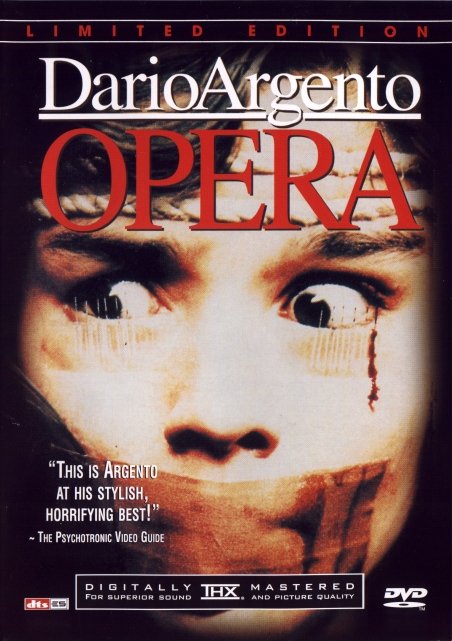
Dario Argento is one of the true greats in horror. And while his films usually produce mixed reactions, there’s no doubt that they’re disquieting products of a unique mind. Opera is not one of his best, but damn it’s got some fine horror in the middle of the morass.

Following the injury of the leading lady in a production of Verdi’s Macbeth, understudy soprano Betty (Cristina Marsillach) finds herself thrust into the lead role. But almost the second that she takes the stage, a masked man begins murdering the cast and crew, forcing Betty to watch by tying her up and propping her eyelids open with pins. The film interweaves numerous POV shots from the killer’s perspective as he pursues Betty in a lethal game of sadistic voyeurism with an operatic soundtrack.

The setting of an opera is tailor-made for Argento, a chance to indulge in the gaudy giallo that made his films famous. And the film’s murders are appropriately extreme and well-done, horrifying without being off-puttingThe use of the POV shots is especially unnerving, the camera jiggling and jerking and bringing us up close to acts of sadistic violence in a way that no other filmmaker has approximated.

Unfortunately, Opera suffers from a lack of coherent plot. While Argento’s favorite themes of sadism, murder, and repressed childhood memories abound, he can’t seem to bring them all together to a clear conclusion. He wastes the central conceit of the opera-which has so many possibilities-by focusing instead on Betty’s bizarre tendency to not report the crimes she’s seen committed. Where Suspiria gave us a plucky heroine plunged into a surreal nightmare world, Opera gives us a disconnected young woman who takes multiple murders in stride. The final act especially is tacked on, a twisty conclusion that actually reminded me of the breakdown at the end of Monty Python and the Holy Grail. While none of Argento’s films hang together in the perfect narrative sense, this one in particular just lacks any notion of coherency.

That being said, Opera does have a nightmarish quality that makes it an enjoyable, if lesser, example of Argento’s work. The violence is so gaudy that it’s almost funny. Imperfect and a lesser film than many an Argento, Opera has enough surreal, nightmarish horror to make for a delirious indulgence.

Bloody October: Beyond The Walls (2016)

Beyond The Walls (2016)

lisa-beyond-the-walls

It’s always exciting to discover an interesting and evocative horror story that manages to do something new with a potentially tired sub-genre. The French miniseries Beyond the Walls, directed by Herve Hadmar and now airing on AMC’s Shudder, is exactly that.

Beyond the Walls is a three-part miniseries about a lonely young French woman named Lisa (Veerle Baetens) who suddenly inherits the strange house across the street from her apartment building. A man’s body was recently discovered in the house, which hasn’t been opened for thirty years – no one seems to know who he is, or where he came from, and Lisa has no idea why she was made his heir. Detached from her life and her friends, Lisa moves into the derelict house, throwing down most of her stuff in a single room and wandering the place in search of things to do. One night, she hears weird noises coming from beyond the walls, and promptly smashes a hole in the plaster to investigate. She wanders down winding corridors and through broken doorways until she realizes, all too late, that she doesn’t know her way back. Stumbling upon Julien (Francois Deblock), another lost soul in the walls, Lisa tries to find her way out and evade the weird Others who threaten to keep her in the house forever.

Beyond the Walls interweaves some standard horror narratives into a new, complex mythology that the series manages to keep mysterious without sacrificing coherency. The story begins like a twisted Alice in Wonderland, with Lisa plunging into the house within the house largely because she’s curious about what lies beyond. But as the film proceeds and the layers of the house deepen into something darker and more meaningful, an interesting – if occasionally confusing – philosophy begins to emerge. What opens as a straight haunted house horror story becomes a truly complex narrative, replete with tenderness, desire, and the need to accept both guilt and redemption.

Aesthetically, Beyond the Walls occasionally relies too much on what are becoming common horror tropes: a man with the head of a pig, zombie-like creatures twisting their way down corridors, men with blackened eyes. The house is in a constant state of decay and acts as a labyrinthine metaphor for the complex interaction of guilt and love. Julien inscribes a map of the house on the walls of a hidden cellar, and writes cryptic symbols all over his body, as though reminding himself who and what he is as the house threatens to take more of him.

There’s an episodic, video-game feel to some of the sequences, as Lisa collects more stories, rules, and information that will enable her to escape the house, but these are all brought together in the final act. The final episode is intense and lyrical, drawing together the strands that have been slowly revealed over the course of the previous two into a moving and terrifying conclusion (one that features Geraldine Chaplin, no less). Although I watched it as three separate episodes, it’s really an extended film and should be experienced as such.

Beyond the Walls contains much, but explains very little – the meaning behind the house and the connections of the characters are not fully elucidated by the conclusion. Yet, it still satisfies. It’s a surprising story, mixing common themes together in a haunting melody that echoes long after it has ended.

Beyond The Walls is available exclusively on Shudder.

Bloody October: The Host (2006)

The Host (2006)

the-host-bong-joon-ho

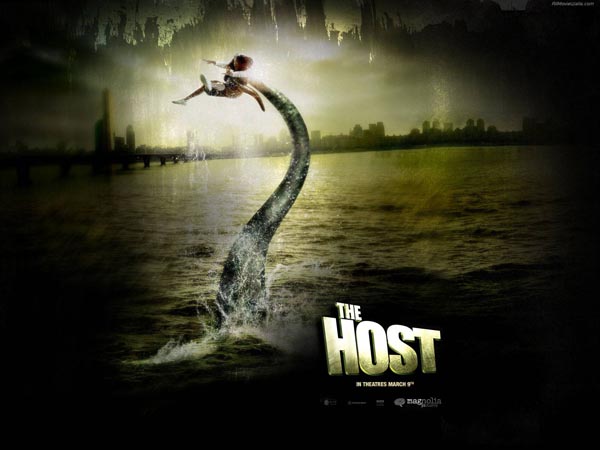
While a South Korean monster comedy might seem a contradiction in terms, The Host proves itself both unique and of its time, a mocking commentary on the depredations of toxic waste in South Korea and the government mistreatment of its own people.

The film opens with an American military scientist instructing his South Korean assistant to dump bottles of formaldehyde down the drain, where it will eventually flow in the Han River. Many years later, a deformed fish-monster, mutated from the toxic waste, crawls from the river and runs amok, killing and consuming. The film zeroes in on the Park family who run a noodle stand by the Han. The monster grabs Hyun-seo (Go Ah-sung) and drags her down into the river, while her horrified father Gang-du (Song Kang-hu) and grandfather Hee-bong (Byun Hee-bong) look on. But the nightmare is only beginning: Gang-du and his family must face off against government officials, the American military, and even Korean businessmen to escape from a government containment facility to search the sewers for Hyun-seo.

Rather than a straight monster movie for the 00s, The Host veers into comedic territory whenever it has the chance, mocking the incompetent government forces and increasingly dangerous attempts to eradicate the monster through biological warfare. Like many of the kaiju and Atomic Age monsters, The Host‘s monster is brought to life by scientific hubris and inattention – and was, in fact, inspired by an actual incident in 2000 when a Korean mortician working for the Americans admitted to dumping formaldehyde down a drain and poisoning the river. The efforts of the Park family to recover their daughter are met with absurd bureaucracy and manipulation, to the degree that the family actually resorts to criminals to escape a government facility. The heroes are all members of the underclass – shop owners, criminals, poor children, students, and the homeless – while government, military, and business forces (American and Korean) are at best sycophantic and at worst diabolical.

The Host is a deceptively complex monster movie. Monstrosity itself is neither good nor evil – the monster is simply an animal attempting to survive, and the Parks a family who don’t care about government bureaucracy and only want to rescue their child. Monster movie tropes are subverted and new ones introduced, making the film unpredictable and phenomenally entertaining. I only wish I spoke Korean.

The Host is happily available to watch on AMC’s Shudder streaming service.

(Incidentally, director Bong Joon-ho was also behind the spectacular Memories of Murder, a very different kind of horror film, more than worth checking out).

Bloody October: The Shallows (2016)

The Shallows (2016)

shallows

The Shallows is certainly the most contemporary film you’re going to see on my Bloody October list (and it probably wouldn’t be on here at all save for my roommate reminding me of its existence). The Shallows hit cinemas this past summer, shocking everyone by being a “decently scary shark” movie instead of a “Blake Lively in a bathing suit, with a shark” movie. And while it ain’t Jaws, I’d say that The Shallows is a damn enjoyable film.

The plot is lovely in its simplicity. Surfer-girl and medical student Nancy (Lively) goes to Mexico to decompress from the emotions following the death of her mother. Heading to a “secret beach,” she has a nice day of surfing and sun. But when she tries to catch her final wave back to shore, a shark knocks her from her surfboard and takes a bite out of her leg. Bleeding and succumbing to shock, Nancy manages to pull herself onto a jutting rock in the middle of the shallows. She’s trapped there, hunted by a shark with a taste for human flesh, with no rescue in sight.

The Shallows hits all the right notes for a menacing monster movie without banking on complicated twists or needless exposition. All of the necessary elements are introduced early on: Nancy goes to the beach alone because her sister was supposed to go with her and bailed at the last minute; her medical training is established long before it becomes a necessary plot point; the presence of fire corral and jellyfish, which will figure into her attempts at escape, are points clearly dropped in without making an issue out of them. The leanness of the plot means that the film can focus on the trials of Nancy, for awhile the only character on the screen.

Lively makes for a sympathetic protagonist, pulling The Shallows away from a gimmick-laden genre film to an honestly decent movie that understands its predictability and revels in it. Without descending to parody, the film manages to be tense and frightening. Neither Nancy nor the shark strain credulity with their abilities – the latter is just an animal looking for food, the former prey trying to escape. While the film does hint at some deeper meaning – Nancy questions what’s the point of fighting when it’s all going to end the same anyways – it thankfully shies away from giving too much importance to philosophical life lessons.

The weakest point of The Shallows is the CGI shark, which makes its appearance way too early and takes away some of the menace. One of the strengths of Jaws was not showing too much of an animatronic animal, allowing the unseen evil to suffice for horror. The Shallows’ shark appears several times, and at each appearance becomes less believable. It’s so obviously CGI that it dissipates the menace of an actual animal hunting an injured woman.

Despite a few shortcomings, The Shallows is an effective film, never trying to be more than it is. This is a movie about woman vs. shark, and it’s allowed to be just that.

Bloody October: Night of the Demon (1957)

Night of the Demon (1957)

nightofthedemonposter

There are surprisingly few film adaptations of M.R. James’s short stories – I assume because many of James’s stories are more creepy than they scary. His works are populated with professors, researchers, and antiquarians digging up weird myths, creepy factoids, and bizarre histories, but – unlike fellow acronym H.P. Lovecraft – very often that’s where the stories end. Night of the Demon, however, takes the basis of James’s short story “Casting the Runes” and builds a more complex narrative around it, with Dana Andrews in the professorial lead.

Andrews is John Holden, professional skeptic, who arrives in London to attend a convention with the purpose of exposing a devil cult run by former magician Dr. Karswell (Niall MacGinnis). When Holden arrives, he finds that one member of the convention, Professor Harrington (Maurice Denham), is already dead, while the others are troubled by weird reports surrounding his death. Enter Harrington’s niece Joanna (Peggy Cummins), not nearly as skeptical as Holden, who believes that her uncle was cursed by Karswell. When Karswell informs Holden that he must cease his investigations or be subject to the curse, Holden refuses. Karswell tells him told that he will have three days to live before the demon comes for him.

Night of the Demon is directed by Jacques Tourneur, perhaps best known for Cat People, another horror film that pits skepticism against belief. That dynamic is – a bit more annoyingly – on display in Night of the Demon, with Andrews playing a man so skeptical that he’d probably deny the existence of gravity because he can’t actually see an apparatus that produces it. As Joanna leads Holden around to seances and even scientific demonstrations in an attempt to convince him to take the curse seriously, she and the audience become increasingly exasperated. This reaches its height when Holden actually sees the demon begin to manifest in the woods, and subsequently concludes that it must be a magician’s trick.

Belief and skepticism fuel this film, with the usual arguments about mass hysteria and psychological experience becoming more diabolical as Karswell’s own fears are revealed. MacGinnis is delicious as the devil-bearded magician whose apparent faith in himself conceals a slightly hysterical nature. The film, in fact, is populated with excellent character actors of the period, including Athene Seyler as Mrs. Karswell (you’ll recognize her as one of the old ladies in the Avengers episode “Build a Better Mousetrap”), and Richard Leech (of “Traitor in Zebra”) as a police inspector.

I heard someone refer to this as “horror noir,” and it’s an apt description. As with Cat People, the use of chiaroscuro makes every-day scenes take on demonic significance. Hotel hallways stretch off into the dark unknown, POV shots create a wobbly world of demoniacal interference. The only blot on Night of the Demon’s escutcheon is the rather hokey appearance of the actual demon (which occurs within the first five minutes, so I promise I’m not spoiling anything). Part wolfman and part Muppet, the demon unfortunately removes a bit of the mystery and some of the argument of the film by externalizing the evil. I was reassured, however, to learn that this element was actually forced on Tourneur by producer Hal E. Chester, who inserted the monster over the objections of director, writer Charles Bennett, and Dana Andrews. I don’t have to blame Tourneur for this one, then.

Night of the Demon is a very enjoyable piece of British horror, straddling the divide between studio filmmaking of the 1950s and the more location-heavy horrors of the 1960s. If one ignores the hokey-ness of the actual demon and the occasional pedantry of Dana Andrews, it’s a film that stands right up there with Cat People. 

Bloody October: The Blair Witch Project (1999)

The Blair Witch Project (1999)

blair-witch-project

Every year in the run-up to Halloween, I watch as many horror movies as my little horror-loving brain can stand. I also attempt to rectify the oversights of past years and see some classics (cult or otherwise) that have somehow managed to escape notice. This year, the first up is The Blair Witch Project, the horror smash from 1999 that inaugurated our ongoing obsession with the found-footage sub-genre.

Contrary to popular belief, The Blair Witch Project is not the first found-footage horror film. That distinction goes to Cannibal Holocaust, the controversial Italian cannibal film made in 1980. But Blair Witch definitely established some of the hallmarks of the sub-genre that we now see today.

The story is pretty simple: three student filmmakers (Heather, Mike, and Josh) embark on a documentary trip into the woods near Burkittsville, Maryland to make a movie about the local “Blair Witch” legend. After they vanish, their footage is discovered and edited into the film we see. The film combines the faux documentary made by the students – including talking-head interviews with local residents to establish the Blair Witch legend – and the “real-life” footage the students take as they get lost in the woods, stalked by an unseen force.

The conceit of The Blair Witch Project is provocative in itself: the documentary footage feels very much like a student film project, with leading questions to residents and silly, posed scenes at cemeteries. As the students head into the woods, the documentary elements are slowly abandoned and the students become the subjects of their own work. They fight among themselves, breaking down psychologically as they wander off map and bizarre things begin to happen. Some of the film’s more iconic images, like stick-dolls hanging in the trees, are incredibly creepy, while others – the POV camera shots of trembling hikers – have become so iconic as to lose their power.

The Blair Witch Project is a weak film in many ways. While it has some good ideas, the conceit begins to strain credulity. Although some excuse is made for Heather’s obsession with continuing to film even in the direst of circumstances, it feels just like that: an excuse. As time goes on, the conceit itself began to pull me out of the film and remind me that these were not actually documentarians lost in the woods, but fiction-filmmakers pretending to be lost in the woods.

The found-footage concept is a difficult one to pull off for just that reason, and it’s to Blair Witch’s credit that they manage to keep it going as long as they do. Still, the shaking camera and heavy breathing does become wearing after a while. Rather than creating horrific tension, it becomes an exercise in trying to understand just what is going on. What am I supposed to be afraid of and why? After all, this is a fiction film; it does need some kind of coherent arc and coherent horror. Not being able to see the monster can often be terrifying, but The Blair Witch Project does not manage to create tension surrounding it.

I also struggled with understanding the actual legend behind the Blair Witch, and the film doesn’t take many pains to establish why certain elements are important. The dolls hanging in the trees, the piles of rocks, the weird abandoned house that makes up the film’s denouement…what are we really supposed to get from all this? I don’t insist that all elements of a film be explained – and a film like this has difficulty providing exposition without it coming off as an info drop – but there was still a sense that the characters knew more than they ever explain.

I’m glad that I have The Blair Witch Project under my belt – it’s a seminal horror film, and influenced quite a few of my favorite contemporary horror films. But it’s far less successful in 2016 than it was in 1999.

Bloody October: From Beyond (1986)

From Beyond (1986)

FROM-BEYOND

It just isn’t Halloween without H.P. Lovecraft. Director Stuart Gordon made his mark with the grossly brilliant Re-Animator, so he got the gang back together for From Beyond, a similarly-toned adaptation of Lovecraft that also succeeds in doing its own, disgusting thing.

From Beyond takes Lovecraft’s short story of the same name and runs with it. Dr. Edward Pretorius (Ted Sorel) creates a machine called the Resonator, meant to stimulate the pineal gland and allow people within the machine’s range to experience a new sixth sense. What it does, however, is reveal that the world around us is populated by weird, nasty beings cut off from the human world by a thin veil that the Resonator pierces. Pretorius is murdered and his assistant Crawford Tillinghast (Jeffrey Combs) driven almost mad with terror. But it doesn’t end there: Dr. Katherine McMichaels (Barbara Crampton) thinks that she can help Tillinghast by forcing him to relive his experience with the Resonator. Katherine, Tillinghast, and police officer Bubba Brownlee (Ken Foree) hole up in Pretorius’s old house and start the Resonator again. I think you can imagine what happens from there.

From Beyond is less tongue-in-cheek than Re-Animator; where the latter film created humor by going totally over the top, From Beyond is actually quite subdued in the early sections of the film, establishing a tone more realistic than its sister film. Unfortunately, this means that the latter sections, when the body horror really starts getting good, come off as more serious and the film itself more exploitative. Why we need an extended sequence with Barbara Crampton in bondage gear I do not know, but it’s there and it feels more like the director working out his own kinks than a viable addition to the structure of the movie.

That being said, From Beyond is probably one of the best straight adaptations of Lovecraft I’ve seen. The film develops Lovecraft’s underlying despair, the sense that there is a world beyond our own the very glimpse of which could drive people mad. As with Lovecraft, there is no chance for a happy ending here; just the hope that we might be able to close off our minds from the horror.

I wouldn’t suggest From Beyond to anyone not well-versed in Lovecraft lore (itself an acquired taste). But for any Lovecraft fan, it’s quite an experience. Just be sure to pop in your disc of Re-Animator afterwards.

Bloody October: Housebound (2014)

Housebound (2014)

housebound

I’m not sure what’s in the water over there around New Zealand and Australia, but they are producing some unique horror films right now. The Australian feature The Babadook was notable for its female-centric narrative punctuated by some truly terrifying sequences; now another film about haunted women comes from the neighboring country of New Zealand in the form of Housebound. 

Housebound focuses on Kylie (Morgana O’Reilly), a very inept felon captured while trying to rob an ATM. This is not her first offense, however, so the court sentences her to a fate worse than prison: house arrest at her mother (Rima Te Wiata) Miriam’s home. With a sensor fixed to her ankle so that she can’t leave the grounds without setting off an alarm, Kylie has to settle in to life with her mother and stepfather Graham (Ross Harper). At first Kylie is just sullen about the whole ordeal, but soon she learns that her mother persists in a long-standing belief that the house is haunted. When Kylie herself begins experiencing some rather paranormal phenomena, she enlists the help of Amos (Glen-Paul Waru), the security contractor who monitors her sensor and just so happens to be an amateur ghost hunter. As the pair begin to discover some sinister secrets about the house, Kylie becomes more convinced that it’s not all in her mind.

Housebound is that perfect blend of horror and comedy that makes films like Scream or Gremlins so enjoyable. The first half of the film is a legitimate haunted house story, complete with weird noises, looming figures, flashing lights, and strange events. The second half focuses more on Amos and Kylie’s attempts to discover the reason behind the haunting, leading them further afield – and Kylie into greater danger. But the whole film is underscored with wry humor: Kylie is a sarcastic, sullen young woman, her mother bright and bubbly and largely at peace with the fact that her house is plagued by a ghost. Most importantly, however, the plot all hangs together, right from the very beginning. The denouement is always a challenge for haunting films; there’s only so many way to resolve the story. Housebound actually gives a satisfying, believable conclusion to a very weird tale, bending genre tropes without ever breaking its own rules. The fact that this is all done by a first-time director and a relatively unknown cast just makes that much more surprising and exciting.

As an inveterate lover of haunted house movies, I can recommend Housebound with gusto. My one complaint is that there’s at least one twist that I did manage to predict, but that did nothing to damage my enjoyment of the film. It’s an entertaining ride from start to finish, rarely missing a beat, and bringing some proper scares along with it.

Bloody October: Salem’s Lot (1979)

Salem’s Lot (1979)

salems-lot-1979

It’s my favorite time of year! With autumn finally arriving in all its pumpkin-spice flavored glory, it’s time to settle down with some good, old-fashioned scares. First up is Salem’s Lot, the 1979 TV adaptation of Stephen King’s vampire novel starring every late-70s character actor ever, and James Mason.

Last year I made it exactly halfway through King’s novel before hitting what I usually call King’s “sadism wall.” Every single Stephen King novel I’ve ever read arrives at a point where King begins to take bizarre enjoyment out of torturing his characters. While I’m all for a bit of nasty horror, it’s something different when an author actually enjoys making his readers nauseous. So I abandoned Salem’s Lot as I had abandoned Pet Semetary and Misery before it – which is a shame, as I was really enjoying the scary vampires.

The 1979 Salem’s Lot could have done with a bit more of that sadism, though, because it’s one of the most aggressively un-scary movies I’ve ever seen. The tale centers on Ben Mears (David Soul), a writer who returns to his hometown of Salem’s Lot to work on a book about the creepy, potentially evil Marston House. He encounters the slightly weird small town inhabitants and strikes up a relationship with Susan (Bonnie Bedelia), the local schoolteacher. But something is wrong in Salem’s Lot and it all has to do with Mr. Straker (James Mason), an elderly gent who has moved into the Marston House with his business partner Mr. Barlow – a mysterious man who seems to go on a lot of business trips to Europe. After a little boy goes missing in the woods, deaths begin to pile up, leading Mears to suspect that there’s something vampiric going on at that evil old house.

Salem’s Lot cleaves very close to King’s book, with some important differences; what it doesn’t manage to adapt is the scares. Director Tobe Hooper spends much time setting up the small town life, but tension dissipates with every slightly weird or sudden cut from one scene to the next. Plot threads are introduced to be summarily discarded; other threads are picked up without the least bit of narrative consistency. What happened when the sheriff got ahold of Straker’s black coat? Where did the priest come from, and what happened to him? Can vampires be destroyed by fire? What actually did happen at the Marston House? What the hell is going on?! For a three-hour TV miniseries, there are too many unanswered questions and too many extended scenes in which nothing happens. The entire cast speaks in monotone – all except James Mason, the sole bright light in the murky mirage. Mason is having a great time snacking on the scenery and tossing veiled vampiric threats at everyone in sight. Thank God too, because otherwise I would never have sat through the damn film.

One thing I will say for Salem’s Lot: the vampires are proper vampires. There’s no sparkling, no gentleman counts, no erudite discussions about how we misunderstand the poor baby bloodsuckers. These are evil motherfuckers who want to drink blood and destroy civilization from the inside out. I miss those kinds of vampires.

Bloody October: Fright Night (1985)

Fright Night (1985)

fright_night_1985

Yet again, I am a big horror fan and yet, somehow, I have managed to miss seeing the original Fright Night before now. This has been properly rectified, and I am pleased to say that the hype was not misplaced.

Fright Night tells the story of Charley (William Ragsdale), a high school student who decides that he’d rather watch the weird neighbors next door than have sex with his girlfriend Amy (Amanda Bearse). Although I know that subsequent events were largely out of Charley’s control, there still seems to be a moral in that story: sex first, vampires later. What Charley does see that fateful night are his new neighbors moving a coffin into the basement; this, in addition to the appearance on the TV screen of Fright Night, a late-night spookfest featuring “vampire killer” Peter Vincent (Roddy McDowall), provokes Charley to believe that his neighbor might be a vampire. This is later confirmed by the arrival and subsequent disappearance of a prostitute, whom Charlie sees going into the house. When the prostitute later winds up dead, Charley’s suspicions are confirmed. Consulting his friend “Evil” Ed (Stephen Geoffreys), Charley learns about the best way to fight against vampires – but not before his mother has invited the offending creature into the house. And no wonder! Our vampire is dashing Jerry Dandridge (Chris Sarandon), by whom most of us would not object to being bitten. Will sexy vampire triumph over horny teenager? We’ll just have to wait and see!

fright-night-1

Fright Night makes excellent use of the vampire mythos we all know so well – and anyone who has ever watched a vampire movie, from Dracula to Dracula Untold, will recognize certain important rules that are made, subverted, and at times even broken. The film melds tradition with a unique story, as the vampire moves in next door and heads to dance clubs. Dandridge is a charming but wholly unsympathetic villain, avoiding at every turn the pitfalls of modern vampires that are just “misunderstood.” He’s not misunderstood – he’s an evil lord of the undead, taking sadistic pleasure in torturing Charley (whom no one will believe) and seducing fair young maidens. While I cannot avoid thinking of Chris Sarandon as Prince Humperdinck from The Princess Bride, he makes a credible vampire.

Roddy McDowall is the other major force at work here, channeling everyone from Peter Cushing to Vincent Price (Peter Vincent, anyone?), with a smattering of Elvira. He’s an actor playing a vampire killer, now faced with an actual vampire – and when he finally gets into the swing of things, it’s a pleasure to watch. The other actors in the group are a cut below McDowall’s hamming, the most obnoxious being Evil, who shouts and giggles like a demented Renfield to no apparent purpose. Charley and Amy are likably bland, as are most heroes and heroines in vampire stories.

My sole objection to Fright Night is a reveal nearing the end, where a rule hitherto established and accepted is bent and then broken with little to no explanation. Vampire movies depend upon their rules: if your vampire is repelled by crucifixes but not by garlic, can’t cast a reflection in glass but can in water, all well and good. But you don’t introduce a new and non-traditional rule at the eleventh hour and then fail to explain it. That’s just bad form.

But for that single caveat, Fright Night is a glorious love letter to the vampire genre and a classic in its own right. There are no sparkly vegetarian vamps here: these guys are strictly carnivores.

fright-night-1985-jerry-dandridge-charley-brewster-vampire-chris-sarandon-william-ragsdale