Wonderstruck (NYFF 2017)

Wonderstruck (2017)

Wonderstruck has all the trappings of a sweet and whimsical work of wonder. Based on the novel by Brian Selznick, from a screenplay written by the author himself, Todd Haynes’s film tells the story of two children from two different time periods, finding companionship and freedom in the environs of the Museum of Natural History in New York. In 1927, there is Rose (Millicent Simmonds), a deaf girl who runs away from her New Jersey home to find silent screen idol Lillian Mayhew (Julianne Moore). In 1977, there’s Ben (Oakes Fegley), who runs away from his home in Michigan following his mother’s death. The two stories are told in parallel, drawing comparisons to the situations of the two children, and especially highlighting their shared deafness. Rose was born deaf and her story is presented in black and white, as a sort of homage to silent film (but without any intertitles). Ben is struck deaf  not long after his mother’s death, though he seems to be able to sometimes hear himself, though not others? The pair are also connected to a book called Wonderstruck, a discussion of collecting and the building of museum collections that informs their journeys.

Wonderstruck has so much going for it. There are many excellent concepts: the idea of telling a deaf girl’s story as a silent film, the homage to collecting and museum culture, the connection between people across an expanse of fifty years. So it’s a shame that the film is such a spectacular mess. Wonderstruck manages to squander every single one of its concepts, visual, thematic, and aural, in the service of an ultimately superficial story that fails to hit any of the emotional markers it sets for itself. Ridden with clichés and overly predictable plot turns, it seems to believe that whimsy can replace emotion and that style can paper over a paucity of script that has all the sentimental honesty of a Hallmark card.

The messiness of the film seems to stem from a total lack of regard for basic things like plot structure and character development. There are moments of magical realism – like Ben’s sudden deafness following his discovery of the book – that simply don’t land, because the rest of the film does nothing to reinforce them. Ben’s journey to find his father in 1970s NYC is not only ill-advised, it’s insanely dangerous, and yet the boy seems to have no fear, not even the slightest bit of nervousness of uprooting himself and fleeing to a big city where he spends the first night sleeping in a bus terminal (despite being unable to hear or to understand sign language). Rose’s story fares a bit better, but Haynes’s insistence on filming in 35-negative anamorphic rather than attempting to approximate silent film aspect ratio and style makes the occasional use of silent film techniques incongruous. It’s as though Haynes only wanted to go partway with an interesting concept, and relied on the audience’s good faith without earning it.

In fact, the entirety of Wonderstruck is half-baked. There is not a concept followed through on, not a plot thread that isn’t left hanging, or resolved without fraying other threads beyond repair. The cast is strong, and apparently game, but they’re given little to work with, trying to mine a script for emotion that simply isn’t there. The conclusion – which is telegraphed early and often – is endless exposition meant to be moving. Visually, the film is all over the place, and completely anachronistic to its various time periods. Scenes go on for far too long – no, I do not see a deep emotional impact in watching a little boy walk around NYC in 1977 – and elements are introduced and then discarded with little regard for character or arc. Finally,Wonderstruck is so aggressively twee that it seems willing to beat itself to death with its own mediocre sentimentality.

I’m not quite sure what happened with Wonderstruck. I suspect that allowing Selznick to write the script based on his own book was a major miscalculation, for perhaps he had no ability to cut or streamline his own work. But Haynes is better than this. He’s perfectly capable of constructing a film with aesthetic and thematic depth without sacrificing either. How this particular film fails so abysmally is beyond me – and I’ve been trying to figure it out for some time.

Lady Bird (NYFF 2017)

Lady Bird (NYFF 2017)

Greta Gerwig’s directorial debut Lady Bird doesn’t feel like a first film. It’s more mature, more cinematically eloquent than that. Gerwig has already done most jobs in the film industry, including acting and writing and co-directing, so directing her first solo feature is hardly a big jump. But unlike many actors turned directors, there is not even a hint of self-indulgence in her film; not a glimmer of smugness or egotism. She simply tells the story, with intelligence and quirky humor and an awkwardness that can only approximate the mind and emotions of a teenage girl.

Saoirse Ronan is Christine “Lady Bird” MacPherson, a high school senior in Sacramento, where she attends a Catholic high school because, as her mother Marion (Laurie Metcalf) says, her elder brother Miguel (Jordan Rodrigues) “saw a kid stabbed” in the public school. The film encompasses all of Lady Bird’s senior year, as she shifts identities according to her social desires, spars with her mother and father (Tracy Letts), and hopes to get into a New York college, despite her mother’s constant admonition that they cannot afford to send her out of state. She hangs out with her best friend Julie (Beanie Feldstein), finds a tentative romance with Danny (Lucas Hedges), and flirts with social anarchism via Kyle (Timothee Chalamet).

But Lady Bird is more than the sum of its parts. I’ve tried – and failed – to think of another film that so sharply and humorously shows what it’s like to be a teenage girl. Lady Bird’s shifting identities reveal a combination of uncertainty and confidence, a desire to fit in and a desire to stand out. She tells everyone to call her Lady Bird – a nickname she gives herself and that is never explained – because she rejects the idea that her parents should be allowed to name her, and thus identify her. But she seems to have difficulty discovering her own identity, or accepting those parts of her life that are bequeathed to her by her family. Many of her friends and classmates are wealthy, and she dreams of living in the big houses on the “right side of the tracks,” where she goes to Thanksgiving with Danny. Her father’s job is in jeopardy, her mother works double shifts in the psychiatric ward of a local hospital, her brother and his girlfriend graduated from Berkeley but have to work at the grocery, but Lady Bird has ambitions to escape Sacramento for the excitement of New York City. She in love many different ideas, and not quite able to fulfill any of them. She’s not unaware of her family’s circumstances but, as with many children and teenagers, she doesn’t seem to understand just how difficult it is for them to get by.

Class and religion are not the focus of the film, yet they do drive much of the narrative, integrated as they are into the characters’ lives and desires. Lady Bird’s class consciousness is immature as yet, and she flirts with various performative identities as a way of standing out. There are moments of high hilarity and joy, as when she joins the school’s drama club for a Sondheim production, and moments where she’s petty and mean, rejecting good friends in order to be accepted by the cool kids. As basically predictable as these plot points are, Lady Bird transcends them by making them real. Yes, teenage girls really do try on identities in the same way they try on clothes. Yes, they do sometimes drop good friendships in order to find some social acceptance in bad ones. And, yes, they do fall for overly cool boys who are just douchebags. These things happen in real life and Lady Bird treats them with the seriousness and the humor that they demand, weaving them into a complex fabric that makes them an organic part of the characters’ lives.

There is also something so fundamentally believable about these characters. They are fully realized people whose lives we are allowed to watch. Yes, they are sometimes types, but they never clichéd. These are human beings, not symbols, and they live whole and sometimes tragic lives. Drama and comedy go hand in hand; there are moments of cringe-worthy humor and all-too-human meanness. While the film is often uproariously funny, it’s also poignant, and we are never asked to really laugh at the different people who come in and out of Lady Bird’s life. They are people, too. In this, Gerwig is already a mature director with a deep respect for her medium and the characters that permeate it.

The supporting cast here are excellent, but the stand out – the co-star, really – of the film is Laurie Metcalf, who deserves an Oscar and more for her multifaceted performance as Lady Bird’s mother Marion. It’s as much a movie about her as it is about Lady Bird. She’s trying to learn to let go, worried about her daughter’s future and intensely critical of her choices at the same time. She’s an acerbic character, but never shrill, never deliberately vicious, even if she is sometimes a bit cruel. There is one scene in particular nearing the end as the camera dwells on Metcalf’s face as it transforms with a tapestry of conflicting emotions, culminating in one of the most heartbreaking and beautiful moments in the film. I’ve always appreciated Metcalf as a comedienne, and now I truly appreciate her as an actress.

At another time, on a second or third or fourth watch, I’m sure I will be able to find something to criticize about Lady Bird. But right now, having ruminated on this film for a full day, there is little to nitpick. It’s a beautiful film, very funny, and profoundly moving. Gerwig the director can only improve from here, and that’s incredibly exciting.

Bloody October: Dark Water (2002)

Dark Water (2002)

Ah, yes. Another big old hole in my horror education is Asian Extreme, the umbrella term that usually encompasses horror films produced across the continent. Last year I had the pleasure of experiencing, for the first time, Hideo Nakata’s original Ring, so this year I went for one of Nakata’s slightly lesser known films: Dark Water, a 2002 movie about some terrifying plumbing problems.

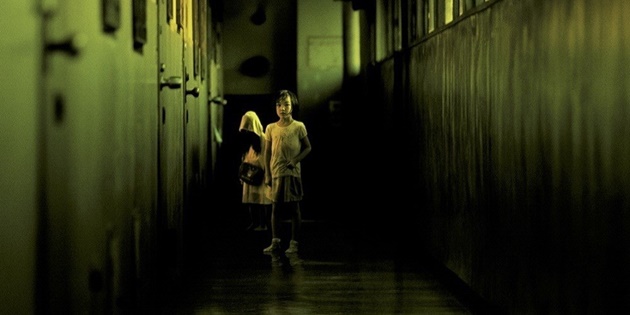
Dark Water follows Yoshimi Matsubara (Hitomi Kuroki), a woman battling for custody of her daughter Ikuko (Rio Kanno), who’s just going into kindergarten. In an effort to prove that she’s capable of caring for her child properly, Yoshimi moves into an apartment building right around the corner from Ikuko’s school. Things are a bit weird right from the start – the super is wholly uninterested in welcoming the pair to the building, and the manager seems very eager to unload the apartment. When Ikuko discovers a child’s bag on the roof of the building, Yoshimi freaks out, insisting that her daughter throw it out. Once they’ve moved in, Yoshimi notices a patch of water on the ceiling that seems to grow larger with every passing day. She complains, but the super won’t do anything about it, and the patch continues to grow, dripping water into the bedroom. The creepy bag continues to make appearances, along with the silhouette of a girl in the empty apartment just above them. Is Yoshimi going crazy or is there actually a ghost roaming the building?

Dark Water is a surprising film in many ways, not the least of them being that it’s more melancholic than terrifying. As we learn more about who the ghost might be, and why she’s wreaking such havoc with the water supply, what comes into focus is not a malevolent spirit coming after Yoshimi and her child, but a lost soul searching for something to cling to. The film plays with the notion of neglect passed down from generation to generation, infecting the entire society so that all wind up paying for their crime of simply doing nothing to help. Yoshimi’s one goal is to keep her daughter with her, but she’s strained to the breaking point, facing a husband she suspects is following her and a set of well-meaning but ultimately cold legal counsels. She has no friends and no real family – it’s implied that her mother more or less abandoned her. Her solace is Ikuko; her reason for continuing to work, and to suffer, is her daughter. That mother-love, intense and heartbreaking, is a thread that runs through the film.

This is a more restrained film than Ring. It’s also less overtly terrifying, relying more on the creation of atmosphere than on creepy creatures or jump scares. A melancholy pervades the film, focalized through Yoshimi, who cannot tell if she’s really seeing ghosts or just going mad. But her drive to understand and somehow expel the spirit, or whatever it is that haunts her, works in tandem with her desperation to keep her daughter. Dark Water becomes a movie about generational sacrifice to protect and give solace to children, including those that have been lost or abandoned.

Dark Water is a slow-burning, melancholic ghost story that never quite reaches the horrific heights of Ring, yet is not the less moving and horrifying for that. A lesser film, in some ways, but an interesting one nevertheless.

Call Me By Your Name (NYFF 2017)

Call Me By Your Name (NYFF 2017)

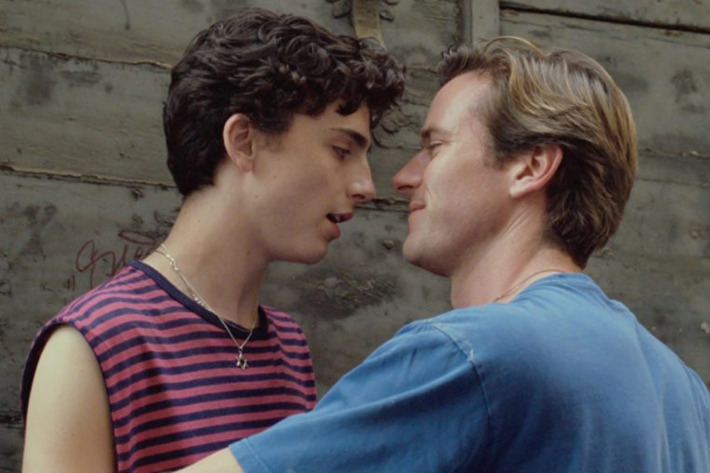
Undoubtedly one of the best films to come to the New York Film Festival this year is Luca Guadagnino’s Call Me By Your Name, a sun-drenched story of first love and loss based on the novel by Andre Aciman. While coming-of-age stories have a tendency to rely on clichés and easy answers, Call Me By Your Name treats a boy’s experience of love with a tenderness and sensuality unseen in many mainstream films, queer and straight alike.

Call Me By Your Name opens with the arrival of Oliver (Armie Hammer) in northern Italy, where he’s staying and working at a villa owned by Professor Perlman (Michael Stuhlberg), his wife Annella (Amira Casar), and their son, pianist Elio (Timothee Chalamet). Over the course of the season, Oliver and Elio develop an intense, occasionally antagonistic relationship that eventually becomes a summer romance. Their relationship grows, but is stymied by their own uncertainties, the difference in their ages, and Elio’s sexual awakening.

Anything that I can say about the plot of Call Me By Your Name would be inadequate, for this is not a film about plot. It’s about emotion, about youth and sexuality and love; about desire, and the confusion, elation, and anger that comes with it. The film focalizes everything through Elio – the camera gazes at Oliver as Elio does, turning the older man’s body into an object of sensual veneration. But the relationship is mixed with a heavy dose of antagonism, as Elio attempts to navigate the growing attraction and confused emotions that it brings. Oliver is a little distant and tends to head off on his own, even as Elio wants to draw closer to him. The pair engage in a tentative dance, punctuated by moments of friendship and deepening respect. Elio is already engaged in a flirtation with a local friend, but his connection with Oliver grows deeper the more time they spend together. The lyricism of the film works in tandem with the eroticism, never crossing over to exploitation or even discomfort. There’s never overt discussion of their relationship, never discussions about homosexuality or bisexuality, or even sexuality in general.  This is a story about first love shorn of clichés and avoiding simplistic solutions to a problem of the characters’ own making.

Hammer and Chalamet are brilliantly matched here – and if there’s any justice in the world, they’d both be nominated for an Oscar. Hammer’s Oliver is slightly aloof, trying to keep Elio at a distance, but constantly circling back to him, fascinated by the young man’s talent and intellect. Yet Oliver remains something of an enigmatic presence, like a fantasy that Elio has made real and will eventually have to give up. Chalamet likewise creates a character relatable and ultimately impenetrable – young, but with a deep intellectual curiosity and confidence. He’s a trifle awkward, not yet grown to manhood – watch the way that Elio struts, or attempts to, or dances, a little disconnected from his own body and not yet in control of it, while Oliver is himself fully embodied. Elio is a shifting force – smug but vulnerable, apparently confident and yet concerned about the way others think of him. Chalamet creates not only a believable character but one that is not always sympathetic, at times a snotty teenager and a vulnerable young man.

Of the supporting cast, Michael Stuhlberg is the standout as Elio’s father, an equally enigmatic – though far more centered – man as his son. Stuhlberg gets the best speech in the entire film, a moving tribute to a father’s love and understanding that forms the film’s moral and emotional core. In a film where answers are neither easy nor always required, this speech catalyzes so many of the emotions that run rampant across the screen, not trying to push them into boxes but rather allowing, encouraging, them to be free and accepted. Stuhlberg delivers his lines with an eloquence and a seriousness that moves and affects without seeking to control.

What all this comes to is that Call Me By Your Name is more than a worthwhile film; it’s a film with something profound to say about love, about desire, and about life itself. There are few works of art that so precisely capture the experience of being young and in love, of the awkwardness and the fear and the absolute joy of desiring and being desired. It deals with what is said and what isn’t said and the space in between. There’s no compartmentalizing, no coming out story, no moral about young love and growing up. It’s a beautiful and emotional story, personal and universal, one with a finite ending and infinite implications.

Bloody October: The Texas Chain Saw Massacre (1974)

The Texas Chain Saw Massacre (1974)

After the sad loss of Tobe Hooper this year, I realized that, much to my horror-watching shame, I had seen the mainstream film he’s best known for but not, alas, the film that cemented him in the pantheon of horror masters. I’ve avoided The Texas Chain Saw Massacre mostly because I am not a fan of chain saws or cannibalism or hillbilliesploitation. But could I truly call myself a horror fan if I didn’t at least make the attempt? So, out of respect for Mr. Hooper and his undoubted contribution to the genre, I finally filled this gap in my lexicon.

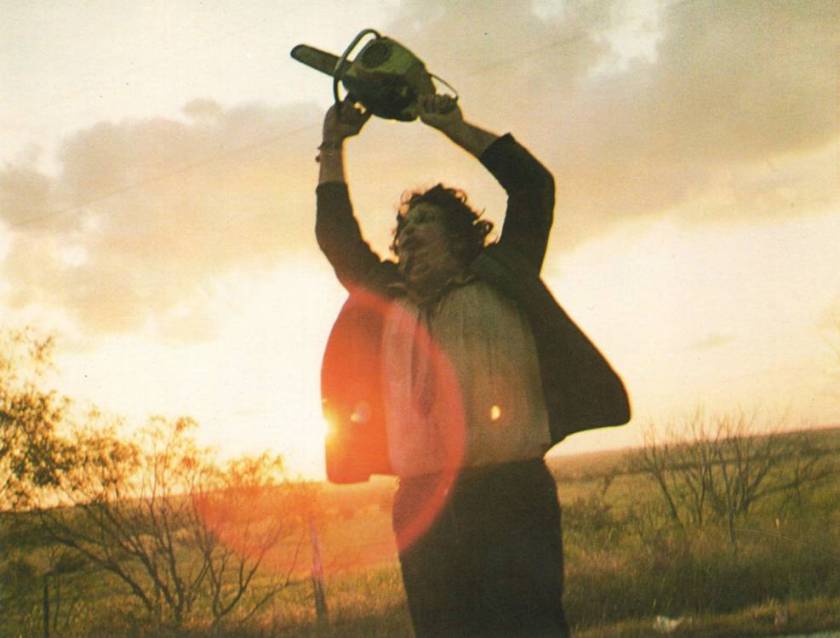
The Texas Chain Saw Massacre deals with five hippie-esque youths taking a ride through Texas one hot summer day. They’re there to investigate the possible vandalism of the grave of Sally (Marilyn Burns) and Franklin (Paul A. Partain) Hardesty’s grandfather. Assured that their grandfather still dead and buried, the group decide to visit the old home of the Hardestys. On the way, they pick up a creepy hitchhiker (Edwin Neal), who tells them about how his family used to work for the local slaughterhouse (foreshadowing!), and pass the local gas station/barbecue joint, where the proprietor (Jim Siedow) tells them there’s no gas to be had. The group arrives at the homestead and then make their way (severally) across to the neighboring house, where they think they might be able to barter for some gas to fill up their van. And it’s there, in a deceptively attractive farmhouse, that all hell breaks loose.

The Texas Chain Saw Massacre is nothing short of a feverish nightmare, right from the start. It opens with shots of desiccated corpses and just gets more profane from there. The Texas heat melts the screen, the five leads are plenty weird even before being pursued by cannibalistic hillbillies, and there are ample moments in which to shout “Don’t go in there!” Of course, they do go in there, because otherwise there wouldn’t be a film. Leatherface’s (Gunnar Hansen) introduction is shocking and explains why he’s right up there with Freddy Krueger, Jason Voorhees, and Michael Myers. For its extremely low-budget, the film is incredibly effective in the first two acts, ramping up the tension before unleashing a surprisingly bloodless hellfire on the viewer.

At the same time, I found it difficult, at least on first viewing, to really get into The Texas Chain Saw Massacre. It’s one of those films that was shocking in 1974, and has its own nightmarish brilliance even now. There are genuine scares, and several scenes that had me peeking through my fingers. But by the time we get to the final act, I was getting a little tired of hearing Sally scream and Leatherface squeal. There’s little explanation as to how this family of cannibals have managed to operate for as long as they evidently have, where the women are at, or why they, uh, began eating people in the first place. For once I wanted a little more exposition, or at least some dire warnings from townspeople that the hippies ignore. The brutality of the film is intense and effective, yes, but the deaths needed more build-up and, preferably, less screaming.

Yet I cannot discard The Texas Chain Saw Massacre. It’s an admirable work of horror and incredibly influential. Hooper’s undoubted talent as a director elevates it from pure schlock – it’s exploitative on many levels, but it’s also so artistically shot and constructed that it’s impossible to dismiss. Did I like it? No, not really. But I don’t think I’m really supposed to. I certainly don’t ever want to eat sausages again.

Bloody October: Ouija: Origin of Evil (2016)

Ouija: Origin of Evil (2016)

Ah! ‘Tis the most wonderful time of the year, as numerous people have already quipped on Twitter. Here in New York, the leaves are (gradually) changing and the nights are (very slowly) getting colder. It’s definitely Pumpkin Spice season at Trader Joe’s, even more so at Starbucks, and so that means that it’s time for some good (and some not-so-good) scary movies. This year my intention is to watch some new (to me) horror films, filling in the gaps of my horror vocab and perhaps adding a few new favorites. First up is a film that I unfortunately missed in theaters: Mike Flanagan’s throwback horror Ouija: Origin of Evil.

As its title suggests, this is actually a prequel, though I went into it not having seen the original 2014 Ouija. And this one stands on its own pretty well, although my later researches indicate that there’s quite a bit that might have been spoiled here if I’d seen the original. Ouija: Origin of Evil opens in 1967 Los Angeles, in the home of the Zanders, where mother Alice (Elizabeth Rasser), teenage daughter Paulina (Annalise Basso), and child Doris (Lulu Wilson) make a difficult living performing séances for people seeking to connect to spirits of the dearly departed. They’re charlatans, of course, but well-meaning ones – Alice says that they’re not really lying, just giving closure and hope to people who need it. Lina and Doris’s father died several years before, and Alice is beginning to have difficulty making ends meet. Doris is bullied at school, Lina is tired of feeling unmoored, and Alice has a minor crush on the school principal Father Tom Hogan (Henry Thomas). Enter the cursed board game, to first save the day and then make life really terrible. After playing Ouija with her friends one evening, Lina suggests that her mother incorporate it into their séance routine. Alice takes it to heart and buys the game, but soon Doris becomes obsessed with it, claiming that she can actually talk to people, including her father, on the other side.

Ouija: Origin of Evil hits some delicious scares, especially during the first two acts. This is a jump-scare film, trading on things glimpsed just out of the corner of the eye, figures lurking in doorways, and sheets slowly sliding off beds, with long pauses right before something slams into the back of your head. As the film progresses, the haunting ramps up, with Doris eventually going full Damien as her interaction with the other side becomes more pronounced. Lulu Wilson, by the way, acquits herself admirably in the evil child role. There’s one memorable scene between her and Lina’s boyfriend Michael (Parker Mack) that is as wonderfully creepy as anything in The Omen. The entire film pays generous homage to haunted house films of the 1970s – The Amityville HorrorThe Changeling, and Burnt Offerings come immediately to mind – but without depending on referentiality. This feels like a 70s horror film, down to the use of soundtrack and the un-ironic 70s styles.

The denouement is where the film falters, showing far too much of its hand all at once with a rather complex and repulsive revelation that includes, um, Nazis. I never find this kind of horror particularly scary – just nauseating. Yes, there’s rusted medical devices, a creepy backstory, and ghosts a-plenty, but somehow the ending just doesn’t land. The final scenes set up for the sequel – or the original – but they feel a bit perfunctory. The film is working too hard to clearly link to the original and would have been better served to be something that stood steadily on its own.

But Ouija: Origin of Evil is still one of the most solid mainstream entries into the genre that I’ve recently seen. While indie horror is on the rise, it’s good to see that mainstream horror films – polished and focus grouped – can still bring the scares. Watch it for the first two acts, if nothing else.


Un Beau Soleil Interieur (Let The Sun Shine In) (NYFF 2017)

Un Beau Soleil Interieur (Let The Sun Shine In) (2017)

Claire Denis’s latest film Un Beau Soleil Interieur (Let the Sun Shine In) makes the almost unbelievable proposal that Juliette Binoche just cannot find a halfway decent man in all of France. I mean, if she can’t, then there is no hope for anyone else. But this concept runs throughout the film, as Isabelle (Binoche) drifts in and out of relationships with a multitude of sub-par men, from the outright boorish to the inept and childish. The question becomes: are all men in France terrible, or is Isabelle just attracted to terrible men?

And the answer is: both. I’m being facetious, because Un Beau Soleil Interieur is a truly beautiful and realistic film that evades taking itself too seriously while speaking legitimate truths about the female condition. Isabelle attempts to navigate a series of relationships that fill her with a desperation to love, to be loved, and, more nebulously, to be satisfied. The film opens with one of her lovers actually asking (in the midst of rather dull love-making) if it always takes her this long to come. A gross question, to be sure, but one that hits at the heart of this film, which makes Isabelle’s dissatisfaction with all her relationships into an intriguing and multifaceted plot. While she sleeps with a number of men, the most intimate, sensual moments don’t involve sex at all. What Isabelle craves, and what she cannot find but in fleeting instances, is human connection. A brush of the hands, a quick kiss, an embrace, an intimate dance hold more weight for her than do the more mechanical and distant sex scenes.

There is also a healthy dose of humor mixed in to Isabelle’s dissatisfying existence. Her boorish lover Vincent (Xavier Beauvois) is so precise that he instructs the bartender exactly how to serve him whisky and soda, while another lover goes through all kinds of mental gymnastics to avoid committing to her. The humor is rarely at the expense of Isabelle, though -the men are almost uniformly ridiculous, attempting to justify themselves and their relationship with her by philosophy, by moralism, by didactic explanations of her life and her needs that she does not apparently share. Much of Isabelle’s discomfort is because she takes these things to heart, listening to men who either want something from her or want to avoid giving her something. She’s an everywoman, in that sense, angry but also internalizing what is being said by men around her. As they attempt to narrate themselves into her life or form her according to their needs and desires, she becomes unmoored, further removed from herself and her own desires.

Binoche once again proves that she’s one of the finest actresses working today, drawing out the comedy of her character’s situation without sacrificing emotional honesty or making Isabelle ridiculous. There is something refreshing in seeing an actress, and a film, unafraid to show women as they actually are, without histrionics or fabricated drama. Binoche’s co-stars are a shifting roster of terrible men, all of them terrible in their own ways, and all acquitting themselves admirably in their roles (though none stick around for long). The center is always her, bright, desperate, and relatable, longing for love and sabotaging herself in the process.

The final scene of the film indicates a potential future for Isabelle as she extricates herself from some of her more damaging relationships and seeks out happiness within herself. My French is a tad rusty, but I’m fairly positive that “un beau soleil interieur” actually translates to “a beautiful sun within/inside.” This has some significance in light of the way the phrase is used within the film, nearing the end. It acts as an admonition that Isabelle find some kind of sunlight within herself, rather than basking in the reflected glow of other people. But because of who utters it, and in what context, it can be read as another masculine attempt to rewrite Isabelle into his own narrative, to inject his opinions, and himself, into her life. At the same time, Isabelle finally begins to smile, aware of what is happening but also taking the advice to heart. It’s humorous, hopeful, and ambiguous ending.

Un Beau Soleil Interieur will likely be a minor film at NYFF this year, for it has no grandiose performances or “important” statements about the world. It’s a slice of one woman’s life, intensely personal and individual while also speaking truths about modern human relationships. It’s the best kind of art there is: personal and universal.

Un Beau Soleil Interieur (Let the Sun Shine In) is now showing at NYFF 2017.

Madame Hyde (Mrs. Hyde) (NYFF 2017)

Madame Hyde (Mrs. Hyde) (2017)

There have been any number of adaptations of The Strange Case Dr. Jekyll and Mr. Hyde over the years, veering between Freudian analysis and Social Darwinism in the 1931 and 1941 films, to the more subversive versions involving sexual mores and gender-bending in I, Monster and Hammer Studios’ Dr. Jekyll and Sister Hyde. And no wonder: Stevenson’s novel raises questions about human psychosis and monstrosity, the desire to do “evil” in a way that escapes detection or even personal morality. So it’s a reasonable story to inspire Serge Bozon’s Madame Hyde, a story about a science teacher at a technical school who obtains some very strange powers.

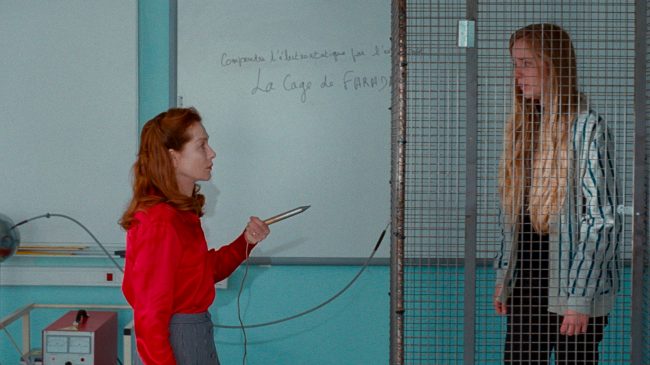
Madame Hyde stars Isabelle Huppert as Mrs. Gequil, a timid woman who teaches physics to underperforming students at a technical high school. She’s unable to control her classroom, harassed by students and mocked by other teachers and the principal (Romain Duris, mugging for the camera). The only person who appreciates her at all is her husband Pierre (Jose Garcia), and the only place where she seems to find any solace is her technical laboratory, where she works on unspecified experiments involving electricity. One night, lightning strikes her laboratory and alters Mrs. Gequil forever, providing her with a “spark” that eventually transforms her into a glowing woman of fire. She begins to control her classroom and challenge her students, especially her most problematic pupil Malik (Adda Senani), slowly transforming into the teacher she has always wanted to be.

Madame Hyde is a difficult film, for it shifts wildly in tone and subject and, at times, seems to be trying to make a point without making it in a coherent manner. The ideas behind it are solid enough, though they’ve been done before, but the occasional bouts of wry comedy and absurdism conflict with the serious philosophical underpinnings. What has happened to Mrs. Gequil and how it transforms her isn’t terribly clear, but it’s a lack of clarity that indicates a simultaneous lack of direction beneath it. This isn’t a film that begs to be understood or to challenge the viewer, but that rather seems to be concealing its own lack of coherence through sudden cuts and jumps in narrative. I was willing to go with Madame Hyde for much of its runtime, but at some point I realized that it wasn’t going to provide any solid resolution. There’s certainly some commentary going on here – Mrs. Gequil is faced with a group of capable but impoverished students who remain intellectually unchallenged by their work. All the teachers and officials are white, most of the students Arabic and Algerian and living in housing projects, but if there’s a social commentary at work here, I can’t figure it out. Those elements, so rich in themselves, are never really explored. Instead we have random moments that include charring two dogs, Mrs. Gequil ripping her shirt off, and an extended shot of Mr. Gequil sadly watching his wife nearing the end of the film. What is the goal? What is the point?

Unsurprisingly, Huppert is (literally) luminous, her shifts in personality believable and moving. She commands the screen in every scene, and is quite well matched by Senani’s Malik, who becomes Mrs. Gequil’s biggest challenge, grappling with his evident intellectual curiosity, the limitations brought on by a disability, and his anger at his academic and social situation. One of the best scenes of the film is between the two of them, alone in a lab, as Mrs. Gequil finally learns how to teach her most intelligent and recalcitrant student by delving into a deceptively simple physics problem that she asks him to solve not by theoretics and equations, but by practical logic. The conflict and chemistry between them keeps the film afloat, and stops it from being a total wash. But it’s still not enough.

Madame Hyde has so many good elements that it’s hard to dismiss it out of hand. It doesn’t work; it’s messy and lacks clarity, but there’s still something there at the core, if only Bozon’s script could get at it. It’s a frustrating film, failing to make enough of the undoubted talent of its cast, the depth of its philosophy, and the quirks of its use of adaptation. The film never quite works, yet I still desperately want it to.

Madame Hyde is currently at NYFF 2017.

Professor Marston And The Wonder Women (2017)

Professor Marston and the Wonder Women (2017)

It seems that 2017 is the year of Wonder Woman. With the spectacular success of Patty Jenkins’s version of the iconic superhero, now seems as good a time as ever to examine the past and future of the character, what she means to female representation onscreen, and to feminism at large. To this end, Angela Robinson’s Professor Marston and the Wonder Women goes back to the man who created Diana Prince, and the women who inspired her. It also successfully gives the lie to any dude-bro masturbatory fantasies that claim that Wonder Woman is, by design, a thing to be objectified, ogled, and fetishized. There is so much more to her, and so much more to those behind her creation.

Robinson’s film deals in far more detail with Marston’s personal life than it does with the actual creation and popularization of the character that made him famous. The film opens with the burning of Wonder Woman comics as Marston (Luke Evans) faces off against a “decency panel,” led by Josette Frank (Connie Britton). As Marston defends his creation against accusations of perversion, the film flashes back to the late 1920s. Marston is employed at Harvard and teaching classes in psychology at sister college Radcliffe alongside his wife Elizabeth (Rebecca Hall). The pair have an intense, combative relationship, made more intense by Marston’s immediate attraction to his new student Olive (Bella Heathcote), the niece of Margaret Sanger, who becomes the couple’s lab assistant. Over the course of a fraught relationship, the trio wind up falling in love, exploring BDSM, and constructing an unorthodox and loving home life.

Olive at first appears to be a wide-eyed ingenue, excited to be working with a well-known pair of academics, but gradually becomes essential to the lives of the Marstons. Marston and Elizabeth have invented a version of the lie-detector, but it’s only with Olive that they are able to discover a way to get a base reading. They treat her almost as a guinea pig, observing her interactions with men, with her sorority sisters, and with themselves as a way of studying human psychology and giving credence to DISC theory (a concept involving the interplay of dominance, inducement, submission, and compliance). But soon Olive enforces her own right to have a voice in the relationship, and the pattern of sexual attraction and jealousy develops as it becomes increasingly clear that the three of them have fallen in love with one another.

Professor Marston and the Wonder Women manages to depict the depth and complexity of a polyamorous relationship without making it into a puerile act of titillation. Much of this has to do with the gaze of the camera, which eroticizes all three of the leads without making them at all voyeuristic. The gaze here has never been more feminine, rejecting voyeurism for engaged pleasure–yes, even in the BDSM scenes. Robinson’s camera avoids titillating glimpses of breasts or asses, instead dwelling on the complexity of emotions being exchanged among three very different but complementary people. None of this is told exclusively from Marston’s perspective, and there is never the sense that the two women are performing roles for his pleasure. They are all performing for each other’s pleasure, changing sexual and gender roles as it suits them at the time, indulging bondage fantasies that echo the Marstons’ psychological theories.

There are so many places where this film might have stumbled, so many opportunities of turning Marston into a letch, Elizabeth into a harridan, or Olive into a seductive ingenue, sacrificing character for objectification. But the strength of the script, the trenchant gaze of Robinson’s camera, and the performances of the actors means that there is no moment left untapped of potential. Professor Marston creates believable characters enmeshed in a set of contradictory emotions and desires that are difficult to navigate without harming others, yet likewise cannot be denied. Rebecca Hall is the standout, mining her acerbic characterization of Elizabeth for depth of feeling, a woman accustomed to power and domination thrown through a loop by her growing love for Olive and her continued love for Marston.

Wonder Woman doesn’t actually come into the film until quite late in the proceedings, although comic book imagery pops up every once in a while to indicate where Marston will eventually get his character from. The basic idea is that Wonder Woman/Diana Prince is an amalgam of Olive and Elizabeth, what Marston considers to be the perfect woman. Yet there is never a sense that he has simply mined them for their characteristics to construct a fantasy. Rather he wants to put everything that they are into her, to express through her the heights to which women can and should aspire. There’s a healthy dose of sexual “perversion” here, of course – much of it coming from the trio’s increasing interest in bondage – but that is less important to Wonder Woman than her complex relationship to female power and, most importantly, love.

Professor Marston and the Wonder Women stumbles in places, with pacing and plot beginning to lag in the second half of the film. Having a set up a dynamic set of relationships, Robinson doesn’t seem quite certain what to do to bring together the disparate elements that are supposed to inform Wonder Woman’s creation. Marston, Elizabeth, and Olive create their own polyamorous utopia within modern society, but the push and pull of the relationships, especially when social mores threaten, begins to suffer from emotional whiplash that grows more annoying than heartbreaking at times. The use of the decency panel as a sort of interstitial narration feels like a forced reminder that this whole story is really about the creation of Wonder Woman, even though that’s probably the least interesting element of the narrative.

But for its momentary weaknesses, Professor Marston and the Wonder Women has so much to recommend it that it’s hard to fault it for occasionally lacking in proper pace or a somewhat confusing plot arc. At the heart of the narrative is a story about three people deeply in love with each other, attempting to navigate fluid sexual and gender roles at a time when those roles were rigidly, even violently, enforced. That so few films are able to depict human sexuality with such eroticism without objectification speaks more to the failings of modern cinema than anything else. Professor Marston and the Wonder Women is unique of its kind. God, how I wish there were more films like it.

Swann In Love (1984)

Swann in Love (1984)

Whether it ultimately works as a film or not, props must be given to director Volker Schlondorff for even attempting an adaptation of a portion of Marcel Proust’s Swann’s Way, the first volume of the French author’s endless epic In Search of Lost Time. Schlondorff’s film specifically deals with the romance between aesthete Charles Swann and his mistress Odette de Crecy, the story of which only takes up about half of Proust’s first volume. Which is just as well – Swann in Love is the most plot-driven part of the book, with the most action and intense emotions. How to translate Proust’s languid sentences to the cinematic medium is another challenge, and one which Schlondorff but imperfectly captures.

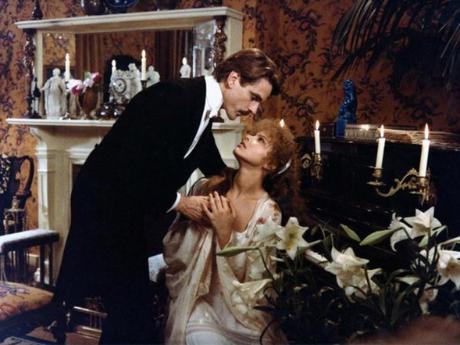
Jeremy Irons is Charles Swann, an aesthete bachelor in fin-de-siecle France who spends his days going to elegant parties, hobnobbing with aristocrats, and pining for his mistress Odette (Ornella Muti). Odette is a source of intense suffering for Swann, who experiences bouts of jealousy over her relationships with everyone else (some justified, some not) to the degree that he follows her to parties and the opera, and even heads to brothels to inquire of her previous life. It’s not so much that Swann is horrified by Odette’s past – there’s no question that she has had a multitude of lovers, male and female – but rather wants to be certain what her past even was, so that he can understand it and, in some way, claim it as a part of himself. He refuses to take her assurances as fact, yet cannot find solid ground to cling to, pursuing an image rather than a woman. Swann wants to define Odette only in relation to himself, driving sudden wedges between them, then torturing himself with thoughts of what might have been.

Swann’s own social position further complicates his relationship with Odette. His drive to be accepted means that he can’t really marry her without jeopardizing his friendships with people like the Duchess of Guermantes (Fanny Ardant, underused). Swann is himself Jewish, as remarked by several characters at the start of the film, putting a further blot on his social escutcheon. Swann’s wobbly social position is the undercurrent that runs through the film, as he’s apparently rejected by Odette’s “lower” friends the Verdurins, while not quite of the proper social class to be more than a hanger-on of the Guermantes.

Jeremy Irons captures Swann’s haunted, ephemeral beauty and obsessive nature, as he pursues Odette with a condescension and a passion both maddening and erotic. Equally strong, but underused, is Alain Delon, applying his waning beauty to a curiously sympathetic performance as the Baron de Charlus, an aging dandy whose world-wise cynicism and pursuit of aesthetic pleasures conceals a basically decent nature. Odette, meanwhile, is a venal and occasionally annoying young woman and the film conjures little sympathy for her relationship with a nearly violently obsessive man, either in script or in Muti’s performance. So much time and energy is spent on focalizing through Swann that the basics of his relationship with Odette – and the essential unfairness with which he treats her – become obscured within his obsession.

Like its main character, Swann in Love is a deeply aesthetic film, in love with the precise rendering of fin-de-siecle France and the placement of the social classes within it. Also like its main character, finding the soul beneath the aestheticism can be difficult, and Schlondorff’s camera, on occasion, seems to avoid humanizing the characters for fear of tainting their superficial perfection. The occasional flights of cinematic fancy, like the use of voiceover to render Swann’s ever-changing desires about Odette, seem to be attempts to depict the ephemeral nature of time and memory that was such a large part of Proust’s project. But because the central story is told in a fairly straight-forward manner, these momentary departures fall flat.

Swann in Love is an interesting film, very pretty to look at but without any desire to bring out the soul of its characters. It is inadequate as an adaptation – as I think just about any attempt at faithfully adapting Proust would be – but fulfills a good bit of its promise as a piece of cinema, deeply visual and pleasurable in its images. Fascinating, superficial, and ephemeral, it does manage to capture something of a lost world, a time and a place and a set of people who will eventually fade into memories before they vanish altogether.