No Orchids for Miss Blandish (1948)

No Orchids for Miss Blandish (1948)

No Orchids for Miss Blandish is based on a book of the same title by James Hadley Chase – a notorious 1939 crime novel that the writer supposedly composed on a bet to “outdo The Postman Always Rings Twice.” Despite the controversy surrounding its depiction of sex, violence, and general nastiness, the novel was a major success and later became a stage play. It was finally transformed into this film, which is a study in all the worst aspects of film noir and indulges its enjoyment of sex, sadism, and melodrama to a degree that’s still kind of shocking.

Linden Travers is Miss Blandish, a bored heiress about to marry an equally boring man who is summarily knocked off during a simple jewel robbery. After bludgeoning the bridegroom to death, one of the robbers takes Miss Blandish hostage, intending to ransom her back to her father. He’s murdered in his turn, this time by the Grisson gang, headed by Slim Grisson (Jack La Rue) and Ma (Lilli Monar), and Miss Blandish once again changes hands. It doesn’t take long for her to fall for Slim, however, as he offers her a life of excitement and cruelty that her regular world was sorely lacking.

On the face of it, the story is pretty bog standard for a film noir, but this film milks every lurid detail, doubling down on the gangster patter – while a British film, some of the cast are American and Canadian, and it makes for a weird and somewhat jarring combination of American accents and attempts at American accents. No one is particularly comfortable with the words they have to speak, though, as the actors appear to be doing game impressions of Bogart, John Garfield, Edward G. Robinson, and Rita Hayworth. But even Bogie couldn’t have made much out of this script, which insists on tossing in every single gangster cliche in the book, and inventing a few of its own. No one is nice, not even Miss Blandish, who is a combination of – ahem – bland and heartless. The lack of anyone to root for, or even anyone to enjoy watching, makes the film feel that much colder and meaner, exacerbated by its continued insistence of depicting coercive sex and violence with a clarity that somehow made it past the censors.

The frank depiction of pretty coercive sexuality is the film’s most cringeworthy theme. Miss Blandish’s first kidnapper attempts to rape her, only interrupted by the arrival of Slim; it’s implied that Slim also has sex with her, though the film subsumes that slightly and indicates in a few lines that she kind of wanted it.  A nightclub singer has an extensive song entitled “When He Got It, Did He Want It?”, which proves to be a celebration of famous rapes. The newspaperman Flyn (Hugh McDermott) later breaks into the singer’s room, holds her at gunpoint, then promptly sleeps with her. Miss Blandish’s excitement with Slim seems to be mostly about him being so violent and dangerous, which could have proved an interesting amour fou, if there was any heat between them. But while Travers is a decent enough actress, La Rue is a bargain basement Humphrey Bogart, and his shift from ruthless killer to tender lover makes very little sense.

The ham-fistedness of No Orchids for Miss Blandish does provide a kind of perverse enjoyment, however. The shifts in tone are wild – one minute we’re watching gangsters summarily execute each other in the most brutal manner possible, the next we’re treated to our lovers making eyes at each other in a forest. There are some odd attempts at humor, like the scene where two members of the gang debate the merits of Italian cuisine, or that horrifying rape song. The sheer dedication to nastiness is fascinating on its own, as we watch one gangster smash a bottle in a guy’s face, or stomp a man’s head in. This film was banned in some British territories, denounced by Bishop of London, and roundly condemned by critics. Unsurprisingly, it was commercially successful.

I stumbled across this film because I remembered learning about the controversy surrounding the book during a crime fiction class. While I can’t claim that my life has been materially improved by watching No Orchids for Miss Blandish, it was certainly a unique experience. At least we learned that the Brits really shouldn’t try to make American films.

No Orchids for Miss Blandish is available to stream on FilmStruck.

Outrage (1950)

Outrage (1950)

Between 1949 and 1953, actress/writer/director/producer/general badass Ida Lupino directed five feature films, making her the most prolific female director of her era. She was only the second woman to join the DGA, and she learned to direct during one of her extensive suspensions from Warner Brothers, where she wandered the backlots and watched directors at work. She was vocal about the need for more female directors, for directors to take on more taboo and out of the way subjects. And, like so many of her fellow female stars, she was far smarter and more talented than she was probably ever given credit for.

Outrage was her third film as a director, and in it we can see most clearly the development of the talent that she would hone to perfection with The Hitch-Hiker and The Bigamist. And like those films, Lupino takes on a deeply taboo subject with an unforgiving clarity of vision that transcends the film’s somewhat pat third act.

Outrage deals with rape and sexual assault with explicit attention (for the era) and a degree of sympathy that’s as refreshing as it is surprising. The film focalizes itself not through the pain suffered by those surrounding the victim, not through the search for the attacker or the machinations of the family, but through the victim almost exclusively. Lupino makes use of multiple POV shots to drive home the audience’s sympathy with the violated woman, her sense of fear and shame and undirected anger, and how she finds a way to cope with the trauma of her assault.

Ann Walton (Mala Powers) is a young woman working as a bookkeeper, with a boyfriend who becomes her fiance (Robert Owens), a loving family, and a normal, middle-class future. As she leaves work late one night, she’s followed and then attacked by the man who works the concession stand near her workplace, and who we see early on hitting on her with no response. Ann runs and then blacks out before the attack; she can’t recall the face of the man, remembering only the scar on his neck. Her sense of shame around her family, her fiance, and her fellow workers eventually drives her out of town, fleeing to the countryside where she finds a kind of solace with the help of Rev. Bruce Ferguson (Tod Andrews). But her assault continues to haunt her, even as she tries to repress it, and her terror soon takes a darker turn.

Outrage has so many interesting elements that it’s difficult to pick up on a single one. Lupino treats the subject with sympathy, but also photographs it as a film noir. When Ann flees from her hometown, she does so with the air of a criminal – she hides her face when her disappearance is talked about on the radio, and begins to act guilty when she’s introduced to a local sheriff. She changes her name, and declines to talk about where she came from or why she left. All of this is part of the recognizable tropes of film noir – the man or woman on the run. But Ann is the victim, not the criminal; her shame was something that was forced upon her. The film takes pains to avoid placing any blame on Ann for her assault. She hardly knows the man who attacks her; her greatest crime is turning him down, and even then it’s a rejection that carries very little weight. Like many women, Ann is catcalled and whistled at and she generally ignores it or takes it in stride as a simple fact of being female. Up to her assault, Ann is treated as an average woman, without any particular neuroses or anxieties; the sort of woman about to marry a long-time boyfriend, with a family that loves her and a good job that she enjoys. She is, in other words, a normal girl for the 1950s.

This act of rendering a victimized woman completely sympathetic, avoiding even the shadow of blame attached to her, drives several points home. The terror of the assault is that it really can happen to anyone; Ann’s greatest error is an understandable fear that slowly morphs into panic, which in turn makes her make bad decisions and errors as she runs. In Lupino’s work, victimized women are not “asking for it;” they are not “fallen women,” they do not “lead men on.” They are normal, average women victimized not just by a single man, but by the expectations and taboos of the culture surrounding them.

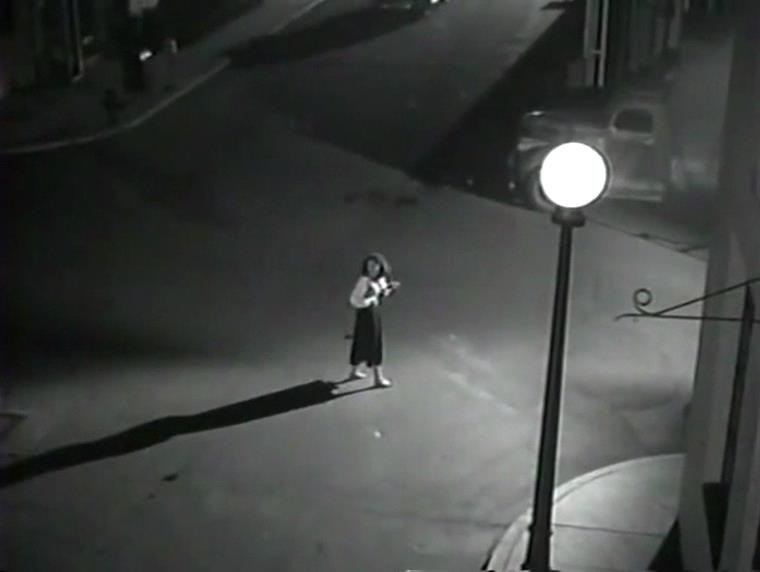
The film’s strongest and most terrifying scene is the lead up to the assault, as Ann’s eventual rapist pursues her through an empty urban landscape. Ann’s walk through the empty streets and industrial yards is at first relaxed; it’s quite obvious that she has done this often, and she’s comfortable in her surroundings. As her attacker pursues her, occasionally whistling or calling out, her panic develops. She’s clearly aware that she’s alone, isolated, and under threat. Lupino’s camera draws away from her into overhead shots combined with medium close-ups, emphasizing her isolation. Belatedly, Ann begins to do what most women are instructed to do in such situations – she heads for a cab, that quickly pulls away from her, and then begins banging on windows, calling for help. But no help comes. Ann finally resorts to hiding from her would-be attacker, but fails at the last to escape him. This combination of panic and an attempt at clear-headedness is believable – as any woman who has ever been followed by a man will tell you – and reminds us that most women who don’t actually fight their rapists are not actually consenting. Ann is terrified, she runs, she finally blacks out to defend her mind from the attack. It’s heart-breaking partially because the story is all too familiar.

As the film goes on, Lupino develops the terror that men can be for women, including ones that technically “mean no harm.” Ann’s fiance Jim at one point chases and grabs her, trying to convince her that they should run away and get married barely a week after her assault. Late in the third act, another man attempts to kiss Ann, despite her repeated denials. Ann’s horror at men and the prospect of being married, is part of her trauma, and the film doesn’t blame her for it. The men that she’s able to connect to following her assault are the ones like Bruce, who do not obviously view her as sexual, and who do not attempt to touch or coerce her.

Outrage’s greatest weakness is in providing a kind of solution to Ann’s trauma via Bruce, a reverend and a former Army chaplain who attempts to break through Ann’s reticence with a recounting of his own traumatic experience. The film relies on a pat combination of psychological and religious salvation that jars a bit with the earlier, noir-ish tone. In this, however, Outrage shows its generation more than anything. There are really only two solutions for Ann in the 1950s – salvation, or condemnation, and there was every possibility that the film would err on the more recognizable side of the “fallen woman” trope and plunge Ann into a life of vice or prostitution. But Lupino does have a defter hand than that. If the film somewhat shirks in its otherwise clear depiction of rape culture in the final act – including a decidedly post-war explanation of the attacker’s warped psychology – I think it can be forgiven.

Outrage is very much a film of its time, but it renders a sympathetic, complex understanding of the aftermath of rape, told through a woman’s eyes and with a woman’s camera. While Lupino would make technically better films, she probably never made a more significant one.

Blood Sisters (Short) (Final Girls Berlin 2018)

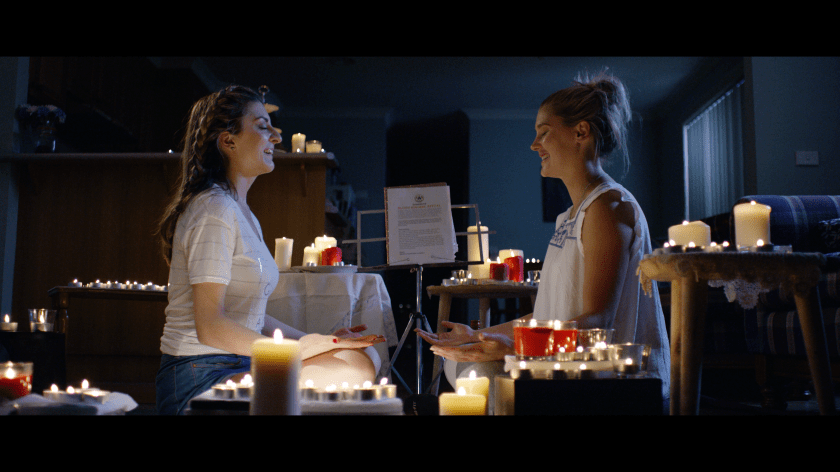
Also showing in the “Dark Gatherings” shorts block is Blood Sisters, a humorous entry from director Caitlin Koller that entertains, even if it doesn’t completely stick the ending. Two young women spend an evening doing what all young women do: watching movies, drinking vodka, and performing blood rituals. The pair cut each other’s hands and chant incantations to become “blood sisters,” but soon find that things have gone wrong when they won’t stop bleeding.

The humor is strong here, as the two girls debate going to the doctor and attempt to fix things themselves. The punctuation of horror with laughs works well, for the most part, and undercuts the scares without totally relaxing the tension. The final few minutes, however, don’t really pay off, as the girls come up with an idea to stop the bleeding. It feels like the film needs to be five minutes longer to develop their reasoning, rather than jumping from one event to the next without a clear connection. At the same time, though, it’s a well-made short, with good performances from the two women, and a sharp script. It just needs to be a bit longer.

Blood Sisters will show in the “Dark Gatherings” shorts block of Final Girls Berlin on February 2.

What Metal Girls Are Into (Short)(Final Girls Berlin 2018)

I’ve now remotely covered Final Girls Berlin for two years, and each year I’ve found one short especially that stands out to me. Last year it was Goblin Baby, and this year…it’s What Metal Girls Are Into. The first was because it was an intriguing and sharply realized film (that still needs to be a full length feature), and the second is because, in this time of #MeToo, it is deeply satisfying.

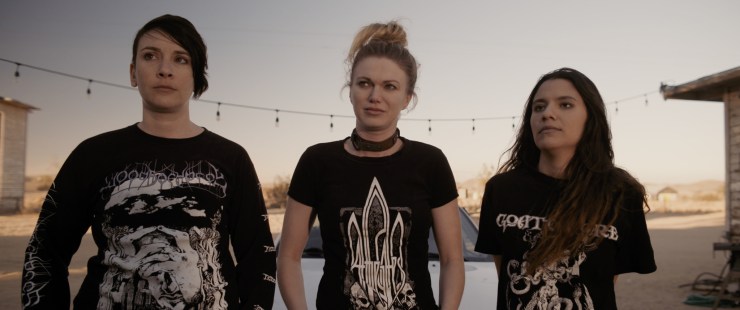
What Metal Girls Are Into comes to use courtesy of director Laurel Veil, and tells the initially familiar story of three young women on vacation who stumble into their own personal hell. In this case, it’s three metal-heads, heading to a heavy metal music festival, who are staying at an isolated house somewhere in the desert. There’s no cell service (of course there isn’t), no wi-fi, and the proprietor is creepy and over-solicitous, opening his first conversation with the girls by asking them why they’re not smiling. When the three find something disturbing in their freezer, they decide to wait to call the cops…and of course, things go wrong from there.

The strength of this short is the use of horror tropes that establishes the situation, only to be skewered. The dialogue and attitudes – young women dealing with a creepy dude, trying to ignore his behavior because they just want to have fun, and the dude in turn becoming insulted when they won’t respond to his overtures – is on point, horrifically reminiscent of way too many conversations that pretty much every woman has had. The women themselves are unmitigated badasses, and the performances here excellent, a combination of humor and terror that is both entertaining and believable. I won’t spoil the final line, but it’s…satisfying.

As with Goblin Baby last year, I want to see this one as a full-length horror film, featuring this cast. All the ingredients are there, and they’re perfectly delicious.

What Metal Girls Are Into is showing as part of the “Dark Gatherings” shorts block on February 2.

Black Coat (Short) (Final Girls Berlin 2018)

It’s that time of year again – time for a reminder that women are still pushing the boundaries of horror filmmaking. The Final Girls Berlin Film Festival, which began yesterday, provides a showcase for both shorts and features, directed (and often written by) talented female filmmakers. If you ever wondered about my constant assertion that women are the future of horror, then check out some of these films and be educated.

First up for me is Black Coat, part of the festival’s “Mind Games” shorts block. Directed by Tatiana Vyshegorodseva, the film wends through a nightmarish fantasy as a young woman awakens by the side of the road, with no memory of who she is or why she’s wearing someone else’s black coat. Picked up by two strangers who insist on being paid for the lift, she finds herself plunged into a circuitous nightmare.

The film aspires to a fascinating if somewhat obscure kind of surrealism, weaving a dark narrative that only clarifies within the last few minutes. It’s visually reminiscent of the sparseness of Ducournau’s Raw, though in this case it’s decaying architecture and evocations of homelessness that drive the horror. Pursued by terrors, the protagonist has to find a way out of the nightmare’s spiral, repeating events and actions until she can finally open her eyes. There are some shorts that feel like they’re templates for features, but Black Coat functions best as a short, a quick, sharp piece of terror that confounds and finally resolves. While I almost hoped for clearer elucidation of the film’s imagery, the more I think about it, the more I’m convinced that any further exposition would have damaged the film’s final moments. It’s a short story (literally based on one), reliant on visual language, and can only be resolved through visuals. An example, in other words, of pure (horror) cinema. 

Black Coat shows as a part of the “Mind Games” block on February 2. 

The Dynamics Of Voyeurism In Psycho And Phantom Thread

*Note: This is an analysis, not a review. There are spoilers for both Psycho and Phantom Thread. As I’ve only seen Phantom Thread once, this analysis may change over time. 

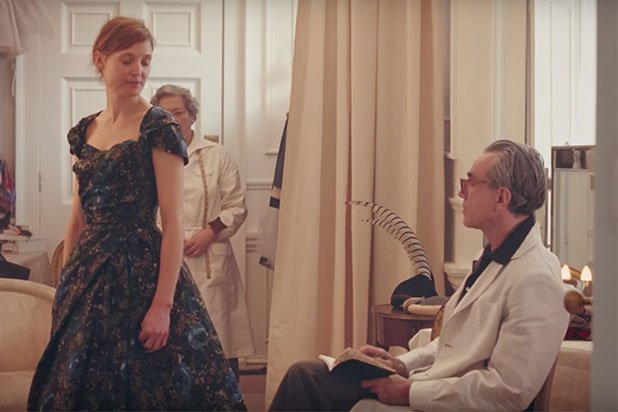
In a pivotal scene in Phantom Thread, Paul Thomas Anderson utilizes a visual reference to Hitchcock’s Psycho, drawing out the film’s Hitchcockian aspirations and establishing a parallel relationship between Alma/Woodcock and Marion/Norman. Alma has gone out to demonstrate her dress before Woodcock’s patrons, and Woodcock rushes to a peephole in one of the doors to watch her perform. The image of Woodcock’s eye lit by the peephole references a shot in Psycho, where Norman Bates watches Marion Crane undress through a secret peephole in the Bates Motel office. Woodcock’s visual association with Bates is not just a comment on him as psychopathic lover, but also an attempt to draw parallels between Woodcock’s act of voyeurism and Norman’s.

Norman’s act of voyeurism is presented as pathetic, a moment of perversion for a lonely young man. At the juncture in the narrative, the audience is unaware of Norman’s psychopathy and his behavior, while unnerving, is simply an act of voyeurism. What will happen to Marion is as yet unknown. As the camera takes Norman’s perspective, drawing close to the image of him at the peephole, the audience comes into visual sympathy with him – we see what he sees. The shot cuts to the image of Marion removing her clothes from Norman’s perspective, the frame edged with black as the camera mimics the view through the peephole. The reverse shot cut brings us into close-up with Norman’s eye, and then again cuts back to Marion as she moves toward the bathroom.

The act of voyeurism is not merely an act that Norman performs, but an act that the camera – and, by extension, the audience – performs with him. Pushed into sympathy with Norman whether we want to be or not, the audience is implicated in his act of voyeurism and all that it entails, up to and including the eventual murder. But Norman’s behavior is also tentative; his voyeurism slightly embarrassed, as though the act of looking is compulsive rather than wholly deliberate. What is more, he steps away from the peephole before Marion fully undresses—it is thwarted desire, perverted though it is, that compels him, and he doesn’t want to see it through to conclusion.

To look and be looked at returns again and again in Psycho, especially during the pivotal lead-up to the shower sequence, and the scene itself. When the camera gives us our first real glimpse of Mother, backlit by the sheer white of the bathroom, the shot is from Marion’s perspective. The peephole shot of Norman’s eyes recurs in its mirror image of Marion’s dead eye, the camera spiralling from it following her murder. Just as the audience has looked at Marion from Norman’s perspective, so do we see Mother from Marion’s, and finally ourselves, her eye looking back at us. The dynamic of looking and being looked at, and the violence and violation that is a part of the look, returns throughout the film, implicating the audience as well as the characters in its varieties of voyeurism and violation. (This scene, by the way, becomes even more complicated once we understand that Norman is Mother and that is it Norman’s initial act of voyeurism that eventually awakens “Mother’s” homicidal tendencies.)

Phantom Thread utilizes this dynamic as well, but the peephole shot here is one of the more blatant uses of another film’s imagery to draw the act of voyeurism into focus. Where Norman moves tentatively to observe Marion, Woodcock’s observation of Alma is breathless – he practically flings himself at the peephole, even though he’s standing in a room full of other models and seamstresses. Alma, meanwhile, is fully aware that Woodcock is looking at her. Unlike Marion, who is a passive and basically innocent victim (her greatest crime, vis a vis Norman, is trying to be sympathetic to him), Alma is a performer in her own objectification. However, the film does not therefore give her greater autonomy than Marion. She is performing as a model, and is therefore only present to be a passive object of the look. That Woodcock extends this objectification to his own form of rather sexless titillation further complicates the referentiality in using the peephole shot – he is looking, and the object of his gaze knows he is looking, and thus performs for him. But she also has no choice but to perform – she is a victim as well, because her professional role of a model enforces on her a passivity removes any choice that she might have. He will look and she will be looked at, no matter what. The way that Woodcock looks at her is not particularly a mark of his perversion, because that is literally her role.

The other marked difference in the shot as used in Phantom Thread is the lack of audience perspective/sympathy in conjunction with Woodcock’s voyeurism. Where Psycho forces the audience into visual complicity with Norman, including all that comes after, the audience is not forced to be complicit with Woodcock. He flings himself against the door, but the next image we see is not associated with Woodcock’s gaze. We briefly observe Alma returning his look as she glances at the door, knowing he’s watching her, but the camera itself does not take Woodcock’s perspective. The lack of POV distances the audience from the character, but also does not force us to interrogate our place in Woodcock’s voyeurism. His obsession, such as it is, is more an aesthetic one. While Norman’s vision is both intentionally titillating and intentionally disturbing, complicating the audience’s ethical standing in terms of the characters and in terms of the eventual murder and its solution, the scene in Phantom Thread makes no such demand of its viewers. Rather, Woodcock’s obsession forms a sort of aesthetic romance that the camera reinforces by declining to truly represent it as voyeurism. Where Hitchcock attempts to draw his audience into uncomfortable proximity with his obsessive character, Anderson allows the audience to remain distant and thus not particularly culpable. Looking and being looked at is a matter of aesthetic appreciation, not of perversion.

Yet Anderson chooses such a clear and deliberate reference to Psycho, in the midst of a film that is very much about looking and being looked at. This referentiality, while somewhat incoherent, is a mark of Anderson’s attempts to draw the viewer into the film vis a vis Hitchcock, to imply that we are, at least partially, to understand Woodcock’s relationship with Alma as having a corollary in Norman’s voyeurism. This is not particularly carried through to the rest of the narrative, however, and the Psycho reference gets lost in a pattern of referentiality and aesthetic fetishization. Phantom Thread’s treatment of voyeurism in general, and the presentation of the peephole shot specifically, avoids making the audience culpable in the interplay of dominance and submission, violation and control, that makes up so much of Phantom Thread’s narrative. We are asked to understand voyeurism from afar, to appreciate it aesthetically, and, much like Alma, to never really question our participation in it.

The Killing Of A Sacred Deer (2017) (Blu-Ray Review)

The Killing of a Sacred Deer (2017)

One thing you have to say for director Yorgos Lanthimos: he makes challenging films. The Lobster dared viewers’ comprehension (and patience), and his most recent The Killing of a Sacred Deer extends that, crafting an aesthetically honed narrative that borders on incomprehensible. Is it good? Is it incoherent? Does it even matter?

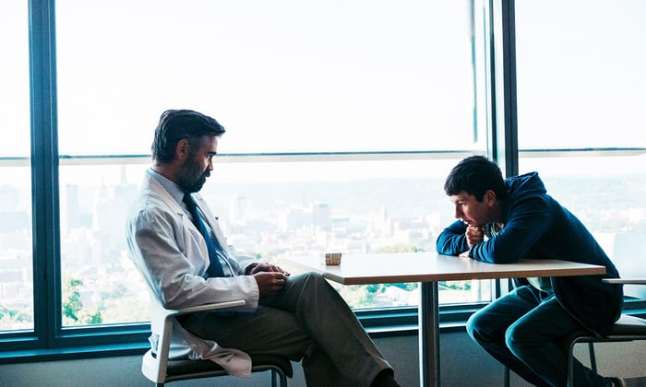
The plot of The Killing of a Sacred Deer is made only slightly more coherent when you realize that it’s (very loosely) based on Euripides’ Iphigenia in Aulis. Colin Farrell is Steven Murphy, a heart surgeon living an exemplary (and remarkably clean) life with his wife Anna (Nicole Kidman) and two children Bob (Sunny Suljic) and Kim (Raffey Cassidy). Steven has a curious friendship with troubled teenager, Martin (Barry Keoghan), whose influence in Steven’s life increases as he insinuates himself deeper and deeper into the family. Soon Martin’s motivations become (somewhat) clear when Bob comes down with a mysterious illness that Martin claims is a punishment for Steven’s past transgressions. Steven now has a dreadful choice to make or risk the total destruction of his family. What ensues is a battle of emotionless wills between Steven and Martin, leading to a somewhat inevitable conclusion (again, especially if you take Euripides into account).

The mythological basis only just manages to make greater sense of a film that doesn’t quite make sense on its own. But taking The Killing of a Sacred Deer at face value – as I had to while watching the film, initially – there is a complex of tragedy and comedy feeding into a narrative that never completely fulfills its promise. The film slides between apparent, if studied, realism and the supernatural – characters speak with a precision that mimics stagecraft (to a degree), as they move within sparse settings photographed with a mobile but distant camera eye. This is all deliberate, and one has to admire Lanthimos’s dedication to the imagery that he constructs. The Murphys live in a pristine world where everyone has a set responsibility – Steven repeats his injunction that Bob cut his hair and water the plants, as per his familial role – and everything is as ordered as it is soulless. The movement from the Murphy house to the hospital and back again is surprising because there really is no sense that the two places are any different – the sterile world that the Murphys inhabit forms itself around them, and thus the inevitability of their tragedy is laid bare. Enter into this Martin, who stands out in his messiness, his off-ness, as he slurps pasta and explains to Steven that there’s no animosity in what is happening to the family—just justice. It’s a horrifying turn, but it’s hard to be overly sympathetic to Steven, who refuses to acknowledge his transgressions or his role in Martin’s vengeance.

Barry Keoghan is a standout here, playing Martin with a sociopathic tenderness that makes him fascinating and horrifying to watch. He’s a haunting presence, even when he departs the screen for long periods of time to provide space for the horrors of the Murphys. There’s more than a hint of the vampire in the way that he has to be invited in to the Murphys’ household, the way he insinuates himself with Kim, and even the way he attempts first to obtain some reparation in hooking Steven up with his mother (Alicia Silverstone, underused but excellent in her small role).

The Killing of a Sacred Deer is not going to please anyone not already convinced by Lanthimos’s style. It’s a deeply aesthetic film, moving slowly from one scene to the next with deliberate camera movements and dolly work, avoiding drawing us too close to the characters (for fear, I think, that we might actually consider them human). It looks unflinchingly at the cruelty of the situation, and there’s really no one – save, perhaps, the children – to sympathize with. In that sense, it’s a perfect Greek tragedy, fatalistic and completely, viciously moral. But it doesn’t make for particularly pleasant viewing, and there were several moments when I simply considered turning the whole thing off.

This Blu-ray release is very pretty to look at, the HD looks great and the sound mixing excellent, but the special features are incredibly thin, comprising only a single featurette. I would have welcomed a more in-depth look at the film’s mythos, the stories that Lanthimos is drawing from, and the way that he constructs this tragedy within a modern setting. While I’m no fan of a director telling his audience how to understand his work, to have some basis for what Lanthimos thought he was doing might have helped to deepen my understanding of the film’s imagery. That the Blu-ray provides no further elucidation of the film’s project is a weakness, because it would have at least been interesting and would certainly justify purchasing it.

I’m almost inclined to write off The Killing of a Sacred Deer as a failed attempt to reconstitute the meaning of tragedy, a very ambitious but ultimately incoherent work of art. The film wants so much to force its viewer to interact with a combination of obscure meanings that it manages to establish no clear moral universe. At the same time, there’s something fascinating at the base of all this, failure or not. While it’s hardly a film I want to see a second time, it did keep me thinking and debating within myself for the better part of a weekend. That, in itself, makes for an intriguing work of art.

The Killing of a Sacred Deer is now available on Blu-ray.

Flesh And Blood: The Misogyny of Blade Runner 2049


*Note: this is an analysis, not a review. I spoil everything.

One of the earliest arguments to originate from the Mediterranean basin is the male/female dialectic of the woman providing the flesh and blood of humanity, the man the soul. Espoused by Greek philosophers, eventually translated into Jewish and then Christian doctrine, this element of the woman as the conveying vessel for humanity – evident even in the concept of the Virgin Birth – has had the effect of reducing women to the corporeal, of making the importance of women existent only in their ability to bear children. A barren woman is a hollow husk, devoid of her most basic function, while a fertile woman is reduced only to the function. This simultaneous valorization and dehumanization of motherhood has informed Western thought and art for centuries, so it’s hardly surprising that a contemporary film should enthusiastically reflect the same dialectic.

Blade Runner 2049 makes use of this dialectic in rendering women the conveying vessels of the humanity of replicants. But female bodies are more than just baby-machines – in Blade Runner 2049, they are also the repositories of male desire, sexual, religious, cultural, and social. The film indulges in the fragmentation and destruction of female bodies without bothering – or apparently desiring – to restore them. Women are robots, holograms, and advertisements; the only human female, Madam, is deliberately de-sexualized, her humanity reliant on her lack of (visual) femininity that also makes her easy to eliminate. In the commodification of the female form and image, there is hope for subversion, a questioning of the patriarchal superstructure that forces women into the “hollow vessel” role. Perhaps the film is setting up a vision of a world in which that commodification becomes the source of rebellion?

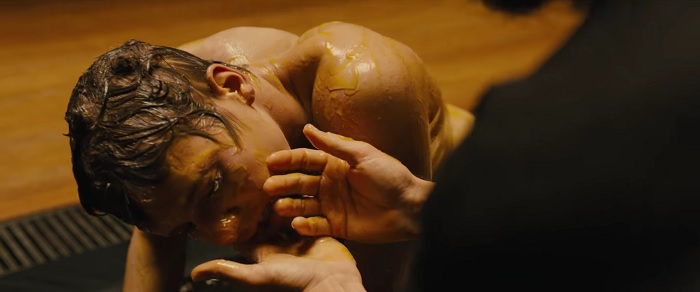
Perhaps not. The women of Blade Runner 2049 continue to be (at times literally) pulled apart, their bodies the repository of male desire with no hint of human autonomy – or soul. This is not merely a result of the actions of the male characters, but of the camera eye itself, which consumes women and fragments them, emphasizing their physicality and discardability. When the new designer of replicants Wallace witnesses the “birth” of a new replicant, he bends to caress her, the camera tracking his movements as he strokes the naked body of the young woman. The woman stands, shivering, and the camera eye itself focalizes through Wallace, sweeping up her body, dwelling on the curves of her ass, her stomach, and her breasts. Finally, Wallace stabs her and blood pours down her thighs – a visual reference to both menstruation and miscarriage, created by the male villain. But because the camera has taken Wallace’s perspective, and participated in the sexualization of the newly born replicant, any deliberate subversion is undercut by its evident participation in the replicant’s violation. The violation of the female body is made to seem horrific, but it is still the violation of a symbol, a symbolic rape and dissection that renders the existence of female humanity itself moot. Wallace caresses and then punishes the female body, and the camera participates in that punishment.

Wallace is the villain, and so his efforts at dehumanizing his creations might very well be indicative of his villainy. The same cannot be said for the film’s protagonist K, a replicant police officer in the mold of the original film’s hero Deckard. K might be a replicant existing within the system, and so absorbs all the system’s beliefs. But the film never provides him the opportunity to break free of those beliefs, instead attempting to provide him with a “love interest” in the form of a hologram program named Joi. At no point does he truly break free of that system or question the role of women – or female figures – within it. Joi is something that he has purchased and that he wishes to make “more human.” She eventually inhabits the physical body of a prostitute Mariette – herself a replicant – to provide the physical connection that K desires. But the film never makes it clear if Joi herself needs or wants that physical connection, because her programming means that she only acts on K’s desires. Joi is missing a part of herself – she is only an image, a thing that K can modify (literally upgrade) according to his needs, whims, and desires. Her personhood does not exist because it cannot; she can only ever be “half” a human being, the other half – the all-important physical body – provided by a woman who sells herself.

The frank attempt at eroticizing this scene, at stating that this is something that Joi wants, falls flat in the images we have of K modifying and altering Joi as he sees fit, in order to provide for himself that emotional and, eventually, physical catharsis. Joi cannot give consent any more than the prostitute can, because she has no external will – it is only K’s will, and Joi can only, at best, act as a symbolic repository for his desire. Her value is physical – any emotional or psychological connection the two share is treated as secondary. Her “gift” to him is to try to inhabit the physical body of Mariette, and it is a gift that he accepts, largely as his due. The film figures Joi as not being enough for K until she becomes physical – another devaluation of female existence down to the simple fact of the physical body.

Again, this division of the image and the corporeal might have provided sexual and gender dynamic commentary, but Joi once again is forced to occupy a symbolic space. Her union with Mariette is about providing K with a connection to his humanness, the sex act establishing him as more human than robot. While some emphasis is given to their emotional connection, the relationship between K and Joi is not really codified until Joi becomes momentarily corporeal. Her existence as a female image with artificial intelligence is not enough – there must be a female body for K to sleep with. Afterwards, Joi discards the body, telling Mariette “I’m done with you.” Joi herself can only find value in her existence when it becomes physical – and K is more than willing to accept the “gift” of a prostitute in order to achieve physical catharsis. Joi’s greatest act of personal autonomy is in the purchasing of a female body for her “husband.” When she is finally destroyed, Joi tells K that she loves him – but the film never spends any time investigating Joi’s potential humanity, and her “death” is primarily figured as a symbolic loss for K.

Both Joi and Mariette are things that K has purchased to fulfill his desires, but it is Mariette who is able to gain some agency outside of the human/replicant, male/female dialectic. But even her apparent autonomy is short-lived. She is given a voice as a prostitute, mocking K for his “love” of Joi and Joi for her holographic emptiness, but once Mariette joins the replicant rebellion, she becomes faceless, another female body among many female bodies, acting as a single entity. She is used as a medium of exchange, her body providing a connection between K and the rebellion, to draw him in and introduce him to Freysa, who provides further plot exposition about K’s assignment in the rebellion. Freysa, in her turn, is merely a conduit for information to K and to the viewer. The total trifecta of the “good” female replicants/AIs are as conduits, vessels, and sources of information for the male protagonist.

Blade Runner shares a few affinities with the contemporary Bond franchise, among them the use of a female henchman for the villain. Tortured and likely abused by Wallace, Luv exists to reinforce the patriarchal structure as Wallace’s slave who becomes as evil as the man who abuses her. As K drowns her, the camera brings us up close to her suffering, indulging in her contorted face until she finally dies. This might be moving, even pathetic, were the film interested in summoning up more than a cursory interest in her psyche. Rather, it becomes simply the destruction of a villain by the comparative hero, another instance in which the female body and face is made to undergo cleansing pain in order for the men to, finally, go free. Luv hints at a deeper characterization, but the film never follows through on it, instead turning her into an abused woman who gleefully abuses others, a relatively banal character type whose violation is turned inward, transforming her into a monster. Wallace himself is never particularly punished for his treatment of his replicants, including Luv. K’s anger is enacted against the female body; it is female suffering that gives meaning, and catharsis, to the male.
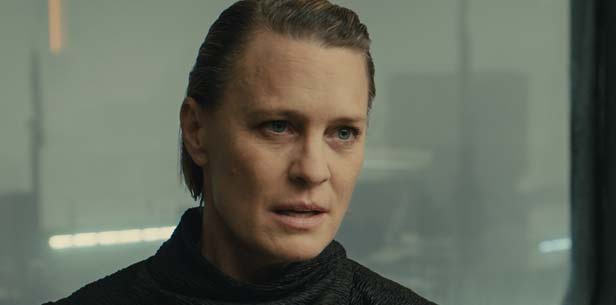
The other female character who could have potentially complicated Blade Runner’s view of women is Madam, K’s human superior. There are undertones of S&M dominance in Madam, down to her name and the deliberate representation of her physicality as largely androgynous. Her costuming and behavior renders her largely sexless – as the only female character possessed of autonomy, she must also not be seen as feminine. Madam is not an object of desire and therefore is human, but she is also disposable – she sacrifices her life for K’s, eliminated by Luv in yet another exhibition of female suffering, this time in defense of the male protagonist. While Madam has a character name, Lieutenant Joshi, she is rarely referred to as such, her being reduced to a title that recalls a dominatrix, a woman operating for male pleasure.

The crux of Blade Runner 2049 does indeed offer up women as the salvation of the replicants, the proof of their humanity. But again, it is only the physical female body that is important here; female replicants remain soulless. Rachael’s only presence is as literal bones, a total fragmentation of her body and her image. The imprint of birth on her body – a mark from a C-section on her pelvis – confirms her ability to bear children and thus her humanity. The question of her having a soul is fairly moot – she is merely a vessel to convey salvation into the world, a symbol of replicant humanness. Moreover, the question of Deckard’s humanity further complicates an understanding of the child that has been produced. If Deckard is human – and I think there’s a good argument for that – then what has been proven is that a replicant woman can carry a human child; but even more than that, it allows Deckard to provide the humanity, the soul, to the replicant body. The film’s unwillingness to answer the question of Deckard being a replicant – at least with any degree of clarity – muddies the waters of cinematic meaning. If Deckard as a human can produce a child with a replicant woman, then all that says is that female replicants are capable of child-bearing. If Deckard as a replicant can produce a replicant child, then there is greater flexibility for understanding that relationship.

The importance of female physicality is once again emphasized as Deckard refuses Wallace’s offer of a “new Rachael,” because her eyes are the wrong color. With a single word, a supposedly human figure is destroyed because the physical body does not match male desire. While the film uses this as a source of horror, it does not follow through on it – once again the female body is merely the site of male need, important only to evoke a sense of horror in the viewer. The destruction of the feminine, the horror of watching a female body rendered, is meant to evoke a quick emotion, to impress upon the viewer the evilness of Wallace and, perhaps, the coldness of Deckard. But those bodies are still dehumanized; once again, the female body is a symbol of exchange and bargaining, not a living, autonomous thing. Rachel is executed and the film moves on, confident that it has made its point.

The child, likewise, is merely symbolic – she cannot ever move outside of the world that she creates for others, and her major connection to the story is in providing her own memories to the male hero – completely removing a part of herself and injecting it into his psyche, because she cannot act on her own memories or desires. Both Rachael and her daughter are symbols of humanity without having humanity themselves; they are devoid of autonomy neither are fighters, soldiers, or rebels, and their eventual role in whatever replicant uprising that is about to take place will, again, only be as symbols. Rachael, because she is dead, and her daughter, because she can never move from outside her confines.

While Deckard’s daughter does indeed inject elements of humanity into the replicants, she can only ever act as a symbol for their humanity, because she has no autonomy outside of that. The ending of the film “gives” her to Deckard, as K tells him to “go see your daughter” – she is his possession, a thing that he has created (though he never participated in her life), and that is there to prove the humanity of the replicants, to act as their symbol for the coming age. She is merely a cog in the male narrative, seen through male eyes, and given importance via male desire.

To subvert patriarchy, a film has to do more than simply represent it. And patriarchy, in Blade Runner, is neither positive nor negative – it simply is. Wallace might be the villain, but it is the camera that fragments and assaults the female body. Female value is formed only through women’s ability to act as symbols for a male-driven narrative. It is the male that is most fully human, the woman a simple vessel for his needs and desires, a physical proof of the human/robot dialectic. To make child-bearing the sole mark of humanity – the indication of the soul – means to reduce female existence to the ability to have children. Female autonomy, emotions, desires, needs, are nothing in comparison to being a symbol for the progress of humanity/replicancy. The female body is merely a vessel to convey information, a thing in which the male can implant information. The backwards nature of such a foundational plot element renders Blade Runner 2049 into something viciously, insidiously anti-woman, an argument that turns female bodies into corporeal vessels, repositories, things to be controlled, mutilated, or venerated, but never to be understood as autonomous beings. The men provide the soul, the women provide the body…and nothing more.

Bloody October: The Invitation (2015)

The Invitation (2015)

I’ve said it before and I’ll say it again: the future of horror is female. And nothing proves that so perfectly as Karyn Kusama’s 2015 slow-burn horror masterpiece The Invitation (which, by the way, is available to stream on Netflix, for your Halloween fix).

Will (Logan Marshall-Green) is heading to the Hollywood Hills with his girlfriend Kira (Emayatzy Corinealdi) to attend a dinner party thrown by his ex-wife Eden (Tammy Blanchard) and her new husband David (Michiel Huisman). When they arrive at the home that Will and Eden used to share, Will is immediately struck by the strange shifts in personality of Eden and David. He’s even more troubled at the absence of their good friend Choi, who was supposed to be there early, and the arrival of Pruitt (John Carroll Lynch), a friend of David and Eden’s that they met at a retreat in New Mexico. The party gets underway among a small group of old pals, with seething tensions building ever higher as Will begins to suspect that all is not well in the Hills.

The Invitation builds ever-so-slowly to one of the most satisfying horror climaxes in recent years, ramping up the tension on each plot thread until they threaten to snap. This is one of those films that is made or broken by its ending, and thankfully The Invitation delivers, hitting the viewer very hard and suddenly and letting the terror just flow like wine. But it doesn’t go on for too long, providing just enough mayhem to justify its build-up, but not so much as to drag things out. I think that putting too much emphasis on the slow-burn nature of this film does it some disservice, as the dread is very real right from the start, when Will hits a coyote with his car and has to finish it off with a tire iron. Will’s paranoia pushes the film into the territory of questionable perception, which allows for a brilliant shifting of viewer sympathies. Something is certainly wrong, but is it Will, his friends, or something else altogether?

Much of The Invitation‘s power lies in the focalizing through Will and the use of the camera eye that just barely captures things going on at the peripheries of the scene – a car pulling away just out of sight and then stopping, a red lantern being hung in a tree. As Will flashes back to the traumatic event that caused his break-up with Eden, his trauma informs what happens around him, keeping the viewer off kilter. The horror, when it hits, is believable and shocking, but the entire film has prepared us for this moment, drawing out a weird kind of fear in the act of simply eating dinner, or pouring a glass of wine. Kusama has a deft hand and eye, giving us just enough to keep us interested, but not so much that we can figure out all the angles before things go horribly wrong.

Of all the scary movies I’ve seen this Halloween season, The Invitation is by far the most unnerving, because it is also the most believable. It’s that terror of the mundane, the little things that seem just slightly off, the stories that remain half told, that give it its power.

Bloody October: Grabbers (2012)

Grabbers (2012)

After reading way too much about Harvey Weinstein, I decided that I needed to see a movie about a different kind of eldritch monster from the depths of the ocean. So I popped on Grabbers, about a little Irish town menaced by octopean monstrosities with a way better weakness than those water-hating aliens in Signs.

Grabbers introduces us to a sweet little village on a remote island off the coast of Ireland. It’s home to exactly two police officers: Ciaran O’Shea (Richard Coyle) and the newly arrived Lisa Nolan (Ruth Bradley). He’s an alcoholic, she’s a workaholic, and so romance will of course be in the offing. When hundred of sea creatures wash up on the beach, the Garda get involved to figure out just what the hell is happening just in time for people to begin vanishing left and right. Meanwhile, one of the many local drunks Paddy (Lalor Roddy) traps an ugly sea monster and takes it home. Dubbing it a “grabber” after it tries to eat him, he carts the creature off to the local biologist, Dr. Smith (Russell Tovey), who proclaims that it’s not quite of this world. But Paddy has discovered the creature’s weakness: it lives on blood, and Paddy’s blood alcohol level was so high when it attacked him that he literally poisoned the thing. The only solution to surviving the creatures, then, is to get roaring drunk.

Grabbers is just an incredibly fun, incredibly Irish little monster movie, with some effective monstrosities to cut through the comedy, and a massive drink-up at the film’s center. The conceit is amusing, of course, and the film carries it off well, building to the revelations of the monsters and how to defeat them with deprecating humor and a charming self-awareness. There are a few plot holes, but that’s all right – I don’t really watch monster movies for the story structure. The romance angle is sweet as well, with a hilarious scene in which a very drunk Lisa explains O’Shea’s life story to him. Grabbers also posits the question of how roaring drunk people can possibly fight vicious aliens, and does so in some hilarious (and gruesome) ways.

I’ve seen very few humorous Halloween movies this year, which is always a mistake. Grabbers was a wonderful distraction from the occasional darkness of the holiday, a reminder that tales of terror need not be soul-crushing. Sit down, have a pint, and prepare to wrestle the tentacled nasties until final call.

Grabbers is available to stream on Shudder.