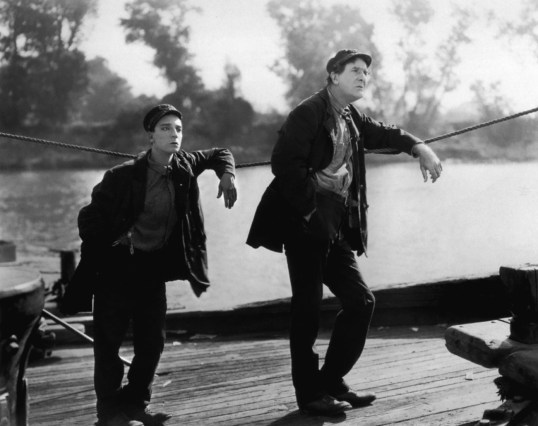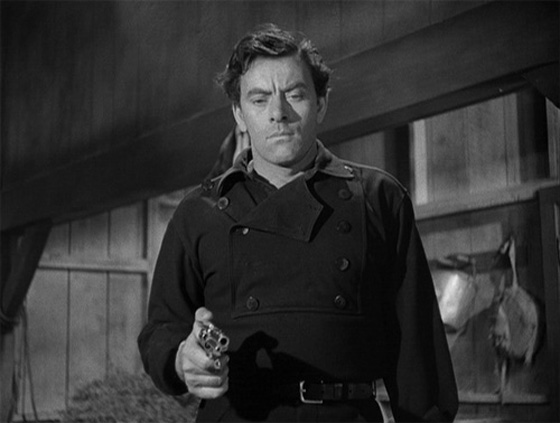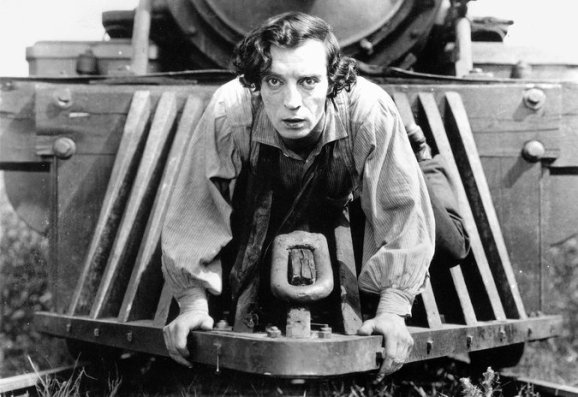
The General (1926) and Three Ages (1923) (Blu-ray Review)

The General (1926)

the-general-1926

The General holds the distinction of being one of the two most famous Buster Keaton films ever made, and consequently the one most often seen even by those who might resist silent cinema. And what a film it is. The General spends the vast majority of its hour and fifteen minute runtime in a breathless chase sequence, with stunts that become ever more elaborate as Keaton and his crew risk life and limb for the sake of a good joke. In this new restoration from Kino Lorber and Lobster Films, we can finally watch The General in all its gorgeous glory (and in the original aspect ratio!).

Keaton is Johnnie Grey, an engineer on the Western & Atlantic Railroad who loves two things: his engine The General, and his girl Annabelle Lee (Marion Mack). When the Civil War breaks out, Annabelle pressures Johnnie to enlist, but the Confederate Army thinks that he’d be more useful as an engineer than as a soldier. Believing her man is a coward, Annabelle refuses to have anything more to do with Johnnie until he puts on a uniform. Fast forward a year, and Annabelle is traveling on the Western & Atlantic to go see her father, who has been injured further North. Little does she – or Johnnie – know, but The General is the target for Union saboteurs, who steal the train with Annabelle still on board. Johnnie gives chase, vowing to bring back his engine and his girl.

The stunts in The General are some of the most remarkable that Keaton would ever pull off, with the comedian riding on the cow catcher, running over the top of the train cars, firing cannons around bends, and setting a bridge on fire. But the stunts also pay off as shocking feats of athletic – and locomotive – prowess that today would take ten stuntmen and lots of insurance forms. The directing and editing of the film plays a large part in The General’s success, maintaining a breakneck speed and elegance that provides a study in continuity editing.

The odd quirks of The General – such as Keaton insisting that the heroes be the Confederate Army, because no one would have sympathy with the Union – don’t serve to undermine it. While the Civil War acts as a backdrop, and there is an undercurrent of the South’s heroism, it’s a very apolitical film, more about the triumph of the little man than about any big victory for the rebels.

Three Ages (1923)
three-ages-123

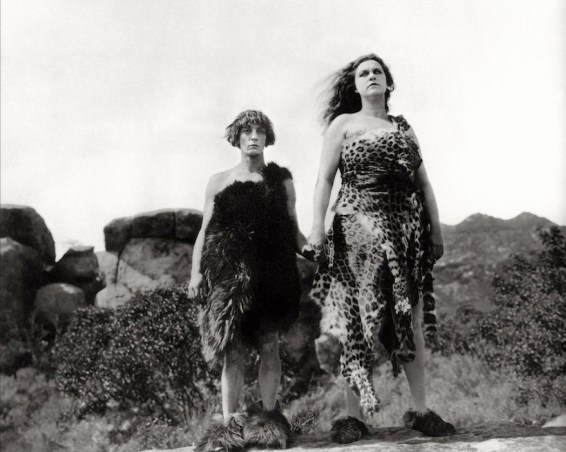
Lesser known than The General or even than the other two films in Kino’s other Keaton collection is Three Ages, an underrated little gem from 1923.

Three Ages gently mocks D.W. Griffith’s Intolerance by taking a similar structure and subject matter, telling of universal human experience through three stories from three different periods of history. Keaton here takes on “love” through the lenses of the Stone Age, the Roman Age, and the Modern Age, each depicted with tongue firmly in cheek. The structure is really just an excuse for Keaton to do his stunts, and the plot is less integral to the stunts than in The General or Steamboat Bill, Jr. But the stunts are, as always, glorious to behold, particularly in the climactic chase scenes at the end of each historical sequence. There are also wonderful little bouts of silliness, as when Keaton’s Roman counterpart runs a chariot race by dog sled, or the acrobatic football game in which the slight comedian faces off against the massive Wallace Beery.

Three Ages is probably one of the sillier Keaton films, and the episodic structure means that the viewer more or less knows what to expect in each sequence. But without being groundbreaking, it’s also quite entertaining.

As with the Steamboat Bill, Jr. and College set, this set from Kino Lorber and Lobster Films features gorgeous 2K restorations of Keaton’s classics, along with a hefty dose of extras on both discs. For the film buffs among us, the audio commentary from film historians on The General is interesting, especially as this is among the best known of Keaton’s works. Three Ages doesn’t receive quite the same attention, though the inclusion of Man’s Genesis, another Griffith film parodied in the Stone Age sequence in Three Ages, is a welcome historical tidbit.Three Ages is unfortunately a visibly damaged film, with several scenes almost obscured by damaged frames. But this restoration thankfully makes even those scenes watchable, and the film is here presented in its entirety.

What’s really most impressive and important in these new Kino releases is the beauty and the care that has gone into the restorations. Thousands of silent films have been lost, and many more have disintegrated beyond repair, so even the smallest attempts to preserve silent film history is welcome in the digital age. And these are not small films, nor are the preservation attempts – they are seminal comedies from one of the greatest comedic minds of his or any other generation, presented with loving attention to detail in crisp digital prints. Embrace these films, watch them, buy them. Support the preservation of our cinematic history. We won’t see anything like this again.

The General/Three Ages is now available from Kino Lorber.
The Death Kiss (1932)

The Death Kiss (1932)

*available to stream on Shudder

the-death-kiss-1

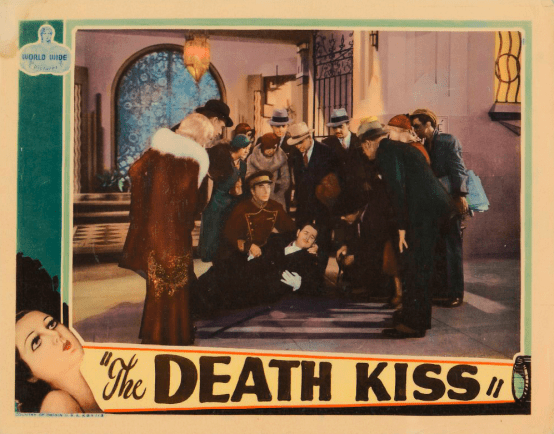
The horror streaming service Shudder has a few high-quality public domain films available for streaming which, if you’re a stickler for quality like me, is very welcome. The Death Kiss, a pre-Code thriller from 1932 and restored by Kino in this edition, is one of the most surprisingly entertaining little dramas that I’ve seen in a long while.

The Death Kiss opens on the making of the film The Death Kiss, as actor Miles Brent (Edmund Burns) walks onscreen for his cinematic death scene…and winds up actually being shot. Almost everyone on set is pretty sanguine about Brent’s death: his ex-wife and leading lady Marcia (Adrienne Ames) can’t stand him, his director Tom Avery (Edward Sloan) and studio manager Joseph Steiner (Bela Lugosi) are more worried about finishing the film than the loss of their leading man, and the head of studio Leon A. Grossmith (Alexander Carr) is counting the money that he’s going to lose by delaying production for such a small thing as a murder. The police arrive, and so does a young scenario writer and would-be detective Franklyn Drew (David Manners), who also happens to be Marcia’s lover. But while no one really cares who killed Brent, when the police set their sights on Marcia, Drew decides he has to act on his own. What follows is a snappy little whodunnit with some silly set-pieces, crackling dialogue, and lots of Hollywood self-effacement.

The Death Kiss is immediately notable for bringing back together three of the main actors from the 1931 Dracula in the persons of Manners, Sloan, and Lugosi. But each are also playing noticeably against type: Sloan is far from the grandfatherly Van Helsing, and Lugosi actually gets more than a few laughs in as the slightly diabolical studio manager. Most notable, however, is David Manners, who was wooden as Jonathan Harker and here actually proves he carry off comedy and dashing wit without creasing his necktie. Because the film is so short, coming in at just over an hour, the plot moves along at a good clip, getting in little digs at Hollywood and movie-making while managing to conjure up a decent plot that had me guessing right to the end. Director Edwin L. Marin would go on to make a series of whodunnits throughout the 1930s, including several Philo Vance detective films and a version of A Study in Scarlet.

An odd little sidenote to The Death Kiss is the use of tinting in several key scenes, which have been properly restored in this print. The little shocks of color are bizarre but quite effective, and it’s lovely to see them in a film this small and quirky. The film is plagued by some sound troubles, probably owing to a poor source print, but these do not disrupt the production as a whole. It’s actually quite an irreverent and energetic little movie, replete with quirky side characters and distractions enough to keep things moving.

While The Death Kiss wins no awards for innovation, it’s an enjoyable film, quick-witted and fast-paced and just a little racy (pre-Code films need to be appreciated more, my friends). Though I wouldn’t quite call it a horror film (despite Lugosi), it’s streaming on Shudder now, so you have no excuse.

Steamboat Bill, Jr. (1928) and College (1927) (Blu-ray Review)

Kino Lorber has a wonderful habit of releasing silent public domain films in proper and worthy restorations, often rivaling the art-house productions of the equally wonderful Criterion Collection. The latest to be restored to 2K glory, in a combined effort from Kino and Lobster Films, are classics from Buster Keaton’s oeuvre, packaged two to a case, and replete with extras that remind us just what a brilliant comedian old Stoneface truly was.

Steamboat Bill, Jr. (1928)

steamboat_bill_jr_1928_1

Keaton’s Steamboat Bill, Jr. dates from 1928, and is Keaton’s last independent silent film before he made the move to MGM. In it, he’s Willie Canfield, Jr., the dandy-ish son of a gruff old steamboat captain (Ernest Torrance) who returns home from college to visit his dear old father. Willie also happens upon his sweetheart Kitty King (Marion Bryan), the daughter of a rival steamboat magnate John King (Tom McGuire). Comedy ensues as Willie Sr. tries to turn his effete son into a hardened old salt, while Willie Jr. must win the girl and rescue his father from being run out of business.

Steamboat Bill, Jr. brings together many of Keaton’s favored and most recognizable tropes: the young dandy trying to win the girl, the son attempting to impress the father, and the little guy facing off against encroaching obsolescence and in danger of being crushed by bigger, wealthier men. The sight gags come thick and fast, building up to the glorious (and famous) hurricane scene in which Keaton destroys most of the set and very nearly gets crushed by a falling building. But while Keaton is known for his acrobatic comedy (seriously – I’ve never seen a man fall on his head quite so much), there’s much to be said for the smaller visual gags that he carries off with such aplomb. In one scene, he attempts to signal to his imprisoned father that the loaf of bread he’s carrying has a file in it, all without tipping off the jailer. Keaton actually uses a song – in a silent film, no less – which he uses to make gestures to indicate the presence of the file. In another scene, he tries on a series of ridiculous hats – quickly discarding each, even his famous pork pie hat that had become his symbol.

The restoration of Steamboat Bill, Jr. is a lovely one, smoothing out the film and avoiding unnecessary crackles and pops so common in silent film restorations. New scores provide punctuation to the silent antics, and the Blu-ray also includes an informative audio commentary from two film historians.

College (1927)

college-1927

The second disc in this collection is College, another Keaton classic from later in his silent career. As with Steamboat Bill, Jr., College features Keaton as Ronald, a bit of a dandy whose lack of athleticism keeps him from the girl of his dreams, Mary (Anne Cornwall). As he sacrifices his collegiate studies for sports, he finds that he’s completely incapable of playing baseball, going out for track, or rowing…until the Dean forces the rowing coach to take him on as coxswain.

The joke, of course, is that Keaton’s “failed” athletics are spectacularly athletic. As he cycles through every track event, he succeeds in not completing the high jump, knocking over every hurdle (without actually tripping), and endangering the whole track team with his attempts at throwing the javelin. As with many of Keaton’s films, the sight gags and acrobatics become more and more elaborate until the film’s climax, encompassing a boat race followed by a breathless dash from the docks to save Mary.

There are a few minor stumbles in College, however, that slightly cut through its otherwise stellar antics. Ronald’s attempts to find a job to pay for his tuition backfire, leading  to a sequence with Keaton in blackface as a waiter. If you can look past the cringe-worthiness of the sequence, there are some good sight gags, but it’s still a fairly uncomfortable scene.

College is also an excellent restoration, and has an even more elaborate series of extras. In fact, there are two extras film on here: a twenty minute collegiate comedy with Carol Lombard entitled Run, Girl, Run, and The Scribe, which was Keaton’s final onscreen performance. Neither are much to write home about, but they provide diverting entertainment. Film scholars will be further edified by historical commentary, and a tour of College’s filming locations.

There are few comedians like Buster Keaton – even among his fellow silent clowns, he’s uniquely daring in his acrobatics and in his love of cinema. While neither of these films quite hits the calibre of Sherlock Jr. or The General, they are hardly lesser films – they’re just as eye-popping as they were in 1928.

Steamboat Bill, Jr. and College are available in new stellar restorations from Kino beginning February 21.

Queen Of Katwe (2016) (Blu-ray Review)

Queen of Katwe (2016)

null

Quietly joining the ranks of films that branch out from Hollywood’s usual “white people do things” plot, Queen of Katwe is a refreshing and unpredictable entry from Disney about a young girl in Uganda who discovers a spectacular talent for chess.

The true story follows the life of Phiona (Madina Nalwanga), a teenage girl living in the Katwe slum of Uganda’s capital Kampala with her mother Nakku Harriet (Lupita Nyong’o) and her siblings. She discovers a talent for chess at a missionary program run by sports coach Robert Katende (David Oyelowo), and soon begins to compete against children from other, richer schools. She finds friendship and a sense of belonging among the other chess players, but gradually begins to chafe under her lack of education and the extreme poverty in which her mother and family are forced to live.

Queen of Katwe relies on some of the usual clichés about exceptional people in terrible circumstances, painting a picture of Phiona’s rise from poverty in very recognizable and clean-cut terms. But, more so than most Disney films, it also closely depicts the depths of poverty in which Phiona and her family live without either romanticizing them or making them appear exceptional. This is simply their lives, and chess – of all things – might very well be their ticket out of poverty. Phiona’s mother just wants a home with a roof over it, a request seemingly impossible to satisfy. Her daughter wants a way out of the slums. As Phiona becomes increasingly dissatisfied with her family life after every chess tournament, the conflict with her mother and her younger brother increases – she no longer feels at home anywhere, unable to match her growing thirst for education with her impoverished circumstances.

Robert and Harriet both approach Phiona’s talent with love and understanding – Robert sees her as a brilliant child who needs an opportunity, while Harriet recognizes both her daughter’s talent and the undeniable struggles of her daily life. The conflict between the two develops as what they think is best for Phiona, and whether the girl can ever achieve more than just notoriety in chess competition.

Queen of Katwe is a Disney film, and so even the extreme poverty of Phiona and her family is treated with a soft-focus edge. The film avoids going into the seamier side of poverty – Phiona’s elder sister Night (Taryn Kyaze) draws her mother’s condemnation by running off with a boy on a motorbike, but this is treated as mostly ancillary to Phiona’s life. Yet the fact that this is a Disney film works to Queen of Katwe’s benefit. The film presents the day-to-day life of impoverished people rather than dwelling on suffering or violence, avoiding the usual problems of more “adult” films that tend to focus on the dreadful nature of poverty rather than the humanity of the people.

Director Mira Nair gets excellent performances out of her cast – Oyelowo and Nyong’o are predictably good in their respective roles, but the children really steal the film. Newcomer Madina Malwanga turns in a riveting lead performance, fully embodying Phiona and lending her the depth necessary to carry the film. She avoids being overshadowed by the older and more experienced actors – no mean feat, given the calibre of acting on display here.

Queen of Katwe‘s sole weakness lies in the somewhat meandering nature of its story. Nair chooses to bookend the film with an important chess match, but the efficacy of those bookends make the rest of the narrative feel arcless. Phiona’s development from gifted amateur to a potential Grand Master forms the main focus of the story, but secondary plot threads threaten to imbalance the narrative. The film occasionally loses focus, eliding over important events and puncturing the development of suspense. While this doesn’t condemn the film, it does lessen the dramatic impact.

This Blu-ray release is as lovely and rich as one would expect from a Disney Blu-ray. Nair makes use of her usual vibrant color palette, here presented in sharp HD. The extra features include deleted scenes and an audio commentary with Nair that serve to flesh out the story. Two featurettes, including a short film about Robert Katende, explain the background of the real people on which Queen of Katwe is based, while Disney gets in its musical product placement with an Alicia Keys music video. As usual, the film is the major attraction on this disc, but the behind-the-scenes featurettes are especially informative and showcase the reality behind the gloss.

A smart and interesting story that seeks neither to romanticize nor pity its protagonists, Queen of Katwe is a strong entry into Disney’s live action world.

The Light Between Oceans (2016) (Blu-Ray Review)

The Light Between Oceans (2016)

the-light-between-oceans

The romantic melodrama The Light Between Oceans comes to Blu-ray today, so get out your Kleenex and prepare yourself to be moved (and just a little bored) by the trials of a lighthouse keeper, his wife, and the choice that changes numerous lives in a small town in Australia.

Michael Fassbender is Tom Sherbourne, a traumatized World War I vet who becomes a lighthouse keeper at Janus Rock, off the coast of Western Australia. He falls in love with Isabel Graysmark (Alicia Vikander) and together they build an idyllic but isolated existence at Janus. After suffering two miscarriages, Isabel despairs of ever having a child. Then a boat is washed up on shore, containing the body of a man and a very much alive baby girl. Isabel convinces Tom not to report the boat so that they can keep the child as their own. But that’s not the end of the story, of course, when Tom thinks that he’s come across the girl’s real mother Hannah (Rachel Weisz).

The Light Between Oceans is in the best traditions of romantic melodrama – it wouldn’t be out of place in 1930s cinema, probably starring Cary Grant and Irene Dunne (actually, they did make a similar film called Penny Serenade). The film allows the complexities around the trauma of loss and the sacrifices people make for those they love to come to the fore without laying too much blame on anyone. The drama feels unforced, once you’re willing to accept the somewhat unbelievable and romantic notion of a baby literally being washed up on the shore and taken in by a childless couple. There are no real villains, but people living at odds with each other, manipulated by circumstance and coincidence and affected by the choices of others. It would have been easy to vilify Hannah, or to force Isabel into the wrong, but both women are wrenched apart by their mutual love for a child and their personal tragedies.

There are elements that strain credulity, however, with at least one questionable plot complication that is both necessary to what follows and is unreasonably forced. Once that is gotten over, the film moves along cohesively enough, but I confess that I continued to come back to that point, wondering whether the novel on which the film is based succeeded in eliding over this issue with greater success. The moral complications of Tom and Isabel’s decision are dealt with carefully, although there are moments when the film threatens to tip over into soap opera territory. A secondary theme that could have been handled with greater complexity are Tom’s issues with faith – as the final act of the film proceeds, this becomes an important point, yet was never really elucidated or developed earlier in the film.

The Light Between Oceans boasts beautiful cinematography and this Blu-ray release showcases that, lovingly painting the gorgeous landscapes and the close, intimate images of the actors. The extras on the disc are mostly what one would expect: an audio commentary with director Derek Cianfrance, a few featurettes detailing the film as an adaptation and the use of location and cinematography. These are interesting enough insights into the production circumstances, though they naturally don’t touch on the greater thematic complexities of the narrative. The strength of the Blu-ray is in the presentation of the film itself.

Moving and complex and a touch melodramatic, The Light Between Oceans never quite rises to the heights of greatness, but neither should it be ignored. It’s an excellent piece of entertainment, beautifully presented on the new Blu-ray, with strong performances and some gorgeous locations. An enjoyable way to spend a Sunday afternoon.

The Man Who Fell To Earth (1976) (Blu-Ray Review)

The Man Who Fell To Earth (1976)

themanwhofelltoearth_main-poster

Nicholas Roeg’s The Man Who Fell To Earth, out on Blu-ray January 24, is a strange, sometimes successful cross between a straight sci-fi and an art installation. The film attempts to incorporate pretty much everything you might expect from both forms of art, mixing perception, dreams, reality, and drug-induced hysteria into a plot that doesn’t so much arc as hover slowly to different ethereal planes.

What little plot there is concerns Thomas Newton (David Bowie), an alien from a drought-stricken planet who arrives on Earth to bring water home. He immediately acquires great wealth using the technology from his home planet, bringing him power and increased scrutiny. He falls in love (sort of) with Mary-Lou (Candy Clark), a maid and bellhop in a rundown hotel, who introduces him to booze, sex, and religion (and cookies). With the help of Dr. Nathan Bryce (Rip Torn), a womanizing scientist who guesses at Newton’s alienness, Newton hopes to construct a spaceship to return him home to his wife and family.

Of course, The Man Who Fell To Earth can’t do something as easy as tell a coherent story about a stranger in a strange land. Newton’s rise and fall is interspersed with a complexity of images, sounds, and scenes as he flashes back to (or dreams about or has foreshadowings of) his home planet and the family he left behind. His experience of Earth is likewise informed by media, as he absorbs everything from TV to music in a smorgasbord of sensory experience. Never having had alcohol before, he becomes an alcoholic; never having experienced human sex, he becomes a nymphomaniac. Yet he’s also curiously distant, unable to make real connections with those people around him.

The problem with the film is that it doesn’t seem to be entirely certain what it’s trying to do, or why it’s trying to do it. Whole swathes of time are covered in single scene changes, while other scenes drag on and on, for no clear reason. While I never argue about a naked David Bowie, I could have done without seeing Rip Torn bed an ever-increasing number of ingenues. Nor is it clear what, if anything, these scenes are supposed to accomplish. The Man Who Fell To Earth is too linear to be surreal, but too scattered to tell a coherent story. It seems to be desperate to say something without having much of a clue about what it wants to say.

Bowie is the weirdly comforting center of all this, his beauty as ethereal and mesmerizing as ever. While he gave better performances in his acting career, he would never step into a role that suited him as closely as playing a gentle alien who just wants to go home. His moving performance attempts to articulate his experiences to human beings ill-equipped to understand them, and keeps the film from vanishing into its own personal black hole. Newton stretches out for contact that he’s not capable of, trying to express love or connection in a way that he can’t accomplish. There’s a sadness to Bowie’s performance that makes the viewer feel that we’re truly watching someone desperate to connect who doesn’t have the means or the language to do so.

This Limited Collector’s Edition Blu-ray release of The Man Who Fell To Earth is a gorgeous one, and offers the film in a beautiful 4K restoration, so that one may experience the Thin White Duke in all his multi-hued glory. The extras on the disc itself consist of new interviews with the costume designer May Routh and producer Michael Deeley, a multitude of archival interviews with Bowie, Candy Clark, Roeg, and writer Paul Mayersberg, and a “Lost Soundtracks” featurette, detailing the sound design of the film and what might have been. Although the interviews are interesting, they don’t entirely clarify the meaning behind the film and fail to reinforce it for anyone who might be unconvinced as a fan. The inserts in the pack are great, however, including a 72-page booklet, art cards, and a mini-poster with Bowie front and center (and which now adorns my wall).

The Man Who Fell To Earth is one of those films that’s interesting as a curiosity and provocative for what it doesn’t quite succeed at doing. It’s an incoherent film, but it’s an interesting incoherent film, one that doesn’t entirely fail despite it’s incoherency. It aspires to the photographic beauty and depth of 2001: A Space Odyssey and the emotional resonance of The Day The Earth Stood Still, and seems to forget, at times, to just be a film.

Dearest Sister (2016)

Dearest Sister (2016)

*Now streaming exclusively on Shudder.

bfi-dearest-sister

As women make ever greater strides into the horror genre, one to watch is certainly Lao director Mattie Do, Laos’s first female director and first horror director. Her second horror feature Dearest Sister showed at Cannes in 2014, at last year’s Fantastic Fest in Austin, and now finally sees a streaming release on AMC’s Shudder.

Dearest Sister tells the story of village girl Nok (Amphaiphun Phommapunya) who travels to Vientiane, the national capital, to attend to her cousin Ana (Vilouna Phetmany) who lost her eyesight years before. Nok is treated as an indentured servant, paid by Ana’s Estonian husband Jakob (Tambet Tuisk) to act as a companion and guide to his partially blind wife. As such, Nok occupies a nebulous class space – she lives in the house with Ana and Jakob and is treated with suspicion and eventually outright hostility by the two servants who sleep outside. But she’s also not quite family, working as she does for payment, which she’s supposed to send home to her parents.

Nok soon discovers that Ana’s blindness enables her to see and communicate with the dead. In a fit, Ana sees a ghost and begins muttering numbers, which Nok proceeds to play in the national lottery. She wins, discovering a way to obtain money quickly and without the knowledge of her cousin or her family. As the film proceeds, the dangerous nature of Nok’s game, her relationship with Ana, and the low-key horrors of class and femininity are drawn to the fore, producing an increasingly dark narrative that can only end one way.

Do’s film is restrained by contemporary horror standards, relying far more on low-key anxiety and implication than on gory horror (though there’s that too). The camera becomes increasingly disjointed, at times taking Ana’s perspective in foggy POV shots. Do often films in extreme close up, or through gates, bushes, railings, and windows, forcing viewers to constantly realign themselves within the cinematic space and with different perspectives. The cinematography has an imbalancing effect that serves to unnerve viewers even when apparently innocuous things are happening.

Dearest Sister offers up a dark, critical vision of Laos, mixing in contemporary concerns about class, language, and poverty with mythology, folk tales, and traditional structures. Nok strives for what her cousin has in the way of material comfort and security. The simple acts of purchasing an iPhone or going to a nightclub become transgressive acts, digging Nok deeper into a series of half-truths as she uses money meant for her family in order to obtain possessions. Ana’s class position is likewise tenuous and built on theft – a secondary plot involves Jakob figuring out how to dupe an inspector coming to investigate his company, which has been cutting corners and skimming money off the top. Ana’s visions are treated as hallucinations or tricks of the eye by Jakob and Ana’s doctors, but taken far more seriously by Nok, who accepts them as ghosts or psychic images.

In the interplay between Nok and Ana’s traditional backgrounds with the (white) modernity presented by Jakob, Dearest Sister develops a disturbing vision of a country mined for its resources, the extreme poverty of some citizens exploited as a support for the ruling classes. Nok runs into constant conflict  with her cousin, who goes back and forth between insisting she act as a servant and insisting she act as a friend, and with the two servants in the house, who use their position to quietly torture their masters and lord it over Nok. Nok’s quiet subservience begins to give way to quiet domination, pushing the plot to its inexorable conclusion.

Dearest Sister gives unique insight into a country that has only recently begun developing a film industry of its own. And it bodes well for Laos to have directors like Mattie Do, pushing the envelope of the horror genre in a new direction that’s very much grounded in Lao culture and modernity.

Dearest Sister can be streamed on Shudder, starting today.

Chimes At Midnight (1967)

Chimes at Midnight (1967) 

*originally published on The News Hub

Chimes at Midnight is available to watch on FilmStruck

“Banish Plump Jack, and banish all the world.” –Henry IV Part 1, Act II, Scene IV.

r3-chimes-at-midnight-3

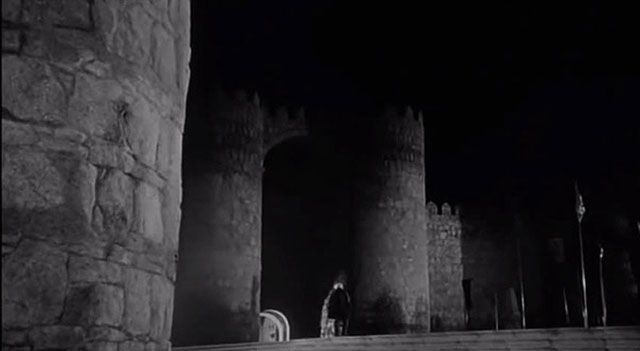
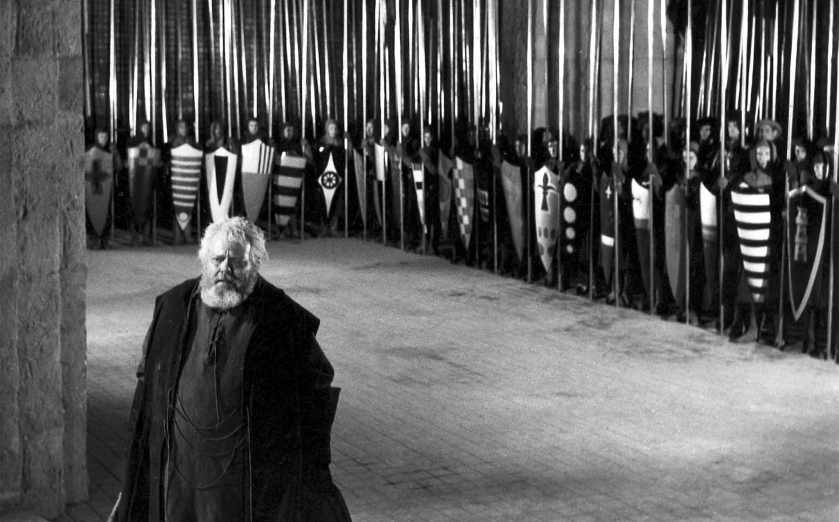
The stage empties, leaving a solitary figure at the center. The pomp of a king’s coronation ended, the shadows of the castle lengthen and the chimes ring out midnight. The figure is a large man, photographed throughout the film from low angles so that he looms, dominates the screen. Now he’s suddenly dwarfed by the architecture that surrounds him. The grin that always adorned his face might still be there, but we cannot see it as he limps out of sight into the graceful shadows. The chimes sound and the stage is vacated.

We don’t see Jack Falstaff again. The next we hear of him he has died, a huge black coffin replacing the bluff, boisterous clown who forms the gravitational center of Orson Welles’s magnificent Shakespeare adaptation Chimes at Midnight.

Chimes at Midnight was a Wellesian dream finally realized as a Spanish-Swiss co-production. Populated with some recognizable actors, including the overwhelming persona of Welles himself, it is nonetheless an oddity, an amalgam of Shakespeare that takes on different proportions as it places Falstaff in the center and removes some of the extraneous details. The film combines scenes, events, and dialogue from Richard II, Henry IV Parts 1 and 2, The Merry Wives of Windsor, and even a bit of Henry V, all held together by voiceover narration from Holinshed’s Chronicles (spoken by Ralph Richardson, no less) that bridges the gaps in the narrative and forms a fascinating counterpoint to the down and dirty experience of war.

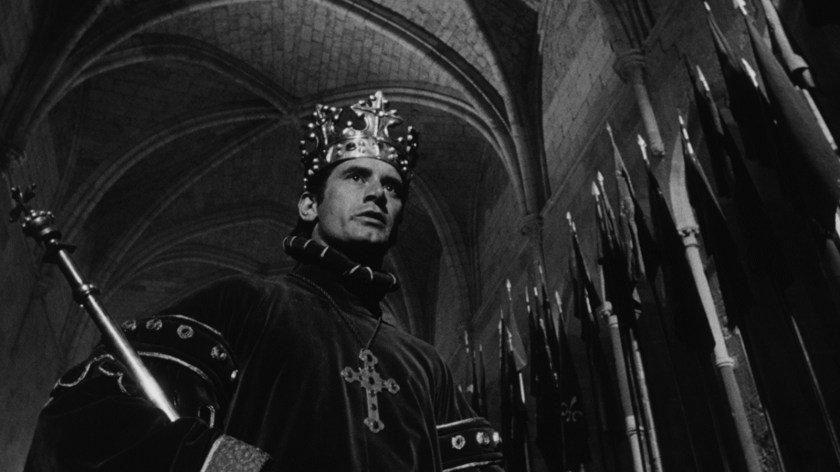
Those who are unfamiliar with the original Shakespeare plays might find some of Chimes at Midnight a bit difficult to understand – the story begins long after the deposal of Richard II by Henry Bolingbroke, who becomes King Henry IV (John Gielgud). Henry in turn faces a rebellion by the Mortimer family and their acolytes – the reasons behind this are somewhat obscure if one hasn’t seen or read the original plays, as Welles eliminates all but the most salient details. The point is that there’s a rebellion, led in part by the hotheaded Henry Percy, better known as Hotspur (Norman Rodway). While the King wrestles with a rising danger to his regime, he has a similar concern with the behavior of his eldest son and heir Prince Hal (Keith Baxter), who spends most of his time hanging out at the Boar’s Head Inn in the company of a gang of ne’er-do-wells and thieves, headed by Sir John Falstaff (Orson Welles).

Henry’s guilt at deposing Richard II underscores the scenes at court, as the King becomes increasingly convinced that he’s being punished for his crimes against Richard in the rise of rebellion and the apparent waywardness of Prince Hal. But Chimes at Midnight is not concerned with the affairs of state and kingship. Shakespeare uses the halls of power as a balancing counterpoint to the world of the inn, giving as much time to the aristocratic concerns as he does to that of the underclasses. Welles uses kingship as a point of contrast, not a central argument. The affairs of the mighty only concern him insofar as they affect the affairs of the common. Falstaff is king here, not Henry, and the film is more about his tragedy than it is about Prince Hal’s ascension to the throne. This element plays out in the numerous parodies of King Henry, as Hal, his friend Poins (Tony Beckley), and Falstaff all imitate the King, striking a parodic note against John Gielgud himself in their vocal mimicry.

Yet Welles does not allow King Henry to be a mere foil for his satire – Gielgud gets one of the most striking speeches in the play. As the King nears death, his face framed in a tight close-up, he holds the camera, the screen, and the audience captive, his elongated, mellifluous tones striking a note of seriousness and sorrow that was missing in the earlier parodies. In contrast to the fast, pattering speeches of Falstaff, Henry’s speech is sonorous and moving, a portrait of a man who believes all he worked and fought for will be lost. Gielgud is physically and verbally the opposite of Welles – thin and angular, he seems to meld with the arches and huge halls of the court, his physicality bound up in the world he occupies. He is the quintessential Shakespearean actor, and his voice carries all the weight of tragedy. Henry will get what he wants – the proof of his son’s nobility – too late for real reconciliation. Like Falstaff, he believes the child he loves has abandoned him; like Falstaff, he will lose his kingdom in death.

chimes_main2050

In focusing on the inhabitants of the inn rather than the concerns of state, Welles draws out one of the plays’ central arguments about the experience of the people under a state of war. Falstaff is a rogue, and not always a lovable one – he owes money to his long-suffering landlady Mistress Quickly (Margaret Rutherford), and occasionally indulges himself by holding up people in the forest. Prince Hal participates in his roguery, however, and the film draws out the fact that while Hal might be doing this for a lark, Falstaff and his company do it for their livelihood. When Falstaff is charged with recruiting men for the king’s next war, he does so by taking every man who can stand up, and then pocketing money for releasing them. In the plays, this carries extra villainy because the viewer has been privy to King Henry’s fears about his own deposal – thus we are invested in whether or not the King wins the war. Not so with Chimes at Midnight – the audience barely understands the reasons behind Henry’s war, and so we’re in much the same position as the commoners who will fight it.

The film’s major set piece occurs during the Battle of Shrewsbury, where the forces of Henry IV and the rebels finally cross swords. Welles takes his initial visual cues from Laurence Olivier’s Henry V in the lead up to war. As with Olivier’s film, the heroes lead a cavalry charge across an open field, pounding hooves that lead to a rattling crash of sword. But there Chimes at Midnight sheds any pretensions to triumphalism. The battle, filmed in black and white and at close quarter, is intense and violent and, most importantly, confused. As men writhe on the ground and horses trample the earth into mud, it’s nearly impossible to tell who is fighting for whom. The battle’s origins are obscure – in fact, the whole battle is fought on a lie, as Hal’s challenge to single combat with Hotspur is ignored by the leader of the Mortimer’s. In the background, Falstaff – comically huge in his oversized armor – runs back and forth, hiding behind trees and bushes and generally trying to keep out of the way until he can steal some glory for himself. Yet he seems to be the only sensible man on the field, gamely trying to keep himself alive rather than fulfill a code of honor.

The dialogue between honor and cowardice plays out in the persons of Falstaff/King Henry and Hal/Hotspur. Falstaff may be a coward, but he’s a live coward – unconcerned with honor, except that which he can steal from others, he comments on the war around him with the full recognition that it is a battle between aristocratic forces. The common people don’t much care if Richard, Henry, or Mortimer is King, yet it is their lives that pay the price. As Hotspur and Hal finally meet, Falstaff lingers in the background – cheering on young Hal not as a knight to his king, but as a father to his son. It is Falstaff, not King Henry, who witnesses Hal’s triumph; Falstaff who calls Hal ‘my boy,’ pas proud as a father can be. Hal achieves far more recognition from Falstaff than he ever does from his biological father, who views his antics with shame.

henry-chimes

Just as the people of the inn parody the people of the court, Falstaff and King Henry become two sides of the same coin. Both old and exhausted by their pasts, Henry finds himself at the end of his life, fearful that England and his house will fall once he has died. Falstaff consistently begs to be remembered, to be advanced because of his loyalty to young Hal – in his memorable line, he tells Hal that to banish Plump Jack is to banish all the world, as though he encompasses all. Of course, this is exactly what Hal does, as both father and surrogate father pass on. As Hal ascends the throne to take his rightful place, he fulfills his promise to a deceased father, and rejects the father who, for all his failings, supported and guided him. One war begets another, as Henry V goes off to fight France for the honor of his house, to prove that he is not a weak or idle king. Falstaff is left behind, dwarfed by the world that rages around him, too old to be of any more use. Where he has been consistently represented as larger than life, his enormous belly, roaring voice, and broad grinning face photographed in stark, at times terrifying proximity in the deepest focus, he now becomes a tiny, almost insignificant figure, an old man, like King Henry, superseded by the boy he loved. His death, and not King Henry’s, marks the end of the story – plump Jack has been banished, and so the whole world.

Welles achieves a remarkable feat with Chimes at Midnight – by cutting and rearranging Shakespeare, he manages to create a new independent work of art that nonetheless remains true to the Bard’s original. He has not removed the multiple meanings of Shakespeare’s plays but highlighted them, giving the work new depth and new meaning. Chimes at Midnight is a unique achievement that few filmmakers have ever equaled.

The Woman In The Woods: The Witch (2016) and Horror Narrative

The Witch (2016)

*originally published on The News Hub

the-witch

Whatever you do, don’t go into the woods – there are witches there. That’s the basic moral of The Witch, one of the odder and more provocative works of cinematic horror to appear in the past few years. Directed by first timer Robert Eggers and without a single star to its name, it has received a wide theater release on the strength of critical praise from Sundance and beyond. It won the Directing Award at Sundance and has been critically touted as the “scariest film of the year,” a slow-burning folktale that reaches back to the roots of Puritanism and our ancestors’ terror of Satanic possession. Critics have dubbed it a milestone in horror, a game changer, a new world order.

There is no doubt that The Witch is a remarkable film. At a basic cinematic level, it’s a brilliant use of atmosphere: the central family occupy a cabin on the fringes of a haunted wood (Canada, standing in for New England), replete with fog and winding, uncertain paths that lead farther from civilization. The film’s well-placed moments of violence and slow-building tension found themselves within the hysterical underpinnings of Puritan religion, making the entire film as much a rumination on sin and salvation as it is a fairly straightforward haunting narrative, the fear of the witch in the woods. It is an effective, intelligent, and somewhat inaccessible art-house film – a film that deals more with the vagaries of belief and superstition than it does with actual scares. There are long sections of silence punctuated by dialogue that has characters speaking in a dialect steeped in religious tradition – a tradition that is never fully elucidated, with Biblically founded terrors that are never fully explained. The Witch is practically a slice of life, with little explanation for much of its horror. It is many things, and all of them interesting, but it is not the horror film we have come to expect.

The Witch both is and is not a horror film. It hits on specific tropes, but does not spend much time in examining their cause within the world of the film. The family is ejected from their colony, forced to eke out their existence in isolation, yet we never learn why they were removed in the first place. Nor is it terribly clear how isolated they really are – we know that they still trade to a degree, and that the colony is still accessible, if a day’s ride away. The film introduces concepts of the demonic possession of women and children, communion with Satan, blood sacrifice, and witches’ Sabbaths, yet the religious underpinnings of these beliefs are developed only through cryptic dialogue and never outright exposition. These are not modern people haunted by an age-old evil at odds with contemporary belief structures, as in films like Paranormal Activity, but a family steeped in a cultural tradition where these things are very real. The Witch advertises itself as a “New England folktale,” and it is something like listening to a folktale from an antecedent culture we no longer live in. The Witch does indeed hit generic horror markers, but from the perspective of foundational horror myths themselves. It looks back in time to treat of terror from the source.

The horror genre has gone through numerous permutations in its long, complex history. Even if one passes by horror’s literary and folktale antecedents, the changes in genre from the advent of film to the contemporary period mean that some traditional horror is almost unrecognizable as scary to us now. Horror is steeped in the bending of tradition – it possesses its own rules, which it subsequently breaks, and then enforces new rules based on the breaking of the old ones. In the most simplistic terms, horror brings up the fears of the culture from which it stems, often altered or manipulated so that our monsters are but amalgams of our collective terrors. Horror is the collective cultural nightmare and even if we don’t always find it particularly scary, we always see something of ourselves within both the victims and the monsters. In this context, what are we to make of The Witch?

thewitch2

One of the through-lines of The Witch is fear not just of the Other, but of the female Other. Female monstrosity is as old as the horror genre, and The Witch seeks for some of the historical antecedents of the fear of the feminine. Early in the film, the audience learns that witches are real and that they do all of the things that old Puritan stories say they do: stealing unbaptized children, dancing naked at midnight, having sex with Satan, transforming their shapes, leading men (or boys) astray. From our cultural perspective, The Witch reinforces the continued contemporary fear of the feminine – the witch (one of them at least) is an ugly monstrosity, the very symbol of the monstrous feminine. The film does not treat of the viciousness of witch trials or accusations, nor does it account for the foundational fears of powerful (and sexual) women that made the Puritans so very hysterical. Witch lore is rich in manipulative misogyny and power dynamics, yet The Witch avoids this dialogue in favor of a family drama driven by externalized fear and internal strife. At the same time, the film provides a catharsis of a sort, as the teenage girl at the edge of womanhood chooses to reject her father’s repressive religion and ally herself to the (feminine) darkness. The film does not fall into the error of proclaiming itself as feminist or anti-feminist, but rather presents a complex, multi-layered narrative that presents itself as an examination into the foundations of contemporary horror.

The horror genre has been going through yet another shift in focus. A genre often – though not exclusively – dominated by patriarchal prerogative, it now has begun to focalize through the female experience. Women in horror have often been monsters and have often been victims, but rarely have they been the driving narrative force. Rarely have they possessed the camera, either behind it or in front of it, and so films like The Babadook, A Girl Walks Home Alone At Night, It Follows, Teeth, and, now, The Witch are unique in their focus on the feminine experience, both from within the characters themselves and from their external participation patriarchal structure. Even the original version of Paranormal Activity, a film that arguably began the most recent low-budget, low maintenance horror craze, was directed through the experience of a woman faced with male disbelief and then fear. The Witch, though far from a feminist work, adds another piece to the puzzle.

In returning to the origins of American horror, the film places itself in a unique and problematic position vis-a-vis its audience. The audience with which I saw The Witch was not particularly receptive to what the film was trying to achieve. While they were relatively respectful during the first half of the film, the building of tension and atmosphere began to give way to boredom. The people beside, behind, and in front began to talk, and then to giggle during silences or periods with long stretches of dialogue. The lack of jump scares, of any real recognizable “horror” tropes, evidently got to them. By the time the film had ended, both my friend and myself were seething with anger because we had been robbed of our cinematic experience.

I think this experience was indicative of a failing not of The Witch, but of it’s marketing, and of the way that critics have treated it. The Witch is not a horror film in the contemporary sense – it is an introspective drama, a folktale with horror elements that nonetheless cannot and should not occupy the same space as Paranormal Activity. It is about a culture that you must have some background with going in, as well as a willingness to pay attention to the film’s structuring of religious superstition. To offer this film to audiences with the promise of “the scariest film ever made” is to set yourself up for exactly the problem I had: an audience that grows increasingly frustrated with the film failing to fulfill new genre conventions. And so the film suffers, along with those who wish to experience The Witch as it actually stands, and not as critics imply that it’s supposed to stand.

Even as critics tout the film, audience response has been overwhelmingly negative. The complaint, I think, is not so much that The Witch is a bad film, but that rather it does not appeal to the things that many audiences want it to appeal to. It is an art-house film, applicable to those who want to investigate terror in the silences, the power of Calvinist religion, the fear of sin, the origins of horror. This is a world in which witches are real, in which children can accuse their elders of communing with the devil, in which Lucifer can appear in the form of a black goat, in which freedom comes at the price of your soul. This is the world of the Puritans, a world of darkness and real terror, but a world that is full of silence, of struggle, of random death and rampant dedication to a very strict system of belief. It is not a world of things that go bump in the night.

the-witch-2015-2

I believe that The Witch will ultimately receive its due and will be understood for the thing that it is and not the thing that it is not. At the very least its critically enforced popularity asks greater questions about what scares us as a culture, both where those fears came from and where they might be going. The future of the horror genre is bright, it seems, even as we wander in the darkness.

I Shot Jesse James (1949)

I Shot Jesse James (1949)

*Originally published on The News Hub

poster-i-shot-jesse-james_01

When we think of director Samuel Fuller we tend to think of films noir about displaced men, damaged women, criminals searching for redemption, and tabloid stories expanded to the level of mythology. Yet Fuller cut his teeth originally in the Western genre, with his first feature film I Shot Jesse James. This might seem like a strange starting for the crime reporter and veteran turned director, especially for those already acquainted with Shock Corridor and The Naked Kiss, but I Shot Jesse James shares remarkable affinities with those more perfected works of tabloid filmmaking.

I Shot Jesse James takes as its subject the now iconic shooting of Jesse James by his friend and fellow gang member Robert Ford. After being injured in a bank robbery, Ford (John Ireland) holes up in Jesse’s (Reed Hadley) house to recover. Ford is in love with Cynthy (Barbara Britton), a singer who keeps on refusing his marriage proposals because he can’t give her a stable existence. When Ford learns about the bounty on Jesse’s head, including a substantial reward and amnesty from imprisonment or execution, he chooses the coward’s way and decides to betray and murder his best friend.

James’s death is the catalyst for Ford’s narrative to truly begin, but the film is not particularly concerned with the relationship between the two men. In the aftermath of the killing, Ford finds himself vilified in the eyes of the public, and in the eyes of Cynthy, who wants nothing more to do with him. He’s given only a fraction of the reward and forced to make a new living, branded a coward and a traitor. After a brief stint in which Ford re-enacts the murder onstage for an eager public, he heads out West to Colorado on a search for silver and gold, which he hopes will be the key to make Cynthy marry him.

ishotjessejames

I Shot Jesse James could have been a straightforward Western, but Fuller turns his attention to the internal, as Ford grapples with his cowardice, his anger, and his sense of betrayal. The murder of Jesse invigorates Ford’s nascent self-loathing. Far from a real villain, he keeps trying to take the easy way out, insisting on his love for Cynthy despite her consistent rejection of him, fooling himself into the belief that everything he did, he did for love. Ireland plays Robert Ford with a pathos tinged by hollowness – he seems to not quite understand why Cynthy would be horrified by him, or why the public would vilify him. While not an inherently likable character, his tragedy lies in the flaws that pushed him to murder Jesse in the first place. He’s a coward not because he’s afraid of Jesse James, but because he truly does love the man he murders and so cannot bring himself to look his victim or his crime squarely in the eye. In a particularly powerful sequence, Ford listens to a wandering singer sing “The Ballad of Jesse James,” detailing Jesse’s murder with references to Ford as “the dirty little coward/who shot Mr. Howard.” Each word is a bullet in his heart, and while the singer shakes with fear that Ford will kill him, the viewer sees Ford’s palpable pain. He sees himself as a coward just as much as anyone else, and it’s a stigma he must continue to carry with him, for all he does to eradicate it. He finds a short-lived redemption in the wilds of Colorado, but his continued obsession with Cynthy forces him back into the same pattern, grappling with flaws that will never be resolved.

Fuller’s usually indulgent cinematography is circumspect in I Shot Jesse James. There are no indulgent flourishes, explicit POV shots, or surreal sequences that will so palpably characterize later films like The Naked Kiss and Shock Corridor. Fuller is beginning to develop his style, focalizing the narrative through Ford’s experience and forcing the viewer into a position of sympathy with an occasionally unsympathetic protagonist. Most powerful is the build-up to Jesse’s murder, as Ford contemplates the ease with which he can shoot his friend without even the smallest shred of danger to himself through numerous focalized shots of Jesse’s back.

There are flaws in I Shot Jesse James, though most of them can be put down to generic conventions. This is a B-movie, full of melodrama and heightened emotions, with actors screaming and crying rather than performing with subtlety. The film buys into the characterization of James as a Robin Hood, an outlaw who only kills when he has to, who robs from the rich and gives to the poor – a major departure from the actual history of the James Gang. But this is not a film concerned with history or even verisimilitude. This is the stuff of legend, the story of a legendary outlaw and a legendary coward. Ford’s story gains traction as the film reveals him as more complex, more tragic than the man he murdered. While it never compare favorably with a Bergman film, I Shot Jesse James doesn’t particularly want to. Robert Ford’s tragedy is a melodrama set for the stage.