A River Below (Tribeca 2017)

A River Below (2017)

Every year, the Tribeca Film Festival showcases some of the most interesting documentaries currently in the running, usually adhering (either by accident or design) to a general theme. Last year, nuclear proliferation and the rise of the police state was a major source of dialogue within Tribeca’s documentary entries. This year, the focus has shifted a little to the relationship between art, media, and commerce, and the effects that art and media can have on real world problems.

One of the major issues facing any documentarian is the fact that once you have turned a camera on something, you are affecting its outcome, even if just by drawing attention to a subject. Assuming the documentarian to be operating in good faith, this can sometimes, result in the exposure of corruption, or increased scrutiny on a humanitarian or environmental crisis. It can also cause untold ripple effects that the filmmaker might not have ever foreseen.

A River Below from director Mark Grieco grapples with the issues of environmental reality in a media-driven world. Its initial focus is on an apparently clear-cut environmental problem: the disappearance of the pink river dolphin, a native species of the Amazon that is being hunted nearly to extinction by fishermen who use its flesh to catch a scavenger fish popular as a dish in Columbia and Brazil. Attempting to find ways to conserve the dolphin are Fernando Trujillo, a marine biologist, and reality TV star/conservationist Richard Rasmussen. These men act as the dual stars of this increasingly fascinating and bizarre story of media, nature, and economy.

The film appears to be just an investigation into the conservation attempts surrounding the pink river dolphin and its relationship to the local economies of the Amazon—a troubled but not unknown set of issues that encompasses both the human and the environmental toll of the fishing industry and the political system. The film takes a sudden twist, however, when it discusses one of the major turning points in the attempts at conservation: video footage of the slaughter of a pregnant dolphin by local fishermen, released to popular TV show Fantastico. The video inexorably leads the documentary down a new political and media-fueled path. The story of the video, and the ripple effects that it has on everyone involved, takes up the majority of the film’s runtime, raising questions about the meaning of reality and the future of conservation in an increasingly media driven world.

A River Below deals with a multitude of complex and thorny issues. The filmmakers themselves must make choices about how their film is put together and what they show, but rather than condemning or lauding any of their subjects, they let the subjects speak for themselves—sometimes allowing the camera to continue running long after someone has ceased to speak. There’s a tacit acknowledgment that editing will affect the way that the topic is seen, and certainly the viewer might begin to come down on a single side (at least one of the main players in this drama comes off very badly indeed). But the film also doesn’t shy away from depicting every side of the story, further entwining the viewer in a circuitous course as confusing and dangerous as the Amazon itself. The crux of the story is the degree to which fiction is used to augment reality in order to bring closer attention to a real problem, and who is sacrificed on the altar of someone else’s conservation attempts. The results—what the camera does and does not show, what difference editing does indeed make—have diverse effects, many of them unintentional.

A River Below might have done well to scrutinize its own motives slightly more, or at least reveal the apparatus behind the film. In a film that purports to tell a straightforward story, it fails to completely acknowledge that even in telling the story, and constructing it the way that it does, it produces a very particular narrative. While Grieco and his crew are attempting to present a non-biased perspective, even the presence of their camera affects the way that the subjects talk.

A River Below ultimately doesn’t provide answers to some of its thornier problems, but it does lay bare the way in which media scrutiny affects the world. As the film winds its way further into the jungles of the Amazon, a simple narrative fails to emerge, save for the single overarching element of exploitation. The dolphins and people alike are caught in the same webbed system, and many are unable to extricate themselves from it.

LA 92 (Tribeca 2017)

LA 92 (2017)

LA 92 is unlike any documentary I’ve ever seen. Few documentaries plunge you into the middle of a rioting city, into the bleeding heart of America itself. Made up entirely of archival footage, including home video, news reports, and behind-the-scenes images, the film tells the story of the violent destruction of much of L.A. following the Rodney King verdict in 1992. The film traces the city’s history of racial discrimination and police brutality that came to a head (once again) with the beating of Rodney King and the exoneration of the police officers by a primarily white jury.

The film begins with footage of the Watts riots in 1965 that followed the brutalizing of two African-American men by police officers. Moving forward to the 1990s, L.A. remained in turmoil, brought to a head when Rodney King was dragged from his car and beaten bloody by several LAPD officers. Not long after King’s beating, a Korean grocery store owner shot and killed fifteen-year-old Latasha Harlins over a carton of orange juice—the shooting, again, caught on the security camera. The owner was eventually convicted but the judge commuted the sentence of sixteen years in prison to community service and a fine. The King verdict, then, is seen in the light of more than thirty years of racial violence in L.A., and the fairly recent spate of violence against African-Americans that the American justice system failed utterly to punish.

The foment of anger and despair is palpable throughout LA 92, and the viewer is forced into close proximity with that anger. It’s impossible to trace the series of events, up close and personal, and fail to understand just what a searing and shocking miscarriage of justice the King verdict was. The energy and the anger is so intense in the lead up to the King verdict that it’s hardly surprising it boiled over into total violence. What is shocking is the degree of violence, and the film draws the viewer directly into the heart of the riots via footage filmed right at the ground level. Protests outside L.A. police departments turn into riots; marches meant to be peaceful boil over into burning and looting, as the city’s incredible fury finally erupts.

LA 92’s greatest strength is that it does not purport to be a political work—it simply shows what happened, and why. It’s a difficult film to watch as it shows, with an unflinching gaze, an American city transforming into a war zone, people bloodied, beaten, cars burned, buildings gutted, and citizens clashing with each other, while police and National Guard troops stand by and do nothing. The lack of concerted police response to the riots exposes a police department and a city government apparently unaware of the degree of anger surrounding the King verdict, and unable or unwilling to do their jobs and protect and serve the people of Los Angeles. There are images here that will be seared in the viewer’s memory: of a woman watching her shop burn, screaming at the unfairness of it; of a man dragged from a truck and beaten almost to death; of Korean shopkeepers arming themselves with automatic weapons to patrol in front of their shops like soldiers; of young men and women, howling in impotent rage, breaking and burning everything in their path because no one will give them justice; of King himself, nearly in tears, begging for it all to stop.

But LA 92 is far more than a historical document—it’s a warning. The film shows, in stark and certain terms, the consequences of a country refusing to provide its citizens, all of them, with the protection and the justice they deserve as human beings. What happened in L.A. in 1992 is not shocking at all, given the current events surrounding police brutality and violence against African-Americans in Ferguson, Cleveland, Baltimore, New York, and across the country. Nothing that happened in L.A. in 1992 was right—not the verdict, not the riots, not the government response, not the loss of life and of property, not the violence done against a city by its own people. But it is the result of an apparently incurable sickness in this nation, as we continue to refuse justice to people because of the color of their skin, as we continue to treat human beings like animals.

It happened before. It is going to happen again.

LA 92 is currently at the Tribeca Film Festival. It will premiere on National Geographic on April 30.

Shadowman (Tribeca 2017)

Shadowman (2017)

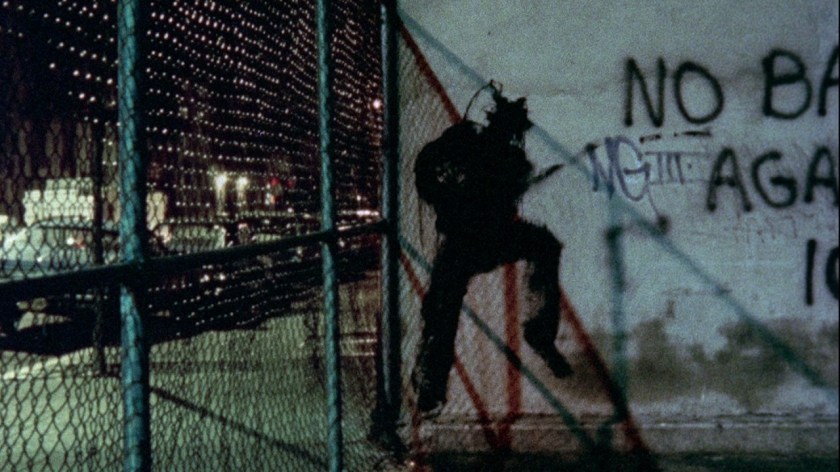
Oren Jacoby’s Tribeca documentary Shadowman looks at the vibrant New York street art scene through the life and work of graffiti artist Richard Hambleton. Along with Jean-Michel Basquiat and Keith Haring, Hambleton became representative of the gritty energy of emerging street art as he painted over the streets of the Lower East Side with his famous “Shadowman” paintings. The stark, ghost-like paintings that appeared on walls and buildings around New York City were calculated to produce the maximum effect on the viewer, interacting with and informing on the urban landscape. Unlike his contemporaries, however, Hambleton survived the epidemics of disease and drugs that decimated the scene, instead vanishing suddenly at the apex of his fame. Through talking head interviews, copious archival footage, and contemporary chronicles, Shadowman paints itself through the 1980s and into the current period, following Hambleton’s strange and meandering path around (and on) the Manhattan streets.

Shadowman presents itself as a window into the gritty, wild, energetic art scene of the Lower East Side, as well as a more personal look into the enigmatic nature of Hambleton himself. Though his studio art was valued at a higher rate than Basquiat’s, Hambleton is not the household name of his contemporary. Some of this is a result of the latter’s personality: Arrogant and self-destructive, Hambleton falls out the bottom of the scene as he increasingly refuses to engage in the branding and sale of himself as a commodity. His drug addiction and connected problems further alienate him from those who try to help him when he stops being dependable. He’s used by friends, who take advantage both of his drug addiction and his desperation; he makes agreements with gallery owners and enthusiasts only to renege on them for no clear reason.

What Hambleton—and, by extension, Shadowman—grapples with is the notion of public art when it becomes mainstream, and the ever-present dichotomy of artists needing to survive while at the same time avoiding selling out to a market. By any stretch, Haring and Basquiat sold out, choosing to play the art world game, branding their work for mass consumption. Hambleton didn’t, moving from his Shadowman paintings to an obsession with the Marlboro Man in his studio art, and finally to the “beautiful paintings” that he produced as he became more involved with drugs and eventual homelessness. Owners of Hambleton paintings recall being asked by gallery owners if “Richard is still alive,” knowing that his art will increase in value the moment he dies.

As the film proceeds, Hambleton becomes more, not less, enigmatic. He’s “rediscovered” by several gallery owners and patrons in quick succession, but he’s erratic, unwilling to declare pieces finished despite constant deadlines. He’s found living on the street, in abandoned gas stations, or in flophouses with prostitutes and drug dealers, trading paintings for a meal or drug money. When he’s rediscovered yet again, he’s sick with skin cancer (for which he refuses to get treatment), his back twisted by scoliosis, his body and mind damaged by years of drug abuse. He’s finally offered the opportunity to open his own show, and to once again make enough money to get himself out of the vicious cycle he’s lived in since the mid-eighties. But Hambleton continues to resist commodification, even when it’s in his own best interests. Yet his rejection of commodification isn’t particularly represented as political—it’s rather his inability to do anything except produce art, even to the detriment of his body. He produces art because he must.

Simultaneously tragic and honorable is Hambleton and his total unwillingness to compromise. It would be easy to categorize him as the artist fallen low, or to try to paint his arc into a redemption narrative. But what Shadowman hammers home, intentionally or not, is that life does not fit into comfortable narratives, and that even artists might not fully understand, or be able to articulate, the reasons behind their work. Like his surprising, frightening shadows, now no doubt painted over and subsumed beneath gentrification, Hambleton remains. As the film closes, he becomes a living embodiment of the old New York, a shadow, a reminder of the city’s violent, beautiful, and tragic past, and the people who lived it. There’s something deeply artistic about that.

Shadowman is currently showing at the Tribeca Film Festival.

The Blackcoat’s Daughter (2017)

The Blackcoat’s Daughter (2017)

Horror filmmaking continues into its renaissance, thanks in large part to a burgeoning indie scene that has dragged the genre back from the mainstream and given voice to writers, directors, and productions that would otherwise have none (read: it ain’t just straight white dudes running the show any more). Today, A24 adds to their formidable indie cred with the release of The Blackcoat’s Daughter, a fascinating little horror movie from the mind of Osgood Perkins.

Set in a Catholic girls’ boarding school somewhere in Bramford, NY, The Blackcoat’s Daughter focuses on classmates Kat (Kiernan Shipka) and Rose (Lucy Boynton), whose parents fail to show up to pick them up for a week’s vacation. While Kat is convinced that her parents are dead, Rose attempts to reassure her, but has problems of her own. Left alone in the school, with the sole exception of two nuns, bizarre things begin to happen, and it becomes apparent that the girls are not totally alone, the hallways stalked by something not quite human. Their story is intercut with Joan (Emma Roberts), a girl who arrives at a bus station in the dead of winter and is given a ride by Bill (James Remar) and his wife Linda (Lauren Holly) to Bramford.

The film cannily avoids revealing too much of its hand at once by constructing a three-pronged tale from varying perspectives, intercutting the experiences of Rose, Kat, and Joan without offering too much introduction or explanation. Just what is happening, and why, only becomes apparent with the piecing together of narratives and minor, apparently throwaway lines. Because of this, the initial half hour of the film might feel disjointed and directionless, but as it all begins to come together, you realize that there was indeed a method at work.

The Blackcoat’s Daughter has much in common with other films that involve devilish hauntings – and bears more than a passing resemblance, visually and thematically, to The Exorcist and The Witch. Yet it is also, fundamentally, about loneliness, and about the lengths to which people will go to escape from the isolation of their lives. The girls are isolated, physically and metaphorically. The inherent loneliness of their situation is rendered palpable by their surroundings, and the horrors that they face become almost inevitable in their enforced isolation – even the blankets on their beds look cold and inappropriate for the weather. The only source of real heat, and color, on the screen is the furnace in the school’s basement – a chilling symbol, in fact, as the significance of the furnace becomes clearer. The storytelling technique here meshes brilliantly with the stark, almost black and white cinematography (and, having lived through numerous Central NY winters, I can safely say that the depiction is pretty much spot-on).

The Blackcoat’s Daughter is a fascinating film, another excellent indie horror that frightens without relying on major jump scares or buckets of blood (there is blood, but it’s late in the day and it’s very effective). While it doesn’t quite live up to the multiple layers of A24’s similar production The Witch, The Blackcoat’s Daughter does bring an oblique terror all its own.

A Knock At The Door (Short) (2017)

A Knock at the Door (2017)

I am rapidly becoming more convinced that female writers, directors, and female-driven subjects will end up being a major force in the development of the horror genre. This has become increasingly apparent with a spate of fairly recent releases, as women carve out their niche is what has been a male-centric and dominated genre. At the NewFilmakers LA festival this month, female directors have taken a front seat with a showcase of films. One of these is the short A Knock at the Door, written and directed by Katrina Rennells and Wendie Weldon, and produced by Kelley Mack.

A Knock at the Door is an unsolved mystery of sorts, telling in its scant eight minutes the story of Nick (Drew Jenkins), who comes home one evening and hears a terrifying scream from next door. The next instant, Sara (Mack) knocks on his door with an explanation that Nick (and the viewer) doesn’t exactly buy.

A Knock at the Door has a twisted spirit that would serve it well as a full-length feature – in fact, its one major flaw is its length, which limits its story to the barest details and offers little exposition in what we see. Still, for its shortness, it manages to ramp up the tension very quickly, via quick cuts and disturbing sound cues played over otherwise innocuous moments. Like many contemporary horror films, A Knock at the Door creates a cyclical story based in a suburban setting, the threat being the people that surround you every day. Just what is happening to Nick – and why – is never fully elucidated, but the film doesn’t burden itself with attempting to offer explanations for the inexplicable. Nor does it rely on jump scares or gore to make its point; flashes of horror and subtle, unfinished moments are all it needs.

Nevertheless, I found myself wishing that this was a full length feature rather than a short. One would hope that Rennells, Weldon, et al will make further forays into full length horror films. What the film certainly reinforces is that female writers and directors are damn good at horror.

So, watch out for A Knock at the Door. There’s something very interesting going on here.

Mr. Sardonicus (1961)

Mr. Sardonicus (1961)

*now streaming on Shudder

Director William Castle stands shoulder to dubious shoulder with Roger Corman as one of the premiere makers of American B-horror. While Corman lavished his audience with Technicolor-soaked melodrama punctuated by the occasional bout of Grand Guignol violence, Castle went the gimmick route, creating B-pictures that sought to expand the movie-going experience by involving the audience directly. The most justifiably famous of these was The Tingler, in which Castle famously wired up the theater seats with buzzers to scare the audience. Castle’s 1961 schlock-horror masterpiece Mr. Sardonicus is arguably the better film, happily reveling in its ghoulish carnival of the grotesque, with the director himself as Ringmaster.

Mr. Sardonicus is based on Ray Russell’s story of the same name (and Russell himself wrote the screenplay). It tells the deliciously malevolent story of Sir Robert Cargrave (Ronald Lewis), a doctor summoned to the nation of Gorslava by his former lover Maude (Audrey Dalton) to help her mysterious husband, the Baron Sardonicus (Guy Rolfe). Sardonicus is the “victim” of a terrible affliction: while robbing his father’s grave to obtain a winning lottery ticket, he’s so horrified by the appearance of the corpse that his face becomes frozen in a hideous grin. He enlists the help of Sir Robert, an expert in the healing of paralyzed limbs, to restore his face. But Sardonicus is also a sadist, torturing his servants, abusing his wife, and doing unspeakable things to young women in his off-hours, and Sir Robert has some serious reservations about assisting him.

Mr. Sardonicus is just an excellent B-grade picture, totally indulgent of the nastiness it’s presenting on-screen without excuse, or even particularly strident morality. The good guys are not too good – Lewis’s performance as Cargrave is somewhere between concerned and totally done with everything – and Sardonicus’s tragic backstory at least gives some meat to his character. Oskar Homolka is particularly notable as Krull, Sardonicus’s faithful servant who carries out some of his less palatable orders with a twisted glee.

Castle’s films are always heavy-handed, more like carnival rides than actual films, but Mr. Sardonicus moves beyond some of his more gimmicky work. The grotesqueries and “shock” moments are fully integrated into the main story, rather than acting as extraneous gimmicks. The most disgusting and enjoyable of these are the prosthetics used for Sardonicus’s smile, which are actually quite good for this period of film history. Russell’s story – already a masterwork of grotesque horror – translates brilliantly to the screen, and even manages to fill in some glaring plot-holes that might otherwise have remained open.

Superintending everything is Castle, who appears on-screen at the beginning and nearing the end of the film to remind the audience that we’re all here to watch terrible things happen to terrible people. His gimmick this time is giving the audience the option of voting on the ending – one in which Sardonicus is punished, and one in which he’s given mercy – by providing cards with a thumbs up or thumbs down on them. The transformation of the cinema to the site of participatory, gladiator-style theater has to be seen to be believed.

Mr. Sardonicus has a mean streak a mile wide, and asks you to participate in every wondrous moment of it. The more I watch of Castle’s films, the more I realize that he was one of cinema’s finest Ringmasters, fulfilling the audience’s penchant for murder and mayhem by getting them involved in the proceedings. There’s a weird pleasure to be derived from his films, something on the order of being escorted through a house of horrors by a guide who enjoys the wax figures and flying skeletons even more than his audience.

*Like this review? Please consider contributing to my Patreon.

Prevenge (2016)

Prevenge (2016)

*soon to be streaming on Shudder

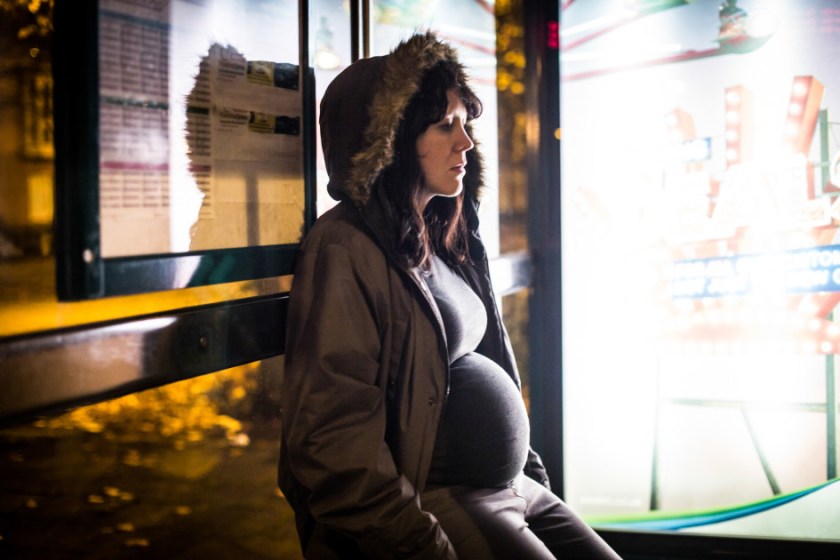
prevenge_01

There’s nothing weirder, or more terrifying, than taking the innocence of the child and imbuing it with a secret malevolence concealed behind an angelic face. Within the evil child subgenre of horror, the mother is typically the victim, the most obvious target for the child’s hatred. Alice Lowe’s bizarrely delightful horror comedy Prevenge takes those tropes and warps them even further to create a bloody, hilarious, and moving story that asks the question: what if your unborn baby was a serial murderer?

Writer/director Lowe is Ruth, a very pregnant young woman in Cardiff who becomes convinced that her unborn daughter is impelling her to commit murder. As Ruth and her massive belly cut a bloody swath through the night, the mystery of her vengeance is gradually revealed through flashbacks and personal discussions between Ruth and her daughter. The murders are suitably gruesome without being overkill, while Ruth’s motivation for the killings becomes complicated by the fact that none of her victims are particularly sympathetic people.

Lowe is an entertaining screen presence with a wry sense of humor, punctuating her horror film with comedic moments that cut through the violence. She likewise imbues the undeniably comedic aspects of the film with a very palpable sense of anger and loss. Like The Babadook (another film about sympathetic female monstrosity and motherhood), Prevenge treats grief as a physical presence that manifests itself through acts of horrific violence. But the film is further complicated by the questionable nature of Ruth’s sanity – is her unborn child really a monster, or is her pregnancy and its undercurrent of grief warping her mind?

The difference between Prevenge and a similar pregnancy horror film like Rosemary’s Baby is that the mother is herself not a victim – she finds outlet for her fury through her pregnancy, refusing to be subject to the assumptions and controls of the rest of society. It’s hard to feel sorry for most of those subjected to Ruth’s wrath, representative as they are of selfishness, misogyny, and complacency. Ruth’s pregnancy represents both her monstrosity and her strength; she possesses the social stigma and monstrosity that transforms a woman’s body into a vessel “controlled” by the unborn child. While Western society is accustomed to treating pregnant women as both the sublime form of human nature and the ultimate Other, Ruth takes over her Otherness, using it to enact revenge on those who (in her perception) have wronged her.

Prevenge has few weaknesses. It’s well-paced, building up the tension between Ruth’s acts of violence by interspersing visits to the doctor to monitor her pregnancy, and her conversations with the very angry child inside of her. Giving voice to the baby makes it more palpably real, deepening the question of whether Ruth is acting out her own revenge fantasy or the fury of the child that has been deprived even before it was born. That voice also contributes to the comedic nature of the film, refusing to plunge too deeply into elements of horror, grief, or anger, as Ruth argues with a tiny childish voice inside of her about the morality of cutting off a man’s balls.

The female body and female emotions have so typically been the site of monstrosity in horror films that women began to suppress the notion that our hormones and our physical presence in any way distinguished us from maleness. PMS, postpartum depression, the alterations in hormones that comes with pregnancy, the pain of having a period – all suppressed in the belief that to be female was, in essence, to be an Other, to be something unknown and frightening. In evil child films, to be a mother is to be a victim, and in some ways a deserving one – the mother is the conduit for unnatural evil, the one who brought the evil into the world and is thus destroyed by it. It is the role of the father, or of the masculine society, to control that evil, condemn it, and banish it, usually at the expense of mother and child alike. Femininity is uncontrollable emotions writ large, and as such must be suppressed and controlled by the more rational masculine forces.

Prevenge eliminates the father, the patriarchal, and embraces Otherness, the perceived monstrosity of women, and of pregnant women especially. What’s more, it does so from a sympathetic, feminine perspective, emphasizing the cohesion between mother and child, the reality of female anger and the need to express it, or to destroy the world in the attempt. In horror, women typically have a choice between being the victim or the monster. We’ve chosen the monster.

Prevenge will stream on Shudder on March 24.

*Like my writing? Please consider contributing to my Patreon. Your support is appreciated.

A Cat In Paris (2010)

A Cat in Paris (2010)

*currently streaming on Sundance Now

a-cat-in-paris1

Although many of us bemoan the death of the video store, one of the (unintentional) consequences of the rise of streaming services is the broadening market for indies and foreign-language films. Movies that otherwise would have been found buried in the stacks at Blockbuster are widely available. I know for certain my childhood Blockbuster wouldn’t have carried A Cat in Paris, an animated film from Folimage that was nominated for an Academy Award back in 2010.

A Cat in Paris tells of the exciting adventures of Dino, a black cat with red stripes who lives with Zoe and her mother Jeanne by day, and by night accompanies dashing cat burglar Nico on his nefarious rounds. Dino is a source of solace and companionship for Zoe, who has become increasingly distant from her mother since her father’s murder by crime boss Victor Costa. In her grief and anger, Zoe has retreated into herself, refusing to speak and largely relating to her cat. While Jeanne investigates her husband’s murder, she leaves her daughter in the care of Dino and their housekeeper Claudine. Dino’s wanderings soon result in the intersection of Jeanne and Nico’s lives, when he accidentally leads Zoe out of the house and into danger.

A Cat in Paris has both its plot and its animation style going for it, developing the characters as much through their fluid movements and physical types as through their roles in the actual narrative. Nico’s movements are fluid, his arms and legs bending and elongating as he traverses the rooftops of Paris with catlike (!) ease. He’s of a piece with Dino, perhaps the most perfectly inscrutable and adorable representation of a cat in animation. Dino is completely at home sliding across fences, annoying dogs, and following in the footsteps of his criminal friend, then returning home to cuddle Zoe and reassure her that she’s loved, as only a pet can do.

As the film develops from Dino’s nighttime wanderings to a screwball-ish caper somewhere between latter-day Hitchcock and Stanley Donen’s Charade, the animation doesn’t lose its sense of magic. Paris is rendered in all its beauty, the essence of the city captured in  stuttering, elegant lines and popping colors. The film doesn’t shy away from creating a sense of danger, though the effect is more emotional and psychological than representative of real physical violence. One sequence in which the lights go out during rescue attempt is drawn so brilliantly style that one realizes this is a film that must be animated, that cannot exist outside the realm of hand-drawn art.

My sole complaint about A Cat in Paris is that I was unable to watch it in the original French via streaming, and so had to make do with the English language version. However, this also means that I got to hear Anjelica Huston doing voice work as Claudine, so it all came out right in the end.

Coming in at a brisk 65 minutes, A Cat in Paris is a welcome respite from CGI, as well as an adventure worthy of a 1960s caper film. It also reminded me that of all the cities in the world, Paris is still the most magical.

A Cat in Paris is available to stream on Sundance Now.

*Like my writing? Please consider supporting my Patreon!

The General (1926) and Three Ages (1923) (Blu-ray Review)

The General (1926)

the-general-1926

The General holds the distinction of being one of the two most famous Buster Keaton films ever made, and consequently the one most often seen even by those who might resist silent cinema. And what a film it is. The General spends the vast majority of its hour and fifteen minute runtime in a breathless chase sequence, with stunts that become ever more elaborate as Keaton and his crew risk life and limb for the sake of a good joke. In this new restoration from Kino Lorber and Lobster Films, we can finally watch The General in all its gorgeous glory (and in the original aspect ratio!).

Keaton is Johnnie Grey, an engineer on the Western & Atlantic Railroad who loves two things: his engine The General, and his girl Annabelle Lee (Marion Mack). When the Civil War breaks out, Annabelle pressures Johnnie to enlist, but the Confederate Army thinks that he’d be more useful as an engineer than as a soldier. Believing her man is a coward, Annabelle refuses to have anything more to do with Johnnie until he puts on a uniform. Fast forward a year, and Annabelle is traveling on the Western & Atlantic to go see her father, who has been injured further North. Little does she – or Johnnie – know, but The General is the target for Union saboteurs, who steal the train with Annabelle still on board. Johnnie gives chase, vowing to bring back his engine and his girl.

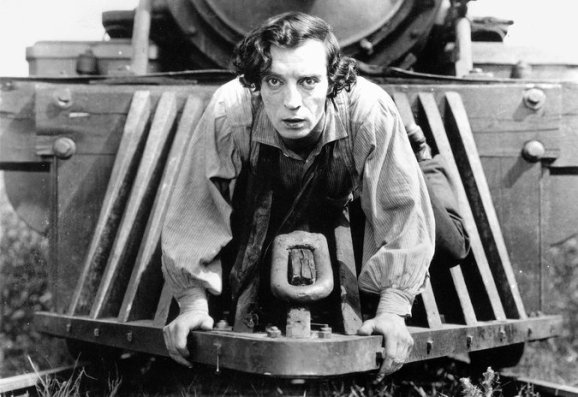
The stunts in The General are some of the most remarkable that Keaton would ever pull off, with the comedian riding on the cow catcher, running over the top of the train cars, firing cannons around bends, and setting a bridge on fire. But the stunts also pay off as shocking feats of athletic – and locomotive – prowess that today would take ten stuntmen and lots of insurance forms. The directing and editing of the film plays a large part in The General’s success, maintaining a breakneck speed and elegance that provides a study in continuity editing.

The odd quirks of The General – such as Keaton insisting that the heroes be the Confederate Army, because no one would have sympathy with the Union – don’t serve to undermine it. While the Civil War acts as a backdrop, and there is an undercurrent of the South’s heroism, it’s a very apolitical film, more about the triumph of the little man than about any big victory for the rebels.

Three Ages (1923)

three-ages-123

Lesser known than The General or even than the other two films in Kino’s other Keaton collection is Three Ages, an underrated little gem from 1923.

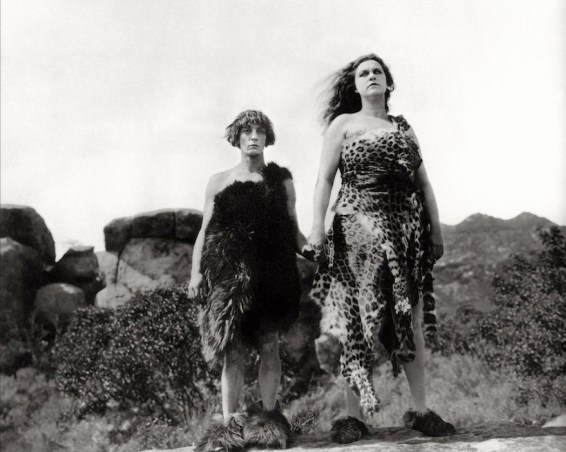
Three Ages gently mocks D.W. Griffith’s Intolerance by taking a similar structure and subject matter, telling of universal human experience through three stories from three different periods of history. Keaton here takes on “love” through the lenses of the Stone Age, the Roman Age, and the Modern Age, each depicted with tongue firmly in cheek. The structure is really just an excuse for Keaton to do his stunts, and the plot is less integral to the stunts than in The General or Steamboat Bill, Jr. But the stunts are, as always, glorious to behold, particularly in the climactic chase scenes at the end of each historical sequence. There are also wonderful little bouts of silliness, as when Keaton’s Roman counterpart runs a chariot race by dog sled, or the acrobatic football game in which the slight comedian faces off against the massive Wallace Beery.

Three Ages is probably one of the sillier Keaton films, and the episodic structure means that the viewer more or less knows what to expect in each sequence. But without being groundbreaking, it’s also quite entertaining.

As with the Steamboat Bill, Jr. and College set, this set from Kino Lorber and Lobster Films features gorgeous 2K restorations of Keaton’s classics, along with a hefty dose of extras on both discs. For the film buffs among us, the audio commentary from film historians on The General is interesting, especially as this is among the best known of Keaton’s works. Three Ages doesn’t receive quite the same attention, though the inclusion of Man’s Genesis, another Griffith film parodied in the Stone Age sequence in Three Ages, is a welcome historical tidbit.Three Ages is unfortunately a visibly damaged film, with several scenes almost obscured by damaged frames. But this restoration thankfully makes even those scenes watchable, and the film is here presented in its entirety.

What’s really most impressive and important in these new Kino releases is the beauty and the care that has gone into the restorations. Thousands of silent films have been lost, and many more have disintegrated beyond repair, so even the smallest attempts to preserve silent film history is welcome in the digital age. And these are not small films, nor are the preservation attempts – they are seminal comedies from one of the greatest comedic minds of his or any other generation, presented with loving attention to detail in crisp digital prints. Embrace these films, watch them, buy them. Support the preservation of our cinematic history. We won’t see anything like this again.

The General/Three Ages is now available from Kino Lorber.

The Death Kiss (1932)

The Death Kiss (1932)

*available to stream on Shudder

the-death-kiss-1

The horror streaming service Shudder has a few high-quality public domain films available for streaming which, if you’re a stickler for quality like me, is very welcome. The Death Kiss, a pre-Code thriller from 1932 and restored by Kino in this edition, is one of the most surprisingly entertaining little dramas that I’ve seen in a long while.

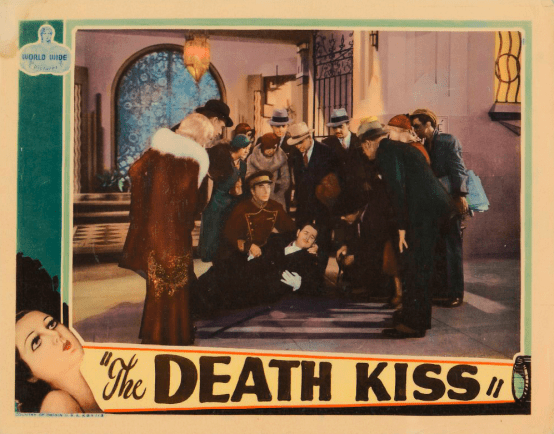
The Death Kiss opens on the making of the film The Death Kiss, as actor Miles Brent (Edmund Burns) walks onscreen for his cinematic death scene…and winds up actually being shot. Almost everyone on set is pretty sanguine about Brent’s death: his ex-wife and leading lady Marcia (Adrienne Ames) can’t stand him, his director Tom Avery (Edward Sloan) and studio manager Joseph Steiner (Bela Lugosi) are more worried about finishing the film than the loss of their leading man, and the head of studio Leon A. Grossmith (Alexander Carr) is counting the money that he’s going to lose by delaying production for such a small thing as a murder. The police arrive, and so does a young scenario writer and would-be detective Franklyn Drew (David Manners), who also happens to be Marcia’s lover. But while no one really cares who killed Brent, when the police set their sights on Marcia, Drew decides he has to act on his own. What follows is a snappy little whodunnit with some silly set-pieces, crackling dialogue, and lots of Hollywood self-effacement.

The Death Kiss is immediately notable for bringing back together three of the main actors from the 1931 Dracula in the persons of Manners, Sloan, and Lugosi. But each are also playing noticeably against type: Sloan is far from the grandfatherly Van Helsing, and Lugosi actually gets more than a few laughs in as the slightly diabolical studio manager. Most notable, however, is David Manners, who was wooden as Jonathan Harker and here actually proves he carry off comedy and dashing wit without creasing his necktie. Because the film is so short, coming in at just over an hour, the plot moves along at a good clip, getting in little digs at Hollywood and movie-making while managing to conjure up a decent plot that had me guessing right to the end. Director Edwin L. Marin would go on to make a series of whodunnits throughout the 1930s, including several Philo Vance detective films and a version of A Study in Scarlet.

An odd little sidenote to The Death Kiss is the use of tinting in several key scenes, which have been properly restored in this print. The little shocks of color are bizarre but quite effective, and it’s lovely to see them in a film this small and quirky. The film is plagued by some sound troubles, probably owing to a poor source print, but these do not disrupt the production as a whole. It’s actually quite an irreverent and energetic little movie, replete with quirky side characters and distractions enough to keep things moving.

While The Death Kiss wins no awards for innovation, it’s an enjoyable film, quick-witted and fast-paced and just a little racy (pre-Code films need to be appreciated more, my friends). Though I wouldn’t quite call it a horror film (despite Lugosi), it’s streaming on Shudder now, so you have no excuse.